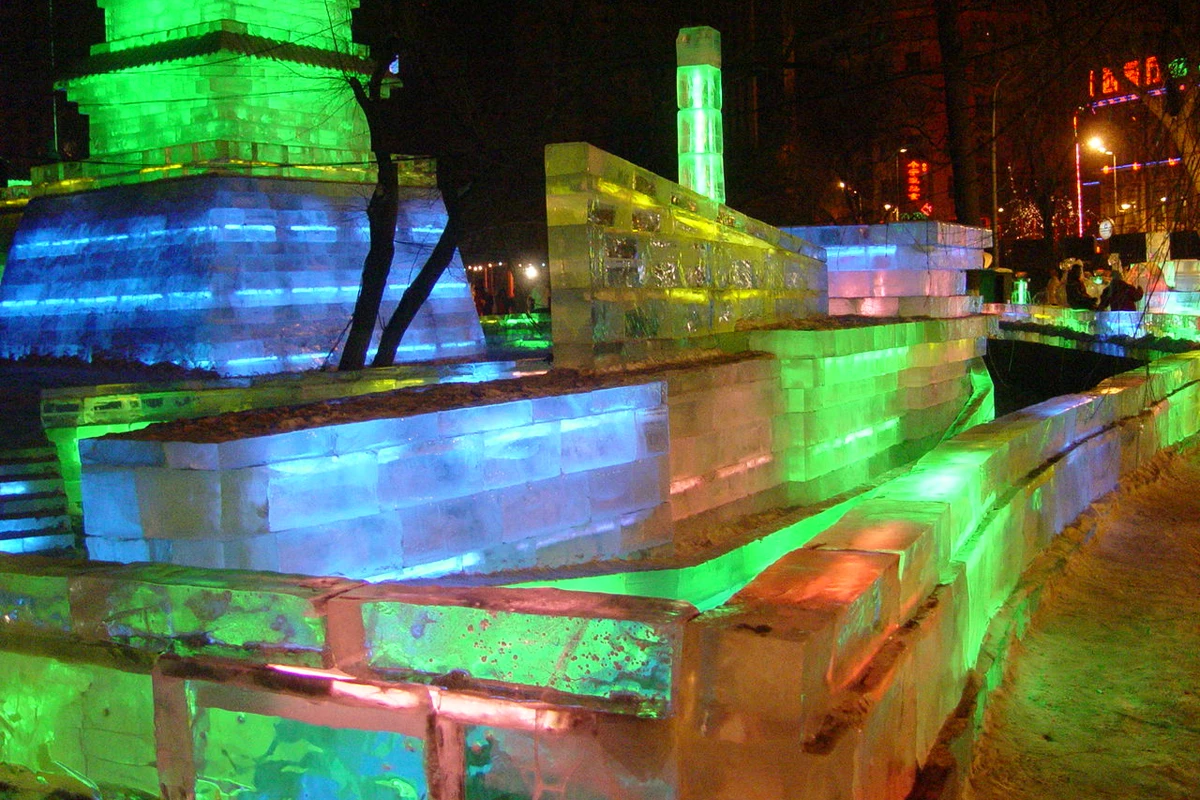
Heilongjiang Tourism: Winter Viewing of the Colorful Ice Lantern World (Photo)
During the annual Spring Festival Golden Week tourism period, the warm spring-like climate in the south attracts numerous tourists. However, with the improvement of people's living standards in recent years, many tourists have gone against the trend, choosing to head to the freezing northeast in the bitter cold winter to seek excitement and fun. In particular, visiting Harbin in Heilongjiang to see the colorful ice lantern world is an enchanting experience...
Boarding the Snow and Ice Tourism Special Train (Photo by Feng Ganyong)
With the booming development of tourism, winter ice lantern viewing in Harbin, Heilongjiang, has become famous worldwide for its unique charm. In particular, the dazzling ice lantern exhibitions have kept pace with the times, displaying a more novel and fantastic style. Nevertheless, the reporter still cherishes memories of the early ice lantern viewing on the "Snow and Ice Tourism Special Train" with China Railway Travel to the northeast.
Snow and Ice Special Train Cabin (Photo by Feng Ganyong)
It was February 10, 2005. To experience the unique charm of the natural beauty of the frozen northeast, the reporter participated in the China Railway Travel "Snow and Ice Tourism Special Train" press trip, departing from Beijing Station for a five-day journey to the northeast.
Harbin Central Street (Photo by Feng Ganyong)
The special train was mainly full of young people. Departing from Beijing Railway Station, after about 17 hours of travel, it arrived at Harbin, the capital of Heilongjiang Province, around 4 p.m. the next day.
Reporter in Harbin (Photo by Zhao Rong)
Because the reporter and the tourists had mentally prepared for the cold to varying degrees before departure, the temperature of over 20 degrees below zero felt less unbearable than imagined. As the saying goes, "Cold starts from the feet" — indeed, it proved true.
Harbin Street Sculpture (Photo by Feng Ganyong)
The reporter couldn't find suitable cotton shoes before coming, so he wore a pair of new thick wool socks inside leather shoes, hoping to manage. But after walking a while, he already felt the discomfort of "cold starting from the feet." To prevent frostbite, the reporter, like many tourists, bought snow boots on Harbin's Central Street as a precaution. In fact, in the following days, keeping the feet warm played a crucial role in protecting against the cold throughout the trip.
Central Street at Night (Photo by Feng Ganyong)
The first stop of the tour group upon arriving in Harbin was to visit the famous Central Street. Under the guidance of the local guide, people entered Central Street near the Flood Control Monument on the banks of the Songhua River. Winter nights fall early in the northeast, so shortly after stepping onto Central Street, the streetlights came on. Central Street is the most prosperous and well-planned commercial pedestrian street in Harbin, akin to Nathan Road in Hong Kong. The entire street is divided into several sections, lined with department stores, branded fashion shops, specialty eateries, and some Russian goods stores.
Church Ice Sculpture (Photo by Feng Ganyong)
Central Street retains well-preserved European-style old buildings. Under the evening lights, strolling along the street feels romantic. Since it was already the ice carving season, small ice sculptures were added along the street, allowing people to warm up their eyes before heading to the Ice and Snow World.
Cathedral Night View (Photo by Feng Ganyong)
Central Street was first built in 1900, with 71 buildings covering architectural styles including Renaissance and Baroque. It encapsulates nearly 300 years of the most charming European cultural development. Whether by day or night, it is a beautiful sight in Harbin and a rare architectural art corridor in China.
Cathedral Night View (Photo by Feng Ganyong)
Leaving Central Street, the tour bus took tourists to the famous Sofia Cathedral in Harbin. By then it was completely dark. Although it was night, the beautiful night lighting of Sofia Cathedral still offered a visually pleasing experience. The Sofia Cathedral scenic area is located on the south bank of the beautiful Songhua River, covering 50,000 square meters, renowned domestically and internationally for its unique architectural landscape and exotic charm.
Zhaolin Park Entrance (Photo by Feng Ganyong)
According to records, Sofia Cathedral is the best-preserved typical Byzantine building in China. This nearly century-old building is full of charming colors. The murals, chandeliers, bell tower, dome, and choir platform all display rich cultural landscapes and ingenious artistic features, holding high historical, cultural, and architectural ornamental value.
Ice Sculpture Memorial Garden (Photo by Feng Ganyong)
Every brick and stone here is frozen music, every plant and tree is extraordinary. The cathedral's grand scale rivals Moscow's St. Basil's Cathedral, and its exquisite shape rivals Notre Dame de Paris. The magnificent dome and elegant wall decorations exude charm, with the entire scenic area embodying the beautiful melody of music and the wisdom of architecture.
Zhaolin Park Corner (Photo by Feng Ganyong)
In fact, the most important tour item of the Snow and Ice Tourism Special Train in Harbin was viewing the colorful ice lanterns. Since complete darkness is the best time for ice lantern viewing, after visiting Central Street and Sofia Cathedral, tourists finally arrived at Harbin's Zhaolin Park.
Ice Sculpture Memorial Garden (Photo by Feng Ganyong)
People savored the experience here, especially watching the magical dreamlike ice lantern world in the ice and snow—a unique and rare visual impact and physical and mental enjoyment.
Ice Sculpture of a Lady (Photo by Feng Ganyong)
Ice lanterns are a folk art form that circulated in northern China in winter. The Qing dynasty scholar Xi Qing recorded the ice lantern exhibition in Qiqihar during the Jiaqing era in his book "Heilongjiang Waiji": "On the Lantern Festival, lanterns are displayed in the city for five nights; village women come to watch the plays, with the sound of carts ceaseless throughout the night. Some carve ice over five or six feet into the shape of the God of Longevity lantern, placing a pair of torches inside, looking like a crystal figure. This is truly rare."
Ice Slide (Photo by Feng Ganyong)
Today's ice lanterns have been transformed into a snow and ice art with contemporary characteristics. Harbin is known as the Ice City, and its ice lanterns are the city's pride.
Ice Sculpture Screen Wall (Photo by Feng Ganyong)
Using their intelligence and hardworking hands, the people of the Ice City have turned the ordinary into the magical, creating this unique ice lantern art. Ice lantern art has a long history of development. According to records, in the early days, farmers feeding horses on the Songnen Plain and fishermen along the Songhua River often made ice lanterns in winter as lighting tools.
Overseas Works Selection (Photo by Feng Ganyong)
At that time, the method of making ice lanterns was very simple: pour water into a bucket and freeze it; before it fully freezes, bring the bucket indoors and slightly heat it to separate the bucket from the ice block, then pull out the ice block, chisel open the top center, pour out the unfrozen water inside to form a hollow ice cover, place a lamp inside, and it would not be blown out by the cold wind.
Overseas Works Selection (Photo by Feng Ganyong)
Later, during the Spring Festival and Lantern Festival, people also made ice lanterns to place in front of their doors, or pierced holes and threaded strings for children to carry and play, adding to the festive atmosphere.
Overseas Works Selection (Photo by Feng Ganyong)
Broadly speaking, Harbin's ice lanterns refer to plastic arts using ice and snow as materials, a general term for snow and ice artistic shapes and lighting effects. It includes many artistic forms such as ice carving, snow carving, ice architecture, snow and ice shapes, and ice flowers, with rich and diverse artistic techniques. Among them, ice carving is the most common, similar to traditional sculpture, divided into three categories: round carving, relief carving, and openwork carving.
Overseas Works Selection (Photo by Feng Ganyong)
The Ice Lantern Garden Party held in Harbin's Zhaolin Park was once rated as one of China's 35 "Unique, Wonderful, Beautiful" tourist attractions. The Snow and Ice Tourism Special Train tour group happened to catch the grand ice lantern art exhibition held there that year.
Many Tourists Visiting (Photo by Feng Ganyong)
The park set up ten scenic areas, including the Three Stars Shining High, Mysterious Christmas Eve, Natural Snow and Ice Land, History Echo Wall, and Folk Custom Paintings, with a dazzling array of colorful snow and ice works. On the freezing night, the Snow and Ice Special Train tourists, exhaling white breath, toured the park with great interest. The flashing lights of cameras captured cheerful faces everywhere.
Ice Sculpture Works Selection (Photo by Feng Ganyong)
As early as the early 1960s, Harbin began hosting an annual Ice Lantern Garden Party. The ice lanterns at that time were crude and low in artistry, but the activity sparked the creative passion of the Ice City people for snow and ice art. In 1985, Harbin designated January 5 each year as the Harbin International Ice and Snow Festival, with ice and snow activities lasting until the end of February each year.
Ice Sculpture Archway (Photo by Feng Ganyong)
Since then, the Harbin Ice and Snow Festival has continuously innovated and developed, expanding from the single art form of ice lanterns to multiple fields such as tourism, trade, culture, art, and sports.
Ice Bridge Corner (Photo by Feng Ganyong)
During the annual Ice and Snow Festival, many foreign and southern tourists come to Harbin to experience the charm of ice lanterns. As of the reporter's visit that year, it was said that Harbin's ice lantern art had gone through 40 years. This unique ice lantern art has deeply developed Harbin's snow and ice resources, gradually turning the severe cold from a disadvantage into an advantage, and has become widely known for its enchanting tourism projects.
Ice Sculpture Pavilion (Photo by Feng Ganyong)
Ice lantern art not only enriches the winter cultural life of citizens and enhances the city's taste, but also boosts snow and ice tourism, promotes cultural exchange and international relations. It can be said that the charm of Harbin's ice lantern art far exceeds the art itself.
Ice Sculpture Dragon Boat (Photo by Feng Ganyong)
Although the Snow and Ice Special Train tourists only stayed in Harbin for nearly seven hours, they had an unforgettable and wonderful time. Afterwards, the entire group returned to the special train on the night of February 11, 2005, and the ice and snow train carrying the reporter and his companions headed to the second scenic spot—Jilin City. (Text and photos by Feng Ganyong)


