A Northeastern China Girl's Trip: Walking in a World of Ice and Snow, Having a Blast While Freezing My Legs Off
I’ve always believed that staying home, watching TV, and eating hotpot is a kind of happiness, but traveling, hitting the road, and experiencing all sorts of different firsts in life is also a kind of happiness. As someone who can’t sit still, I especially enjoy the second kind. This trip to Northeast China was a long-awaited journey for me. I wanted to go to an extremely cold place in the dead of winter to experience that bone-chilling, unforgettable feeling of ice and snow—it’s truly a fantastic life experience. I’m the type to leave on a whim. To reward myself for a hard year, in the last week of 2019, I decisively booked the trip, convinced my bestie, and set off!
The direct flight from Shiyan to Harbin had a very comfortable schedule: departing Shiyan at 18:25 and arriving in Harbin at 21:50. I snagged the cheapest tickets, round trip for 1,246 yuan. I originally planned to join a local tour group, but there were no spots left. Based on my years of experience with independent travel, I decided to go with a tour only for the Snow Town part, while exploring downtown Harbin on my own. I made a simple itinerary and booked the hotel. The three of us met at the airport, barely able to contain our excitement, and immediately started celebrating the start of our Northeast trip with food and drinks. To get the alcohol through security, under the watchful eyes of everyone, we three middle-aged women took turns gulping down the bottle until it was under 100 ml, completely ignoring the disdainful looks. We made it through the gate. The flight was delayed by half an hour, which gave us plenty of time to finish off the big pig trotters, sipping wine and eating braised dishes, dreaming of the journey ahead—what a great feeling! After eating and drinking our fill, we slept on the plane, and three hours later, we arrived at Harbin Taiping Airport. Harbin is a city full of exotic charm. I had visited once during summer vacation as a place to escape the heat, but not coming during the snow-covered season was always a big regret. People say that Harbin only truly shows itself in winter, so choosing to come at the turn of the year was a wise move. As soon as we got off the plane, the ground temperature was minus 25°C, and the cold wind hitting my face made me shiver. After standing still for a moment, it didn’t feel that cold, haha. So this is the legendary minus 20-something degrees—it’s nothing! Look at us, still looking gorgeous!
We checked into the apartment hotel we booked in advance, the Harbin Maikailaiwang·Jiangnan Hotel Apartment (Room B10FB03, Building B, Maikailai International Apartment, 90 Zhaolin Street, Daoli District, Harbin, Heilongjiang Province). It’s pretty good—located diagonally opposite St. Sophia Cathedral, very convenient for getting around. For three people, it’s more spacious than a traditional hotel and feels more like home. One large bed and one small bed perfectly met our sleeping needs. I recommend this place for family trips. As soon as we entered the room, the room temperature of over 20°C from the heating instantly made us, bundled up like cotton balls, sweat profusely. Indoors in Northeast China, you really can eat popsicles in short sleeves. No wonder Northeasterners, when they go to the unheated south, end up with runny noses after one night’s sleep. After settling in, we fell into a sweet dream, starting our fantasy journey.
I booked a three-day, two-night in-depth pure play tour of Snow Town with Zhongguo International Travel Service online. (It turned out to be probably the best value pure play tour in Northeast China. It covered all the classic activities, and the itinerary was very well arranged. Compared to traditional travel agency routes, it was much more enjoyable. The key point is that there were absolutely no shopping stops. The only downsides were that there were too many people, wasting time waiting, and the group meals were terrible. But if you go, I recommend choosing a small-group boutique tour, and definitely don’t consider self-driving in Northeast China—if possible, charter a car to save a lot of time.) At 5:20 a.m., we met our guide and boarded the bus. After more than four hours, we arrived at the first stop: Yabuli Sunshine Resort. We changed into ski suits, took a horse-drawn sled into the snow forest for a spin, enjoyed the scenery of pure white snow, and got up close with the snow—kind of a warm-up. But personally, I think the horse-drawn sled is the most boring activity. It was far from my imagination of sitting on a sleigh, cracking the whip loudly, and speeding along! The whole thing was a slow and leisurely sway, bumping along a forest path, with a view of birch trees and small wooden huts in the snowfield. That was it. Once was enough. My travel buddy sitting in the front row happened to be right where a big horse was doing its business—right in front of her face. The feeling... the rest of us behind were laughing uncontrollably. That was probably one of her most memorable moments on this trip. After the sled ride, we took the cable car to the top of the world’s longest ski slope to enjoy the magnificent snowfield scenery. This activity is usually not arranged by regular travel agencies, so many tourists in Yabuli only know about the ski resort and miss the view from the top. The weather wasn’t great that day—down below it was mostly white—but the view from the cable car was still nice. The closer we got to the top, the more beautiful it became. The temperature was relatively lower up there, and under the deep blue sky, white branches were set off. Although the rime wasn’t at its peak, it was still beautiful. At the top, each of us took a small sled and whizzed down the long slide. The speed could be controlled with a brake lever. It was very simple to operate. As long as you’re brave enough and there aren’t many people, it fully satisfies your desire to let loose. I guarantee you’ll be screaming all the way down for three minutes until you reach the bottom. I highly recommend this activity—it’s a great experience.
After the slide, the travel agency arranged for us to have a group meal at a farmhouse—a big pot of random stew with no seasoning, no flavor, and no presentation. It was absolutely terrible. I suggest that anyone joining a tour in Northeast China bring their own spicy sauce or pickled vegetables; otherwise, people used to spicy and flavorful food will end up like me, eating tastelessly every day and using it as a way to lose weight. While waiting for the food, we got up close and personal with the snow. As soon as we stepped onto the snowfield, even middle-aged ladies turned into snow-crazed play monsters, completely forgetting the cold and just playing. After the madness, since we had major activities in the afternoon, and skiing is very physically demanding, we barely managed to eat a little to fill our stomachs before heading straight to the ski resort. Yabuli Ski Resort is probably the most professional and largest ski resort in China. It hosts several professional ski competitions every year, with a dizzying array of slopes at all levels spread across the mountain. We encountered professional athletes carrying their snowboards up the cable car to the top and then skiing all the way down. As a novice, I could only admire them silently. At the ski resort, the guide directed us to line up to receive ski equipment. All equipment was included in the tour fee, but hiring a ski instructor was an extra cost: 240 yuan for two hours, which allowed you to enter the intermediate slopes and experience the thrill of fast skiing. Without an instructor, you could only use the beginner slope. Given my lesson from the Wudang Ski Resort, where I fell flat on my back, I decisively hired an instructor. After two hours, I was completely exhausted. It turned out that skiing isn’t for me—I’m too clumsy and can’t keep my balance. It’s better to just lie in the snow, pose for photos, and pretend! After the afternoon’s slide and skiing, having experienced the thrill of high-speed gliding, we had no energy left for other snow activities. We got on the bus and slept all the way to the farmhouse accommodation arranged by the travel agency. We three shared a large heated kang room. It wasn’t big, but it was clean, tidy, and comfortable. The villages along the way had limited accommodation and dining options, mostly farmhouse-style. It was my first time sleeping on such a communal bed, experiencing the Northeastern flavor, and it was pretty good. Once settled, we realized it was only a little after 4 p.m., but it was already completely dark. We rested for a while, then endured another indescribable group meal before heading to Yabuli Forest Hot Springs to experience the ice-and-fire contrast of snow hot springs. The hot springs were divided into indoor and outdoor areas. We decisively headed outdoors. The sight of snow everywhere plus steaming hot water was indescribable. There was a thick layer of ice around the pool, and touching it with our skin felt incredibly icy! Soaking in the water, the fatigue from the day quickly melted away. After finishing outdoors, we went inside. Having a Modier ice cream bar was also great, but the problem was that the first bite stuck my tongue and lips to it. After some frantic help from my friends and constant breathing of warm air, we avoided tearing the skin off bloody. So remember: in Northeast China, never ever immediately eat frozen things! You must let them warm up indoors first, or they’ll stick to your mouth instantly—stronger than superglue! After the hot springs, the first full and joyful day came to an end. We went back to sleep beautifully, ready for the next day.
Waking up from a warm and comfortable sleep, the swirling snow instantly painted the world white. We happily ran into the snowfield and took all kinds of crazy photos. After admiring ourselves and eating breakfast, we got back on the bus and headed to the next attraction to watch an explanation of ice fishing. The local fishermen open nets to catch fish, symbolizing abundance every year. On the frozen lake, fishermen cut a hole in the ice and hauled up heavy fish with joy. When we went, there was no fishing; the long net cages only caught forest frogs. It was said that these frogs are the source of the “snow frog” in papaya stewed with snow frog—a dish we often eat. And the snow frog is actually the fallopian tube of the female frog. My stomach immediately turned. I had always thought snow frog was a plant, never imagining it was the reproductive organ of such small animals for bearing life. I couldn’t help but feel sorry for human cruelty, and I urge everyone to eat more vegetables and less killing.
After this reflection, we took a short break and entered a post station. Seeing icicles over a meter long outside, following the guide’s advice, we put on all our cold-weather gear in preparation for the next leg: hiking into the Muxue Mountain Village and passing through the Ten-Mile Gallery. After another indescribable group meal, we arrived at the hiking area. We agreed on a meeting time with the guide and started free activities. First, we sat on a snow tube, pulled by an off-road vehicle, speeding along the snow track. Countless rime-covered trees flashed by in the sky, and the cold wind cut like a knife across our skin. At this point, the three-piece cold-weather kit played a decisive role: hat, gloves, and scarf are essential. Try not to expose any skin to the air, or you’ll experience an incredibly icy sensation. After the snow tube ride, we began our icy hike. Along the way, we saw the legendary Northeastern mythical creature, the “silly roe deer” (shao paozi). It is said that if a hunter shoots at it and misses, it will come back to see if the hunter has left. If the hunter shoots again, it will bury its head in the snow, revealing only its white-tufted butt—truly not just ordinary silly. After taking happy photos with the silly roe deer, we entered the Muxue Mountain Village and passed through the Ten-Mile Gallery. Being there in person gave me the feeling of stepping into a fairy tale world. Touching the vast fields of snow, all I could see was endless white—like piles of cotton, like clouds, or even like a world built from foam that didn’t feel real. Everyone gradually detached from reality, feeling a sense of illusion. Everyone couldn’t help but rush into it, fall into the snow, and roll happily, as if we had found the childlike innocence lost for years. Contact with snow brought nothing but cold and happiness, no other problems! After passing through the Weihu Stockaded Village and exchanging the secret code with the “bandits,” we could take a snowmobile to the top of Big Bald Mountain. As soon as I got on the snowmobile, my heart was in my throat. The thrill and excitement were no less than a high-speed roller coaster. The speeding motorcycle, the howling mountain wind, the raging snow, and the pure white world—my screams echoed through the mountain all the way to the top. The louder I screamed, the more the driver accelerated, and the rougher the bumps became. Sitting in the back, I felt like I could be thrown off at any moment. I truly admire their courage! When we reached the top and got off, my legs could barely walk; they were trembling uncontrollably. Plus, the wind and snow at the summit were extreme—definitely force six or seven. After a few steps, my eyes couldn’t stay open. If I wasn’t careful, the wind would push me over, and if I stumbled, I’d fall flat on my back. Eventually, I fell so many times I couldn’t get up, so I just sat on the ground calling for my mom. I wondered if her ears were itching back home? I thought, “When you’re out being wild, you don’t think about your mom!” After experiencing the extremely thrilling snowmobile ride, we directly passed on all other snow activities and took the bus straight to Snow Town. When we arrived at Snow Town, it was only 5 p.m., but outside was pitch black. It happened to be the time when the lights came on, and the colorful neon lit up the whole village. We settled in and had the best group meal of the trip—Northeastern dumpling feast—then headed out to have fun. As soon as we stepped out, we were on Xueyun Avenue, a street that is not very long or wide but makes tourists linger. It was once the forest railway track and is the main street running through Snow Town. There are all kinds of houses, snacks, and shops. Snowmen selling candied hawthorns, boxes of scattered popsicles, baskets of frozen pears, frozen persimmons, frozen hawthorns—Northeastern food doesn’t need a refrigerator. Everywhere is a natural freezer: fish, meat, fruit, just thrown outside, instantly frozen. My favorite is the frozen pear. After thawing, one bite—so icy! It’s simply divine! After eating the frozen pear, we arrived at the gate of the most classic Dreamland in Snow Town. The tour guide had given each of us a ticket for the Errenzhuan performance earlier. We were going in, but my scatterbrained buddy searched everywhere and couldn’t find her ticket. Helpless, I and Youyou had to go back to the room to look for it. But on the way back, we didn’t find her ticket, and mine... got lost too. When we asked at the entrance, we were told that buying tickets on the spot would mean waiting two or three hours for a seat. Speechless!
After a brief disappointment, we found an even more fun way to play: a human-pulled sled! In the heavy snow, on the crowded Xueyun Avenue, in the freezing cold, the three of us completely reverted to childhood. We pulled the sled with all our might, running wildly. Even the people around us were infected by our joyful atmosphere, making way for us and some even spontaneously joining in to help pull! In less than half an hour, our clothes were soaked with sweat from the inside out. That feeling of wild childhood play is only fully released in the snow—truly a great stress reliever! After all the crazy playing, laughing, and noise, we walked up the boardwalk to admire the scenery of Snow Town from above. The front and back yards of every house, wherever there was a flat surface, were covered with a thick layer of cream by nature, so beautiful that it was hard to believe it was real. Looking down from the boardwalk, it felt like entering a fairy tale world. No filter was needed; any random shot looked like a masterpiece. I couldn’t help but envy the snow here. People are up high, the snow is in the yards—undisturbed by idle people. Even if you love it or hate it, you can only look at it like this, and it only shows its most beautiful side. With these beautiful images lingering in my mind, I returned to the warm kang and gradually fell asleep.
Waking up, passing through Xueyun Avenue in the early morning, tourists had already started appearing in twos and threes. After experiencing the classic internet-famous “pour boiling water into ice” photo, it was time to say goodbye to Snow Town. Snow Town is a place that intoxicates, amazes, and evokes both love and hate. It’s special because it has a climate rarely found in China and stunningly beautiful snow scenes. It’s vulgar because it can’t escape the commercialization and overwhelming crowds of a popular tourist destination. It’s love and hate because its cold penetrates the body and seeps into the heart, yet it’s irresistible. Snow Town, how nice it would be if you could be quieter, more stable, and always maintain your simple appearance! Before leaving, seeing people hurry by, I couldn’t help but sigh: everyone has their own way of life. I am a person of emotions, just wandering with my nature, experiencing different experiences, feeling different feelings. Goodbye, Snow Town. Maybe I’ll come again. On the way back, the tour was about to end. I truly admired our driver all along—driving such a huge vehicle on roads covered with ice and snow is no easy task. Thumbs up for him!
Back in Harbin, we dispersed from Central Street back to the hotel. A ten-minute walk took us nearly twenty minutes. Every step was careful, afraid of slipping. The streets were full of ice and snow, giving us a true taste of bitter cold. Back at the hotel, I discovered that the toner in my suitcase had completely frozen. At this moment, Harbin truly gave us the feeling of an extremely cold place!
The first stop in downtown Harbin was definitely the iconic landmark, St. Sophia Cathedral. I knew before coming it was under major renovation, so we couldn’t go inside, but most of its exterior was still visible. Since I had seen it once before, this time it wasn’t as shocking as the first encounter. It is the largest Eastern Orthodox church in the Far East, first built in March 1907. It is an important historical relic of the Russian invasion of Northeast China and a key site for studying Harbin’s modern history. It was originally a church built by the Russian Fourth East Siberian Infantry Regiment. Designed by Russian architect Kiyasikov, it is magnificent and exquisite—a typical example of Byzantine architecture. Its walls are all made of red brick without plaster, with a high central 16-sided drum support with arched long windows, topped by a large, full, and beautifully decorated onion dome, commanding four different-sized tent roofs with pyramidal and steep slopes, forming a master-slave structure. The overall building exudes a sense of history and the radiance of faith. It was too cold, so we quickly took photos and then looked for food nearby. Following online recommendations, we found a bun shop and had our first self-paid meal of the trip. My friend finally got to eat the Harbin famous snack “guobao rou” (sweet and sour pork), which she had been craving. Although I like meat, this sweet and sour, greasy dish wasn’t exactly to my taste. But anyway, we came, we tried, and that’s fine! Buns with home-style side dishes, plus a small bottle of Niulanshan liquor—my love for drinking is impossible to give up anywhere I go. After drinking two ounces, I felt warm from the inside out. No wonder people say Northeasterners can drink. In this environment, you wouldn’t survive without some tolerance for alcohol—you’d freeze in no time.
After eating, we walked out of the shop. A few steps away was Central Street. Russian-style buildings scattered randomly along the crisscrossing streets. Renaissance, Baroque, Eclecticism—European architectural styles lined Central Street. Every few steps a classic, every ten steps a sight. Architectural styles that took centuries to develop in the West were gathered here, making Central Street the most famous street in the Far East. In May 1924, designed and supervised by Russian engineer Komtrashok, the paving stones of Central Street were carved from granite, 18 cm long and 10 cm wide, each piece fine, close, and shiny. Such artistic paving is rare in Chinese and foreign architectural history. It is said that at the time, a single stone was worth a silver dollar, enough for a poor person to eat for a month. Experts estimate that the stones of Central Street can last another one to two hundred years. When you walk along this romantic Central Street, if you don’t have an authentic Modier ice cream bar with you, all your thoughts will lack a touch of fantasy. The Modier ice cream bar, as a companion of Central Street, echoes that romantic flavor. But because it was too cold, and we had already tried it at the hot springs, we dared not try it outdoors again—if our mouths got stuck again, it would be a bloody tear-off. Instead of ice cream, you can try candied hawthorns. In Harbin, everything can be made into a candied hawthorn: gluten, okra, spicy sticks, chicken feet, duck neck, garlic, green peppers, quail eggs, rice cake, crab, shrimp—there’s nothing Northeasterners can’t turn into a tanghulu, only what you can’t imagine.
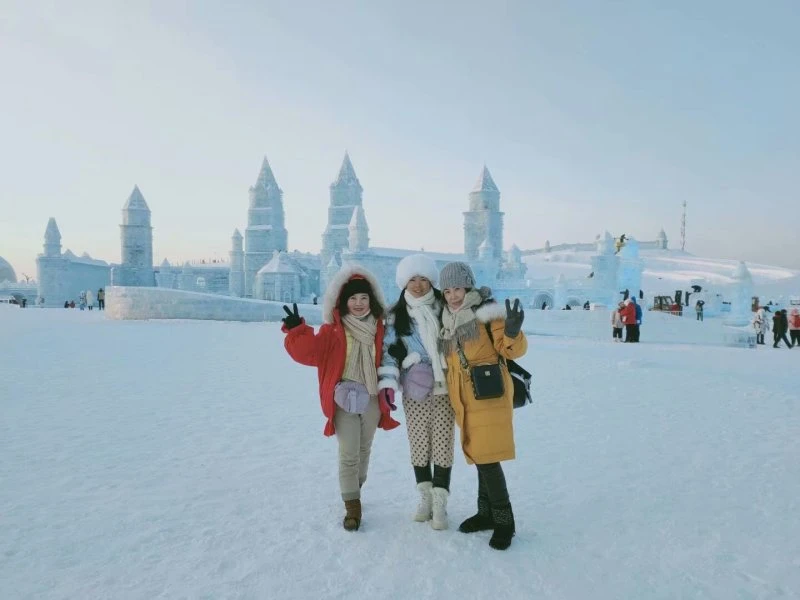
After strolling Central Street, it was time for our last stop: the Ice and Snow World. By this time, we realized that traveling on such roads without a reliable means of transport is really tough. You might spend most of your time waiting for a bus. A half-hour trip normally could take two hours in Harbin. A few steps into the Ice and Snow World, we felt the real cold—it was colder than Yabuli, colder than Snow Town, colder than the city. The only way not to freeze was to keep moving, to keep hands and feet warm. Walking with a mask, our breath wet it, and the exhaled hot air rose to the brim of the hat, forming ice on the front edge. Those with long eyelashes had a layer of frost on them. Eventually, I stopped wearing the mask, but my face was painfully cold. Hand warmers were used to the max, yet I could still feel the cold penetrating from the bottom up. After quickly looking at a few iconic ice lanterns, we headed straight to line up outside the Harbin Ice Show venue. I had done research and knew the big slide and the Ice Show were highlights, but the queue for the big slide must have been at least a thousand people, waiting over two hours, so I decisively gave up. After queuing for half an hour, we got into the Ice Show venue. It turned out to be a very wise move. I strongly recommend that the must-do activity at the Ice and Snow World is the Harbin Ice Show—don’t miss it! Also, the day and night views of the Ice and Snow World are completely different. I suggest going early, playing the activities first, then watching the show, and waiting for dark to see the lanterns. Most importantly, make sure to dress thick enough, or you’ll be questioning your life in minutes. The flight from Harbin back to Shiyan had a terrible time: 6:30 a.m. We had no choice but to go to the airport area the night before and check in. We got up at 4 a.m. to head back, and arrived at 10:15 a.m. This trip to Northeast China was quite well arranged. Essential items: thick down jacket + thin down jacket + down pants + thermal pants. Shoes must be slip-resistant, waterproof high-top boots. Don’t bring UGG-style snow boots—they’ll get wet and freeze to the point you question your life. A thermos, touch-screen gloves, scarf, mask, and hat are indispensable. But try not to choose knitted ones; they won’t resist wind or cold in Northeast China. Choose fur or pure wool. Bring as many hand warmers as you can—stick them in your shoes and on your back. Most importantly, don’t bring an iPhone—its battery will freeze and shut down in minutes. Other brands with hand warmers can barely cope. That’s all I can think of for now.
To summarize, the meaning of travel is to go from a place you’re tired of to a place others are tired of. The new things you see during travel are simply other people’s lives and work. I temporarily escape my own life and work to see others’ lives and work—that’s a special experience. China is vast, with different regions having different ways of living. People’s happiness is similar, but each has its own unknown hardships. Ultimately, the meaning of travel is always beautiful. I will persistently record such beauty.


