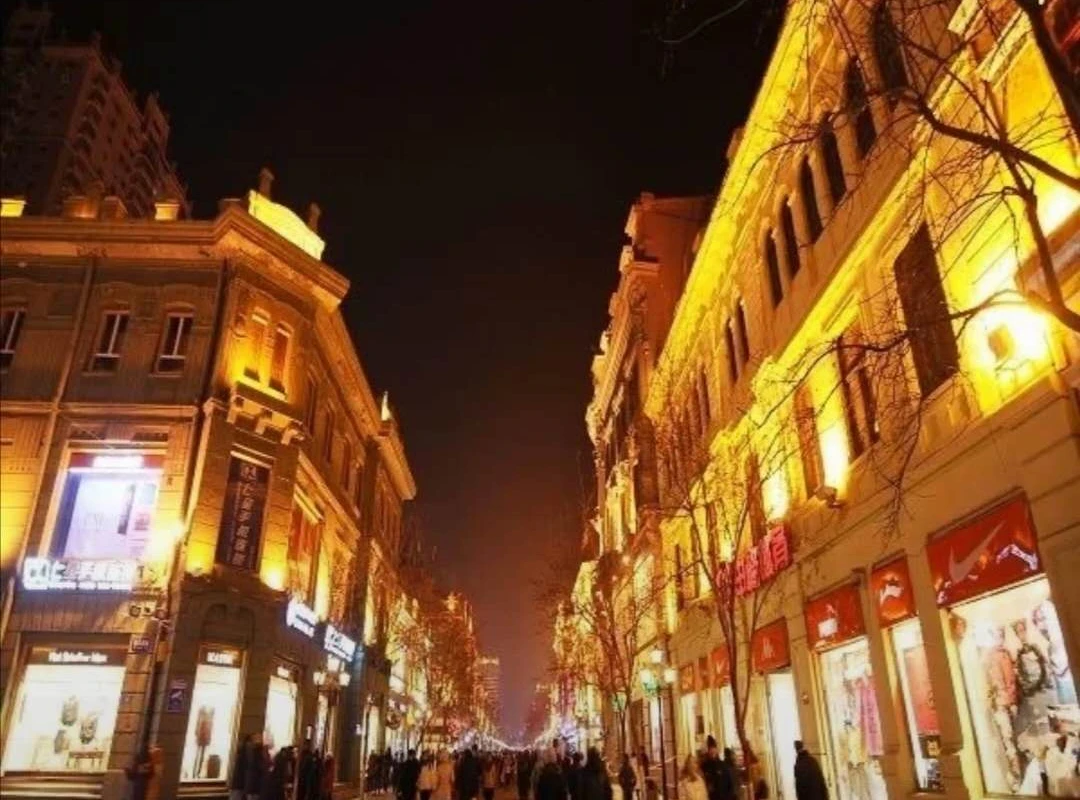
Snow Town Harbin
One day I was lying on the floor staring at a map of China on the wall. Dad asked me what I was doing. I joked, 'Let me see which parts of our motherland’s vast landscape I haven’t visited yet?' Dad casually pointed on the map, 'Here, and here.' Indeed, I had never been to the vast and expansive region of the three northeastern provinces. I thought back to the northernmost place I had visited was Qinhuangdao, and that was in summer. My impression of the three northeastern provinces was limited to the concepts of the Great Northern Wilderness and the black soil that I often read about in childhood textbooks. In my mind, it always felt like a far, far away place—no longing, no impulse.
A few days later, I happened to catch a glimpse of an article titled 'Happy Cities.' I didn’t read it carefully; I only remembered that Harbin ranked first among happy cities. A happy city is a concept I long for. In my travelogue 'Strolling in Another City,' I mentioned that a city is not defined by its GDP or prosperity, but by its citizens’ perception of the city—their happiness is the soul of the city. Harbin, ranked as the number one happy city, sparked my curiosity. I began to pay attention to travelogues about Harbin.
If I were to go, it had to be winter. The lowest temperature I had ever experienced in my city was -13°C. What would -30°C be like? If I were to go, I wanted to experience that icy, snowy Harbin. During those days, reading travelogues online made me shiver all over; every photo of boundless white snow triggered a physical reaction. I filled a hot water bottle and continued to curiously enjoy those ice-and-snow journeys.
After gathering some experience from travelogues—preparation—set off!
The plane took off on time at 7:30, so punctual that I felt unaccustomed. After a stopover in Qingdao, I arrived on time at Harbin Airport. From the plane, I saw a scene different from anywhere else. The earth was white, a boundless white. When the plane landed, the announcement said -13°C. On the airport expressway, I started chatting with the driver about Harbin. The locals spoke beautifully and were very chatty. There was an innate sense of closeness that quickly warmed the conversation. First up was the weather. On both sides of the expressway, there was still vast snow, but in the eyes of Harbin locals, this didn’t count as real snow—the warm winter this year was also unusual for them. Entering the city, both sides of the streets were lined with snow sculptures or ice sculptures, and the Western-style architecture gathered together showcased Harbin’s characteristics.
After checking into the hotel, I went out to the Workers’ Cultural Palace bus stop opposite and took a bus to Daowai district. I got off at 12th Street and walked back.
This was my starting point for walking: North 12th Street.
Jingyu Street is a street with a history of over a hundred years, running east from 14th Street, west to Jingyang Street, south from Nanxun Street, north to Daxin Street. The enclosed area takes Jingyu Pedestrian Street as the main longitudinal axis. Daowai district is the birthplace of Harbin, and the origin of Daowai lies in Jingyang Street and Jingyu Street, with Jingyu Street being the most prosperous.
Jingyu Street divides this area into Daoli and Daowai.
The mottled buildings of Daowai.
The difference between Daoli and Daowai exceeded my imagination. The historic old buildings in Daowai amazed me. No matter how exquisite and solid a building is, it cannot resist the erosion of time. The mottled and damaged walls tell tales of historical vicissitudes, and the worn exterior still hints at its former nobility and splendor. Jingyu Street separates prosperity from desolation, like a train of life passing through every scenic spot, witnessing not only beauty but also desolation.
Walking along this old street felt like being in a Baroque architectural exhibition area. The brick-and-concrete buildings, with their bracket sets, reliefs, columns, railings, steps... the Baroque style blended with many Chinese elements. An old street has life; an old street represents the history of a city. Standing before these buildings, a nostalgic tenderness arises—a sense of the passage of time, a memory of history that wells up inside.
A Mazda with heating equipment.
But on these beautiful old houses, I saw all kinds of colorful, varied signs of all shapes and materials affixed to every part of the buildings, some even dominating the world-renowned Chinese Baroque architectural style of Jingyu Street. One had to filter out these obstructions with one’s eyes to appreciate the beauty of the buildings themselves. It would be wonderful if the size of signs and advertisements were regulated so as not to affect the buildings themselves, restoring the original appearance of the beautiful architecture.
The various signs on the buildings were a mishmash.
The old buildings in the Daowai district exist in their own way. Those seemingly bygone days always bring warmth. In this corner, perhaps you can find the nostalgia of yesteryear.
Walking along Jingyu Street from 12th Street all the way to 1st Street. When I reached 1st Street, I took a bus back to the hotel. The weather was bearable, but I had to wear a hat that covered my ears.
When visiting a strange city, you must take its buses and wander around, even without a destination. On the bus, I listened to the lovely northeastern dialect. The driver and a passenger had a small argument, but to me it sounded so amusing, like watching a skit. And looking out the window at the street scene—it was so different from my own city.
There was a bus that went directly to the hotel, but passing by the train station, on a whim, I jumped up, got off, and went to the bridge to see the interior of the station. Because love for a place extends to everything related to it—whenever I see trains and tracks, my heart stirs. After admiring, photographing, and completing these steps, I was filled with satisfaction. Strolling and stopping like this, observing the unfamiliar world before me with care, I could easily find contentment and freedom in such places.
By the time I got back to the hotel, it was almost 3 PM, and then I realized I was very hungry. I was so excited about Harbin that I hadn’t even had lunch before going to Jingyu Street. It was only when my wish was fulfilled that I felt hunger. I ate noodles at a California Beef Noodle restaurant next to the hotel. I was truly hungry—the noodles even tasted delicious. I also ordered kvass, Harbin’s signature drink, for 3.5 yuan. Bread soda—the aroma of toasted bread blended perfectly with the carbonated drink, and the taste was refreshing. In the evening, I went to the supermarket next door and bought a few bottles for 2.5 yuan each. Then I returned to the hotel to rest, mainly to warm up. Once inside, I could wear just a shirt.
Using GPS, I found a Laochang Spring Pancake shop nearby and planned to have dinner there. I navigated there. Suddenly, a beautiful building caught my eye—St. Alexeyev Church. Harbin is a city of beautiful architecture; with just a pause, there is a distinctive building nearby. The church had a unique shape and complex structure. The bell tower was topped with a small dome and a tent roof; the main body used an onion dome structure, with red brick exterior, presenting a harmonious rhythm, form, and color. Under the night lights, especially tonight’s moonlight, it was magnificently beautiful.
In front of the church, a square dance group of nearly a hundred people moved in perfect synchrony. Under such a clear moon, with the beautiful building as a backdrop, familiar music, and close companions—this is happiness.
Couples whispering by the side of the square—this is happiness.
Just around the corner from the church was the Laochang Spring Pancake shop. It was almost 9 PM, and there were still people waiting for seats. But as soon as we entered, the waitress told us they were closing. It turned out that tomorrow was the Start of Spring, and they have the custom of eating spring pancakes. So they had to close early to prepare for the next day. But we wanted spring pancakes today. The chewy spring pancakes wrapped with fillings were really good.
The streets were quiet and empty. Looking at the night view from the overpass, both sides of the street were lined with ice sculptures decorated with lights, and buildings outlined by lights—the scene was like a symphony.
We ate and chatted in the restaurant until 8 PM, then left and walked back to the hotel. The Snow Town at night had a special charm. Under the red lanterns, the snow town was exceptionally quiet. The snow reflected the light, and the light reflected the snow—a northern night scene. Beautiful nightscape.
At the end of the road, we had to turn a corner to see the hotel. Here, there was only a dim lantern by the roadside, with not a sound around. The serene mood felt surreal. The full moon in the dark sky was strikingly bright; it felt like you could hear the twinkling of stars.
The sun rises in the east every day. I think watching sunrise is actually a matter of going with the flow—it would feel incomplete if you visited Huangshan without seeing the sunrise. I have seen sunrises over the sea, over Danxia, and over Huangshan along with the crowd. But watching the sunrise on Yangcao Mountain in minus 30°C was still exciting and anticipated. I had never experienced such extreme cold, let alone waiting for hours in that temperature. It was quite a challenge. If I succeeded, it would not only be an experience but also a psychological achievement. And the inner sense of accomplishment would bring me the greatest joy.
At 5:30 in the morning, fully dressed, I arrived at the lobby and received the ticket for watching the sunrise on Yangcao Mountain from the tour guide. The guide said, 'Nine out of ten times, you can’t see the sunrise.' I thought I misheard, but when the guide repeated it, I knew I had heard correctly. A momentary hesitation crossed my mind—after all, it was so cold! 'But the moon was so bright last night; maybe there will be a sunrise today,' the guide added, perhaps seeing my hesitation. True. Besides, since it was my first time in this ice-and-snow north, I might as well not give up. Riding a snow sightseeing vehicle up the highest peak of the snow field—Yangcao Mountain at 1686.9 meters—was bumpy and fast. Outside the vehicle it was pitch black, and inside it was also pitch black. I went straight to the top with no idea what was around me. This was the scene when I got off.
There was a small hut at the top where tourists could shelter from the wind and cold. But I didn’t stay in the hut; I found a spot with no shelter and waited. Let me mention my outfit. I really have to thank my snow boots—warm and slip-resistant. They kept my feet warm. When I get back, I’ll add another positive review on Taobao. Also, I wore a cotton Lei Feng hat over my woolen ear-flap hat. Keeping my head and feet warm was crucial. I had a thick gauze mask, covering my face tightly. For convenience in taking photos, I wore fingerless gloves and had to warm my hands in my pockets from time to time. When not using the camera, I wrapped it in a wool scarf.
The first flush of red appeared, and the continuous brown mountain ridges seemed to be dressing up in a riot of colors for a gathering.


