What sights do locals suggest in Harbin?
If you have limited time, I feel one day is enough to see the best of Harbin without feeling rushed or wasting time, allowing you to experience the city thoroughly!
Don't think it's too much – the itinerary is really not tight at all! It's well-paced and can be adjusted based on personal preferences!
1. Saint Sophia Cathedral
Built in 1907, Saint Sophia Cathedral is one of the best-preserved Byzantine-style buildings in China.
The most striking feature is its large onion-shaped dome, a typical Russian architectural style that is grand and magnificent.
Inside, nearly a thousand photographs and an urban planning model showcase Harbin's history, present, and future. If you want to learn about the city's development, the cathedral interior is definitely a great choice!
2. Songhua River Sightseeing Cable Car
The Songhua River Sightseeing Cable Car runs from Tongjiang Square in the south to the Russian Town on Sun Island in the north, spanning the Songhua River. The cable car line is 1,156 meters long and about 70 meters above the river, offering a panoramic view of both banks of the Songhua River with endless scenery.
In winter, you can see activities like snow tubing, ice skating, spinning tops, and snow tanks on the river, creating a completely different scene.
3. Russian Town
This is the most Russian-like town close to home, allowing you to experience exotic charm without leaving the country.
Located on Sun Island, it exudes a strong Russian atmosphere. Cute wooden houses are scattered neatly on the grass, making you feel like you've stepped into a European town!
The town consists of 27 villas and houses that preserve the simple, rich Russian style and architectural art of the early 20th century. They are set among flowers and green trees, each with its own unique style, forming a distinctive natural and architectural landscape.
Every house has a white wooden fence enclosing a garden, with wooden staircases outside, carved patterns on window frames and roofs, and skylights and red brick chimneys on top, authentically recreating an original Russian town.
4. Sun Island
Sun Island covers a total area of 88 square kilometers. It is a scenic area featuring large wetlands, European style, ice and snow culture, and folk culture, offering functions such as leisure, sightseeing, entertainment, science education, and vacation.
The natural scenery of Sun Island is exceptionally beautiful, surrounded by clear water, with glistening waves, lush flowers and trees, a quiet and elegant atmosphere, and a rustic wilderness charm. Attractions like Swan Lake, Sun Waterfall, Water Pavilion Sky, and Squirrel Island perfectly demonstrate the harmony between humans and nature.
5. Harbin Polarland
Harbin Polarland is the world's first polar-themed entertainment park and China's first amusement park featuring polar animal performances. It has the most complete collection of Arctic and Antarctic animals and polar animal shows.
The world's first legendary feast features the famous polar white whales Mira and Nikola, who fall in love with their beautiful female trainer, the "Whale Spirit Princess." The romantic "Angel's Kiss" and eternal "Heart of the Ocean" will immerse you in a sweet icy sea love story, blessing a beautiful life under the halo of angels.
In the Happy Sea Lion Kingdom, a powerful lineup of sea lion stars brings you the fiery passion and humor of the sea lion kingdom.
The Russian baby walruses "Ino" and "Eva" are natural comedy masters and funny experts, showing off their cuteness, talents, coolness, and charm!
The internet-famous penguin "Taoxue" has become an international IP and the spokesperson for Harbin's ice and snow tourism, visiting major scenic spots in the ice city with a cumulative exposure of 300 million times.
6. Siberian Tiger Park
Siberian Tiger Park is currently the world's largest base for artificial breeding and raising Siberian tigers, and a national 4A-level tourist attraction. It houses over 1,300 purebred Siberian tigers of various ages, truly a "park of a thousand tigers."
In summer, the park is vibrant with lush grass and trees, where you can see Siberian tigers' agile figures under the shade, in the grass, and in the water.
In winter, the land is covered in snow, and the colorful tigers stand out brilliantly against the white snow, showcasing their majesty.
7. Chinese Baroque
This is the only remaining Chinese Baroque architectural complex in China.
In the early 20th century, with the construction of the Chinese Eastern Railway, Russians carefully built Central Street within their sphere of influence in Harbin. The street was lined with Renaissance and Baroque buildings that were admired by the Chinese. These buildings shone like beautifully dressed ladies, inspiring reverence from the national capitalists outside the nearby Dao District.
These emerging national capitalists accumulated great wealth during the city's rapid development, and silk and satin clothes could no longer satisfy their strong desire to show off. So someone came up with the idea of building a Baroque shop in front of their factory, hoping it would attract customers. Thus, the first Baroque style with unique Chinese characteristics and elements of ancient Chinese architecture was born. Not only was the "shop in front, factory behind" layout very practical, but the grandeur of Baroque also attracted more customers. More importantly, the praise and envious looks gave the owner great psychological satisfaction.
This novel Baroque architecture was quickly imitated. Wealthy merchants either built Baroque around their factories or around their residential courtyards. At that time, the commercial area of Dao District was concentrated along Jingyu Street (then called Zhengyang Street), and Baroque buildings gathered there. Laodingfeng, Jingyu Pawnshop, Henry's Optical Store, Makewei Commercial Building... This architectural complex extends from the first street to the sixteenth street along Jingyu Street, making it the largest and best-preserved Baroque complex in China. Because it incorporates many Chinese elements, a Japanese scholar gave it a new name – Chinese Baroque.
8. Chinese Eastern Railway Bridge
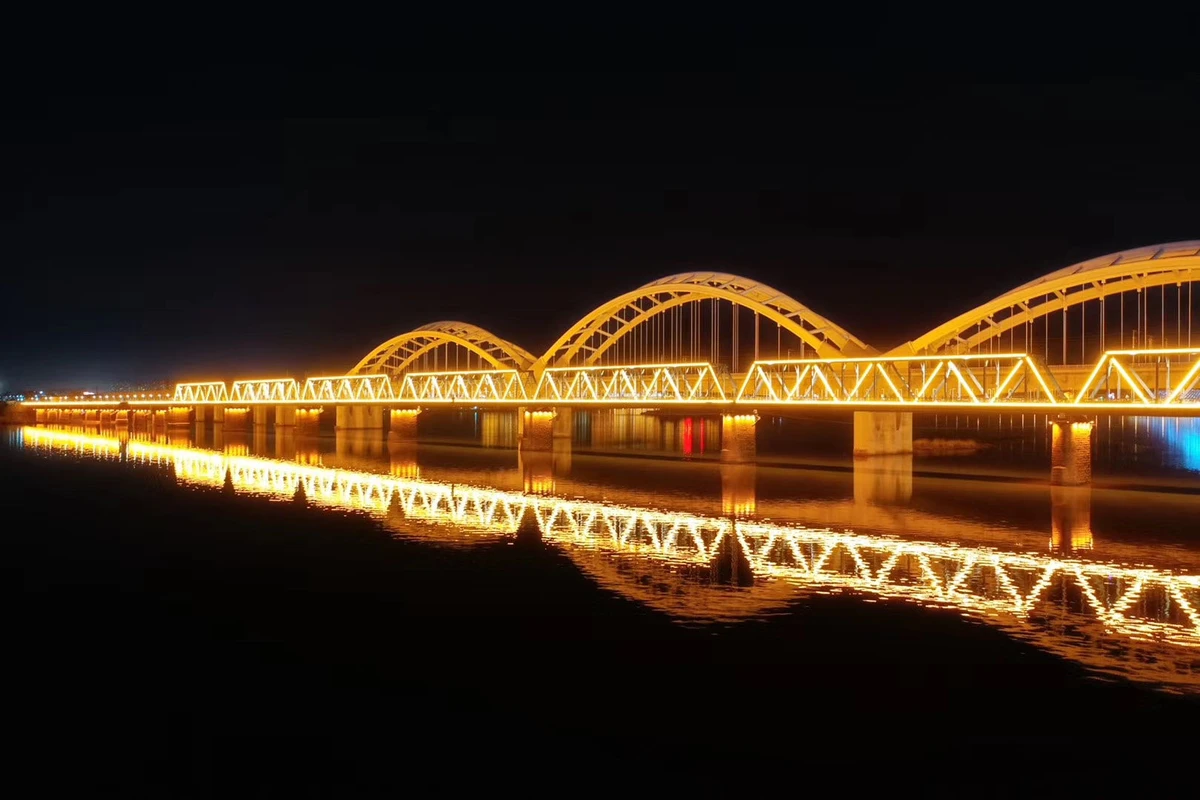
The century-old Binzhou Railway Bridge over the Songhua River, also known as the "Old River Bridge" by Harbin locals.
Located on the east side of Stalin Park along the Songhua River, this railway bridge is not only the earliest railway bridge over the Songhua River but also the first cross-river bridge in Harbin. It also serves as the boundary bridge between Daoli District and Dao District.
The Songhua River Railway Bridge was the cross-river bridge of the Chinese Eastern Railway that traversed Eurasia, designed and supervised by Russian bridge experts. Construction began in May 1900. The bridge has 19 spans, a width of 7.2 meters, and a total length of about 1,015 meters.
This bridge almost determined the rise of the city. The roaring iron dragon ran on this bridge for nearly 113 years, witnessing the birth and rapid growth of a Far Eastern cultural, economic, and trade center.
9. Stalin Park
Stalin Park in Harbin is one of the summer resorts along the Songhua River, located in Daoli District, facing Sun Island across the river. Built in 1953, originally named "Riverside Park," it is a strip-shaped open park built along the embankment, 1,750 meters long and covering an area of 105,000 square meters.
The park is centered around the Flood Control Monument, featuring imitation Russian classical architectural styles, "five-color grass flowerbeds" throughout the park, and 16 groups of artistic sculptures distributed among the green spaces, such as "Swan Spreading Wings," "Three Youths," "Starting," "Diving," and "Sword Dance," which are renowned both domestically and internationally.
10. Flood Control Monument
The Flood Control Monument is located on the square at the northern end of Central Street. It is one of Harbin's most famous landmarks. The monument is grand in shape, with a strong Russian style in its architectural design. Its spacious location makes it a popular photo spot for tourists.
The full name of the Flood Control Monument is the Harbin People's Flood Control Victory Monument, with the Songhua River behind it. In 1957, Harbin suffered a severe flood. The city's residents and stationed soldiers worked together to overcome the flood, and the monument was built the following year in commemoration.
The monument is a cylinder, 22.5 meters high, with relief sculptures depicting the vivid scenes of the flood-fighting efforts. The top features a circular sculpture of workers, peasants, soldiers, and intellectuals, representing the heroic image of overcoming the flood. At the base, there are 11 semicircular pools, marking the highest water level of 1957. Behind the monument is a Roman-style colonnade with 20 columns, forming a harmonious and spectacular scene with the monument.
11. Central Street
Because Harbin's history started right here!!! When you arrive at Central Street, the first thing you see is this golden road – back then, one cobblestone was worth one tael of silver.
Look down at the road, then look up at the buildings. Here you can find 16th-century Renaissance architecture, 17th-century Baroque, 18th-century Eclecticism, and 19th-century Art Nouveau. That's why Harbin is called "Eastern Little Paris" and "Eastern Moscow."
Of course, among these buildings, there are also specialty foods: Modier's ice pops, Huamei's Western cuisine, and various snacks along this 1,450-meter stretch from Jingwei Street to the Flood Control Monument.
Harbin's Central Street is like Beijing's Wangfujing or Shanghai's Nanjing Road – bustling during the day and dazzling at night. Every time I walk here, I gain new insights and feelings.


