【Like a Song of Years, Unstoppable Steps】, Telling You a Beautiful China《Episode 1: The Charm of Winter》
I planned to travel across the motherland in ten years, but the pandemic slowed my steps. In my spare time, I began to pick up travel notes again. And so, I have many reflections. Now, more and more Chinese people have both time and means, and travel, which was once a luxury for leisure, has become a part of life for many.
"There is jade on other mountains, and I have my own pearl." China is rich in tourism resources, with vast territory, magnificent mountains and rivers, and profound history. People hardly need to go abroad; natural beauty and cultural landscapes abound. With the rapid development of internet communication, transportation, and accommodation, traveling has become unprecedentedly convenient.
Upon reflection, the rush of Chinese people to travel is behind the rapid improvement in quality of life. The magnificent landscapes and diverse wonders are heaven's gifts to China. The convenience and speed are blessings of economic prosperity. No matter what others say, we must trust our own eyes! Thank nature for its gifts! Be grateful to our great motherland!
China's rivers and mountains are colorful, fantastic, and unique. The beauty of the four seasons changes beyond your imagination! The breadth and depth of Chinese civilization, the long and profound history, and the rich cultural heritage are unparalleled! We are not really travelers; ten years will certainly not cover all of the motherland. But we tell you a true and beautiful China with our unstopping steps and perspective!
"Jiangxi is a good place." Ten years ago, for our first self-guided trip, we chose Jiangxi's Longhu Mountain, Sanqing Mountain, and Lushan. Later, we came to Jiangxi many times to see rapeseed flowers, scenery, and culture. In early winter of 2018, we chose Jiangxi again to see the village encircled by water at Jujing, morning mist at Shicheng, and drying crops at Huangling.
To see Jujing and Shicheng morning mist, they are on the same route. You can take a train or high-speed rail to Wuyuan Station, then transfer to Bus No. 1 or No. 2 to Wuyuan Old North Bus Station. The scenic spots in Wuyuan are distributed in various townships, and minibuses to these townships depart from Wuyuan Old North Bus Station. Most travelers relying on public transport take the bus from Old North Station to their destinations. The farthest distance is generally 50 kilometers, with bus fares around 25 yuan. Taxi fare is 50 yuan per person; if it exceeds 50 yuan for 50 kilometers, it's overcharging!
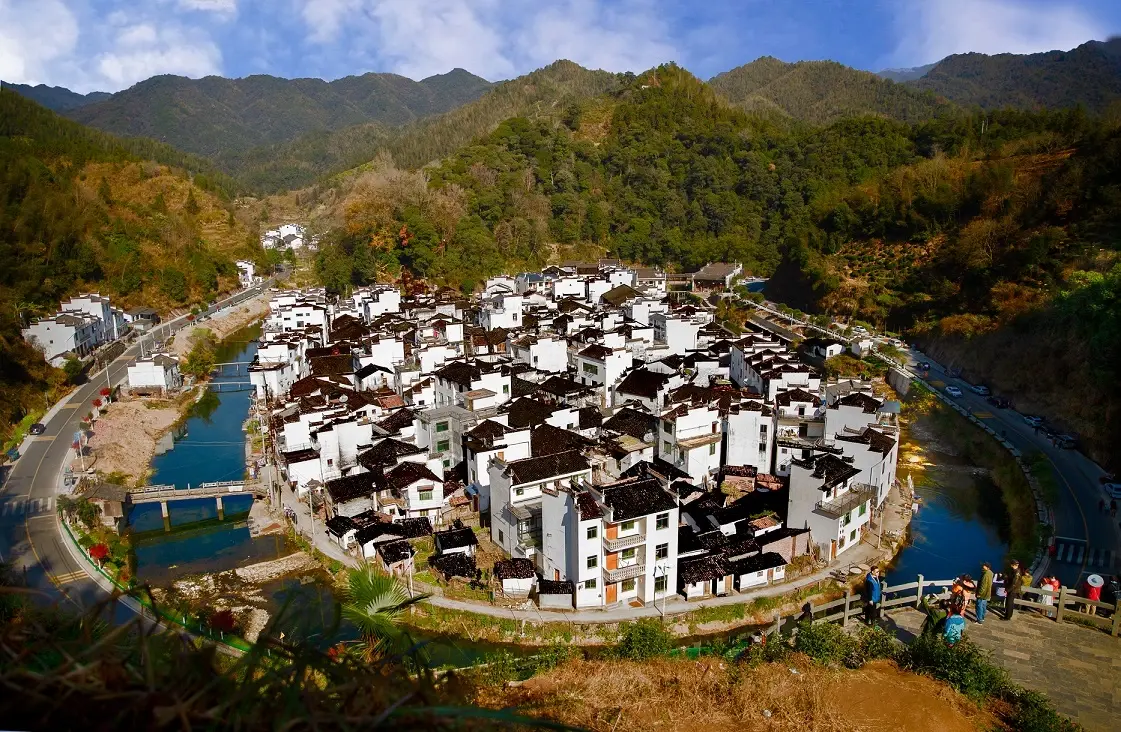
From Wuyuan to Jujing, you can take the bus to Shicheng, fare 22 yuan, and get off at Jujing midway. After viewing the village, take a local farmer's minibus (15 yuan per person) to Shicheng. This can save a bit! Jujing is a small village surrounded by mountains and water. Because it is so perfectly round, it is known as the roundest village in China. The villagers have built a viewing platform by the roadside, charging 20 yuan per person. Climbing up, you can have a panoramic view of Jujing. The scenery of Jujing is quite unique and definitely worth a look!
Wuyuan Shicheng has no city wall; it is so called because the surrounding mountains look like a city from afar. Shicheng has two natural villages: Cheng Village in the lower valley and Dai Village in the upper valley. They are collectively called Shicheng Red Maple Scenic Area. But Cheng Village is much more famous than Dai Village. Every late autumn and early winter, tourists flock to Shicheng to see red leaves and morning mist. It is very popular. Earlier, I heard Shicheng charged an entrance fee of 40 yuan, but we encountered no fee when we came.
Before coming, I heard that accommodation in Shicheng was very expensive. Therefore, we booked a homestay for 137 yuan for a big bed room, about 30 square meters, and the hygiene was quite good. We felt quite pleased. Later, we met some photography enthusiasts in the scenic area. They bargained on the spot and only paid 70 yuan per person, which included not only accommodation but also three meals a day. We were speechless. Truly, "you can't always get the best bargain, and you can't always avoid losses"!
December is the best time to enjoy the red maple morning mist at Shicheng. At that time, early winter comes to Shicheng Cheng Village. Every morning, large numbers of tourists gather on the slopes by the village to watch the morning mist. At this time, even a slightly good shooting spot costs 10 yuan to buy from the villagers, otherwise they would say you trampled their private crop fields. What a great way to get rich!
It is said that the morning mist at Shicheng is "a rare encounter." Some also say that "to see the morning mist, first look at your character, then look at luck." We dare not speak of our character, but we had good luck that day. Not long after waiting, the morning mist began to rise, the sun showed a halo, and we saw very, very beautiful morning mist!
The morning mist at Shicheng is considered by photographers as a place for masterpiece photos. Some people jokingly say that the morning mist at Shicheng is burned by locals using tea oil fruit shells! Others say that the cooking smoke from breakfast mixes with the morning mist—both smoke and mist. Anyway, believe it or not! Regardless, the morning mist at Shicheng is indeed very beautiful! You can be sure that if you come in late autumn or early winter, the red maples and morning mist will be waiting for you!
After seeing the morning mist at Shicheng, you can go to Huangling to see the autumn and winter drying crops. Take the bus from Wuyuan Old North Bus Station to Huangling, fare 17 yuan per person, which takes you directly to the scenic area gate. Huangling often waives the entrance fee, but the cable car (round trip 120 yuan per person) is not cheap! Through the bus driver's contact, we took a local car up the mountain, round trip only 50 yuan per person. Convenient and quick, saving 80 yuan in 10 minutes—that's the real deal!
It is said that Huangling was once the hometown of Cao Wenzhi and Cao Zhengyong, father and son prime ministers of the Qing Dynasty. In spring, you can see layers of rapeseed flowers; in autumn and winter, you can see colorful drying crops. The streets of Huangling are also antique and beautiful, with good accommodation and dining. It is a dream destination for photographers! In our opinion, besides drying autumn and winter, there might also be drying spring and summer. As long as you put various colored grains by the window, regardless of season!
Jilin Rime Island is a small island on the Jilin section of the Songhua River, about 40 kilometers from central Jilin City. Because it is surrounded by water, low-lying, and has unique geographical conditions, warm and moist air from the Songhua River easily gathers here. Coupled with the cold winter in Northeast China and large temperature differences between morning and evening (generally 10°C or more), when there is a windless morning (wind force level 2 or below), the island and its surroundings will display the wonder of rime. Without rime, the island is extremely ordinary, as locals say, "it's nothing." With rime, the island becomes a beautiful fairy-tale world.
Transportation to Rime Island: By train or road to Jilin City, then transfer by bus or taxi to Rime Island. Accommodation is available on the island and in Hantun Village across the river. When there is rime, Hantun also offers good views of rime, and you don't need to buy a ticket (entrance to Rime Island is 70 yuan per person). Therefore, most tourists choose to stay there. If you want a full view of the rime or to see the sunrise over rime, you should come to Rime Island.
In the early morning, tourists from Hantun go to Rime Island to see the rime. For distant inns, there are special transfer vehicles, round trip 10 yuan per person. For nearby inns, you can walk. Transportation is very convenient. Inns have wake-up service and let tourists have a good breakfast to keep warm before going out to see the rime. This way, even outdoors, you don't feel too cold. But rime does not appear every day. Some say: to see rime, first look at character, then look at luck.
With rime, Rime Island is "God's creation." The Songhua River surface steams with mist, as if the river is boiling. The trees are covered in silver, a world of white. A red sun bursts out from the mist. We were quite lucky. We planned to see rime once in two days, but on the first day we saw what was said to be the most beautiful rime of the year!
Rime Island also has an Ice and Snow World!
The rime on Rime Island is indeed beautiful, but the rime in Hantun is also good (picture above). Looking at the photos, don't you want to come? If so, it's best to choose early to mid-January, when the probability of rime is highest!
Every year at the beginning of New Year's Day, Harbin holds the Ice and Snow World on schedule. It gathers the best ice sculptures from top masters worldwide. It is magnificent and dazzling! It is booming every year. Note: the ticket is not cheap: booking within three hours costs 330 yuan per person, outside three hours costs 310 yuan per person. Plus various amusement projects inside, the total cost is quite high! Bring plenty of money before coming!
The Harbin Ice and Snow World is huge. We wandered for more than two hours and only saw a small part. I won't mention transportation to Harbin; planes, trains, and buses are all convenient. During the opening ceremony of the Ice and Snow World, many big-name stars come to support. Don't miss it!
Is the Harbin Ice and Snow World beautiful? Does it make you want to come? If you want to come, try to go after New Year's Day and before the Spring Festival holiday, otherwise there will be too many people, and you'll only see people!
Snow Town is located deep in the Changbai Mountain area of Northeast China. Because to its north is the highest peak in Heilongjiang, Dajiazi Mountain, to its south is the famous Zhangguangcai Range, and the main tributary of the Songhua River, the Hailang River, surrounds it, the geographical conditions are unique. Warm moist air from the Sea of Japan meets the cold air vortex from the Greater Khingan Range here all year round. Therefore, from November to March each year, snowfall is abundant, earning it the name China Snow Town.
The snow in Snow Town is fine and sticky, called "sticky snow." When the snow accumulates to a certain thickness, it forms fantastic "snow mushrooms, snow cakes," etc. Even woodpiles and outhouses become rare snow scenes. The value of Snow Town was first discovered by photographers, and many photographic works have won international and domestic awards based on it. Thus, Snow Town became famous far and wide. It is now one of the most popular winter tourist destinations in Northeast China. But when we saw Snow Town, the snow wasn't big! And we didn't see "the hanging snow mushrooms and snow cakes"! Nor did we see high snow walls or snow blocking doors!
Transportation to Snow Town: Direct buses from Harbin and Mudanjiang (book on Ctrip), single trip 120 yuan, round trip 200 yuan, very convenient. Snow Town ticket is 40 yuan. Accommodation is expensive, so you must book in advance, otherwise you might freeze to death at night!
At Snow Town, make ice flowers: buy a bottle of boiling water for 5 yuan. With a wave of your hand, boiling water turns into ice flowers! Don't believe it? Come and try!
The Snow Town Dream Home, hyped by photographers, has seen ticket prices rise year by year. Now even photographers have to pay; it has gone from 50 yuan in early years to 150 yuan. No wonder people say the Dream Home no longer recognizes its benefactors! If you book through your inn or hotel, you can get into Snow Town Dream Home for 120 yuan!
Hiking from Snow Valley to Snow Town was originally an exercise for brave souls to build willpower. Now it is suitable for all ages. You can take a horse-drawn sleigh to enjoy the scenery all the way to Snow Town easily. And by signing your name, you can get a certificate. But taking a horse-drawn sleigh costs a lot of money!
Is Snow Town beautiful? Doesn't it make you excited and want to come? From late November to early March each year is the viewing season. Before coming, it's best to call someone in Snow Town to ask if the snow is heavy enough that year! And if you can see the fantastic snow mushrooms and snow cakes! Snow Town is very cold, but not so cold that you'll "freeze your nose off or freeze your ears." On windless days, it doesn't feel colder than Beijing! Dining in Snow Town is not as expensive as people say; at the Xueyun Pavilion buffet restaurant on Xueyun Street, 38 yuan per person can get you a meal better than in the south!
Huangshan snow, a winter fairy tale. Every winter, heavy snowfalls blanket Huangshan. At this time, the four wonders of Huangshan—snow scenes, sunrise, oddly shaped pines, and sea of clouds—attract visitors from all directions. Transportation to Huangshan is convenient; trains and planes reach Huangshan City and Huangshan Airport, then transfer by bus to Tangkou Town at the foot of Huangshan, then take the Huangshan New National Line to Yungu Temple to take the cable car up the mountain. This is the established route for snow viewing every year. As long as there is heavy snow on Huangshan, you won't miss it!
A Dutch beauty insisted on taking a photo with us; she said that the Netherlands has no Huangshan pines, no Huangshan clouds, and the snow scene is not as beautiful as Huangshan. Chinese are truly OK!
To see the sunrise on Huangshan, you have to get up early. Some photography enthusiasts come as early as 1 or 2 a.m. to secure a good spot. The night on Huangshan is very cold, with temperatures only minus 10°C. You must wear heavy cold-weather gear, or you'll freeze!
Are the snow scenes, sunrise, oddly shaped pines, and sea of clouds on Huangshan beautiful? Don't you want to come after seeing this? Before coming, check the weather forecast and call the hotel on Huangshan to confirm if there is snow, so you don't come in vain!
Northland scenery, thousands of miles of ice. In Yunnan, the land is like spring. Winter is a great choice to come to Yunnan! If you don't believe me, look at the seagulls—birds know when water is warm! Why else would they come here from Siberia? Because it's warm, and where it's warm, there's food! But even with good food, they don't need to flock like that! It seems the black-headed gulls at Kunming Cuihu Lake are a bit unreasonable!
Compared to Cuihu, the seagulls at Dianchi Lake are skilled fliers; they are the "fighter jets of the air force," and a yearly Kunming sight during Spring Festival. From downtown Kunming, multiple bus routes go to Dianchi Lake for 1 yuan. Dianchi Lake ticket is 8 yuan, and watching seagulls is free. But if you want to interact with them, bring them some treats like biscuits or bread, available at the park gate!
Kunming Flower Expo Park has all kinds of flowers, free to visit. February is winter, but sometimes the flowers in Kunming's parks are "unstable"—heavy snow can come suddenly, and in one day you can see Kunming's "wind, flowers, snow, and moon"!
World Heritage Site—Lijiang Old Town, Yunnan. Take a train from Kunming in the evening and arrive in Lijiang the next morning. Here is the "Big Waterwheel" in the old town. People usually check in here first to prove they have arrived at this famous ancient city. Does Lijiang Old Town look beautiful? No need for us to say more; come and see for yourself!
It is said this is the totem symbol of the Naxi people. Believe it or not, photography is not allowed!
In February, the old town of Lijiang is already full of spring flowers. Welcoming guests with flowers, treating guests with flowers, and seeing guests off with flowers is the traditional hospitality of the old town.
Don't miss the night view of Lijiang Old Town! At night, go to any high tea house in the old town, spend a few yuan, and you can see it!
Lijiang Jade Dragon Snow Mountain Golden Sunrise: it can be seen from any 5th-floor balcony in downtown Lijiang, completely free!
Boating on Lugu Lake in Yunnan, exploring the mystery of the Mosuo people. Take a direct bus from Lijiang, round trip 260 yuan, 6 hours, to Luoshui Village on Lugu Lake. Lugu Lake ticket 80 yuan, bonfire party 30 yuan, boat tour 30 yuan. At Lugu Lake, be sure to take a boat to Wubili Island! The Mosuo young man rowing the boat was handsome and talkative. He said, "All the money I earn is handed over to grandmother!"
The Mosuo people living by Lugu Lake have unique customs and marriage practices. Heads of families are all female, family members are matrilineal, with only maternal grandmother in the elder generation, and only mother, aunts, and maternal uncles among the parent generation. The children of "Azhu" (walking marriage women) call their walking marriage father "Ada." The Mosuo have their own language but no written script, and they believe in Tibetan Buddhism. The Mosuo are the only existing matriarchal society in China, still practicing the "walking marriage" custom where men do not marry into and women do not marry out. The Mosuo now live quite well; come and see! They all excel in singing, dancing, and business. As for whether "Azhu" and "Ada" still secretly practice walking marriage, we don't know!
According to research, the matriarchal system and walking marriage customs of the Mosuo on Lugu Lake are not a relic of ancient matriarchal society but were prompted by the closed geographical environment. It is said that 500 years ago, a Mongol army was left behind here when moving south. Due to limited grasslands and land around Lugu Lake, scarce resources could not support a growing population. Men had to leave their homes to make a living, and with many men not returning, over time, it became a "woman's kingdom." Therefore, people had to adopt this "walking marriage" to solve practical problems. It is said there was a story about a cobbler who had seven marriages in one night. Regardless of whether it was fabricated, it sounds like the women there had a tough time!
The "Walking Marriage Bridge" in the grassy sea belongs to Yanyuan County, Sichuan. It is a place where young Mosuo men and women practice "Azhu marriage" (free love). It is said that every night, Mosuo girls and boys gather here to court. Once they choose their sweetheart, they exchange tokens and begin the mysterious "walking marriage." The story sounds romantic. Now, at the bridgehead shops, tokens are sold, and they are hot items among tourists!
In the evening, attend the bonfire party in Luoshui Village (one show each night, 2 hours, 30 yuan per person). The party features one young man and one young woman from each Mosuo family around Lugu Lake performing Mosuo-style songs and dances. As the performance nears its end, the performers and tourists join hands, circling the bonfire, dancing hard, and singing cheerfully with shouts of "Yasuo, yasuo, yala suo!" The atmosphere is so lively!
The residential style of the Mosuo is similar to that of southwestern Tibetan and Qiang ethnic groups. Generally, they have deep courtyards. In the center of the main house is a large hall (the main mother hall), with a wooden partition wall behind which is a bed (the main mother's bed). Only the main mother (head of the family), the maternal uncle who stays home, and underage children live in the main room. Facing the main mother's room, there are "daughters' rooms" or "Azhu rooms" (number based on daughters). These rooms are only for adult women of the family. The back window of the Azhu room outside the courtyard is usually hidden, with climbable ladders or woodpiles, said to be convenient for "Adas" who "come at night and leave at dawn." Believe it or not!
Yunnan Mingyong Glacier is located under the famous Meili Snow Mountain. It is a low-tongue viewing glacier on the plateau. Transportation: Take a bus from Diqing Passenger Station to Dexin, then from Dexin to Mangkang in Tibet, getting off at Feila Temple Viewing Platform. Then take a local farmer's minibus to the glacier. The journey is long and challenging!
To see the Mingyong Glacier under Meili Snow Mountain in Yunnan, first take a farmer's vehicle from Feila Temple to the glacier entrance, then hike or ride a horse for 4 kilometers to the glacier viewing boardwalk entrance. Then you must climb about 1.1 kilometers of stairway to the top of the viewing platform to see the glacier. From Mingyong Village at 2,300 meters above sea level to the glacier viewing platform at 2,800 meters, the mountain is high and the road steep. Horseback riding and hiking are very tough!
This is the end of the horse ride and the start of the hike to the glacier. Going upward, you reach the top of the glacier viewing platform.
Although the journey was difficult, the moment I saw the glacier, I felt it was worth it!
This is the famous Mingyong Glacier, so close. The glacier is not as white and transparent as imagined; it is unevenly covered with a substance similar to volcanic ash, only showing a faint blue color in the cracked parts. The glacier doesn't look beautiful, but once you see it, you'll have no regrets in this life! If you want to come, prepare for a long journey, preferably in the dry winter!
Yunnan Meili Snow Mountain, located about 10 kilometers northeast of Deqin County in the Diqing Tibetan Autonomous Prefecture, between the Nujiang and Lancang rivers, is a sacred pilgrimage site of Tibetan Buddhism, ranking first among the eight sacred mountains in Tibetan areas. The famous Meili Golden Sunrise attracts countless backpackers. Transportation: Take a bus from Diqing Passenger Station to Dexin, then from Dexin to Mangkang in Tibet, getting off at Feila Temple Viewing Platform.
Meili Snow Mountain is shrouded in clouds and mist all year round, known for its mysterious and magnificent beauty at home and abroad. As early as the 1930s, American scholars praised Kawagebo Peak (Prince Peak) as "the most beautiful mountain in the world." Due to special geographical and climatic conditions, Kawagebo Peak only shows its face about 50 days a year. The period with the highest probability is from January to March. That might be its charm! Therefore, the chance of seeing the Meili Golden Sunrise in winter is much higher!
This is the Meili Golden Sunrise. We waited for two days to see the Prince Peak! It's not easy to see, but it's said that "people who see the golden mountain can win the lottery every time." Still, believe it or not! It is said that if you come and see the Prince Peak, that's good. If you come and don't see it, as long as your heart is sincere, Kawagebo will be in your heart!
The famous Thirteen White Pagodas at Wunongding in Deqin County (symbolizing the thirteen peaks of Meili) are very spectacular. This was originally a famous viewpoint for Meili Snow Mountain, but due to the high mountains and dangerous roads, after the tunnel under the mountain was completed, few people go to Wunongding to view the scenery. Its status has gradually been replaced by Feila Temple Viewing Platform. To see the Thirteen White Pagodas on the way to Meili Snow Mountain, you must drive or charter a car!
From Diqing Prefecture to Feila Temple in Dexin, the road is covered with snow, and it's a beautiful scenery all the way! This is the main peak of Baimang Snow Mountain, Zhalaqueni Peak, 5,417 meters above sea level. At the Baimang Snow Mountain Pass, 4,326 meters above sea level, you can see it clearly! No ticket needed!
This is the famous Five-Peak Crown of Baimang Snow Mountain, right by the roadside; you can drive right under it!
Beyond the Five-Peak Crown is the famous First Bend of the Jinsha River, a rare and magnificent sight!
This is the famous Diqing Pudacuo National Forest Park, a World Natural Heritage site for the Three Parallel Rivers. It is also called China's Shangri-La. But the best time to come here is May when the rhododendrons bloom all over the mountains. On the way to Meili Snow Mountain, if you drop by, it's also a good choice! Transportation: Take a bus from Lijiang Passenger Station to Diqing, very convenient!
The wind of Xiaguan, the moon of Erhai Lake—Erhai is famous for its moon. This is the famous Erhai Lake in Dali, Yunnan. Take a high-speed train or bullet train from Kunming, arriving in just over two hours, very convenient! Dali has Cangshan Mountain, Erhai Lake, Dali Old Town, and Shuanglang Ancient Town. Dali has "wind, flowers, snow, and moon" all year round, beautiful scenery and beautiful people—needless to say!
Erhai Lake at night is like an oil painting. No skill needed to photograph! If you don't believe me, come and see.
"Every year on New Year's Eve, a glass of wine; every year, Spring Festival passes." Think about it, we should change the way we celebrate the New Year. Find a different region to experience a unique Chinese New Year flavor. If you go to Shanxi and Henan, two places with profound traditional New Year customs, that's definitely a great choice!
If you come to Taiyuan, Shanxi, first visit the Jinci Temple! Jinci Temple was built in the 11th century BC, over 3,000 years ago. Jinci Temple integrates ancient Chinese sacrificial architecture, gardens, sculptures, murals, and steles, making it a famous historical and cultural garden in China. Jinci was originally the ancestral temple of Shuyu, Marquis of Tang in the Western Zhou Dynasty (son of King Wu of Zhou, brother of King Wen of Zhou, historically known as Shuyu). Later, Shuyu's son Xiefu changed the name from Tang to Jin, so it was called Jinci. Jinci is known as the number one scenic spot in Taiyuan!
The current Tang Shuyu Temple (Jinci) was rebuilt in the 36th year of Qianlong's reign in the Qing Dynasty (1771 AD). Only the several arborvitae trees (national first-class protected cultural relics) behind us have witnessed everything that has happened here in the long river of China's history of over 3,000 years.
At the end of the Sui Dynasty, Tang Gaozu Li Yuan (then known as Duke of Tang) and his sons Li Jiancheng and Li Shimin planned to raise troops in Jinyang (Taiyuan) here. From here, they began to campaign east and west, defeating Wang Shichong, Dou Jiande, and other late Sui heroes, unifying the Central Plains, and establishing a unified and powerful Tang Empire in Chinese history.
This is the Jinci Temple of the Holy Mother. The statues inside broke away from the pre-Song model of religious figures, pioneering the style of using court or folk figures as prototypes. The statues in the Holy Mother Hall represent the gorgeous and exquisite art of Song Dynasty sculpture, a rare artistic treasure in China. There are many famous historical attractions at Jinci, so I won't introduce them in detail! It's convenient to come to Jinci from Taiyuan. Take bus No. 856 at the train station, arriving within 1.5 hours. To enter Jinci, you must pass through Jinci Park. Jinci Park is free, and Jinci Temple ticket is 80 yuan.
Shanxi Qiao Family Compound, I'm sure everyone is familiar with it, so no need to say much! From Taiyuan Jiannan Bus Station, take a long-distance bus to Qixian County, 12 yuan per person, about 40 minutes, and get off at the entrance of Qiao Family Compound. Very convenient!
Qiao Family Compound, made famous by films and TV dramas like "Qiao Family Compound" and "Raise the Red Lantern," is bustling during the Spring Festival, full of New Year flavor!
History and modernity blend here. Qiao Family Compound is not large, not many attractions, a few hours of sightseeing is enough. From here, take a passing bus to Jiexiu, generally 10 yuan per person, about 1 hour, and you can reach Pingyao Ancient City!
Pingyao Ancient City has a history of over 2,700 years. It is known as one of the four great ancient cities in China, along with Lijiang in Yunnan, Fenghuang in Hunan, and Huizhou in Anhui. But Pingyao has the grandest scale and ancient charm, the best preservation, and the most prominent historical value. During the Spring Festival, Pingyao Ancient City is crowded with tourists, and the strong New Year flavor hits you, filling you with festive joy! It doesn't feel cold at all in winter!
The current Pingyao Ancient City was mainly rebuilt and expanded during the Ming and Qing Dynasties. In particular, the Ming-Qing Street inside the city was once the financial center of North China in modern times, known as China's Wall Street, and is now a World Heritage Site. Pingyao Ancient City itself doesn't charge an entrance fee (a joint ticket for 14 attractions inside and outside the city costs 160 yuan). As long as you enter any one of these attractions, you have to buy the joint ticket. If you don't want to climb the ancient city wall, you don't need to buy the joint ticket!
During the Spring Festival, Pingyao Ancient City is bustling with activity, with music and dancing everywhere. In the festive night of Pingyao, strings of jubilant red lanterns light up the entire ancient city, also lighting up your heart! The song-like years and enchanting night scenery unfold before your eyes. It seems to tell you, "A city is a poem, a book, a history"!
Pingyao Ancient City is rich in history and culture, with many highlights. Coming here to fully experience the rare New Year flavor and the stories that happened here, to savor this precious World Heritage, is absolutely worth it!
Luoyang Longmen Grottoes were carved starting from the Northern Wei Dynasty's Taihe period, continuing through the Northern and Southern Dynasties, Sui, Tang, Five Dynasties, Song, etc., for over 400 years, with a history of more than 1,500 years. The Longmen Grottoes stretch about 1 kilometer from north to south, with 2,345 niches, over 100,000 statues, and more than 2,800 inscriptions. They are one of the three great treasure houses of Chinese Buddhist art, along with Dunhuang Mogao Grottoes and Datong Yungang Grottoes. In 2000, they were listed as a World Heritage Site by UNESCO. Longmen Grottoes ticket is 120 yuan per person. Coming here during the Spring Festival is also a good choice!
The essence of Longmen Grottoes—the Vairocana Buddha. "Vairocana" means great wisdom and universal light. It is also known as the Reward Body Buddha. In the Fengxian Temple group, besides Vairocana Buddha, there are also two attendant bodhisattvas, two disciples of the Buddha, two vajras, and two guardian kings. The statues are arranged in a hierarchical order, with Vairocana Buddha at the center. At a glance, the entire niche temple presents an effect of stars surrounding the moon, and each figure is lifelike, with superb carving skills, truly perfect.
It is said that the Vairocana Buddha was carved according to Empress Wu Zetian's appearance (she donated 20,000 taels of rouge money), highlighting her supreme political status as a female emperor in the Tang Dynasty. "Vairocana" represents the absolute truth and complete wisdom of the Buddha. It's like "the smile of the prosperous Tang transcends a thousand years, and the beautiful dream still remains"!
The Longmen Grottoes scenic area is large, with many highlights. A quick tour takes about 3 hours. Transportation: By train, high-speed rail, or plane to Luoyang, then take city bus or tourist bus to the scenic area, very convenient!
Qingming Shanghe Garden is located northwest of Kaifeng, Henan Province. It is built based on the layout of Zhang Zeduan's famous Song Dynasty painting "Along the River During the Qingming Festival" and is a cultural park themed on Song Dynasty folk customs. It is a national AAAAA-level tourist attraction and intangible cultural heritage base. It integrates the market culture, folk customs, royal gardens, and ancient entertainment of the Northern and Southern Song Dynasties, recreating the millennium-long prosperity of the ancient capital Bianjing (Kaifeng) of the Northern Song Dynasty. Ticket 60 yuan. Electric sightseeing carts inside the park cost 20 yuan per person.
"Along the River During the Qingming Festival" stone carving wall: "A long scroll passes through the ages, a great master leaves a famous legacy."
During the Spring Festival, Qingming Shanghe Garden in Kaifeng is bustling, with lanterns and decorations everywhere, music and dancing, full of strong New Year flavor. The park features scenes and characters from the classic novel "Water Margin." Such as Yang Zhi selling knives, Lin Chong beating up Gao Yanei, heroes of Liangshan rescuing the prisoner cart, Yan Qing fighting on stage, Pan Jinlian's tea house, Wu Dalang's sesame cakes, Sun Erniang's tavern, Shi Qian driving a donkey cart, the princess throwing an embroidered ball to choose a husband, carrying a wedding sedan, playing polo, etc. One after another, recreating the infinite prosperity of Kaifeng as the capital of the Northern Song Dynasty.
From Qingming Shanghe Garden to the famous Kaifeng Prefecture, multiple bus routes are available. Kaifeng Prefecture is located on the north bank of Kaifeng Baogong Lake, covering 60 acres, with building area of 13,600 square meters. The architectural complex is magnificent and spectacular. Here you can truly experience "visiting Kaifeng Prefecture, tasting the culture of the Song Dynasty, paying respects to Lord Bao, and feeling the righteousness of the world." Kaifeng Prefecture ticket is 50 yuan per person.
Every day at Kaifeng Prefecture, the historical drama "Qin Xianglian" is performed. "Lord Bao" with uprightness sits in the hall to "judge the case." Hearing the complaint of the commoner "Qin Xianglian," he immediately summons the imperial son-in-law "Chen Shimei" for questioning. Confirming Chen Shimei's ungratefulness and crime of killing his wife and children, he sentences the imperial son-in-law to death. Facing Chen Shimei's arrogance, and the pleas of the princess and the empress dowager, Lord Bao, with righteous indignation, disregarding the power of the royal family, dares to uphold justice for the people. He roars, "Take Chen Shimei out and behead him!" At once, the audience bursts into heartfelt cheers and applause. The whole drama is very exciting!
Look, this is Lord Bao; he just concluded the unjust case of Qin Xianglian and is now going to the restroom!
Why is "Xi'an Year the Most Chinese"? Xi'an, as a world-renowned historical and cultural city, is the birthplace of the Chinese Spring Festival. Emperor Wu of Han established the calendar in the sixth year of Yuanfeng (104 BC) in Chang'an (now Xi'an), making the first month of the lunar year the beginning of the year, changing the reign title to Taichu first year, known as the Taichu calendar. The Spring Festival thus originated. Subsequently, through the Han, Sui, Tang and other dynasties, new festive rituals were added, and the Chinese people gradually formed the traditional custom of celebrating and reuniting at the beginning of each lunar year.
Terracotta Warriors, Huaging Pool, Daming Palace, Banpo Site, Stele Forest Museum, Qianling Tomb, Famen Temple, Hanyangling, Ancient City Wall, Muslim Street, Bell and Drum Tower, City God Temple, Big Wild Goose Pagoda, Small Wild Goose Pagoda, Tang Dynasty Never Night City, Tang Paradise—Xi'an has countless historical sites. The Spring Festival in this ancient capital of thirteen dynasties is extraordinarily lively!
No need to mention transportation to Xi'an; trains, high-speed rail, and planes are all available. The city's buses and subways are extensive, convenient, and cheap!
Xi'an Stele Forest was founded in 1087 AD. It is a museum with the earliest collection of ancient stone steles and the largest number of inscriptions in China, displaying over a thousand steles and epitaphs from the Han to Qing dynasties. Because the steles are like a forest, it is called Stele Forest. The Stele Forest Museum currently has 19 national treasure-level cultural relics (134 pieces) and 535 first-grade cultural relics. Among the famous "Zhaoling Six Steeds" of Emperor Taizong of Tang, four are kept in the museum as treasures.
Xi'an Stele Forest has many famous stone carvings, including authentic inscriptions from emperors such as Tang Zhongzong, Tang Xianzong, Qing Kangxi, and Qianling!
As night falls, the Tang Dynasty Never Night City, illuminated, just opens the curtain of the most traditional Chinese New Year in ancient city Xi'an. Everywhere is radiant and colorful, everything is brilliant and dazzling. Big and small streets are ablaze with lanterns and decorations. Red lanterns hang high. The lights full of Chinese elements illuminate the night sky of ancient Xi'an and also light up the hearts of every Chinese. What appears before you is both the real modern Xi'an and the colorful prosperous Chang'an of the past. It seems like "the grand Tang scenery spans a thousand years, and the fiery trees and silver flowers shine over China."
At night, the Tang Dynasty Never Night City in Xi'an fully displays the most prosperous side of Chang'an. On the square, the statue of Emperor Taizong of Tang—the emperor who founded the 290-year Tang Empire—with his guard and civil and military officials, under the brilliant lights, appears majestic, as if coming towards you from the depths of history! If you come to Xi'an for the New Year, the feeling that this trip is worth it will arise naturally!
Xi'an Tang Paradise was originally built in the third year of the Kaihuang reign of Emperor Wen of Sui (583 AD) and was later destroyed by war. The current Tang Paradise is built north of the original site, covering over 1,000 mu. It is the first large-scale royal-style cultural theme park in China that fully displays the grand Tang style. It is also the largest imitation Tang dynasty royal architecture group in China, integrating the art of Chinese garden architecture, recreating the brilliant culture and prosperous scenery of the Tang Dynasty. Tang Paradise ticket is 120 yuan. But if you visit during the Spring Festival, you'll find it worth it!
Winter goes and spring comes. Holding hands with my wife of many years, we tread the beautiful land of our motherland, experiencing different customs and cultures, "recording with eyes, reading with heart" our own perspective and experience, adding a touch of color to an ordinary life. Life may not be earth-shattering, may not have wealth and honor, but it cannot lack dreams. As long as there is a wish, it must be realized. Perhaps what you can do now but don't, you will regret for the rest of your life!
Since the Spring Festival has arrived, can spring be far behind? At this moment, on the land of China, spring has quietly arrived with her graceful steps!
(This chapter ends/to be continued) Jinling Lesou, 2020/10/01
Travelogue Contents: 1. 【Before Telling You】 2.【Charm of Winter, Jiangxi Wuyuan】 3.【Charm of Winter, Jilin Rime Island】 4.【Charm of Winter, Ice and Snow World】 5.【Charm of Winter, China Snow Town】 6.【Charm of Winter, Huangshan Snow Viewing】 7.【Charm of Winter, Yunnan】 8.【Charm of Winter, Mingyong Glacier】 9.【Charm of Winter, Meili Snow Mountain】 10.【Charm of Winter, Taiyuan Jinci】 11.【Charm of Winter, Qiao Family Compound】 12.【Charm of Winter, Pingyao Ancient City】 13.【Charm of Winter, Longmen Grottoes】 14.【Charm of Winter, Kaifeng, Henan】 15.【Charm of Winter, Xi'an Glimpse】 16.【Winter Ends, Spring Comes】 Tourism Information Hotel Index Strategy Index Airline Index Website Navigation Tourism Index Cruise Index Corporate Travel Index Franchise Cooperation Distribution Alliance Friendship Links Corporate Gift Card Purchase Insurance Agent Agency Cooperation Hotel Cooperation Destination and Scenic Area Cooperation More Cooperation About Ctrip Ctrip Hotspots Contact Us Career Opportunities User Agreement Privacy Policy Business License Safety Center Ctrip Content Center Intellectual Property Trip.com Group Algorithm Publicity


