Fighting the Epidemic, Not the Beauty: A Self-Guided Tour of Harbin, Xuegu, and Xuexiang (A Complete Guide to Eating, Drinking, and Everything)
Year after year of epidemic prevention, stuck at home for a year, in search of pure colors in the withered winter, my friends and I decided to fly to Harbin to find answers, because the snow here is arguably the most abundant and famous in the country.
We put on our masks, took precautions, and set off.
This is my first time heading to Northeast China in winter during the epidemic. On this black soil set off by the snow, the pure white snowflakes radiate vitality.
Although Xuexiang is often said to be over-commercialized, this time I wanted to see what conventional tourism in the new era is really like. Maybe it would be flashy, disappointing, or perhaps full of surprises and rewards.
But due to the uncontrollable factor of extreme cold, we had to stop wandering early. We booked a guesthouse in advance, and with the help of the guesthouse owner, arranged food, accommodation, and transportation. All that was left was to take my camera and personally experience the snow-covered scenery of the North.
People in Northeast China often say: If the early winter snow hasn't arrived, all you need is patience—a stubborn snow will come eventually.
It is said that a heavy snow fell quietly the night before we arrived in Harbin. During our five-day trip, it snowed twice more, but the temperature wasn't too cold. If it had warmed up, the only consequence would be icy roads, leading to highway closures.
Snow is usually brought by cold air from Siberia, so the top priority when traveling to Northeast China is staying warm. Let me briefly introduce my thermal clothing:
A set of quick-dry thermal underwear is like tinder when starting a fire outdoors. Good tinder ensures your fire ignites smoothly. Later, during the day of hiking, the quick-dry fabric quickly evaporated the sweat, preventing me from freezing into an icicle.
Fleece jacket and pants are like adding thin kindling to a newborn flame. They are warm, lightweight, and breathable. When you're jumping around taking photos on the snowfield, a heavy wool sweater would definitely hinder your jumping height.
A down jacket is like adding thick logs to the fire to keep it burning steadily. I brought an ordinary goose-down jacket with a water-repellent fabric to ensure it doesn't get wet when in close contact with snow. Breathable, lightweight, and water-repellent fabric is the most important feature.
That's basically the core insulation. But there are also some details you shouldn't overlook:
For example, a woolen hat. On a windless, fine day, you might underestimate it, but in the cold wind, your frozen ears will definitely hold a grudge.
Gloves must be windproof and warm, preferably touchscreen-compatible. Otherwise, posting a WeChat Moment at minus 20 degrees Celsius can be an extremely cruel experience.
Waterproof and fleece-lined outdoor shoes: warmth is important, but waterproofing is key, because snow always has moisture.
If you plan to hike Yangcao Mountain, you must have gaiters; otherwise, no matter how big your shoes are, snow will fill them. However, you can buy them when starting the crossing in Xuegu for 20 yuan, so no need to prepare in advance.
Thermal socks: if your shoes aren't warm enough, make up for it with socks—two pairs if one isn't enough.
All the above are passive warmth. There's only one thing that relies on internal power to generate heat: the magic warmer—the hand warmer pack. If you stay outdoors for too long without vigorous exercise, your feet will basically be numb from cold. At that point, what could be more comforting than a warm pack?
It's not enough to keep people warm; cameras, which are hairless and don't generate heat, also need protection. In low temperatures, the lens focus often fails first, and then the battery gives up.
There are winter protective covers for cameras on the market, but I felt I wouldn't use them many times, so I gave up. Instead, I use hand warmers to keep the camera warm. But in extremely cold environments, the warmers don't last long either. When not shooting, I quickly put the camera back in its bag to keep the warmers heating. The same applies to phones. However, iPhones are said to be the least cold-resistant.
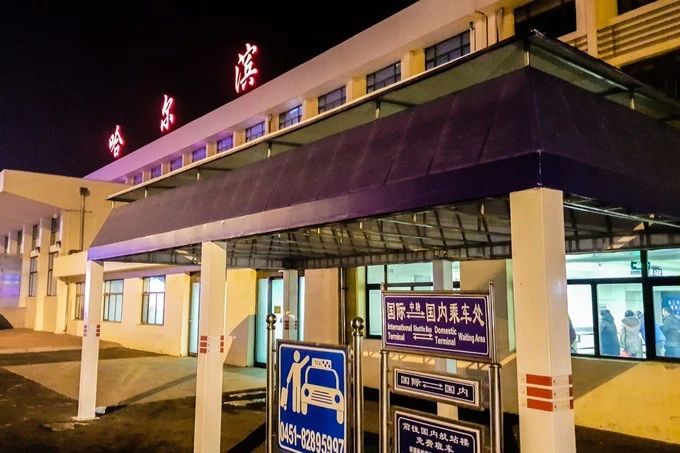
Last time I went to Harbin, I took a hard-seat train. This time, the two-hour flight felt like a fleeting moment, as if traveling through time. For the body, the distance between suffering and enjoyment is as vast as the ten-thousand-meter altitude.
Standing in winter Harbin, exhaling thick breath, even my nose hairs felt frozen.
In this city, known as the 'Moscow of the East,' the architecture blends Chinese and Western styles with distinctive characteristics. It has a long cultural history, not only gathering the history and culture of northern minorities but also being a famous city of Chinese and Western cultural fusion. The tourist center is near Central Street. We were arranged to stay at a hotel nearby that day. The famous attractions are nearby, very convenient.
Central Street is bustling with noise. On Harbin's most prosperous street, besides some buildings that retain Baroque and Renaissance styles, the cheap trinkets sold by vendors feel out of place.
After strolling along Central Street, you can head to the Songhua River to check the water conditions—whether the river can't stand the cold either, and send some 'condolences.'
Along the way, you can pass another landmark—the Flood Control Memorial Tower. It was built to commemorate the people of Harbin overcoming the catastrophic flood of 1957, and it is a symbol of this heroic city.
Another must-visit spot is the Saint Sophia Cathedral.
This is an Eastern Orthodox church, the most well-preserved Byzantine-style building in China. Of course, it was a remnant of the Tsarist Russian invasion. Saint Sophia Cathedral stands quietly here for a century, now alone, surrounded by modern buildings, appearing pitiful yet resilient in its aloofness. Apart from serving as a photo prop for tourists, it seems to have lost its original meaning. Admission: 15 RMB (I couldn't bring myself to spend it).
In Northeast China, whether in a hotel or a restaurant, as long as you are indoors, you can enjoy summer-like heat. People often wear summer clothes indoors. So visiting Northeast in winter is not just about experiencing the cold. In Harbin hotel rooms at night, I always felt the urge to turn on the air conditioning.
Western restaurants here are quite authentic.
Last night, the snowstorm in Harbin was thorough. Today we set off for Xuegu. Along the way, the sky gradually cleared and became sunny, while the earth was covered with pure snow. It seemed only blue and white remained between heaven and earth.
The scenery along the road was truly tempting.
Around noon, we arrived at our destination for the day—Xuegu. In winter, the sun sets in Xuegu around 4 p.m., so it's best to eat dinner early and play early.
We stayed at a family guesthouse called Xiangsi Xuegu Inn, recommended by other travel blogs. Ctrip was indeed convenient. The young man at the inn was very helpful; he reserved rooms for us and arranged the car from Harbin to Xuegu.
Compared to the famous Xuexiang, Xuegu seems more ordinary. But in fact, they share the same mountain. Xuexiang is on the sunny slope, while Xuegu is on the shaded slope. It is said that before Xuexiang was developed, it looked just like Xuegu now.
After lunch, we went wild at a private amusement park recommended by the host.
Outdoor activities in Xuegu generally include skiing, snow drifting, snow tubing, ice tops, ice sleds, and snowmobiles. Their place covered almost all of them. I think beginners would find this ski resort quite good. With a mix of professional and amateur activities, after trying everything, you can shift your focus—everything feels fresh and exciting the first time.
During the tourist season, Xuegu, this simple little mountain village, comes alive. Local villagers put aside everything else and start running guesthouses. Today, for the first time, we slept on the characteristic Northeast heated brick bed (kang). Although they no longer burn wood for the kang, the heated bed is still impressive. After skiing 'ravaged' my stomach, it urgently needed replenishment, and the iron pot braised goose became a lifesaver.
The enthusiastic landlady lifted the pot lid, and a warm, delicious steam rushed up, stimulating saliva.
The female lead of the iron pot braised goose is the goose; the male lead is undoubtedly sauerkraut. The collision of these two souls sparks passion. The sauerkraut absorbs the goose fat, leaving no greasy taste. In this cold winter, taking a sip of strong liquor, looking at the hazy snow scene through the misty window, no matter where you come from, you will feel that the Northeast evening dinner is so warm.
After dinner, you can crunch on the snow in Xuegu and stroll around.
The village is not quiet at night. Fireworks crackle, and the bonfire party heats up again. A group of people dance around the bonfire.
Make sure to put on all your gear. You can take photos of the night scene, go crazy with everyone, or just daydream in the room—this is your time.
The location of our guesthouse was great, convenient for everything. The bonfire party was nearby, and tomorrow morning's hiking trail started right at the doorstep. Very lucky.
In the evening, everyone returned to the guesthouse and made sauerkraut dumplings together. Then we put them outside to freeze for breakfast the next morning. Everyone participated, whether you knew how or not—the dumplings you make yourself are the best in the world. (Mine were so ugly that I won't show them off.)
Crossing Yangcao Mountain to Xuexiang
There is another must-do activity in Xuegu. Without it, the Xuegu trip would feel incomplete: the hiking crossing.
This is also what many tourists look forward to in Xuegu. Starting from Xuegu, you hike through the snow-covered primeval forest, finally crossing to the endpoint Xuexiang. The total distance is 15 km: the first 5 km are gentle uphill, the middle 5 km are a steep climb, and the last 5 km are downhill. Difficulty: Easy.
However, some do the reverse from Xuexiang. I think that would be harder. Because going up is easier than coming down—Xuexiang is slightly higher in altitude, so the climb is less, but the descent is tough. Of course, if you lack stamina or feel unwell, you can take a car directly around the nearly 100 km to Xuegu. The friend who sprained her ankle was a case in point.
We ate dumplings at 8 a.m. and finally reached the starting point for the hike at 9 a.m. There was a 40-yuan entrance fee. Then we started the hiking crossing. There were trail signs all along the way; as long as you don't stray into the forest, it's basically impossible to get lost.
At this time, fewer people were hiking. It was said that earlier tourists entered before 8 a.m. Although the 15 km trail can be finished in half a day, I still carried a big backpack filled with things I later found useless.
Note: unnecessary luggage can be shipped. Tell the guesthouse owner in advance, and they will arrange a car. 50 yuan for a large box, delivered to the luggage storage at the Xuexiang mountain gate.
Lunch during the crossing should be prepared yourself. I bought instant noodles at the foot of the mountain; there is free hot water at the visitor center on the summit.
The first 5 km of Yangcao Mountain are easy. Walking through the vast snowfield, occasionally a small stream appears as decoration. This was my first hiking experience in such an environment, giving me an illusion of stepping into a fantasy world. Snow on the branches (rime) fell off from time to time. Apart from this sound, the forest was extremely quiet.
Along the way, there are two shops where you can rest and have tea, selling some snow gear like gaiters and crampons. I think gaiters are essential; I bought mine at the Xuegu supermarket. Crampons depend on your climbing ability.
There are also horse-drawn sleighs and snowmobiles for service. Horse-drawn sleigh costs 100 yuan per person for 5 km.
Those with poor physical strength can use horse-drawn sleighs or snowmobiles to assist in going up the mountain. These services are only available on the first half of the uphill and the second half of the downhill.
When entering the second 5 km, it's best to take off your heavy coat. On such a steep slope, I would definitely sweat a lot. If you are wrapped in thick clothes and get sweaty, once you stop at the summit, your body will quickly lose heat, which could be life-threatening in severe cases. That's also the main reason for carrying a big backpack: to store the down jacket.
These 5 km are entirely uphill, very strenuous. Don't climb too fast, or you'll lose stamina quickly. Find your own rhythm so you can climb without stopping, which will make the overall speed much faster. The temperature rose that day, meaning the snow on the path was melting and becoming slippery. Flat ground was fine, but uphill became much more difficult. However, on some dangerous sections, there were thick ropes to help you.
Litter on the trail is a common problem everywhere. While having fun, please pay attention to environmental hygiene and keep some public morality. It took almost two hours to complete this 5 km climb, finally reaching the top of Yangcao Mountain.
At the summit, there is a visitor center for Xuexiang. You can use the restroom, get free hot water, and buy various fast food. But the main purpose here is: you need to buy the ticket. The standard price is 115 yuan.
We reached the summit a little after noon. The sky at the top was very, very blue.
After passing the visitor center, you are in Xuexiang territory. The downhill all the way was gentle. I took photos while walking, and within an hour, I arrived at Xuexiang.
Our hotel tonight was on Xueyun Street, very close to the hiking exit, very convenient. I have to admire the recommendation from the young man at Xuegu.
Private cars are not allowed to drive freely in Xuexiang. They must be parked at the parking lot before entering, and then take a shuttle bus into the scenic area.
It is said that Xuexiang is where warm, moist air meets cold Siberian air, resulting in a long snow season (about seven months), heavy snowfall (up to two meters deep), and good snow quality with high viscosity. This allows the formation of various snow houses and snow mushroom wonders. That's why it is so famous, known as 'China's Snow Town.'
A night tour of Xuexiang is the main attraction. Various neon lights begin to decorate the place, pulling Xuexiang from Alaska into Disneyland. It all looks unreal, because it's so dreamy.
There are also many cultural activities to participate in, such as the Northeast Yangge dance starting at 7 p.m. Elderly men and women in colorful cotton jackets gather at the village committee entrance and lead tourists along the street to stretch their limbs.
Also setting off is the reindeer DJ dance team. Reindeer pull sleds while playing wild disco music—a rustic fusion of modern and folk. But don't take it too seriously; behind the reindeer follows a counterfeit donkey.
At 7:30 p.m., there is a two-person comedy show (errenzhuan) at the bonfire square, which you can join.
After that, you can ascend the boardwalk to get a panoramic view of Xuexiang. The famous snow houses seen online are all photographed from here.
There's also a more nostalgic scene—frozen persimmons, frozen pears...
For dinner, we had an iron pot stew with sauerkraut as the core, adding various meats and vegetables, a hot pot stew. Despite its rough appearance, it hid a delicate flavor. Tonight's place was definitely worthy of the warm heated bed.
After eating and drinking to our hearts' content, we can sleep beautifully. Of course, our journey is also nearing its end.
The morning sky was blue, and with the white snow, it was truly pleasing to the eye.
After breakfast, we took an early bus back to Harbin. If your flight is after 9 p.m., you can take the bus at noon.
And so, we bid farewell to Xuexiang and said goodbye to Harbin.
People in Northeast China are very hospitable. If you do good research and book a guesthouse in advance, the owner can help you take care of other troubles. When in Rome, do as the Romans do—just be bold and enjoy yourself in the Northeast.
Finally, I offer a video—the immersive beauty is truly beyond words.
Table of Contents
1. Arriving in the Ice City - Harbin
2. Playground Paradise - Xuegu, China
3. Crossing from Xuegu to Xuexiang (Climbing the Snowy Mountain - Over Yangcao Mountain)
4. Fairy Tale Kingdom - Xuexiang, China
Travel Information
Hotel Index
Guide Index
Airline Index
Website Navigation
Travel Index
Cruise Index
Corporate Travel Index
Franchise Cooperation
Distribution Alliance
Friendship Links
Corporate Gift Card Procurement
Insurance Agent
Agent Cooperation
Hotel Franchise
Destination and Scenic Area Cooperation
More Franchise Cooperation
About Ctrip
About Ctrip
Ctrip Hot Topics
Contact Us
Careers
User Agreement
Privacy Policy
Business License
Security Center
Ctrip Content Center
Intellectual Property
Trip.com Group Algorithm Disclosure


