【Savoring Flavors on the Road】10. Black Soil Cuisine: The Trend of Earth's Water and Soil Nourishing Global Villagers
【Savoring Flavors on the Road】10. Black Soil Cuisine: The Trend of Earth's Water and Soil Nourishing Global Villagers
Introduction: The four basic elements of humanity are 'eating, clothing, shelter, and transportation.' These four elements drive human progress and continuously cycle with the iteration of human civilization. Today, the 'transportation' aspect of life, combined with travel, not only delights the mind through sights and sounds but also allows the taste buds to deeply experience the sour, sweet, bitter, salty, and savory flavors of life. The dishes tasted during the journey stir history and culture, hence I have compiled a series of articles about the dishes eaten on the road. Titled: 'Savoring Flavors on the Road with the Taste Buds.'
Location: Harbin, July 2017
In my impression, when it comes to Harbin cuisine, it is always associated with 'black, sticky, salty, and rough,' with dishes like pork stew, iron pot fish, and four major stews being considered representative of Harbin cuisine. But that's not the case. Harbin cuisine actually absorbs culinary features from Shandong, Henan, and other places, and integrates Russian-style Western flavors, embodying a blend of Chinese and Western elements with an inclusive character.
On this eastern trip, I did not eat the commonly known Northeastern dishes like braised pork with vermicelli, chicken stewed with mushrooms, or Harbin's pork stew and iron pot fish (except for the group meals during the Yichun tour). The dishes I ordered in Harbin had a distinctly southern flair. Here are the details in chronological order:
Arrived in Harbin on July 24, visited Central Street in the afternoon, had dinner at 5 PM at 'Fuchunlong' private kitchen. Two General Managers Li warmly hosted me. The dishes they ordered were excellent, seemingly with a Jiangnan style. Knowing that Cantonese people prefer light flavors, they specifically instructed the restaurant not to make the dishes too salty. Indeed, the taste was good.
First, let me introduce Guobaorou. Guobaorou, originally called 'Guobaorou' (pot-exploded meat), was created by Zheng Xingwen, the personal chef of Du Xueying, the prefect of the Harbin Daotai Mansion, also known as 'Binjiang Shanzu.' Because it is cooked quickly over high heat, the iron pot is heated, and the sauce is poured into the pot to soak into the meat, earning the name 'Guobaorou.' Russians pronounced 'bao' as 'bao,' and over time, 'Guobaorou' became 'Guobaorou.' Before the Xi'an Incident, since the three northeastern provinces were under the Zhang family's control, many dishes from Daotai Mansion were considered forbidden or private. In 1911, at the International Plague Conference in Fengtian (now Shenyang), Zheng Xingwen received high praise from delegates for his culinary skills and was awarded the plaque 'Binjiang Shanzu' by the conference. After Japan occupied Heilongjiang, Zhang Xueliang's control over parts of northeastern regions loosened, and some folk crafts and recipes gradually leaked out, including Guobaorou, which began to spread in Harbin and beyond.
Guobaorou is a Northeastern dish with main seasonings like shredded ginger, green onions, and cilantro. Pork tenderloin is sliced, marinated, coated in batter, fried until golden, then stir-fried with a sauce. The finished dish is golden in color, crispy outside while tender inside, with a sweet and sour flavor. I liked it.
Guobaorou, sweet and sour, crispy outside and tender inside, very delicately portioned.
Lotus root stuffed with glutinous rice, soft, sticky, and sweet.
Baked pumpkin, cut into strips, coated with egg white and fried, sweet and delicious.
Braised Songhua River bighead carp, tender and fresh.
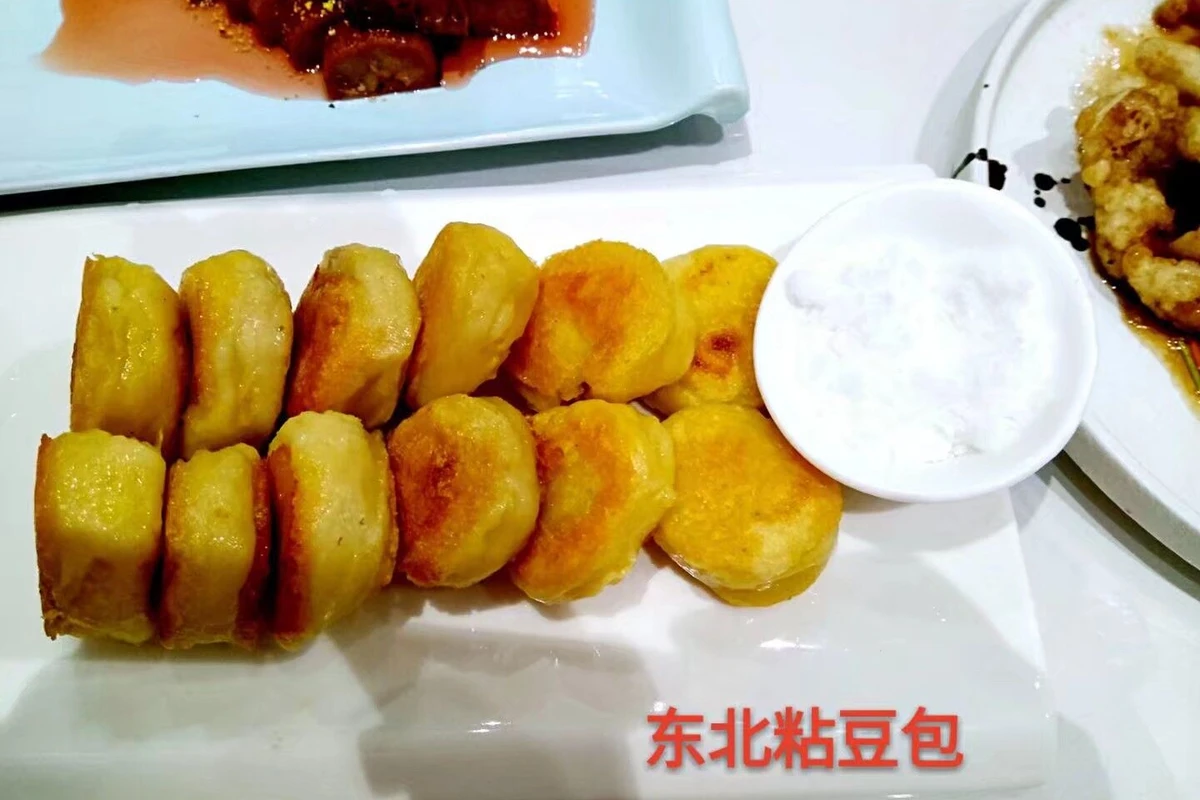
Northeastern sticky bean buns (Nian Doubao). Sticky bean buns are a sticky food that Northeasterners enjoy during the Spring Festival, made from yellow rice flour and red bean paste. They were originally used as offerings to ancestors and as food for hunting trips. Later, when Nurhaci led troops into battle, sticky bean buns became military rations in winter. It can be said that sticky bean buns contributed to half of the Qing Empire's territory.
For the first time, I learned that sticky bean buns are neither sweet nor salty. After eating one in its original flavor, I realized they need to be dipped in sugar.
Slowly savoring, waiting until 7:30 PM to see the night view of Central Street.
On July 26, I returned to Harbin from Yichun just before 7 PM. Manager Chen had been waiting for me at the drop-off point for over two hours. He picked me up and took me to 'Xijiade' for Northeastern dumplings.
Xijiade is a leading brand in Chinese dumpling restaurant chains, founded in 2002 in Hegang City, Heilongjiang. By the end of 2012, Xijiade had over 230 outlets nationwide, making it the most influential professional dumpling chain brand. Freshly made and boiled dumplings are its biggest feature, with delicious taste.
On July 27 at noon, I had a Russian meal at the Golden Ring Western Restaurant in Volga Manor, 128 yuan per person. There were five or six varieties, very delicately presented with tiny portions. It looked beautiful, but eating alone felt too extravagant, so I packed the Russian bread to take back.
In the afternoon, I returned to the hotel from Gogol Bookstore at 6 PM. I asked if the hotel restaurant served dinner, but they said only breakfast was available. So I went out to find food. After walking for 15 minutes, I found no proper restaurants, only noodle shops. I bought a pancake and ate a small portion.
After four days of travel, I hadn't eaten any white rice. Actually, during the Yichun tour, the group meal included two bites of mushy rice that was disgusting.
On July 28, Manager Chen drove me to the Lavender Manor and took a detour to 'Old Chef's House' for lunch—Premier Zhou Enlai once ordered Guobaorou here, and a few years ago, their Guobaorou was featured in the documentary 'A Bite of China.'
The walls were decorated with newspaper clippings and promotional materials. The storefront was small, but every seat was taken, and tables were turned over.
Guobaorou, 38 yuan, a huge bowl!
Shandong meatball soup, meatballs were chewy, with smooth seaweed.
Stir-fried lettuce with mushrooms, lettuce was no different from that in Guangzhou, but the mushrooms were a bit tough and salty.
Two-grain rice (millet and rice). I was amazed by the bright yellow millet here; the millet I cook at home seems dull in color.
This trip to the Northeast felt like heaven and hell in terms of food. The 'hell' was the Yichun group meals—unappetizing to look at and even more so to eat. In Harbin, it was like heaven: I had Russian cuisine, authentic Guobaorou, and sticky bean buns, which broke my bad impression of Northeastern food.
The dishes on the black soil table: some are hard to swallow, some difficult for visitors from all directions to share, while others soar high, spreading across the country and the world.
Each region's water and soil nurture its own people. However, the long-standing pattern of each region's unique nourishment is now moving toward integration and convergence.
The black soil cuisine here includes its own local dishes, Russian-style, Jiangnan flavor, and Central Plains traditions. The vast variety of Chinese and foreign dishes here learn from each other's strengths and discard weaknesses. This signifies that food-loving people, with their tiny taste buds, will eventually taste all the world's delicacies. The water and soil of the global village nurture the people of the world. People will gradually move toward the global village feast.
(1967 1709 2021/2/4)
Wishing everyone a happy Spring Festival! Family happiness and well-being!


