“Cliff Walkers” Is a Hit, and Its Filming Location Harbin Has Become a Sensation—It Turns Out to Be an Underrated Food City
After watching the movie “Cliff Walkers” recently, my passion for Harbin was reignited. The scenes of exotic buildings shrouded in heavy snow made my thoughts drift to this northern city. In winter, standing in front of a church covered in snow feels like being transported to Moscow. Viewing the exquisite ice sculptures and eating popsicles on Central Street are must-do activities for every visitor to Harbin.
Although Harbin is captivating in winter, it is actually a hidden food capital. You might say that Harbin snacks have nothing to do with China’s eight major cuisines, right? That’s true, but it doesn’t stop the city’s dishes from becoming famous nationwide. Harbin red sausage, grilled cold noodles,锅包肉 (Guo Bao Rou), stir-fried pork kidneys, braised pork ribs—almost every dish is a “hard dish,” making it a top choice for food lovers.
Today, come with me to Harbin and taste the well-known and hidden snacks in obscure food shops, and see which one is your favorite.
It is said that if you haven’t been to Central Street, you haven’t really been to Harbin. And locals will say that a life without visiting Harbin’s morning market is incomplete. The morning market on Hongzhuan Street is one of the best. This street was originally called Bread Lane, named after a Russian bakery that once opened there, filling the air with its fragrant aroma. After being renamed, many breakfast stalls gradually gathered here. It can be said that it rose because of food and continues its legend through food.
Among these breakfast stalls, Yin Pangzi Fried Cake is the most famous. There is always a long queue in front of his old two-meter-square cart. Over the past forty years, the vendor has traveled to various markets in Harbin, settling on Hongzhuan Street in recent years. He sets up at five or six in the morning and packs up around eight. Countless tourists come from all over the country, and locals also talk about Yin Pangzi Fried Cake with relish.
This type of fried cake originated in the three northeastern provinces, Inner Mongolia, and other places. It comes with fillings such as bean paste, sugar, and vegetables, often featuring walnuts, preserved fruit, and other ingredients. The most traditional fried cakes in Harbin have a natural rose fragrance, and Yin Pangzi Fried Cake is the pioneer. The crispy glutinous rice skin wraps a delicate mixture of bean paste and rose jam. The filling is generous but not greasy, soft and sticky without sticking to the teeth. Even if you don’t have the nostalgic taste that locals have, it feels strangely familiar when you bite into it. Perhaps this is the commonality of food.
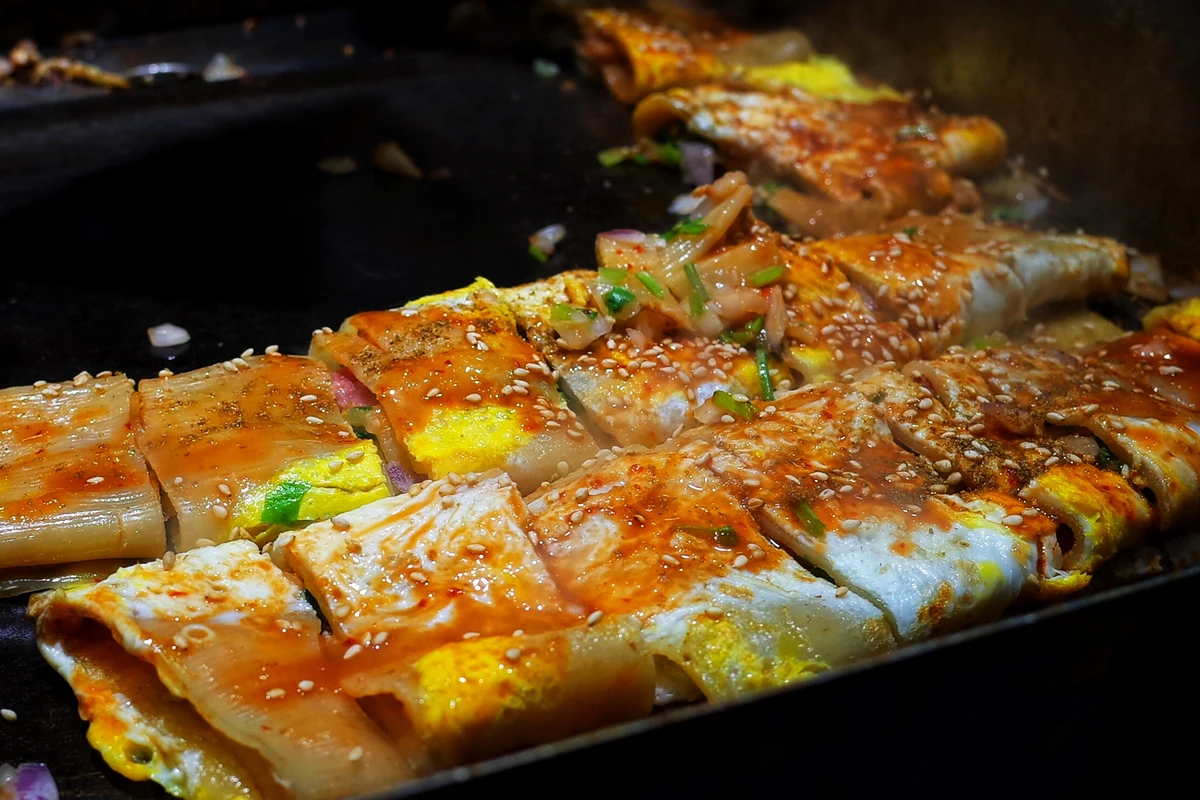
Today, Harbin’s grilled cold noodles have become a popular street snack in northern China. As night falls, the enticing aroma emanates from mobile carts. This folk snack is said to have originated in Mishan, Heilongjiang, and flourished in the Ice City. It is simple to make: a sheet of cold noodle skin, an egg, a sausage, sauce, seasonings, and chopped green onions and cilantro—transforming into a popular national snack.
The most popular grilled cold noodles in Harbin are undoubtedly the Sanhe Grilled Cold Noodles at the Shida Night Market. Don’t be fooled by its small mobile cart; the vendor has been grilling for over a decade. Not to mention the taste, just the momentum of his setup outshines other stalls. On a long iron plate, more than ten portions of noodle skins are laid out in order, each step executed with precision. He can make over ten servings at a time.
Although it’s mass production, the vendor remembers each customer’s requests clearly, and there is also a unique version made with bean starch noodles. This bowl of grilled cold noodles may not have a legendary origin, but it reveals the meticulousness hidden in the boldness of northeasterners. A few simple ingredients satisfy the cravings of passersby.
Many people may have eaten 锅包肉 (Guo Bao Rou) without knowing its origin. It was originally called 锅爆肉 (Guo Bao Rou) and was created by the founder of Harbin’s Daotai Mansion cuisine. Its name comes from the quick stir-frying method, where the sauce is poured into the wok and absorbed into the meat. However, Russians often mispronounced “爆” as “包,” and over time it became known as 锅包肉.
The ingredients for 锅包肉 seem simple, but the preparation is very precise. The pork tenderloin must be cut into 3 mm thick slices. The frying time, marinating sequence, and other steps are extremely strict to achieve a dish that is like a work of art. Bright green cilantro, pure white shredded green onions, orange-red shredded carrots, and golden fried pieces—it is a feast for the eyes.
Lao Chu Jia is the birthplace of 锅包肉. Walking into the restaurant, the walls, corridors, and hallways are filled with traces of Harbin’s past, and the place is always packed. While eating the 锅包肉, you can hear regular customers praising it. 锅包肉 has become a part of Harbin life, making you chew with more and more energy.
“The heavy industry supporting Northeast China’s economy is barbecue, and the light industry is live streaming.” Every joke about the Northeast involves barbecue, highlighting its status in the region. Harbin barbecue has a unique regional character. Due to its proximity to Russia, large skewers of beef and mutton are mainstream, and they must be grilled over traditional charcoal. The skewers are arranged one by one, turned 360 degrees, ensuring each piece is crispy on the outside and tender on the inside.
When eating barbecue in Harbin, any grill stall in a small alley will be decent. But for a decades-old establishment, Shixiang Barbecue is one. Operating since 1986, it is considered a pioneer in Harbin’s barbecue scene. The traditional beef and mutton skewers need no introduction—perfectly marbled with fat and lean, incredibly satisfying to devour. Chewy dry meat skewers, fresh chicken hearts, savory dried tofu rolls, crispy potato slices—each skewer has its own unique aroma. This flavor, preserved for 30 years, is addictive once you taste it.
What other Harbin dishes do you know that are not widely known? Feel free to share in the comments.


