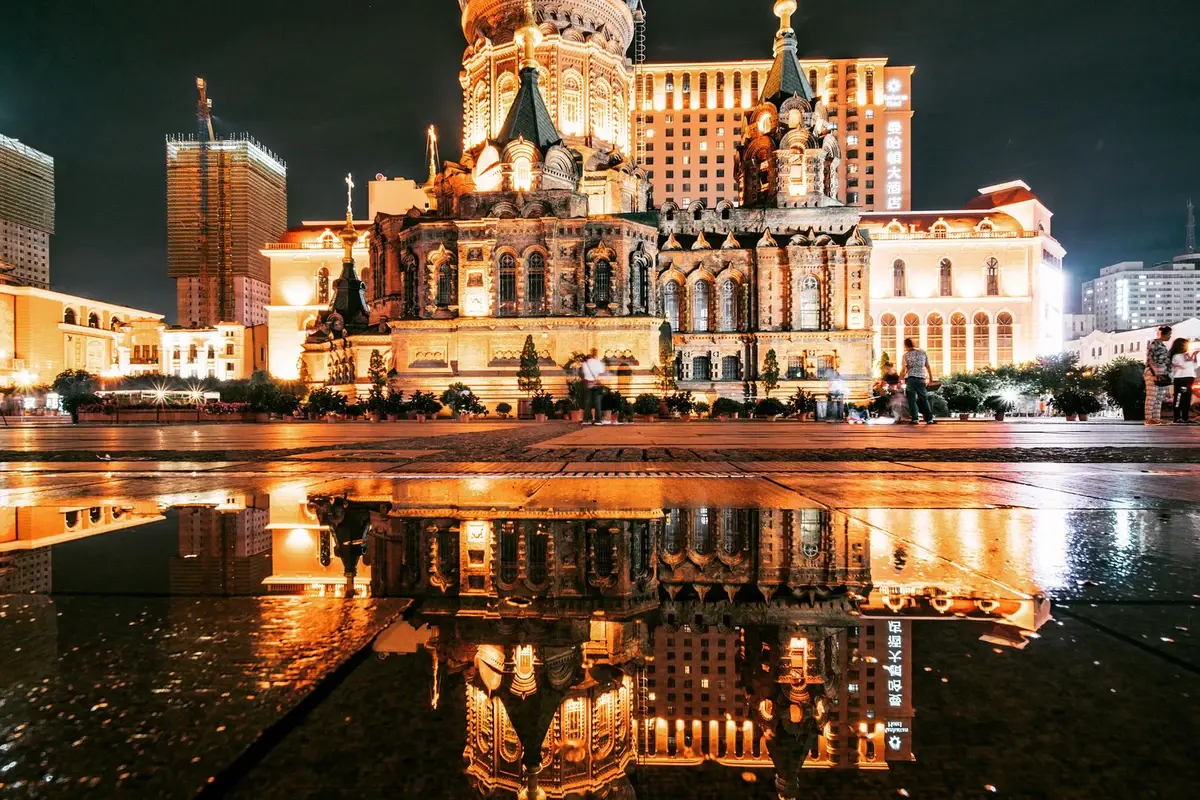
In summer, it's 'Little Paris of the Far East'; in winter, it's 'Oriental Moscow'
In the height of summer, visiting Harbin is a delightful experience. Compared to other big cities, it has less scorching heat and restlessness, and more freedom and ease. If you have been to Wuhan and Guangzhou in August or September, experienced the feeling of panting every three steps and sweating every five steps, then Harbin's ease and freedom will make you feel even more refreshed and reluctant to leave.
Harbin is the northernmost, highest latitude, and coldest metropolis in China. It has a temperate continental monsoon climate with four distinct seasons. Winters are long and cold, summers are short and cool, with a large annual temperature range and relatively little rainfall. The concentrated snowfall period is from November to January each year. The average annual temperature is 3.6°C. January is the coldest month, with an average temperature of -24.8°C; July is the hottest month, with an average temperature of 24.8°C.
Harbin enjoys cool and pleasant summer weather with shady trees, making it an ideal place for vacation and escaping the heat. It is also a city with a strong exotic atmosphere, reflected in its streets and the buildings on either side. Now, let's talk about the streets you must visit.
1) Central Street
As a must-visit attraction in Harbin, Central Street is like Wangfujing in Beijing—the most Western-style place in Harbin. Its distinctive cobblestone road, which resembles a type of Russian bread, is vividly called 'bread stone road.' Those who have never been to Moscow, Paris, Rome, or Greece can still appreciate the architectural styles of these countries through the various Western-style buildings on Central Street.
① Huamei Western Restaurant, one of the four major Western restaurants
② Modern Hotel, China's first涉外 hotel.
Ps: This street not only gathers European-style buildings of Renaissance, Baroque, Eclecticism, and modern styles but also has many historic old shops, such as Huamei Western Restaurant (one of the four major Western restaurants) and Modern Hotel (China's first foreign-related hotel). Don't miss them when strolling!
2) Gogol Street
Gogol Street is named after the famous Russian writer Nikolai Gogol, probably because the residents at that time were all Russians who knew this great writer. However, the elderly in Harbin still habitually call Gogol Street 'Fendou Road' (Struggle Road), named after Chairman Mao's inscription 'Struggle.' That's why some shops still use the name 'Fendou Road.' This street features century-old buildings that remain well-preserved. After renovation, old-fashioned mailboxes from decades ago have reappeared, along with European-style landscapes like the Russian River Garden and trams, adding a nostalgic charm to the old street.
Highlights along the way:
① St. Alexeyev Church, an indispensable scenery and memory of Byzantine art in Harbin.
② Churin Company founded by Mikhail Ivanovich Churin, a fashion dream factory for the old Shenyang people.
③ Russian School (now the Provincial Foreign Affairs Office).
Approaching Old Churches, Savoring a Century of Splendor
1) St. Sophia Cathedral
Harbin St. Sophia Cathedral was first built in March 1907 as a church for the Russian Fourth East Siberian Infantry Division during the construction of the Chinese Eastern Railway. Its floor plan is a Latin cross layout, with overall Byzantine architectural style. The main dome and bell tower also feature Russian traditional 'tent roof' and 'onion head' shapes.
Address: No. 88 Toulong Street, Daoli District, Harbin City, Heilongjiang Province
2) Hulan Catholic Church
Hulan Catholic Church was first built in the 34th year of the Guangxu reign of the Qing Dynasty. It is a brick, blue tile, and wood structure with strong European architectural art style, and its appearance is similar to that of Notre Dame Cathedral in Paris. Moreover, all doors and windows are built in arched shapes with blue bricks. At the top center of the two main towers, a copper cross is inlaid.
Address: North of East Street, Hulan District, Harbin City
This island is about 10,000 meters long from east to west, about 4,000 meters long from north to south, with a total area of 38,000 square meters. The scenic area includes wetlands and grasslands with unique scenery—a profusion of flowers, green willows like smoke, birds chirping and flying around the trees, and a vast river and sky surrounding the island. Sun Island has the largest urban wetland in China, with Tatum heads (tower-head peat mounds) being beautiful markers of the wetland landscape.
Rafting in Harbin began in the 1990s, and now there are 15 sections on 8 rivers available for rafting. Some sections are thrilling and exciting, others are leisurely and relaxing. Among them, the Balan River rafting, known as the 'Number One Rafting in the North,' is the most famous.
Practical Travel Guide for Harbin Transportation
Harbin Taiping International Airport is 30 km from downtown Harbin and is the second largest international airport in Northeast China, capable of handling various large passenger planes day and night. Currently, it operates 75 domestic, regional, and international routes, with regular flights to all seven other airports in Heilongjiang Province except Daqing Airport, and routes covering more than 50 cities across China, including Beijing, Shanghai, Guangzhou, Hong Kong, and Taipei. In addition, international routes connect to multiple cities, including Blagoveshchensk, Khabarovsk, Vladivostok, Yakutsk, and Yuzhno-Sakhalinsk in the Russian Far East; Seoul and Jeju in South Korea; and Osaka and Niigata in Japan.
From the airport to the city, buses depart every half hour, costing 20 RMB per person. Usually, they leave when full, and the journey takes 40 to 60 minutes. The route is: Airport—Kang'an Road—Anfa Bridge—Railway Station—Wenchang Street—No. 99 Zhongshan Road (Civil Aviation Building).
From the city to the airport, there are two airport bus stops in Harbin: No. 99 Zhongshan Road (Civil Aviation Building) and No. 30 Xinyang Road. The bus at Zhongshan Road departs when full, so waiting time is long; tourists should board 2 to 3 hours in advance. The last bus departs at 18:00. At Xinyang Road, there are only two airport buses per day, departing at 10:30 and 12:00.
Taxis are available directly outside the Taiping Airport terminal. A taxi to the city center costs about 130 RMB (including expressway tolls).
Harbin is the second largest railway hub in Northeast China after Shenyang. Five main railway lines—Beijing-Harbin, Harbin-Suifenhe, Harbin-Manchuria, Harbin-Beian, and Lafa-Harbin—converge here. It not only has passenger trains to major cities within the province, Northeast China, and eastern Inner Mongolia, but also direct trains to major tourist cities such as Beijing, Tianjin, Shanghai, Guangzhou, Hankou, Zhengzhou, Jinan, Yantai, Dezhou, and Xuzhou. Currently, Harbin has launched bullet-shaped high-speed trains to Qiqihar, Mudanjiang, Suihua, Jiamusi, and other cities within the province.
Harbin's railway passenger transportation mainly involves two major stations: Harbin Railway Station and Harbin East Railway Station.
Harbin Railway Station is the main departure and arrival station for trains passing through Harbin. You can take buses 6, 11, 13, 14, 16, 21, 64, 74, 89, 101, 103, 108, 109, or 115 to get there.
Harbin East Station is the starting point for most trains departing from Harbin and the terminal station for trains arriving in Harbin. You can take buses 27, 51, 52, 79, 89, or 90 to get there.
As an important transportation hub in Northeast China, Harbin has a very developed highway system. Four national highways—102, 202, 221, and 301—radiate to all parts of the country. Long-distance buses run to more than 20 cities across China, including Beijing, Shanghai, Nanjing, Liaoning, Jilin, Xinjiang, Hebei, and Henan, as well as to various cities and counties within the province.
There are several bus stations in Harbin. Among them, Nangang Passenger Station and Jiaohua Station are both near the railway station and are relatively large highway passenger stations. You can take buses 6, 11, 13, 14, 16, 21, 64, 74, 89, 101, 103, 108, 109, or 115 to reach them. Other stations include Daowai Station, Daqiao Station, Sankeshu Station, and Longyun Highway Station, all offering long-distance buses to destinations within and outside the province.
【Harbin Snacks】
Also called 'Dà liè bā' (large loaf), it is hailed as a unique food of Harbin. This large round bread weighs 2.5 kg and has a distinctive aroma.
The most classic foods in Harbin are red sausage and dry sausage. Red sausage originally came from Russia. The most common, famous, and traditional flavor is 'Lidoss'—garlic-flavored, excellent with alcohol, and when paired with 'Kvass' (a Russian fermented beverage made from bread crust, similar in color to beer but slightly red, sweet and sour), the taste is fantastic. Red sausage can be eaten in a loaf of bread, and it is a primary meat product.
Red sausage can be eaten directly. If you hold it, your hand may get a bit black! Don't panic; it's not dirt, but a thin layer of charcoal ash on the surface. Red sausage is smoked using old fruit wood from the Greater Khingan Range. Well-smoked red sausage will have a layer of invisible fruit wood charcoal ash on the surface. When eating, you should also eat the skin—that's the true red sausage flavor: you must taste that slightly wild charcoal flavor!
Originally called 'Pot-Exploded Meat,' it is an authentic Harbin cuisine. Because it is quickly stir-fried over high heat, the iron pot is heated, and the sauce is poured into the pot to soak into the meat, hence the name 'Pot-Exploded Meat.' To taste authentic pot-roasted pork, you can only find it in Harbin. Whether on the streets or in the restaurants of descendants of the old chefs along the Binjiang River, as long as the chef is a genuine Harbin cook, they can present this century-old culinary heritage of the city.
Jing brand pine nut pork belly
A unique meat product from Zhengyanglou in Harbin. It is mainly flavored with the fragrance of pine nuts. When cut, it has a good color, a rich aroma, and is fatty but not greasy.
A famous time-honored brand in Harbin. It is particularly famous for its mooncakes, which are crispy, delicate, soft, with a unique blend of flavors, and can be stored for a long time without drying out.
【Recommended Summer Tour Routes in Harbin】
One-Day Tour in Harbin
Pick up at Harbin Railway Station, after breakfast, visit the world-famous Sun Island Scenic Area, indoor ice and snow art museum, Siberian Tiger Park, and Northeast Three Treasures Exhibition Hall.
After lunch, visit the Flood Control Monument, Stalin Park, stroll along the century-old street—Central Street, visit the largest Eastern Orthodox church in the Far East—St. Sophia Church Square, and a Sino-Russian folk craft shop. After dinner, see off and conclude your pleasant Harbin trip!
Two-Day Tour in Harbin
Day 1: Pick up at Harbin Railway Station, after lunch, visit Gogol Street (named after the Russian writer), view the Russian River Garden, appreciate the Alexeyev Church, view the exterior of the Long Tower (Asia's first high steel tower), visit the Flood Control Monument, and Stalin Park.
Day 2: After breakfast, visit the world-famous Sun Island Scenic Area, view the ice and snow art museum, Siberian Tiger Park, and Northeast Three Treasures Exhibition Hall. After lunch, stroll along the century-old street—Central Street, visit the largest Eastern Orthodox church in the Far East—St. Sophia Church Square, and a Sino-Russian folk craft shop. After dinner, see off.
Accommodation Recommendation: Xbed Internet Hotel (Central Street k-Room Internet Hotel)
Walking through the street full of Baroque buildings, watching the Renaissance-style buildings on both sides of Central Street, you can meet at the corner of the street—Xbed Internet Hotel (Central Street k-Room Internet Hotel). It is mysterious and dreamy, with gorgeous colors that complement Harbin's architecture and scenery. It is like a miniature Harbin hidden in the hearts of travelers.
The red lighting symbolizes the warmth of Harbin city. The exquisite hanging paintings and ornaments highlight the designer's yearning for a better life. The red and green are used just right, harmonizing the space's colors into complementary tones. Besides the cabinets, there are also small potted plants everywhere, which make the visual effect full of tension yet warm and comfortable.
The uneven bread stones on the background wall and the carved ceiling lights perfectly showcase the essence of European style. Staying here feels like instantly traveling to multiple Eastern European countries: Russia, Turkey, Ukraine...
Clean, pure, with moderate brightness, giving a fresh and cool feeling, leaving all worries behind, running freely at the junction of blue sky and sea, indulging in a clear blue color, as if sleeping on the Aegean Sea.
If you like this hotel, interested friends can search for it themselves.
Address: Unit 1, No. 35 Hongzhuan Street, Daoli District, Harbin City, Heilongjiang Province
That's all for now. See you next time!


