Summer Solstice: Let's Chase the Aurora Together - A Journey to Harbin, Mohe, Wudalianchi, and Yichun
Traveling far with my parents twice a year, where to go this time? Spreading out the map of China, how about heading to the northeast? My parents are elderly and have high blood pressure, so experiencing the 'silver-clad' winter in the northeast is obviously not possible. What about summer? It offers a chance to escape the heat and try our luck at seeing the rare aurora. So we got straight to work, checking travel guides and planning routes. Only then did we realize that the 'Great Northeast' is truly 'great' and its transportation is quite 'underdeveloped'. Ultimately, due to limited time, we settled on the route: Shanghai - Harbin - Mohe - Wudalianchi - Yichun - Harbin. Now, let me take you through the memories of this eight-day trip.
On June 22, we departed from Shanghai in the morning. After a three-hour flight, we arrived in Harbin, the capital of Heilongjiang Province. In summer, Harbin's tourist resources are much scarcer. We took a cable car across the Songhua River to Sun Island, and a short electric cart ride was enough. We had some northeastern dumplings, strolled down Central Street, tasted the 'Madianer Ice Lolly', bought a 'Sha Yi Ke bread' from Huamei's entrance, and took photos in front of European-style buildings. Wandering from Central Street, we arrived at Saint Sophia Cathedral. We visited inside for less than five minutes but still felt the grandeur of this typical Russian architecture.
After a quick, superficial one-day tour of Harbin, we bought bread and instant noodles, and brought along the Shangwei red sausage specially purchased by a friend. At 17:31, we boarded the K7039 green train (soft sleeper) and set off for Mohe! Along the way, everything was green—forests, grasslands, farmland—with barely any houses in sight. It made me marvel at the vastness of our country.
On June 23, at around 9 a.m., we finally arrived at Mohe Station. What a journey! Why isn't there a high-speed rail? Sigh! This is a major factor hindering the development of the northeast.
At Mohe Station, the car we had arranged in advance was already waiting at the exit. The weather was clear and the air was fresh. Were we really at the northernmost tip of China? The driver said, 'I have good news and bad news. Which do you want first?' The good news is that you were lucky to change your original itinerary—if you had come from Hailar and Manzhouli, those bridges are all flooded, and there's no way through. The bad news is that the primitive Beihong Village is also inaccessible, and Longjiang First Bay is closed today. Tomorrow, we'll have to wait for notice. Eh? Wasn't the sun shining brightly? How could this happen? The driver explained that it had been raining every day recently, causing water levels to rise sharply. Well, I could only pray that tomorrow I could go to the First Bay.
For now, we pulled ourselves together and visited the northernmost riverside town in China—Arctic Village. The day's itinerary was all about 'finding north.' The northernmost sentry post, the northernmost family, the northernmost post office, the northernmost square, the northernmost thermometer, the northernmost observation tower... I especially loved climbing the observation tower (rumored to be privately managed with a high fee of 80 yuan) and seeing the scenery on both sides of the Heilongjiang River—blue sky, white clouds, green grass, red houses. The elderly peered through binoculars to 'spy' on the activities of people in the Russian village across the river, haha, having a great time!
The whole village is not big. Due to the flood, the bridge to Shazhou Island was submerged. Sigh! After dinner at Fulong Restaurant, we went to the 'Northernmost Post Office' to send a postcard. Then we strolled along the quiet road back to our lodging (Arctic Mountain Villa). What I miss most are the sunset, starry sky, and moon in Arctic Village—they were incredibly beautiful! The sunset dyed the sky a golden yellow, with a few 'pale red clouds' reflected in the Heilongjiang River, surrounded by tranquility, so comfortable! During dinner, I heard a group of backpackers say that the aurora was forecast for tonight. After 11 p.m., we walked out of the villa to the open square, and what I saw—was that the legendary aurora?
The night in Arctic Village is especially short. After 9 p.m., it gets dark, and by 2 a.m., the sun has already quietly shown its face. My elderly father was even 'woken up by the brightness' at 3 a.m.
On June 24, during breakfast at Arctic Mountain Villa, I immediately asked the staff if they knew whether Longjiang First Bay would open today. When I heard, 'Yes, it opens at 11 a.m.,' I was thrilled. But then came worry—this scenic spot requires climbing 999 wooden steps. How could the elderly manage? Could they accomplish this feat? Setting that aside for now, we enjoyed the scenery along the way and headed for Longjiang First Bay.
At Longjiang First Bay, we were told that due to the previous days' flooding, though the park was open, some sections of the wooden boardwalk were still submerged. So today, the sightseeing car would take us directly to the top. How fortunate and delighted we were! I must have done something good in a previous life, haha! The elderly were also energized upon hearing this news. The sightseeing car took us through 'Wusuli Shoal,' where we found the 'Northernmost Point of China.'
Continuing uphill, we arrived at 'Longjiang First Bay.' Lush trees surrounded the rolling Heilongjiang River. The river turned sharply back on itself, and Hongqi Ridge was cut by the river into a perfect Ω-shaped bay stretching for thirty kilometers. Truly, facing such magnificent scenery, all words are empty. You can only use your eyes to record the wonders of nature.
With good luck, we continued to the 'Nine Bends and Eighteen Turns.' Climbing the observation tower, a natural primitive wetland spread out before us. The Emur River meandered through like a silver ribbon dancing, full of charm.
Next, we visited the Rouge Gully Scenic Area (also called Guanyin Mountain Scenic Area). Taking the sightseeing car, we went to the Guanyin statue to pay respects, thanking her for her protection—clear skies, beautiful scenery, and everyone safe. This statue, brought from Sanya in Hainan in 2006, is the original statue of the South Sea Guanyin. It faces south to the Guanyin dharma statue on Nanshan Mountain in Hainan, echoing each other from afar. The sightseeing car continued, and on the right was the Li Jinrong Ancestral Hall, where we learned about the history and culture of gold mining in Rouge Gully. On the left was Rouge Gully itself—blue sky, white clouds, green grass—a beautiful painting. Under my direction, my father and mother held hands and ran toward each other, and it felt like they were back to the moment of 'young love,' haha!
Accompanied by sunshine, we ended the day's itinerary. Since Beihong Village was still flooded and not fully recovered, we had to give up and returned to Mohe, checking into Mohe Jinma Hotel. In the evening, we tasted the local cuisine—iron pot stew. It was quite distinctive but a bit expensive. After dinner, we walked back to the hotel, enjoying the streets of Mohe, feeling very relaxed.
On June 25, we slept in. After a full breakfast, we wandered around Mohe city—Songyuan Primitive Forest Park, Xishan Park, and Beijixing Square to see the cityscape. Then we went to Mohe Station again to board the K7042 green train (soft sleeper) to Nehe.
On June 26, at 4:05 a.m., the train arrived at Nehe. The morning glow filled the sky with the red sun rising—another clear day, good!
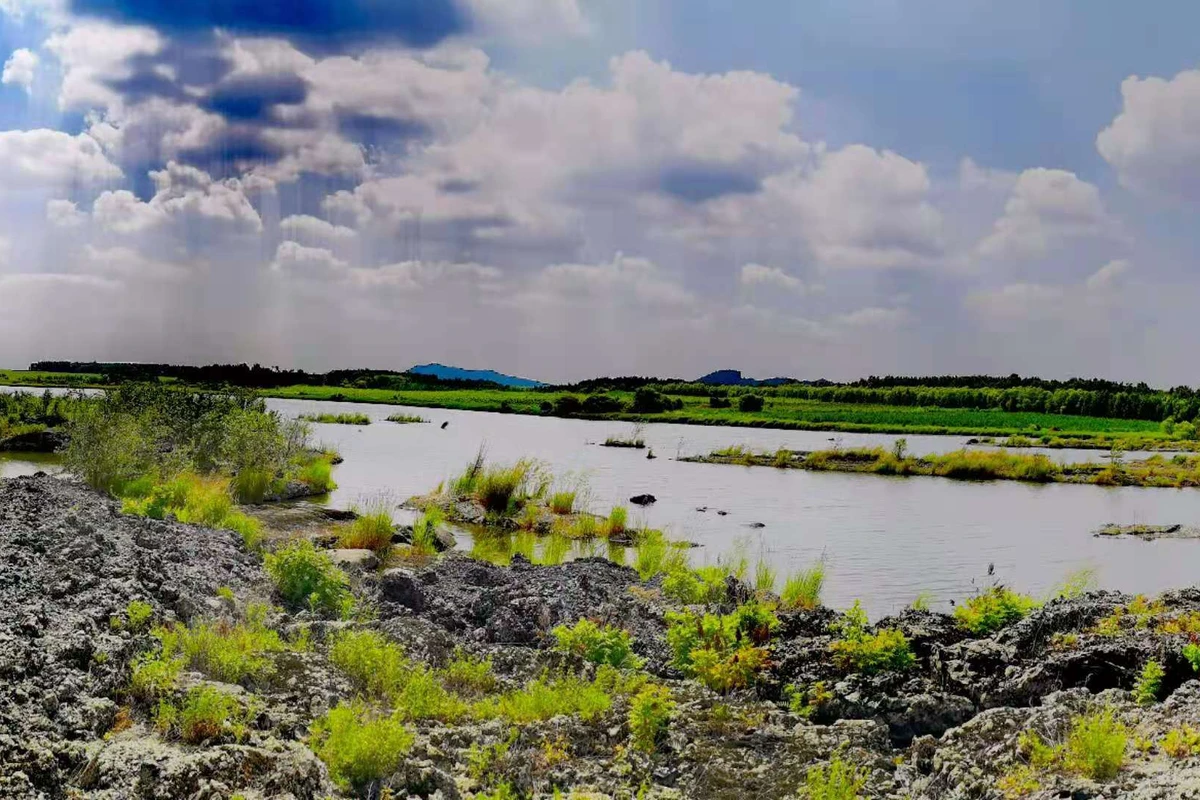
We contacted the driver for Wudalianchi, who was waiting at the station exit. He picked us up, and after about two hours' drive, we arrived at Wudalianchi Marriott Mansion Business Hotel. After prior communication with the hotel, we were able to check in early. After breakfast at the hotel, we rested for half a day. After lunch, we headed to the central scenic areas of Wudalianchi—Laoshan Mountain and Bailong Lake. It was quite hot under the scorching sun (all along, I kept being questioned, 'Is this really a summer escape trip? The daily high temperature can reach 30°C,' hehe). The sightseeing car took us into a world of 'black rocks, green grass, and blue lakes.' My father marveled at nature's wonders. First, we took a boat to visit 'Sanchi' (the third lake) and admired the fourteen volcanoes of Wudalianchi from the water. Sanchi is the largest of the five lakes. Though they don't connect from above, they are linked underground. The boat reached the opposite dock, where volcanic lava and rural scenery combined. The loving couple continued to leave their silhouettes.
After the boat ride (100 yuan), we took the sightseeing car to the foot of Laoshan Mountain. My 83-year-old father, 78-year-old mother, and 77-year-old mother-in-law bravely climbed the stone steps on the right side of the Shihai (stone sea). It took them over an hour to reach the crater. Truly remarkable! Admirable!
At the summit, we enjoyed the panoramic view of Wudalianchi.
After a tiring day, we went to 'Wang Maolv' for a hearty dinner, then experienced the 'charm' of Wudalianchi volcanic mud—soaking our feet and applying face masks, haha! Perfect!
On June 27, the itinerary was relatively relaxed. Early in the morning, we visited the 'Wenpo' scenic area, known as 'little Jiuzhaigou.' It is a bonsai-style volcanic wonder with three pools: 'Jingpo' (Crystal Pool), 'Bipo' (Jade Pool), and 'Lipo' (Beautiful Pool)—beautiful names and lovely scenery. Volcanic rocks, aquatic plants, and green algae surrounded us. We entered from the east gate and strolled along the wooden boardwalk, passing through three pools, then took a boat out from the west gate.
At the 'North Drink Spring,' we filled a bottle of 'sparkling mineral water' and drank it all in one go—refreshing! This mineral water must be consumed within an hour, otherwise it oxidizes. It tastes similar to Paris sparkling water, which you can drink straight from the tap anytime. At 'Erlong Spring,' many people were filling bottles at the outlet. It is said the water is good for eyesight. Haha, well, my father actually took off his glasses and washed his eyes thoroughly. He said with a smile, 'I can throw away my glasses.' As long as you're happy!
After lunch, we left Wudalianchi and drove to Tangwanghe in Yichun. The highway drive took nearly 5 hours, which was tough on the driver. Sigh, with this vast Heilongjiang, why no high-speed rail? I sighed again. The scenery of blue sky, white clouds, green grass, and farmland was not bad.
By early evening, we arrived at Tangwanghe and checked into Jiuxin Mountain Treasure Resort. The whole hotel was made of wood—luxurious! We went out to find dinner. Tangwanghe had surprisingly few people. Walking to the square area, we found 'Heping Restaurant' (Peace Restaurant). The food was cheap and delicious. A large table of delicacies only cost us 316 yuan—pretty good! On our way back to the hotel, we saw another beautiful sunset.
On June 28, we set off early for the Tangwanghe Xing'anling Stone Forest Scenic Area. It's very large, divided into six zones. Since we had elderly with us and the sun was blazing, we only visited the Yixiantian (Line of Sky) landscape area and the Botanical Garden landscape area. 'Yixiantian,' 'Doujin Stone,' 'Buddha Peak,' and 'Lovers' Peak' rose abruptly from the ground, tall and majestic. Strange rocks, red pines, and wild animals coexisted, with lush green mountains—an excellent forest oxygen bar. After listening to the guide's introduction, my parents even burst into song. 'Are you really 'washing your lungs' like that?' Fortunately, they sang quite well, haha!
I had thought of visiting 'Wuying Forest Park' on the way, but the driver said the scenery was similar, so we decided to skip it. After lunch and a rest at the hotel, we headed back to Yichun. In the afternoon, we visited Yichun's Beishan Park and the Forest Museum. The northeastern people are quite friendly—sitting in the park, singing songs, drinking some wine—living a comfortable life! In the evening, we checked into Yichun Chengmao Guojin Hotel and enjoyed a meal at the hotel's Chinese restaurant—also very good. The hotel is located in the new district, surrounded by government offices, with a large square. The sunset was incredibly beautiful!
On June 29, after breakfast, we departed at 9 a.m. After a 5-hour drive, we arrived at Harbin Taiping Airport around 2 p.m., took a flight back to Shanghai, successfully concluding our eight-day 'Finding North' trip.
Throughout the trip, probably because it was summer, I felt that the tourist resources were not abundant enough. Coupled with inconvenient transportation (Mohe Airport is under renovation), my impression of the Great Northeast was considerably diminished. It really hasn't developed as fast or as well as the Great Northwest! There were very few cars on the highway, and few people in the cities—it felt a bit off. Sigh!
Overall expenses: Major transportation (round-trip flights) 1,800 yuan; train sleeper 772 yuan; four-city chartered car, per person 1,150 yuan; accommodation 930 yuan (mostly the best local hotels, four-star); meals 560 yuan; tickets and scenic area transportation about 500 yuan (elderly mostly got free tickets); subtotal around 5,700–6,000 yuan.


