Journey in Search of the Distant and Poetry (Part 7)
Today marks the seventh day of our journey. Last night, Jinhe Town experienced a continuous rain, and the thick, dark clouds outside the window seemed to indicate that the rain would accompany us throughout the day. When I woke up at around 6 a.m. and opened Douyin, I saw that the train from Mohe to Jiagedaqi had been halted due to a railway bridge washed away by consecutive heavy rains. After selecting 'same city' on Douyin, I watched a video titled 'Landslide at Alongshen Mountain Last Night: Firefighters Rescue Trapped Vehicles Urgently,' and I reflected on the dangers brought by natural disasters like landslides. We were staying at the Helun Business Hotel in Jinhe Town (incidentally, this hotel was the worst we've encountered in years of traveling: 1. The room rates were arbitrarily inflated, causing problems until Ctrip intervened. 2. The service attitude was poor. 3. They did not provide meals). After packing our luggage, we braved the heavy rain to find a small breakfast shop where we had fried dough sticks, rice porridge, and eggs. Chatting with the shop owner, we learned that the road to Mohe was closed due to landslides and a road bridge dozens of kilometers from Maogui being submerged; cars had turned back from Alongshen, 60 kilometers away, since 5 a.m. My wife and I exchanged surprised glances, hoping this was just rumor. We hurriedly ate, returned to the room, and my wife called the Mohe International Conference Center, where we had a reservation, to confirm the reliability of the news. The hotel staff confirmed that trains and roads from Jinhe Town and Jiagedaqi were impassable due to the heavy rain-induced landslides, and we could cancel the reservation unconditionally (though it was originally non-refundable). Seeing the map of China we had marked with Mohe last night, we felt mixed emotions. It was a shame to abandon our destination just as we were about to reach it because of the heavy rain. After discussing, we decided to change our route: head towards Heihe and then north to Beihong Village, essentially detouring around the eastern border of China's rooster head and then northward. Calculations showed this would add more than five days, making it unfeasible given our physical strength and time constraints. I had visited Harbin in July 2017 and had always recommended it to my wife. After looking at the map, we decided to make the best of our regret by fulfilling my wife's trip to Harbin. So we turned south and headed toward a major city in the fertile black soil of Northeast China: Harbin! According to Gaode navigation, the entire journey from Jinhe Town to Harbin is about 1,100 kilometers. We would decide where to rest tonight based on the road conditions. At around 9 a.m., we took our 'Big Black' back through the rain on the bumpy 68-kilometer road from Jinhe to Genhe. Along the way, we were stopped by motorcycle travelers who confirmed the road closure. Watching them bravely seek the limits of life against wind and rain touched us deeply. We arrived in Genhe around noon, and the difficulty of the journey goes without saying. On the road, we sighed: many regrets in life stem from these uncertainties, no matter how thorough the plan. It's a pity that this self-driving trip east and north failed to achieve its goal: to see the legendary aurora near the summer solstice in the shortest night at China's northernmost point, and to visit Arctic Village, the northernmost village of the motherland's crown, where one could supposedly talk to Russians across the river. By 7:30 p.m., it was getting dark, and we had traveled over 800 kilometers through wind and rain. At a place called 'Arongqi,' where the clouds finally parted, we checked into the Kuntai Hotel, which my wife had just booked on Ctrip. Arongqi is the border between Inner Mongolia and Heilongjiang Province. Although it felt small, the streets were very clean and the roads particularly wide. We learned that Arongqi is the cleanest and most civilized county-level city in China, with Yili Dairy and Qilu Pharmaceutical based there. After settling in, tired and hungry, we found a restaurant called Old Fishing Village, known for its iron-pot fish stew. The owner was exceptionally kind and hospitable. Hearing that we were self-driving tourists from Shanxi, she let us rest in a private room while instructing the kitchen to pick fresh carp, add various broths, and prepare tofu, cornbread, eggplant, vermicelli, and more to create a delicious pot stew. It was super tasty! When paying, she not only gave us a discount but also offered homemade peanuts and pickles as take-away side dishes. This might be what we often call 'karma': if not for the heavy rain detour, we would never have visited this 'city' or met such genuine, kind, and beautiful people. 'Arongqi,' perhaps I will come again!
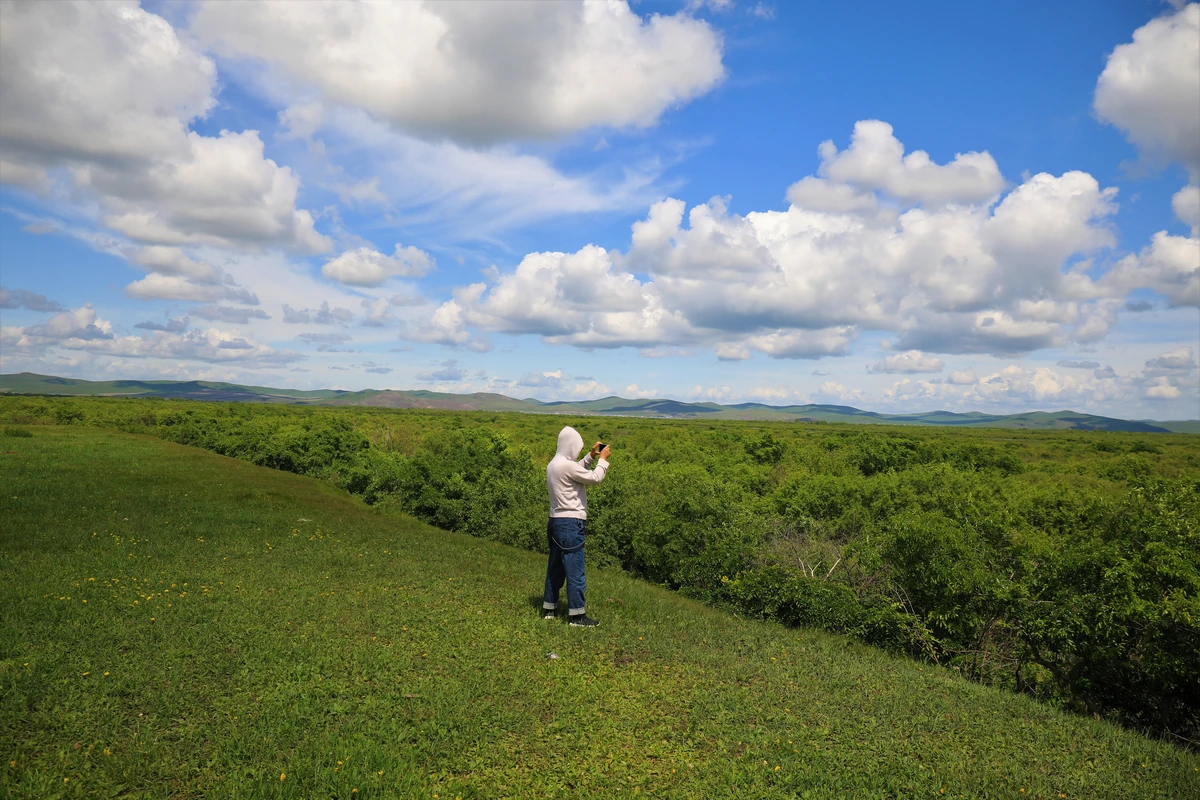
June 18th was the eighth day of our journey. The morning air was exceptionally fresh, with a slight breeze carrying a hint of coolness. After enjoying authentic strong milk tea (in Inner Mongolia) at the hotel breakfast buffet, we drove 'Big Black' from the southern highway entrance of Arongqi toward our destination of the day: Harbin. Along the way, after the previous days' heavy rain, the thick clouds had been dispersed by the winds. As the car sped on the expressway, the fields shifted in perspective. The vivid blue sky was adorned with clouds of indescribable layers transitioning from white to gray, stunningly beautiful. Once again, I marveled at the wonders of nature. After a five-hour drive, weaving through maze-like roads, we arrived at the Hampton by Hilton Harbin at 4:30 p.m. For dinner, we had authentic Harbin-style Guo Bao Rou (sweet and sour pork) and local Harbin draft beer, feeling delighted and content. We planned to stay here for three nights, allowing my wife to leave 'deep footprints' in this city.
Due to its high latitude, Harbin still has cool temperatures even in mid-June. Its four seasons are characterized by short, cool summers, transitional spring and autumn, and long, cold winters. Harbin is located at the confluence of the Nen River, Songhua River, and Heilong River, so it has abundant water systems, with June being the rainy season each year. This year, as the Xin Chou year following the Geng Zi year, rainfall is more abundant, frequent, and intense than usual. As a central city in Northeast China and Northeast Asia, Harbin's fertile black soil is home to 46 ethnic groups living in scattered settlements with local concentrations. It is rich in products, including about 30 species of amphibians and birds that are national first- or second-class protected animals; a wide variety of plant species, including over 11 medicinal plants like algae and moss; grasses such as small-leaf camphor (one of the 'Three Treasures of Northeast China') and fodder alkali grass; as well as oil, forestry, and mineral resources too numerous to list. According to the 2020 census, Harbin's population exceeds 10 million. As a Far Eastern economic and trade center, many foreigners from Russia, Japan, North Korea, Mongolia, South Korea, etc., converge here for business, tourism, study, exchange, work, and life. We experienced firsthand the playful and capricious rain of Harbin. After a sumptuous breakfast at the Hilton, the sky was gray and the air humid, with temperatures around 20°C. Although there was no drizzle, we decided to bring umbrellas for our outing just in case.
St. Sophia Church, as a landmark of Harbin, was originally built in 1907 as a Byzantine-style Orthodox church. It was rebuilt in 1923 and completed in November 1932 after nine years, becoming the largest Orthodox church in the Far East. The building is magnificent, elegant, and majestic. After nearly a century of wind, rain, and war, it remains intact and in use. The top of the main entrance is a bell tower with seven bronze bells cast from resonant copper, each corresponding to a musical note. When the skilled bell ringer strikes them with hands and feet, the rhythmic chimes resonate for a long time over Acheng (another name for Harbin), often heralding the white Christmas night! Now, St. Sophia Church is open to the public as the 'Harbin Architectural Art Museum.' It is both a unique, exotic cultural attraction in Harbin and an important witness to the history of Tsarist Russia's invasion of Northeast China and a vital artifact for studying modern Harbin history.
Central Street is a bustling commercial pedestrian street in Harbin. It starts at the Flood Control Monument on the Songhua River in the north and ends at Xinyang Square in the south, stretching about 1,400 meters. Built in 1900, it has a history of 120 years. In the early 20th century, during the darkest times for the Chinese nation, it was a place of joy for foreign powers. The 71 buildings of various styles along Central Street bear witness to all that history has brought. Central Street is a microcosm of Harbin's unique architecture and European-style life, often called 'Asia's First Street.'


