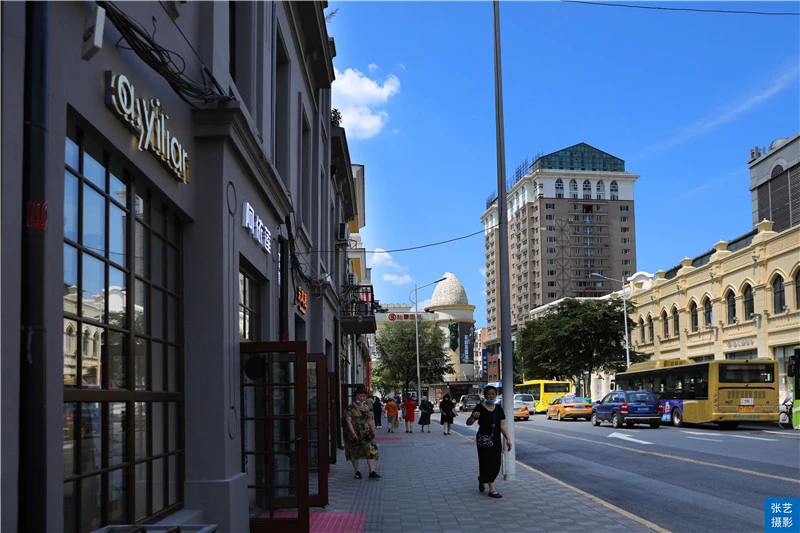
Harbin Has a Street Known as Asia's First: 71 European-Style Buildings, a Stone Road Paved with 'Gold'
I visited Harbin twice, in winter last November and in summer this June, experiencing a different Harbin in summer and winter! Every visitor to Harbin will instinctively feel that the city's overall planning and architecture are full of Russian flavor. This is because, in the early 20th century, Harbin had already become an international trading port, with over 160,000 expatriates from 33 countries gathering here, and 19 countries establishing consulates. At the same time, Chinese national capital also developed significantly, establishing Harbin's status as the economic center of Northern Manchuria and an international metropolis at that time.
It is reported that in April this year, temperatures in Harbin warmed up, with a maximum of 18°C. Citizens went outdoors to enjoy the spring sun with family and friends. Central Street also saw its first passenger traffic peak after the Qingming holiday, with daily visitors exceeding 300,000—truly a cause for celebration!
The History of Harbin Central Street
Formerly known as China Street, it was founded in 1900.
Everyone who goes to Harbin needs to take a walk on Central Street and gaze at the Songhua River.
Central Street is a bustling commercial pedestrian street in Harbin, Heilongjiang Province. Located in Daoli District, it starts from the Flood Control Memorial Tower Square on the riverbank in the north and ends at Xinyang Square in the south, stretching 1,400 meters. The street features 71 buildings in various architectural styles, including Renaissance and Baroque, where Eastern and Western cultures collide and merge, earning Central Street the title of "Asia's First Street."
According to historical records: The formation of Central Street dates back to 1898. That year, large-scale railway construction and urban development began in Harbin. The original riverside area was an ancient riverbed, a desolate low-lying meadow. Horse-drawn carts transporting railway materials opened a dirt road through the mud. The Chinese Eastern Railway Engineering Bureau then allocated the wasteland along the river to scattered Chinese residents in Harbin. By 1900, "China Street" was formed, meaning the street where Chinese people lived.
Stone Road Paved with 'Gold'
The two photos above were taken of the granite blocks paving Central Street. Each granite block is quite expensive. Don't the shapes and sizes of these stones resemble Russian-style small bread? Over the years, they have been trodden underfoot, worn for a century, polished smooth and shiny. It is said that back then, the price of one square stone was worth a silver dollar, which at the time could feed a poor person for a month. By today's standards, can we say that Central Street is a road paved with 'gold'? According to experts, these square stones on the road can last another 200 years.
In May 1924, Russian engineer Komtrashok designed and supervised the laying of square stones on Central Street. The paving stones were carved from granite, 18 cm long and 10 cm wide, and remain perfectly intact after a century.
I recall one night last November when I went to take photos on Central Street. It had just snowed heavily, with snow piles along the street. The bare trees made the street even colder. When I wanted to take pictures, my hands froze within two minutes of taking off my gloves, and my phone immediately lost power. After snapping two photos, I quickly put my hands back in the gloves. It's easy to imagine how tough the freezing outdoor Harbin can be.
In summer, walking on Central Street is the most comfortable state. I walked back and forth on this street many times without getting enough of it—enough of seeing the buildings and the passing crowd. It is said that a couple of years ago, this street would be filled with many Russian tourists weaving through the alleys, but due to the pandemic, almost no Russian tourists can be seen.
There Are 17 European-Style Old Mansions
A popular saying goes: "If you haven't been to Central Street, you haven't been to Harbin."
This is because Central Street is home to 77 European-style buildings, including 17 old European mansions built in the early last century. Their unique shapes, rich artistic atmosphere, and classical charm feature Renaissance, Baroque, Eclectic, and Modern styles from the 1920s.
Russian Cuisine Makes People Reluctant to Leave, Mouthwatering
I heard long ago that there are several Western restaurants in Harbin serving authentic Russian cuisine. So upon arriving at Central Street, I inquired about a few. The top-ranked one is definitely Huamei Western Restaurant, an old establishment founded in 1925. When I visited this restaurant, two girls came up to me and directly said, "Don't go to Huamei; their Western food is terrible. Go to the opposite Moderne Western Restaurant; their food is much better." Heeding their advice, I turned and went to Moderne Western Restaurant. But to my surprise, the Western food at Moderne was so bad I had never experienced anything like it! Later, I wondered if I had encountered a 'shill' for that restaurant.
Let me introduce the Moderne name, which has been famous since the early 20th century, and the Moderne cuisine that is widely known. However, to my astonishment, this Western restaurant is no longer what the internet promotes: "Here, cooking techniques are top-notch, a gathering place for renowned chefs. It has cultivated generation after generation of culinary masters, table-setting experts, and service talents." The current food quality and prices at Moderne Restaurant are hard for me to accept. Perhaps the skills have been lost or there is another reason? Honestly, this Russian cuisine experience was very disappointing!
Every out-of-town visitor buys souvenirs to take home. Smoked red sausage is the most famous in Harbin. If you want to buy red sausage, you have to consider going to Shangwei to buy it. The line at the door can reach hundreds of people. You usually have to queue up in the morning, and by afternoon, it's sold out. Qiulin Liudaosi and Ha Roulian's red sausages also have nearly a hundred years of history, so they are all excellent choices.
Besides Russian cuisine, you can also choose more common foods, such as grilled skewers—good value for money!
There Are Photo Spots Everywhere on the Street
The prosperity of Central Street surpasses many well-known commercial streets in the south, and it continues Harbin's traditions and flavors. Many tourists like to take photos here, especially against the European-style buildings. No matter where you shoot, you feel as if you are in a European city.
The end of Central Street is the Flood Control Memorial Tower, which connects to the Songhua River. So generally, a visit to Central Street also includes a view of the Songhua River.
Naturally, because it is so lively and transportation is convenient, various authentic local foods have chain stores here. Therefore, staying near Central Street during a trip and using it as a starting point to explore the surroundings is highly recommended.
Of course, the charm of Harbin Central Street goes far beyond this. In just three short days, you cannot fully explore everything, including the beautiful natural scenery of One Lake Three Islands, the bustling modern Central Street, the historically rich Old Daowai, and so on. In short, the exotic atmosphere is another charm of Harbin, and there are ten thousand reasons to fall in love with this place.


