This Winter, Head to Heilongjiang for a Romantic Ice and Snow Journey
Every winter, people always look forward to snowy weather. After a snowfall, the city, the streets, and everything seem more alive and romantic. But in recent years, living in Beijing, I haven’t seen a heavy snow for a long time. I was fortunate to participate in the “2022 Beautiful China Tour: Into the Extraordinary Ice and Snow of Heilongjiang” activity, embarking on a 6-day, 5-night creative journey through Harbin, Yabuli, Hengdaohezi, and Snow Village. I visited these cities that best represent the charm of Northeast China, deeply experiencing the rich ice and snow culture of the region. So, follow me and see what novel discoveries I made.
Romantic City — Harbin
Harbin, a national historical and cultural city, is the birthplace of “one country, two dynasties” — the Jin and Qing dynasties. The first capital of the Jin dynasty was located in Harbin’s Acheng District, and the founding ancestor of the Qing dynasty, Mengtemu, was born in Harbin’s Yilan County. The Jin source culture spread throughout Northeast China and then across the country. It is a hot tourist city and an international ice and snow cultural city, known as “Ice City,” “Oriental Moscow,” and “Oriental Little Paris.” This is a city with a long history and culture, and a city full of romance.
Walking along Central Street, you’ll see a dazzling array of goods neatly arranged in the storefronts. Although it’s cold outside, no one can resist eating a Modern ice cream here. This is not only a favorite commercial pedestrian street for locals but also a must-visit internet-famous street for tourists from all over. Central Street starts from the Flood Control Memorial Tower Square on the riverbank in the north and ends at Xinyang Square in the south. The 1,400-meter-long street was built in 1900, with a history of over one hundred years. The architectural style of the entire street is very representative, with 71 European-style and imitation European-style buildings, and 13 city-level protected buildings featuring Renaissance, Baroque, Eclecticism, and modern styles, making it a rare architectural art corridor in China. The pavement is made of granite square stones, shaped like small Russian bread. Walking on it, you can still feel the atmosphere of a hundred years ago.
There are many Russian goods here, from chocolates and red sausages to matryoshka dolls and tea sets, full of exotic charm. The most distinctive Russian-style western restaurants are also concentrated here. Huamei Western Restaurant, founded in 1925, is located here and is known as one of China’s four major western restaurants, along with Shanghai’s Yak Hong House, Beijing’s Maxim’s, and Tianjin’s Kiessling. At night, the lights of Central Street come on, and the neon signs of various shops light up the street, making it even more romantic.
Central Street, only 1,400 meters long, is like a microcosm of Harbin. Its unique architectural culture makes it distinctive, and its cuisine also reveals the European lifestyle that Harbin people are accustomed to. The title of “Asia’s First Street” is well-deserved.
Walking along the road towards the Songhua River, the towering Flood Control Memorial Tower comes into view. The memorial tower consists of a three-dimensional tower body and an attached cloister. It was built in 1958 to commemorate the people of Harbin City’s victory over the great flood of 1957, and it is a symbol of this heroic city. The tower is 22.5 meters high, and the base is built with block stones, symbolizing the firm and unbreakable embankment. The fountain in front of the tower base symbolizes the brave and wise people of Harbin, who tame the raging river into a steady stream, turning harm into benefit for the people.
On the top of the tower is a circular sculpture of workers, peasants, soldiers, and intellectuals; the lower part of the tower body is a group relief, symbolizing the indestructible strength of the people of Harbin in the 20th century, with solid embankments as firm as a rock, shaping the heroic image of defeating the flood. The lower step of the tower indicates an elevation of 119.72 meters, marking the highest water level when Harbin was submerged in the 1932 flood; the upper step indicates an elevation of 120.30 meters, marking the highest water level when the city’s people defeated the great flood in 1957. The Roman-style cloister is 7 meters high, harmonious and spectacular, with 20 columns standing in a circle, connected by a ring at the top, forming a 35-meter-long semicircular cloister.
Now the flood has receded, leaving behind the heroic deeds of the people of Harbin. Here, there are no more raging waves, only the leisurely figures and hearty laughter of people.
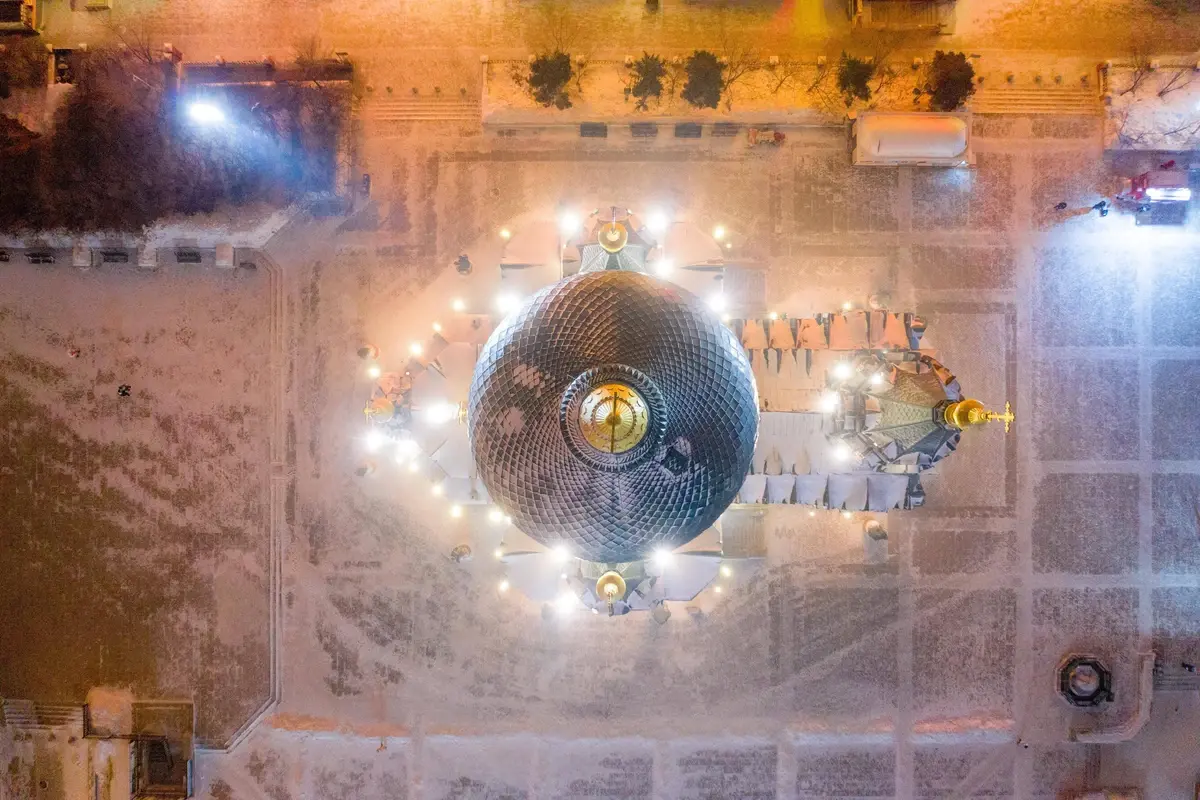
A Byzantine-style Eastern Orthodox church built in 1907, after a hundred years of wind and rain, still shines in the main urban area of Harbin. Saint Sophia Cathedral has become one of the most representative buildings in Harbin and a must-visit spot for everyone who comes here.
It is a courtyard-style building with a main building in the center featuring a large dome, made of red brick structure, majestic and spacious. The church is designed in a Latin cross layout from east to west, with the walls all made of clear red bricks, topped with a huge, full onion-shaped dome, commanding the different-sized tent-shaped roofs on the four wings, forming a master-slave layout with well-proportioned layers. The red bricks and green tiles are solemn and generous, and you can discover its different architectural beauty from various angles, especially when the lights are on at night, even more breathtaking in snowy weather.
When it comes to romantic atmosphere, Harbin goes all out. In the annual Sun Island Snow Expo, various large and small snow sculptures showcase Harbin’s romantic sentiments.
The Sun Island Snow Expo, which has been held for 34 consecutive years, is the birthplace and leader of national snow sculpture art, an important part of the Harbin Ice and Snow Festival, and the biggest highlight of Harbin’s ice and snow tourism. Due to its long exhibition period, high quality, new content, large scale, and strong fun, it is known as the “world’s largest ice and snow carnival.” The 34th Sun Island Snow Expo, with the theme “Winter Olympics Light, Dreamy Snow Expo,” features the main sculpture “Winter Olympics · Sun Island Journey” with the image of Bing Dwen Dwen, 100 meters long and 30 meters high, using 27,000 cubic meters of snow.
In addition, there are the Fortune Welcome Area, Olympic Competition Area, Snow Sculpture Expo Area, Snow Castle Commercial Area, Snow Play Area, and Interactive Area, as well as various colorful ice and snow entertainment activities such as Snow Adventure, Snowmobile, and Cross-Country Skiing. Next to Sun Island is the Harbin Polarland, where you can not only see adorable penguins, agile Arctic wolves, and chubby polar bears, but the most attractive is the “Heart of the Ocean” performance, completed by trainers and white whales Mila and Nikola, which can only be seen here.
If Sun Island is a large scenic area suitable for daytime viewing, then the Ice and Snow World is the most unmissable sight in Harbin’s winter night. Founded in 1999 by the Harbin Municipal Government of Heilongjiang Province to welcome the Millennium Celebration and the Shenzhou Century Tour, it is a large-scale ice and snow art masterpiece launched by leveraging Harbin’s ice and snow season advantages, showcasing the ice and snow culture and tourism charm of the northern city Harbin.
Every year, the theme of the Ice and Snow World attracts much attention from the outside world. This year is the 23rd Harbin Ice and Snow World, covering an area of 820,000 square meters, with a landscape construction area of 400,000 square meters, using 230,000 cubic meters of ice and snow, building 65 ice and snow landscapes, with over 100 individual landscape installations. With the theme “Winter Olympics Light, Shining on the World,” it integrates Winter Olympics elements on the basis of fully displaying Harbin’s ice and snow culture. From an aerial perspective, the huge five rings shine brightly, and each ice and snow landscape forms a magnificent scenery. Colorful and compact, it makes people feel as if they have arrived in a futuristic world, with a cyberpunk flavor.
Harbin can really be described as an internet-famous city. In addition to the famous scenic spots and ancient buildings mentioned earlier, the giant snowman in the Music Corridor at Qunli on the banks of the Songhua River has already become a hot spot. This big snowman is 18.5 meters high, 13 meters wide, about 9 meters thick, using more than 2,000 cubic meters of snow. It is currently one of the largest single snow sculptures in Harbin’s urban area this winter, with about 3,000 people coming to take photos every day. Using a drone perspective, looking from behind the snowman, the corridors on both sides seem like the snowman’s long arms, tightly embracing the highly romantic city of Harbin.
Entering Shangzhi, I Saw National Treasure Giant Pandas at Yabuli in Minus 24 Degrees Celsius
Yabuli, originally named Yabuloni, means “fruit garden” in Russian. What makes Yabuli famous is its ski resort. Yabuli Ski Resort is China’s first large-scale tourist ski resort that meets international standards. In 1996, it successfully hosted all the snow events of the 3rd Asian Winter Games. The total length of ski trails at Yabuli Ski Resort is 40 kilometers, the total length of aerial cable cars is 10,000 meters, the maximum vertical drop is 540 meters, and it has various skiing facilities such as freestyle and aerial ski jumps, cross-country trails, etc. Due to the snow depth at the foot of the mountain being 30-50 cm in winter, and about one meter thick on the mountain, the snow quality is excellent with moderate hardness. The annual snow season lasts 170 days, and the ski season can last up to 120 days, attracting a large number of ski enthusiasts every year.
Yabuli’s world’s first slide is located on Mount Sanguoguo at an altitude of 999.8 meters, extending along the mountainside for a total length of 2,680 meters, with a drop of 570 meters and a full 48 curves, making it the world’s longest.
Even if you’re not a ski enthusiast, you can still find different fun here. Take the high-speed mountain cable car from the foot to the top. The stable cabin and wide field of vision allow you to overlook the unique Northeast forest and snow fields, with sights like dwarf pines, stone seas, and rime. The cable car passes through the ski trails, and you can also watch skiers speeding on the slopes from above.
At the top, there are some observation platforms and wooden walkways built along the ski trails, where you can not only enjoy the snow scenery but also watch the skiers’ agile postures. The slide entrance is at the top, with a total length of 2,680 meters, a drop of 570 meters, and 48 curves. Here you can ride the “dry land sled” — the slide car — which runs on fixed tracks, going from the top to the bottom, with a maximum speed of 80 km/h, taking only 3 minutes. The slide cars come in single and double versions, allowing you to control the speed freely: push forward to accelerate, pull back to decelerate. Passing through this tunnel, you feel an unstoppable sense of impact, conquest, and achievement that transcends time and space.
The Most Northeastern Giant Pandas
Who would have thought that in the great Northeast of the motherland, in such severe cold weather, you could still see national treasure giant pandas? In the Yabuli Panda House, giant pandas Sijia and Youyou live there. On July 5, 2016, giant pandas “Youyou” and “Sijia” were transported from Sichuan to Yabuli Panda House to officially settle in. This is a beneficial attempt to have giant pandas live in the highest latitude, lowest temperature, and most northern region in China, after they have been in 12 countries and regions abroad and 32 provinces and cities domestically. I wonder if the pandas living here have already learned Northeastern dialect?
Snow Village: A Dreamy Ice and Snow World
Perhaps because the winter here is too cold, the falling snowflakes turn into clumps of cotton, tightly intertwined, covering everything with thick, white quilts. Under the quilts, the log-cabin-style peaked-roof houses evoke infinite imagination about this northern rural village.
Wreaths of smoke rise from the chimneys of every household with the rising sun. Tourists are still asleep, while the shopkeepers are preparing to set out baskets of frozen persimmons and frozen pears in front of the street. Approaching noon, the small village becomes livelier. Dog sledding is the most novel play for outsiders, and going to the observation deck to see the scenery is also a good choice. The wind echoing through the valleys, the laughter of tourists, the enthusiastic shouts of vendors, and the crunching sound of footsteps in the snow all together compose a concerto from this northern winter village. The sunset here always comes earlier than elsewhere, and the afterglow lingers only briefly. Interestingly, the main street between the residential houses on the east and west sides turns into a “morning-evening line” at sunset. When the big red lanterns light up, the small village truly becomes bustling. The warm yellow light from the log cabins contrasts perfectly with the pure white snow under the glow of the red lanterns. People overlook the dreamy night scene from high places, experience the phenomenon of splashing water turning into ice in front of the red lanterns, enjoy bonfire parties with lively music, and gather together to watch the blooming fireworks. The night is cold, the voices gradually fade, the bright moonlight once again covers the earth, and the glittering Big Dipper hangs in the sky. Everything in this small northern village returns to peace, sleeping together with the people in a dreamy ice and snow fairy tale world.
“No three sunny days in summer, snow all winter in the forest” is the most apt description of this place. Influenced by the frequent intersection of cold air from Lake Baikal and warm and humid air from the Sea of Japan, as well as the microclimate formed by tall mountains and dense forests, from October to April of the following year, this place experiences a long snowfall period, with snow depths often reaching over 2 meters. The large amount of snow and its sticky quality cause the snow to take on various shapes with objects, creating a dreamy ice and snow world like a fairy tale. It has a beautiful name: Snow Village.
Hengdaohezi: A Century-Old Town from the Movies
Hengdaohezi Town is a key passage from Mudanjiang to Harbin, named after the Hengdaohezi River. The name comes from an early road that crossed the river from north to south, hence “Hengdaohezi” (horizontal crossing river). Hengdaohezi is a century-old ancient town with a long history and Russian cultural heritage. It developed due to the construction of the Eastern Qing Railway (China Eastern Railway). After the China Eastern Railway opened in 1903, from the time of Russian management to the Japanese puppet period, it was always an important site for military and government offices. Some foreigners who came to China built villas and apartments here, opened factories and businesses, and at that time, merchants gathered, high-rise buildings stood, earning it the title “Garden Town.” Many historical relics remain, with precious historical value. The town still has 256 Russian-style buildings built between 1901 and 1905, including 5 national-level protected buildings and 104 city-level protected buildings.
Remember the classic thrilling chase scene shot in the rotating locomotive depot in the movie “Cliff Walkers”? In fact, the scene was not made in a studio or with special effects but actually exists. It is “Hengdaohezi” mentioned in the film. Hengdaohezi is a town under the jurisdiction of Hailin City, Heilongjiang Province, and this fan-shaped China Eastern Railway Locomotive Depot is located in Hengdaohezi Town.
The China Eastern Railway Locomotive Depot was built in 1903, with a history of over a hundred years. The entire building plan is fan-shaped, consisting of 15 garage doors arranged side by side. The locomotive depot was quite famous at the time, serving as the central station on the China Eastern Railway from Suifenhe in the east to Manzhouli in the west, and also the starting point for climbing the high ridge to the west and the only route to Harbin. Later, when steam locomotives were replaced by internal combustion engines, it ceased operation in 1990. In 2006, it was listed as a national-level cultural relic protection unit.
In the Year of the Tiger, See Tigers at Hengdaohezi Northeast Tiger Forest Park
In July 2007, Hengdaohezi Northeast Tiger Forest Park was awarded the title “China Tiger Town” by the State Forestry Administration. This shows the large number of Northeast tigers inhabiting, breeding, and being protected in Hengdaohezi.
Hengdaohezi Northeast Tiger Forest Park is located in Hengdaohezi Town, Hailin City, Mudanjiang. It is the largest breeding and mountain free-range base for Northeast tigers in Northeast China. The Northeast tiger is the largest extant carnivorous feline in terms of body weight, with a large and round head, several black horizontal stripes on the forehead often connected in the middle, resembling the Chinese character “王” (king), hence the titles “King of the Jungle” and “King of Beasts.” The ears are short and round, black on the back with a white spot in the center. Its coat is colorful, with a summer coat of yellowish brown and a winter coat of light yellow. The back and sides are light yellow, the belly is white, and there are multiple narrow black horizontal stripes on the back and sides, often two close together like willow leaves.
The Northeast Tiger Forest Park covers an area of 140,000 square meters. It was built and opened in 1998, conducting artificial breeding, rearing, and wild training for the endangered Northeast tiger. Since its opening, it has artificially bred over 1,000 purebred living Northeast tigers. It has successively built a fierce tiger viewing garden, a cub tiger garden, a lion garden, a bear garden, a deer garden, a liger viewing area, and other small animal viewing areas, as well as the largest Northeast tiger science education exhibition hall in China.
Majestic and tall Northeast tigers inhabit the park. Within the safety protection scope set by the park, people can observe the tigers up close and hear the deafening roars of tigers.
Having come this far, I’ve only seen a small part of Heilongjiang. This vast and resource-rich province boasts superior natural resources, profound human history, and a blend of cultures. Here, you can not only enjoy unique ice and snow scenes, but also appreciate ancient traditional skills, and taste authentic Northeast cuisine. What are you waiting for? Come with me to Heilongjiang to spend this romantic winter!


