Venturing into Northeast China (Part 4)
Taking a train from Shanhaiguan, crossing mountains and plains, our journey into Northeast China truly began. Although we traveled across three provinces in the Northeast and passed through countless towns of all sizes, we didn't even catch a glimpse of cities like Jinzhou, Shenyang, Siping, and Changchun, which are closely tied to the Liaoshen Campaign—a bit disappointing.
This special train was as slow as a snail and rather arrogant, constantly yielding to other trains along the way. It didn't let anyone off at stops, so we just whiled away the time playing cards, chatting, and sleeping. While waiting at a small station to enter Harbin, we started washing up as early as 3 a.m. and waited over four hours before finally exiting the train station.
The long wait was quite frustrating, but the sunny weather lifted our spirits. Finally seeing the sun today swept away the gloom in our hearts. In the early 1980s, the theme song of the TV documentary "Harbin's Summer" by CCTV spread across the country: "The Songhua River waves roll on, and happy songs fly from the spray..."
I had longed for Harbin for forty years, and today I finally arrived by the Songhua River, at Stalin Park. Leisure benches, stone railings, round streetlights, and artistic sculptures like "Piano Rhyme," "Three Youths," and "Swans Spreading Wings" are scattered among the greenery. It's an open park along the river, built along the southern bank of the Songhua River.
The park's landscaping has a European garden flair, with buildings rich in Russian classical style. Walking along the riverside boulevard feels like being in a foreign land. It's a great place for locals to relax and have fun. As the saying goes: "Dense trees shade from the scorching sun, and under them people sing and dance softly; the river breeze brings coolness, and by the shore anglers cast their lines, envying the fish."
Strolling and stopping, gazing into the distance, I saw the famous Sun Island Park across the river. A cable car spans the Songhua River, connecting downtown Harbin with Sun Island Park. Two bridges over the Songhua River echo each other—one like a dragon crossing the river, the other like a rainbow lying on the waves—both bearing witness to the history of Harbin's railway development.
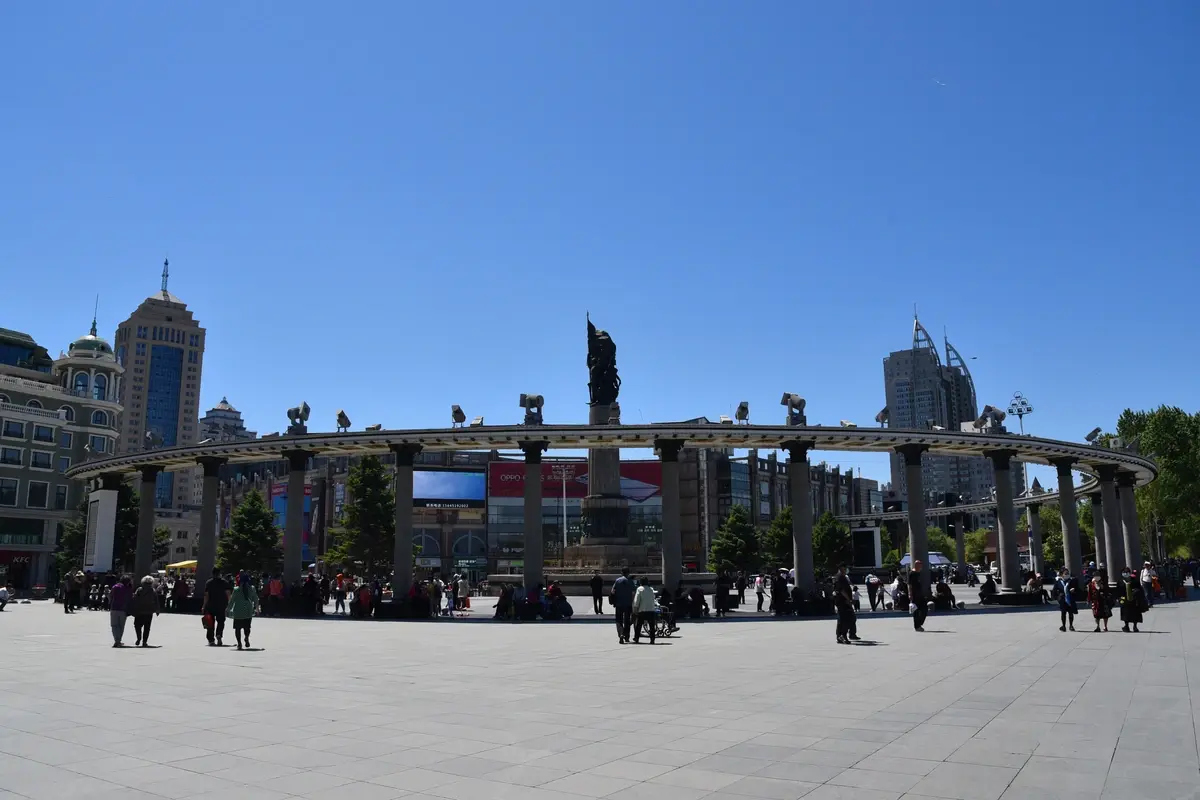
The Harbin Flood Control Victory Memorial Tower rises majestically into the clouds, impressive and grand. It consists of four parts: the base, tower body, fountain, corridor, and plaza, and is a landmark of the city. In the park, the city tree and city flower of Harbin are everywhere. As the saying goes: "Lush trees, elms in a sea of green; flowers blooming, lilacs fragrant."
We took a boat from Shunhang Pier to enjoy the scenery along the Songhua River, then dined at a riverside restaurant, tasting local Harbin cuisine. Every blade of grass, every tree, every lamp, every bench in Stalin Park, along with every uniquely shaped building, forms a long beautiful scroll spread along the Songhua River. Being here feels like traveling within a painting.
The shopping stops on this trip, though time-limited, allowed free entry and exit with no hard selling. But the stores had many tricks. In Shanhaiguan, they recommended local specialty deep-sea fish oil; in Harbin, Russian-made milk powder was limited to two bags per person. If you believed the guide, you'd end up buying overpriced items.
"Zhou Yu hit Huang Gai willingly"—one is willing to be conned. Talking about it now is like closing the barn door after the horse has bolted. I had visited the Chengdu Haichang Polar Ocean World before, and the similar Harbin Polarland, an amusement park with Arctic and Antarctic animals and shows. I watched a sea lion performance for a while but wasn't very interested, so I went outside for fresh air.
Zheng Xulan's song "On Sun Island" is known to nearly everyone from the 1950s and 1960s. Today, I was lucky to come here, and I improvised a parody: "On a bright summer day the sky is so clear, the beautiful Sun Island is so enchanting. With long-cherished longing and boundless imagination, we have come to Sun Island..."
"Sun Island is a place where you'll regret not going, but you'll definitely regret going. I suggest you take the electric cart for a quick tour," the guide said, which made us quite unhappy. We traveled all this way just to spend 20 yuan on an electric cart ride? The train was delayed over four hours, yet they cut our visiting time.
When we arrived at Sun Island Park, we saw a towering dark red landscape stone inscribed with the three characters "Sun Island" by Mr. Zhao Puchu. Ahead was the "Sun Gate," consisting of one large and four small elliptical arch doors linked together. The color was pure white, the design novel and unique, full of spatial depth and a sense of the times.
After crossing a long bridge, we took the scenic electric cart and toured Sun Island in a daze. The park had lush trees and green lawns, but where were the lilac garden and flower garden? The sky was clear, but there was no trace of Sun Lake, Sun Mountain, or Sun Waterfall. Occasionally, small flying insects bothered us, but we saw no deer park, squirrel garden, or swan lake animals.
We didn't even get to see the first scenic spot "Pavilion in the Clouds by the Water" and only made a brief stop at Bathing Sun Terrace. The reliefs on both sides of this Sun God Terrace tell the ancient myth of "Houyi Shooting the Suns." The central sculpture on the round terrace represents the current sun in the sky, while the nine surrounding pillars symbolize the nine suns shot down by Houyi.
Racing through Sun Island, I felt not regret but disappointment. St. Sophia Cathedral is a Byzantine-style Eastern Orthodox church, a landmark of Harbin and a testimony to the Russian invasion of Northeast China. The church has a Latin cross plan, complex exterior wall structures, and fine red brick masonry.
The entire cathedral is well-proportioned and exquisitely decorated. There are four doors at the bottom on the front, back, left, and right. The main entrance has a bell tower on top, with seven bronze bells corresponding to seven musical notes. The second floor has arched long-window walls, and around the top are various sizes of "tent roofs." The central protruding part is a sixteen-sided drum seat with arched long windows.
On top of the drum seat is a huge, plump Russian-style onion dome, giving an impression of soaring into the sky and rising upward. The golden cross, green main dome, small tent roofs, and red walls complement each other, making the church look elegant, majestic, and grand, full of exotic charm.
After a stroll around the cathedral square, we went to see indoor ice lanterns, each costing 200 yuan. Fellow travelers who participated later said they were ripped off. Central Street gathers architectural styles from the European Renaissance, Baroque, Eclecticism, and Art Nouveau, encompassing the essence of Western architecture, earning it the reputation of "a gallery of European architecture."
With a century-old cultural heritage, unique European flair, enduring legends, and dazzling night scenery, Central Street has become a must-visit for tourists. You can have a street artist draw your portrait, or buy a Modern ice cream bar. Walking along Central Street feels like traveling in Europe.
As we arrived at the Flood Control Memorial, we unexpectedly encountered the sunset. The lamps on the semi-circular colonnade looked like birds, and the afterglow of the setting sun added splendor to the heroes of the flood fight. Harbin under the night sky was charming. Walking toward the sunset, we reached the Songhua River, facing the water and the breeze. Looking into the distance, Sun Island on the opposite bank quietly waited for the sun to go home.
The setting sun was like blood, the water shimmering. The sunset clung to the river, and the river couldn't bear to part with it. The sunset over the Songhua River was extraordinarily magnificent. As the lights came on and night fell, this trip sparked many thoughts. I wrote a doggerel to sum it up: "The setting sun is infinitely beautiful, but it's near dusk. Farewell to Harbin, heading to Arctic Village. I'll stop here for today and continue another time."


