Heilongjiang Travel: A Half-Day Whistle-Stop Tour of Harbin (Photos)
The journalist's summer vacation trip to Northeast China successfully concluded visits to Yichun, Jiansanjiang, Tongjiang, Fuyuan, Hulin, and others, then began the return journey to Harbin from Mishan, which is under the jurisdiction of Jixi City. On July 10, 2023, at 07:45 Beijing time, Master Sun Lei drove us away from the hotel we were staying at and set off toward our destination.
Mishan street view (Photo by Feng Ganyong)
Along the way, while admiring the street scenes of buildings with signs bearing the words 'Jixi Mishan' outside the window, the journalist couldn't help but let his imagination wander. For Mishan, although it was the journalist's first visit, he had been to Jixi Xingkai Lake Airport twice before—in August 2016 and August 2018—when traveling to Qitaihe on business trips.
Photo taken at Jixi Xingkai Lake Airport (Photo by Jia Jianxin)
I remember the first time I flew from Jixi to Harbin. Although it was a small plane with only a few dozen people, the one-hour flight was quite pleasant. Moreover, I have been to Harbin many times. Thinking back carefully, my first visit to Harbin was in August 1979, a full 44 years ago. At that time, I even took a black-and-white photo standing in front of the Flood Control Memorial Tower. Now, as my Northeast vacation draws to a close, recalling some past memories related to the trip is rather fun...
Photo taken in Harbin in the 1970s (Photo by Guo Tianjie)
On the way back from Mishan to Harbin, the weather was very strange—sometimes it poured rain, and sometimes it cleared up. However, seeing that friends on WeChat Moments knew I was heading to Harbin, they told me it was raining heavily there. But we were lucky. After nearly eight hours on the road, at 15:30 that day, our group finally arrived in Harbin, which had cleared up after the rain.
Arriving in Harbin (Photo by Feng Ganyong)
Since we still had more than six hours until the train back to Beijing that evening, Master Sun Lei took our group on a whistle-stop tour of Harbin. Although I had been to this city countless times, the famous attractions like St. Sophia Cathedral, Stalin Riverside Park, the Flood Control Memorial Tower, and Central Street are always places I visit every time I come to Harbin. This time, we also made the same rounds as usual.
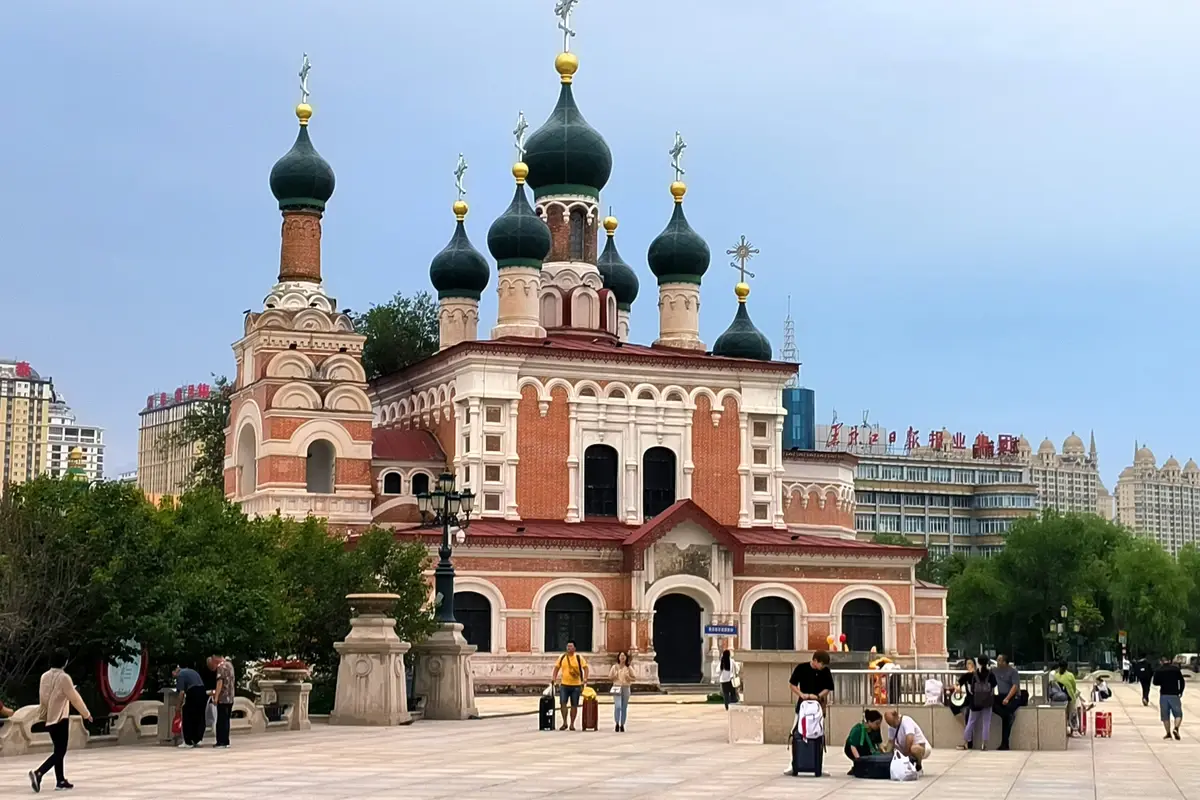
St. Sophia Cathedral (Photo by Feng Ganyong)
First, we visited St. Sophia Cathedral. Looking back at the history of the church, St. Sophia Cathedral was first built in March 1907 (the 33rd year of the Guangxu reign of the Qing Dynasty). It was originally a military chapel built for the Fourth Infantry Division of the Russian Eastern Siberian Army during the construction of the Chinese Eastern Railway. That same year, Russian tea merchant I. F. Chistyakov funded the construction of a new all-wood church based on the original military chapel. In 1911, a layer of brick wall was added to the outside of the wooden wall, forming a brick-and-wood structure.
Photo at St. Sophia Cathedral (Photo by Zhou Changman)
On September 27, 1923, St. Sophia Cathedral underwent a second reconstruction. It took nine years and was completed on November 25, 1932, becoming the largest Eastern Orthodox church in the Far East.
St. Sophia Cathedral plaque (Photo by Wang Jue)
In 1986, the Harbin Municipal People's Government listed it as a first-class protected building. In November 1996, it was listed as the fourth batch of national key cultural relics protection units.
Photo at St. Sophia Cathedral (Photo by Wang Jue)
From June 2, 1997, to September 2, 1997, the Harbin Municipal People's Government fully renovated the church according to the original design, expanded Sophia Square by 7,000 square meters, and established it as the Harbin Architectural Art Museum to promote and showcase Harbin's unique architectural culture.
A corner of Sophia Square (Photo by Feng Ganyong)
Entering Sophia Square and looking around, St. Sophia Cathedral still looks magnificent and exquisite. The church's floor plan is a Latin cross oriented east-west. The walls are all made of bare red bricks, topped with a huge plump onion-shaped dome, commanding four tent-shaped roofs of different sizes, forming a master-slave layout.
Side view of the cathedral (Photo by Feng Ganyong)
Stairs connect the four floors, with doors on the front, back, left, and right for entry and exit. Above the main entrance is a bell tower, with seven copper cast musical bells corresponding to seven notes. A trained bell ringer uses both hands and feet to ring the bells, producing a rhythmic and melodious sound.
Close-up photo at the cathedral (Photo by Liu Jun)
Today, after enduring wind and rain, St. Sophia Cathedral, with its rich exotic charm, has not only become a unique scenery of Harbin but also a historical witness and important relic of the Russian invasion of Northeast China.
Bridgehead of the Songhua River Bridge (Photo by Feng Ganyong)
After leaving St. Sophia Cathedral, our group drove to the banks of the Songhua River. After getting off the car, we first climbed the Harbin Songhua River Sightseeing Bridge, which stands along the river. It is not only the earliest railway bridge over the Songhua River but also the first cross-river bridge in Harbin. Standing on the bridge and looking around, the beautiful scenery of the Songhua River is fully visible.
Photo at Songhua River Bridge (Photo by Zhou Changman)
This bridge is located in the northwest of Harbin city, running north-south. Its southern end connects to Hetu Street in Daoli District, adjacent to the Riverside Park; its northern end connects to Qianjin Township in Daowai District, near the Sun Island Scenic Area. It is the first super-large road bridge built by Heilongjiang and Harbin using their own technical strength, connecting major highways from Harbin to Heihe, Luobei, Yichun, Manzhouli, etc., and is one of the important bridges in the highway network of Heilongjiang Province.
Overlooking the riverside scenery (Photo by Feng Ganyong)
This bridge can be said to have witnessed a period of Harbin's history. The bridge has 19 spans, a width of 7.2 meters, and a total length of about 1,015 meters. Due to the opening of the new Songhua River super-large bridge's regular speed line, this Songhua River railway bridge, which accompanied Harbin for 113 years, was retired and ceased operation in 2014. Although people will no longer see trains crossing the bridge, it has become a scenic spot in Harbin for people to admire.
Large Songhua River Fountain (Photo by Feng Ganyong)
Strolling along the riverbank, although the scenery of the Songhua River remains the same, seeing familiar sights on a different journey still brings a sense of excitement and familiarity.
Lake Geneva Fountain in Switzerland (Photo by Feng Ganyong)
In particular, seeing another large fountain by the Songhua River on this trip reminded me of the Jet d'Eau in Geneva, Switzerland. Although they are in Harbin, China, in Asia, and in Geneva, Switzerland, in Europe, they share a similar charm through different approaches.
Street architecture in Harbin (Photo by Feng Ganyong)
Walking along the riverside landscape belt, we arrived at Stalin Park. This is also one of the summer resorts on the banks of the Songhua River, facing Sun Island across the river. The park was built in 1953 and was originally named 'Riverside Park.' It was established to commemorate the people of Harbin overcoming two major floods.
Photo at Stalin Park (Photo by Feng Ganyong)
This is a linear open park built along the embankment and beside the water, with a total length of 1,750 meters and an area of 105,000 square meters. Centered on the Flood Control Memorial Tower, the park is famous for its imitation of Russian classical architectural styles, the 'five-color grass flower beds' scattered throughout, and 16 sets of artistic sculptures distributed in the green spaces, such as 'Swan Spreading Wings,' 'Three Youths,' 'Starting Step,' 'Diving,' and 'Sword Dance.'
Park crowded with visitors (Photo by Feng Ganyong)
Stalin Park incorporates European garden styles and enhances them with northern characteristics, resulting in an elegant, simple, and rough combination. It stands out among the many parks in the country with its unique style. The flower beds, statues, lawns, seats, round lights, railings, and Russian classical toy-like buildings in the park are novel and unique, forming a fairy-tale world.
Small scene in the park (Photo by Feng Ganyong)
In particular, Stalin Park presents beautiful scenery in both winter and summer. In summer, the park is green with grassy lawns, rows of tall trees provide shade for visitors, and colorful flowers bloom; on the broad and clear Songhua River, a gentle breeze blows, small boats glide leisurely; on the hot sandy beaches, colorful tents compete for beauty; in the river water, people playing and swimming laugh and chatter, lively and bustling.
Photo at Stalin Park (Photo by Liu Jun)
In winter, the park is covered in silver, with jade-like trees and branches, ice and snow wonders, tree rime, ice boats, and sleds delighting people's hearts. It is a great place for ice boating, sledding, skating, and winter swimming. Integrating sightseeing, shopping, and entertainment, the park features various artistic sculptures, the Great Art Corridor, the Sino-foreign Folk Trade Market, the Ice and Snow Sculpture Creation Area, the Northeast Wind Large Sculpture Group Area, and the Snow Painting Creation Garden, etc., which are grand in scale and echo the Snow Expo on the north bank. By taking the giant ice slide, one can slide directly from the embankment into the river scenic area.
First photo at the Memorial Tower in the 1970s (Photo by Guo Tianjie)
The central location of Stalin Park is the Flood Control Memorial Tower, one of Harbin's landmark buildings. This memorial tower is magnificent in appearance, and its architectural design is full of rich Russian style. Combined with its spacious location, it has become a popular spot for tourists to take photos.
Photo at Flood Control Memorial Tower (Photo by Zhou Changman)
The full name of the Flood Control Memorial Tower is the Harbin People's Flood Control Victory Memorial Tower. Behind it is the Songhua River. In the 1950s, in 1957, Harbin encountered a catastrophic flood. The city's people and stationed soldiers worked together to overcome the flood, and this tower was built in 1958 to commemorate it. The memorial tower is cylindrical, 22.5 meters high, and the tower body uses reliefs to depict the vivid scenes of overcoming the flood that year.
Close-up view of the memorial tower statue group (Photo by Feng Ganyong)
The whistle-stop tour of Harbin finally came to Central Street. Located in Daoli District, Harbin, it is 1,400 meters long, covers a total area of 94.05 hectares, and was first built in 1900. Known as the 'Little Paris of the East' and 'Eastern Moscow,' it is called 'Asia's First Street.'
Entering Central Street (Photo by Feng Ganyong)
Historical records show that in 1898, Harbin began large-scale railway construction and urban development. The original riverside area was an ancient river channel, full of meadows. Horse-drawn carriages transporting railway materials opened a dirt road in the mud, and the Chinese Eastern Railway Bureau allocated the riverside wasteland to Chinese people living scattered in Harbin. This was the prototype of Central Street. By 1900, it had formed the 'Chinese Street,' meaning the street where Chinese people lived.
Street sign on Central Street (Photo by Feng Ganyong)
In May 1924, designed and supervised by Russian engineer Komtrashok, Central Street was paved with square stones. The paving stones were made of carved granite, 18 cm long and 10 cm wide. In July 1928, the Chinese Street was officially renamed 'Central Street.' In 1997, it was designated as a pedestrian street by the Harbin Municipal Government.
Food check-in spot on Central Street (Photo by Wang Jue)
Central Street, not long after its inception, became a famous commercial street in Harbin. With many foreigners settling in for business, trade was unprecedentedly prosperous. The rapid economic development stimulated these merchants to engage in large-scale construction here. It is a microcosm of Harbin, where Harbin's unique architectural culture and the European lifestyle of Harbin people are distinctly reflected, and it is called 'Asia's First Street.'
Photo at the Modern Hotel (Photo by Zhou Changman)
Strolling along Central Street to admire the European architecture, the Modern Hotel (Maidel Hotel) stands out particularly. Especially the scene at the entrance, with a large horse pulling a wine barrel, attracts many visitors to take photos.
Main entrance of the Modern Hotel (Photo by Feng Ganyong)
In Harbin, the name 'Modern' (Maidel) is known to everyone. Like Churin, it is a historic brand full of exotic charm. The Modern Hotel was built later than the Churin Department Store, opening in 1906, and was one of the most luxurious multi-functional hotels among the hotel buildings in Harbin at that time.
Central Street scenery (Photo by Feng Ganyong)
As described in an advertisement in the 1931 Russian edition of the 'Harbin Guide': 'The Modern Hotel has the most luxurious ballroom and restaurant, and the most modern and comfortable guest rooms.' Merchants like to use foreign names for their shops, but the Modern Hotel is a true phonetic translation of a foreign word.
A corner of Central Street (Photo by Wang Jue)
The buildings on Central Street gather the most influential architectural schools in Western architectural history, including the Renaissance style from the 15th to 16th centuries, the Baroque style from the 17th century, the Eclecticism style from the 18th century, and the Art Nouveau style from the 19th century. These schools collectively encapsulate the century-old essence of Western architectural art.
Photo at Harbin Railway Station (Photo by Zhou Changman)
On July 10, 2023, at 18:30 Beijing time, after our group had the last dinner of this trip at the Dongfang Dumpling King on Central Street, Master Sun Lei took us to Harbin Railway Station, where we took the final photo of the Northeast vacation trip. Thus, the eight-day summer vacation trip to Northeast China came to a successful end. At the moment of parting, everyone sincerely thanked Master Sun Lei, who had taken good care of us and provided warm service throughout the journey, and also welcomed him to visit Beijing when he has the chance. (Text and photos by Feng Ganyong)


