Hulunbuir Grassland to Greater Khingan Range Loop Route: Summer Escape and Search for the North
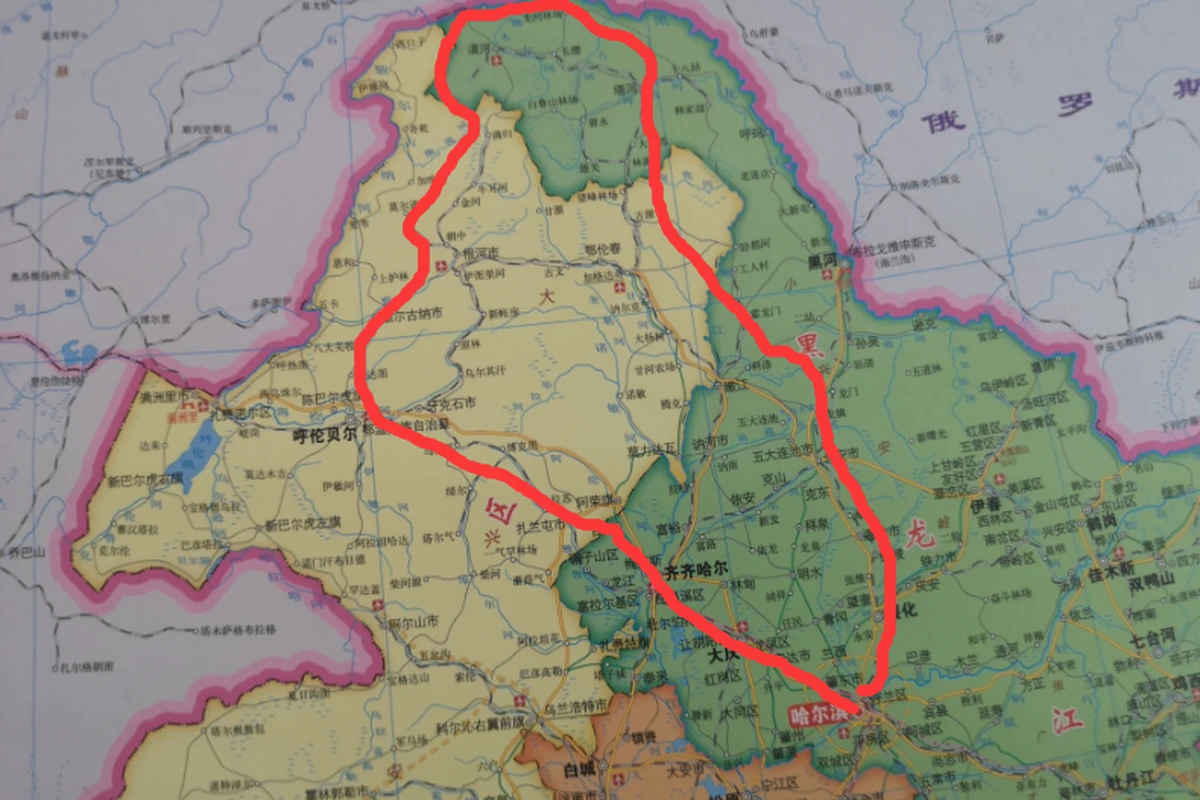
I'll take you, and you bring the money. Let's start the journey to find the North. Due to limited time, we didn't make it to Manzhouli, which is a pity. If time allowed, the usual route would be Arxan, Manzhouli, then to the northernmost point, heading southeast from there, passing through Heihe Port, Yichun, Hegang, then Jiamusi, and finally reaching Fuyuan. Checking off the northernmost and easternmost points of China.
The route we took this time is more of a small loop. The scenery along the way is beautiful, transitioning from grassland to forest. Personally, I feel that all ticketed attractions are a bit of a rip-off; the most beautiful scenery is all on the road: herds of cattle, sheep, and horses, the winding Morgole River, stopping by the roadside to pick wild blueberries from the Greater Khingan Range, and playing with squirrels. Essential items: car, money, a small folding table bought online, a portable stove, and gas canisters—eat wherever you go. On the first day, sleep well and eat well, then set off fully prepared.
Day 1: From Harbin to Qiqihar, passing through Zhalong Wetland. There you take a bus, then a boat, and watch the red-crowned cranes fly. Overall, it's decent, with large areas of reeds. Ticket price: 65 for the scenic area, 20 for the sightseeing bus, 50 for the boat, 70 for the speedboat. The price is a bit high; not great value. You can walk in without taking the boat, it's not far. The cranes there aren't afraid of people, but I've heard they might peck—though they won't if you don't provoke them.
A flock of red-crowned cranes taking off is quite a sight. But for some reason I can't upload videos, so I won't spoil it. You'll have to see for yourself.
In the evening, we had Northeast cuisine in Qiqihar and stayed there. Northeast food is very generous; portions are huge, served in big bowls, and not expensive. The table was full of pork, tofu, blood sausage, and vermicelli. The next day, after eating and drinking well, we stocked up on essentials like oil, salt, and rice, and headed towards the Hulunbuir Grassland. We drove straight into the grassland without stopping in Hailar. I don't drive at night, especially when road conditions are unknown. If you can drive at night, it's possible to reach Hailar on the first day.
The Suiman Expressway is in good condition, but there are many speed cameras along the way. Important thing repeated three times: The Xing'anling Service Area is the last gas station before Jinzhanghan; there are no gas stations within a 100-kilometer radius. Please fill up! Xing'anling Service Area is the last gas station before Jinzhanghan; no gas stations within 100 kilometers. Please fill up! Xing'anling Service Area is the last gas station before Jinzhanghan; no gas stations within 100 kilometers. Please fill up! The dining conditions at Xing'anling Service Area are passable; we took out our pots and pans to make lunch. The service area also sells a set meal for 35 yuan, called a buffet, but it's terrible. Still, it's enough to fill your stomach.
Big greedy cat Tangdouzi
After leaving the Xing'anling Service Area and exiting the highway, you basically enter the grassland. The roads are all dirt, with average conditions—be careful of scraping the bottom. Jinzhanghan Scenic Area is already very commercialized. Entrance fee: 20 yuan. Standard room: 780 yuan per night, with private bathroom. Our family stayed in a modified yurt, 600 yuan, with five beds. It seems you can share with other tourists: 120 yuan per bed. I saw many young ladies staying there. It's fairly reasonably priced. The scenic area provides breakfast for guests, but it's simple; eggs are unlimited. There is a bonfire square in the area; supposedly it costs 1200 yuan to light a bonfire—quite a rip-off. I didn't see anyone lighting one. The restaurant offers whole roasted lamb and lamb chops; a whole lamb is about 2000 yuan, lamb chops 380, other meat dishes around 80, vegetables around 40. It rained a bit on the road; after the rain cleared, we saw a long-lost rainbow over the grassland. In the scenic area, there is a huge Obo (cairn) in many colors, great for photos, perfect for young ladies to show off. Passing through the scenic area, you can walk to the bank of the Morgole River. The water is clear, the grass is green, and the sky is blue.
The elderly couple looked quite spirited in their photo.
Further ahead in the scenic area, there are places for gliding and horseback riding. There is also horseback riding inside the scenic area; 100 yuan for a spin—pretty expensive. I remember last year when we went to Ulanbutong, horseback riding was 50 yuan, and you could bargain. The glider costs 498 yuan for a flight, a few minutes. Poor little Fatty had just taken off when it started raining. The pilot worried about safety and turned back. After Fatty landed, the rain stopped. Fatty said from the plane you could see the winding Morgole River and many yurts. Well, as long as he was happy.
Day 3: The Jinzhanghan cafeteria opens at 7:30, not a minute earlier. After eating and drinking, we set off. Leaving Jinzhanghan, heading north, there are two spots where you can see the winding Morgole River, but both seem to charge. The first is a hill where cars can supposedly drive up; fee 20 per person. The second is about 20 kilometers north of Jinzhanghan, reachable by following the road; many cars stop there to take photos.
Entering no-signal mode. It's best to download the map to your phone in advance and enable offline navigation. Road conditions are average. Deep into the grassland, you see large herds of cattle, sheep, and horses, as well as animals blocking the road. Few vehicles. Control your speed; you might hit livestock crossing the road. If you hit one, you might not get out easily.
There are road construction sites along the way. Do not detour; there are no gas stations within 200 kilometers, and you don't know where a detour might lead. At construction sites, driving straight through the grassy mud pits next to the road is the correct method. Small cars should be cautious. Arrived at our first stop: Ergun Wetland.
Entrance fee 65, sightseeing bus 20. Feels like a huge rip-off. We thought the wetland would have grass and water where kids could play and see birds, getting close to small animals. But inside it's a commercial street with vendors, then the sightseeing bus takes you to a wetland museum, then to a viewing platform where you look at the wetland from afar and then are taken out. The whole thing takes half an hour. Doesn't feel worth the ticket. The experience wasn't great. We originally wanted to visit the Reindeer Tribe, but gave up due to rain. Along the way, there are large fields of rapeseed flowers, beautiful scenery—much nicer than the scenic area. The biggest rip-offs are at the attractions; the most beautiful is on the road.
In the afternoon, it started raining. I kept driving with my head down, while everyone in the back was fast asleep. Road conditions were terrible: big potholes, lots of water. Before departure, make sure your car is in good condition. No signal throughout the trip; if you break down, rescue can't find you. Arrived in Mangui in the evening. Passed through Jinhe Town along the way. If you don't want to go to Mangui, you can stay in Jinhe, but the accommodation conditions are average; Mangui is slightly better.
Genhe's big thermometer. Our little Fatty once took a photo at the Flaming Mountains in Xinjiang showing the highest surface temperature; this one shows the lowest, perfect match.
Mangui's entrance arch is quite grand: 'China Mangui'. Mangui has just one main street. Entering the town, you see a large statue of Genghis Khan. Across from the statue, there is a hotel which is one of the better ones in Mangui; accommodation is decent, price not too high, around 300 yuan. Along the street, there are many barbecue, hotpot, and Northeast cuisine restaurants. At the intersection near the fruit shop, there is a hotpot restaurant called Fumanlou or something; their lamb is good. Locals buy lamb there for hotpot: 38 yuan per jin (500g) of lamb slices, no gamey taste, delicious. We bought 4 jin, added some greens, fruits, wide vermicelli, tofu, tripe, and cooked in our room. Paired with local smoked meat and sausage, and had some drinks.
Day 4: Woke up. Comrade Lao Wu had already cooked porridge—a pot of rice porridge and a pot of millet porridge. With potato and egg pancakes bought locally by Comrade Lao Tian, we were very happy. After eating and drinking, we set off. We had entered the Greater Khingan Range forest area. Still no signal, offline mode. Today's target: Arctic Village. Important thing repeated three times: If you see a large number of parked cars along the way, be curious and stop to check—you won't regret it! If you see a large number of parked cars along the way, be curious and stop to check—you won't regret it! If you see a large number of parked cars along the way, be curious and stop to check—you won't regret it! The most beautiful is on the road. Various small reindeer tribes: 20 yuan per person, 10 yuan for a bucket of reindeer-favorite moss. Walking along a small wooden boardwalk, you see the domesticated reindeer. Reindeer are cunning: they only eat moss from the bucket; if it falls on the ground, they won't pick it up. The kids finally got to touch reindeer up close; they are very gentle and you can pet them. The northeastern girl at the tribe entrance spoke softly. The reindeer keeper inside was a long-haired young man who talked like a jerk; we ignored him—probably drunk early in the morning.
Little Tangdou picking mushrooms.
The northeastern girl at the tribe entrance told us that 50 meters outside the tribe there is a small river where you can wash the mud from the forest. Indeed a small river; our silly sweet girl played happily in the water. The water was very clear but very cold. Mosquitoes near the river were fierce, biting like crazy. I heard there are many wild reindeer in the forest, but you usually can't see them because wild reindeer are afraid of humans and run away when they see people from afar. There's everything in the forest; we even saw a wild boar charging across the road—very aggressive. Wherever there is parking along the road, there is usually something to do. This road runs along the Genhe River; there are a few places where you can go down and play in the water. Along the road, many locals on motorcycles pick wild blueberries in the forest, probably also picking mushrooms. Wild blueberries are everywhere and quite tasty. Buying from locals, it's about 13 yuan per jin; at the county market, it's over 20; by the time we reached Arctic Village, it was over 40 per jin, and they didn't look wild.
Greater Khingan Range pure wild blueberries
Fatty picked and ate at the same time—ate faster than he picked.
Wild blueberries look like this.
Arrived in Arctic Village. Booked the Suojin Hotel inside Arctic Village on Ctrip; it's said to be the best in Arctic Village. Room conditions are good, price not expensive. Excellent location: left out the door is Qixing Square, right is Commercial Street and the Northernmost Post Office. Most importantly, you can drive your car into the scenic area. Arctic Village has a South Route and a North Route. Before 8am and after 6:30pm, you can drive your own car around. The theme is all about 'North'—stones with 'North', houses with 'North', sentry posts with 'North', post office with 'North', even a utility pole marked 'Northernmost Utility Pole'. At noon, we had Northeast cuisine at a restaurant opposite our hotel; it was very affordable and tasty: 7 dishes for over 200 yuan—really a fair price in a scenic area. In the evening, we found a barbecue place with many customers; the meal cost over 500 yuan, a bit of a rip-off—I won't name it. The fresh blueberry juice sold at the Northernmost Post Office is delicious, made from wild blueberries, not farmed. The ice cream cones sold at the post office are also very good, very smooth. Across from the post office, there is a girl selling grilled cold noodles; she looks sweet, and the cold noodles are arranged in strips—different from what we usually eat. 10 yuan per serving.
In the evening, you can drive to the riverbank to play in the water and with stones. Across the river is Russia. If you want to sneak across, wait until dark and cross the river.
Day 5: Had breakfast at the hotel—pretty abundant. We visited the old town we missed yesterday. Then set off for Beihong Village, Wusuli Shoal, and Longjiang First Bay. This is basically the Mohe loop. Many guides exist online. Beihong Village is free and not much to see; it's the real northernmost village, full of farm stays—you can stay one night if interested. Longjiang First Bay requires taking the scenic shuttle bus; you have to climb stairs to the highest viewing platform. Lao Tian, Lao Wu, and Zhu Yangyang gave up halfway; I accompanied Little Fatty to the top for photos.
Along the way, we passed a birch forest; it used to be a paid attraction but now it's free and no longer maintained. Through the forest, there is a viewing platform with scenery similar to Longjiang First Bay. The birch forest is beautiful.
Usually local guides bring tourists here; outsiders can't find it. I took a photo of the boundary marker for you. Whether you find it or not, it's fate. This place should belong to Jiagadaqi (I'm guessing—don't rely on it).
We stayed overnight in Tahe County, at the Tahe County Hotel—a designated government reception hotel, basically three-star standard. Local shops close around 6pm. Behind the hotel, there is a Horqin beef and mutton shop with everything for hotpot: from lamb to seasonings. Bought ingredients and cooked in our room. Highly recommend the high-calcium thick slices—delicious.
Day 6: Left Tahe in the morning and headed straight for Wudalianchi. Along the way, we were in offline mode, lost in the Greater Khingan Range forest: various birches, pines, and forest paths. Headed straight to Wudalianchi Scenic Area. Wudalianchi Scenic Area and Wudalianchi city are two separate places, about 20 kilometers apart. The scenic area's facilities are quite developed. No need to stay in the city. Passing through Nenjiang, we found a wetland park and went in for a look—nice, and best of all, free. Saw many people fishing for fish and shrimp. There were many water birds on the water: wild ducks, egrets. That's all I can remember about birds.
Stepping in Nenjiang.
Fatty blew all the dandelions on the grass. So beautiful. He had never seen such fun things.
I don't know what it is, but it looks good. We stayed overnight at Wudalianchi Scenic Area. Many hotels; decent ones cost around 300 yuan per standard room. I booked a four-bedroom one-living-room homestay on the edge of the scenic area. The room was large, with seven beds—slept very comfortably.
Day 7: Slept in, then drove to Wudalianchi Scenic Area. The area is huge, with attractions like Laohai Mountain, South Spring, North Spring, Wenpo, etc. Lots of variety. There are also places for hot springs and mud baths, I'm told. But I didn't go. We checked out North Spring. It's said that Laohai Mountain is the most famous, but it requires a 3-hour hike; we decisively gave up. Actually, Wudalianchi is a volcanic landscape; you see black volcanic rocks everywhere. We didn't have high expectations going in, but since we were there, we had to see. The vast black rocks are quite spectacular, but not great for photos. There are helicopter rides in the scenic area; the cheapest is over 300 yuan—better value than the glider at Jinzhanghan. Everywhere you see locals carrying thermoses to fetch water. Little Fatty filled a bottle. I tasted it... Not for me. Spring water oxidizes to yellow after two hours (confirmed by Tian Xiaopang), so locals use thermoses to prevent oxidation.
Went to Wenpo for a look; this year the water is high, and the dock is flooded. Can't take a boat; need to walk in. Gave up, left, and headed straight for Harbin. Entered the city and stayed at a Lavande Hotel, then went straight to Sun Island Scenic Area. The area is huge and free. The internal tram costs 20 yuan per person; the famous cable car costs 80 yuan per person, with long lines full of young ladies. We decided not to bother. There are many squirrels in the area, not very afraid of people. Outside the island, there is a swan goose breeding farm. I wonder if they taste good.
Sun Island is large; it would take half a day to explore. We were hungry and found a Korean barbecue restaurant called Benwang Family. Had a big meal; good taste. Prices similar to Hannashan, but seems a bit more refined.
We were so hungry we wolfed it down without taking photos. I'll paste a few from Baidu for you to imagine.
After eating, we went to the Cathedral to check in. Successfully met with the famous senior tour group leader, Comrade Shi. Then strolled along Central Street, ate many Madiel ice creams. Personally, I think the hazelnut flavor is the best.
Days 8 and 9: All spent eating and wandering in Harbin. There are actually many things to do in Harbin. The Ice and Snow World only has an indoor pavilion open in summer. Yesterday, I read Little Fatty's composition about this trip: 'At the Harbin Ice and Snow World, my family members froze like dogs, but I was sweating like crazy inside.'
The two kids played inside until almost 2pm before we dragged them out and headed straight for Poseidon.
We arrived too late in the afternoon, so only saw the underwater world. Actually, you can spend a whole day at Poseidon; the water world there is super crowded. The next day, after waking up, we packed and went to Wanda to kill time. Wanda has been renamed Sunac Mao, with everything for eating, drinking, and fun. There's a 'Fly Over Longjiang' show—a large dome screen, similar to Disney's Soaring Over the Horizon. 35 yuan per person, pretty good. It covers all famous scenic spots in Heilongjiang. After eating and drinking, we ended the trip. That's the end of the travel notes. After this journey, the most beautiful is all on the road. No need to rush to attractions. Relax and slow down. While we can still travel, while we have the mood: I'll take you, you bring the money. Let's go.


