Travel Notes on Mount Jiuhua
Mount Jiuhua Scenic Area mainly consists of 5 parts.
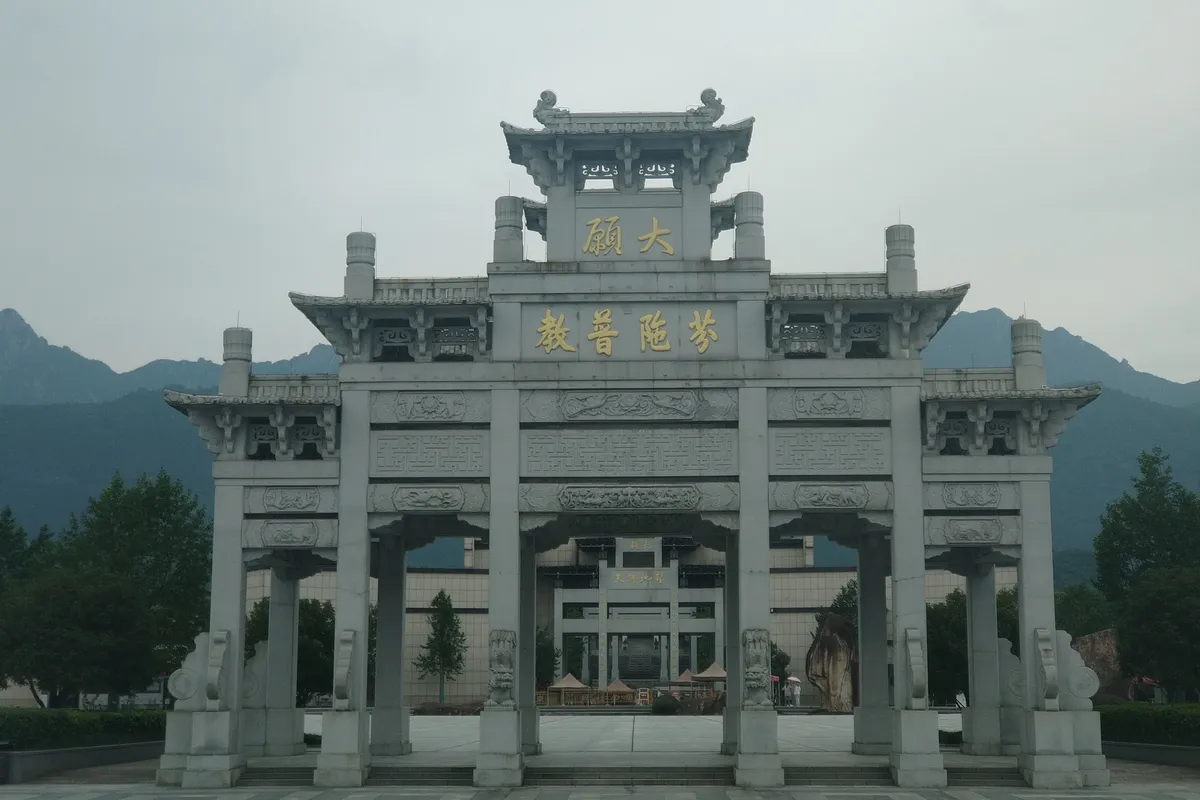
Dayuan Cultural Park: Located at the foot of Mount Jiuhua, about 500m from the Jiuhua Mountain Tourist Service Center (Kecun), reachable on foot. Main attractions: the 99-meter outdoor bronze statue of Ksitigarbha Bodhisattva and the Hongyuan Hall.
Jiuhua Street Scenic Area: Jiuhua Street is like a lively small town. It offers convenient amenities with many supermarkets, hotels, inns, and guesthouses. Temples are clustered here, including most of the famous temples on Mount Jiuhua. The cable car station for Baishui Palace is also on Jiuhua Street. From the tourist service center at the foot of the mountain, take the internal shuttle bus to Yingxian Bridge and alight. Jiuhua Street is a must-visit and essential stop for any trip to Mount Jiuhua.
Minyuan Scenic Area: This area basically covers the lower sections of Tiantai and Huatai scenic areas. From Huxingshan Station on Jiuhua Street, take the internal shuttle bus to Fenghuang Song Station and then hike. Main attractions: the millennium-old Phoenix Pine (the oldest pine under heaven), the Minyuan Nunnery Cluster, Longxi Stream (Jiuhua Stream) beside the nunnery cluster, Minyuan folk houses, and Minyuan bamboo sea.
Tiantai Scenic Area: From Huxingshan Station on Jiuhua Street, take the internal shuttle bus to Fenghuang Song Station, where the Tiantai cable car is located. Alternatively, hike from Fenghuang Song Station to the summit of Tiantai. This scenic area is a must-visit. Main attractions: Tiantai Summit at 1,306m, Tiantai Temple on Tiantai Peak, the highest peak of Mount Jiuhua at 1,342m (Shiwang Peak), the Ksitigarbha Bodhisattva site: Ancient Baijing Terrace, and the millennium-old Phoenix Pine.
Huatai Scenic Area: From the tourist service center, take the internal shuttle bus to the Huatai cable car station, where you can take the cable car up and down. Alternatively, hike from Tiantai area to Huatai, or from Minyuan area upward. Huatai is renowned for its natural scenery of peaks, strange rocks, and high-altitude plank road views.
Chizhou High-speed Rail Station has direct buses to Mount Jiuhua, costing 50 yuan. This includes two parts: round-trip bus from the station to Kecun Tourist Center (about 1 hour), and scenic area sightseeing bus tickets (from tourist center to Jiuhua Street up/down, round-trip to Huatai cable car, and internal transport on Jiuhua Street). If you buy tickets at Kecun Tourist Center on your own, it's also 50 yuan, but it doesn't include the round-trip bus from the high-speed rail station to Kecun.
First-time visitors to Mount Jiuhua can start with Dayuan Cultural Park, about 500m from Kecun Tourist Center. The park's centerpiece is the 99-meter Ksitigarbha statue. The park is free to enter, but the Hongyuan Hall inside charges a separate fee. Hongyuan Hall is like a museum, covering five aspects: (1) Buddhism's eastward transmission; (2) Life of Ksitigarbha and origin of the Mount Jiuhua sacred site; (3) Calligraphy and writings of ancient worthies about Mount Jiuhua; (4) Introduction to Mount Jiuhua Buddhist culture: famous temples, flesh body Bodhisattvas, Buddhist customs, etc., relevant to pilgrims; (5) Introduction to Dayuan Cultural Park.
Then take the scenic area bus up to Jiuhua Street, where there are many lodgings, with guesthouses around 150 yuan.
From Jiuhua Street, take the scenic bus to Minyuan Fenghuang Song Station, then hike up to Tiantai, or take the cable car if preferred. Minyuan Scenic Area has over 20 nunneries with distinctive architecture, and the Phoenix Pine, known as the "Finest Pine Under Heaven."
Important temples along the way:
(1) Huiju Temple: Originally Huijing Nunnery, built in the Qing Dynasty and expanded. In 1938, renovations were funded and renamed Huiju Chan Temple. The Buddha statues inside are made of dry lacquer and ramie, beautifully shaped and lifelike.
(2) Tianqiao Chan Temple (Diaoqiao Temple, Banshan Temple): Originally Cuiyun Nunnery, built on a sky bridge over a sheer cliff, offering the best views of the sea of clouds on Mount Jiuhua.
(3) Guanyin Peak: Originally Yuanrong Nunnery, above Diaoqiao Temple and below Baijing Terrace, like a celestial platform. The temple was built on the peak, so the peak name replaced the temple name. From the west hall window, a strange rock resembles a Guanyin statue, hence the name.
(4) Ancient Baijing Terrace: Legend says Jin Dizang (Ksitigarbha) recited the Avatamsaka Sutra here. Monks built a temple in memory, named Dayuan Nunnery. It's commonly called Ancient Baijing Terrace. Inside is a rectangular rock with footprints, said to be where Jin Dizang knelt while reciting sutras, leaving footprints known as "Ksitigarbha's True Footprints."
(5) Tiantai Temple: Also known as Dizang Temple, at the summit of Tiantai Peak (1,306m), the highest temple on Mount Jiuhua. It is said that Ksitigarbha once meditated here, leaving the "Golden Immortal Cave." It is a must-visit for pilgrims; a saying goes: "If you haven't been to Tiantai, your trip is in vain." Tiantai Peak ranks second after Shiwang Peak and Qixian Peak among the 99 peaks of Mount Jiuhua.
Opposite Tiantai Temple is Shiwang Peak, the highest peak at 1,344.4m.
Tiantai Peak offers picturesque scenery.
From Tiantai Peak, head north toward Huatai Scenic Area, the most beautiful part of Mount Jiuhua. On the way, there is a fork leading to Ancient Buddha Cave, recommended to visit. Entering requires passing through a bottomless cave; narrow sections require sideways movement, not suitable for large people. Before Ancient Buddha Cave, there is a path to Dabei Hall and Taiji Cave, but it's not recommended due to rough terrain.
After visiting Ancient Buddha Cave, you can return the same way or take a fork near the cave to join the main road at Xiangxing Rock. After rejoining, there is an eastward fork to Liantai Peak, recommended for visitors. Liantai Peak is 1,218m high, with five large rocks stacked into a peak, forming an airy cave with four entrances. The cave is warm in winter and cool in summer, an ideal meditation spot. The latter part of Liantai Peak is steep; climbers must be careful.
3. Great Huatai and Huatai Plank Road
After returning from Liantai Peak, continue down through the Dreamlike Stone Valley (various strange rocks), then up a slope (V-shaped: down to the valley then up). There is a west fork leading to Small Huatai. The author, needing to go down to Lower Minyuan and back to Jiuhua Street, skipped Small Huatai and headed directly to Great Huatai. Continuing upward, there is a fork: left is a new wooden plank road leading directly to Huatai cable car, relatively flat with many sights; right is a mountain path also ending at the cable car but passing through Great Huatai, mostly uphill. The author took the right path to Great Huatai, but weather turned bad with dark clouds.
Then descend to the Huatai cable car station, and return along the new wooden plank road, enjoying beautiful scenery.
After returning via the plank road, go to the earlier fork for Small Huatai. Small Huatai, originally Huixian Peak, is 1,006m high. The peak has stone pillars and "stone people" standing as if immortals gathering. Legend says Taoist Zhao Zhiwei led disciples here for a Mid-Autumn moon-viewing and feasted immortals. Poet Chen Yan of the late Southern Song wrote a poem about it.
Then continue down to Lower Minyuan, about 2 hours. Along the way, you pass Wenshu Ancient Cave, where a temple once stood but is now demolished. From Lower Minyuan, cross Mingong Bridge to reach the Fenghuang Song bus parking lot, passing through Minyuan Bamboo Sea on an easy path. Alternatively, walk along Longxi Stream (Jiuhua Stream) upstream, but this path is overgrown and passes Longxi Waterfall Group and rock formations; the waterfalls are small and the path is rough, so it's not recommended.
Jiuhua Street Scenic Area is the core of Mount Jiuhua, housing the most important temples (except Tiantai Temple and Ancient Baijing Terrace) and all six flesh body Bodhisattvas. Most temples are along Jiuhua Street, with some on the hills. Famous temples along the street: Qiyuan Chan Temple, Mingong Chan Temple, Tonghui Chanlin, Zhantanlin, Huacheng Temple, Dizang Chan Temple and Yuebao Hall, Shangchan Hall. Hill temples: Guanyin Cave, Tiger Cave, Baishui Palace, Dongya Chan Temple, Huixiang Pavilion, Wanfo Pagoda, Small Tiantai, Yuanjue Hermitage. The six flesh body Bodhisattvas: (1) Jin Dizang, Yuebao Hall (only worship the sealed pagoda); (2) Master Wuxia, Baishui Palace; (3) Master Ciming, Yuebao Hall Dizang Chan Temple; (4) Master Mingjing, Zhantanlin; (5) Bhiksuni Renyi, Tonghui Chanlin; (6) Bhiksuni Yuankong, Yuanjue Hermitage (near Small Tiantai).
Beside Qiyuan Chan Temple, a road leads up to Baishui Palace (also accessible by cable car). Along the way, a fork leads to Xitian Temple, Wanfu Temple, Dayuan Slope, then to Guanyin Cave and Tiger Cave (both temples). Guanyin Cave is recommended for its excellent views and open space, with twelve zodiac animal heads, giving a transcendent feeling. However, you must return the same way to Dayuan Slope, then from there to Motian Pavilion, and via a dirt path to Baishui Palace (refer to Baidu or Gaode maps).
Baishui Palace is a national key Buddhist temple, originally Zhaixing Nunnery, also known as Wannian Chan Temple, on Chaxiao Peak at 871m. Built in the Ming Dynasty, it is the second flesh body hall on Mount Jiuhua, housing the body of Master Wuxia, who died at 124. The name was changed to Baishui Palace in his honor. In 1626, Emperor Ming Sizong bestowed the title "Yingshen Bodhisattva" and gave an inscription. The gate of Baishui Palace has a plaque with calligraphy by President Li Yuanhong. Inside is a 500-Arhat Hall, unique among the four great Buddhist mountains.
3. Dongya Chan Temple
From Baishui Palace, go south, passing Feilai Guanyin Hall and Natural Sleeping Buddha Viewing Platform, to reach Dongya Chan Temple. It is one of the "Four Great Chan Forests" along with Baishui Palace, Qiyuan Chan Temple, and Ganlu Temple. The temple is built on a huge rock; east of the cliff is an ancient cave with cloud-like snow at the entrance, named "Duiyun Cave," where Jin Dizang lived upon arrival. Above the cave is Dongyan, a square rock where Jin Dizang often chanted and meditated, called "Yanzuo Rock." Dongya Chan Temple offers a panoramic view of the Buddhist kingdom: close views of Minyuan Bamboo Sea, Minyuan Nunnery, Jiuhua Street; distant views of Tiantai Temple and the Natural Sleeping Buddha.
3. Huixiang Pavilion and Wanfo Pagoda
Continue south to Huixiang Pavilion and Wanfo Pagoda. Huixiang Pavilion, originally Huayan Nunnery, later Huayan Chan Temple, on Huayan Ridge at the south end of Dongyan. There is a path from Huayan Ridge to Minyuan. It was a must-pass for pilgrims heading to Tiantai, who often burned incense on return, hence the name. Nearby is Wanfo Pagoda, made entirely of fine copper without wood, nine stories visible, the largest copper pagoda in China. Inside are 10,000 "Medicine Buddha" statues. Beside Huixiang Pavilion is a 13m tall welcoming pine with a 2m girth, known as the Mount Jiuhua Welcoming Pine.
Huixiang Pavilion is a four-way intersection: one road leads south to Minyuan and then to Tiantai; one leads north to Jiuhua Street Tonghui Chanlin; one leads west to Yuebao Hall and Small Tiantai. Choose the west path to Small Tiantai first. Near Small Tiantai (northeast side) is Yuanjue Hermitage, housing the body of Bhiksuni Yuankong, the second bhiksuni flesh body on Mount Jiuhua. Self-driving or taking scenic transport, you can go directly to Small Tiantai.
After returning from Small Tiantai, head to Yuebao Hall. At Chabei Pavilion, two paths: one to Shangchan Hall, one to Yuebao Hall.
Shangchan Hall, originally Jingde Hall, at mid-mountain of Shenguangling, built in Ming Dynasty, existing halls are late Qing Hui-style architecture. Ancients said Shangchan Hall had three "mosts": "the poorest incense in Jiuhua, the best scenery, and the most beautiful courtyards." Its backyard has Guanyin Pavilion, housing the only dripping-water Guanyin statue on Jiuhua, with a spring called Jinsha Spring, clear and with golden sand. Beside the spring is a money tree, one of the three treasures of Jiuhua (money tree, giant salamander, dingdong bird).
Tips: Why "three mosts":
(1) Poorest incense: pilgrims usually burn incense at Flesh Body Hall, passing by Shangchan Hall quickly. Now incense is abundant too.
(2) Best scenery: Wang Wenxi of Qianlong era gave a plaque "Xiucheng Yunlin," praising the surroundings with clouds, trees, streams, and ancient trees.
(3) Most beautiful courtyards: unique architecture and solemn statues. The gate is twisted to ward off evil, with a skylight between halls, creatively designed. The main hall has Sakyamuni, Guanyin, Ksitigarbha, and 18 Arhats, vivid and golden. TV series Journey to the West episode 19 was filmed here.
6. Yuebao Hall and Dizang Chan Temple
Yuebao Hall is where Ksitigarbha preached and where his flesh body is buried (only worship the sealed pagoda). It is also called "Sacred Place of Sutra Preaching." It is a national key Buddhist temple, with a plaque "Southeast First Mountain" by Emperor Qianlong. Below, Dizang Chan Temple houses the body of Master Ciming (known for lifting 800 jin).
7. Zhantanlin
From Yuebao Hall down to Jiuhua Street, along the street is Zhantanlin, also called Zhantan Chanlin (zhantan is a precious tree). Built in Kangxi period, rebuilt in Guangxu period. The carvings on brackets and window lattices depict stories from Journey to the West and Buddhist scriptures, exquisite and vivid. Zhantanlin consists of three main halls: Great Compassion Hall, Huayan Hall, and Great Vow Hall. The main hall is Great Mercy Hall, left is Great Compassion Hall, right is Great Vow Hall. It is suggested to start from the left Great Compassion Hall, then Great Mercy Hall, Great Vow Hall, and finally pay respects to the body of Master Mingjing (standing monk with extraordinary meditation power).
8. Tonghui Chanlin
Built in early Qing, one of the east-side rooms of Huacheng Temple. In 1988, abbot Bhiksuni Renyi renovated it, reviving the site. Tonghui Chanlin houses the world's first bhiksuni flesh body, Renyi. The south and rear halls are still called Tonghui Nunnery.
Qiyuan Temple, originally Qishu Nunnery, also Qiyuan Chan Temple. Built in Ming Dynasty, existing buildings from Qing. It is the largest temple complex on Mount Jiuhua, the only palace-style temple. It is one of the Four Great Chan Forests along with Ganlu Temple, Baishui Palace, and Dongyan Chan Temple. It is named after Jetavana (where Sakyamuni lived).
10. Huacheng Temple
Huacheng Temple is the earliest temple on Mount Jiuhua, the head temple and general monastery, the oldest and the sacred site of Ksitigarbha. It was first a hut by monk Beidu in Eastern Jin, then rebuilt in Tang Dynasty and named Huacheng. The name originates from the Lotus Sutra story: Sakyamuni pointed to a city to help a novice monk continue his journey. In 1981, it was renovated and became the Mount Jiuhua Historical Museum, displaying some artifacts, some of which are also shown in Dayuan Cultural Park's Hongyuan Hall (e.g., imperial edicts of Kangxi and Qianlong).
On the way up from the tourist center to Jiuhua Street, at half-mountain on the north road under Dingxin Rock, there is a temple called Ganlu Temple. It is one of the Four Great Forests. Originally Ganlu Nunnery, also Ganlu Chanlin. Legend: before construction, dew hung on tree tops, so named Ganlu (Sweet Dew). Now it houses the Mount Jiuhua Buddhist Academy. Self-driving visitors can visit.
Itinerary:
- Jiuhua Street along: Qiyuan Temple—Mingong Temple—Tonghui Chanlin—Zhantanlin—Yuebao Hall—Shangchan Hall—Huacheng Temple
- One-day tour (Grand Loop): (Guanyin Cave)—(Tiger Cave)—Baishui Palace—Dongya Chan Temple—Huixiang Pavilion, Wanfo Pagoda—Small Tiantai, Yuanjue Hermitage—Shangchan Hall—Yuebao Hall—Huacheng Temple—Zhantanlin—Tonghui Chanlin—Mingong Temple—Qiyuan Temple
(1) It is recommended to start from the path beside Qiyuan Temple up to Baishui Palace, then descend all the way. Baishui Palace is also accessible by cable car.
(2) This Grand Loop covers all main temples of Jiuhua Street.
(3) Those with energy can visit Guanyin Cave and Tiger Cave, especially Guanyin Cave.
(4) A reverse direction is also feasible for better time management.
- Day 1: Same as above.
- Day 2 (Scenery): Fenghuang Song—Tiantai cable car up—Ancient Baijing Terrace—(Shiwang Peak)—Tiantai Temple—Ganlu Pavilion—(Ancient Buddha Cave)—Xiangxing Rock—(Liantai Peak)—Dreamlike Stone Valley—(Small Huatai)—Huatai High-altitude Plank Road—Huatai Cable Car Upper Station—Great Huatai—Huatai High-altitude Plank Road—Huatai Cable Car Upper Station—Huatai cable car down.
(1) Items in parentheses are branch routes. Shiwang Peak, Liantai Peak, Small Huatai require backtracking; Ancient Buddha Cave branch can rejoin the main road.
(2) Huatai Plank Road to Huatai cable car forms a loop: one side plank road, one side mountain path, both scenic. It is suggested to take the plank road to the cable car station, then take the mountain path via Great Huatai back to the plank road, then return to the cable car station for descent.
(3) The narrow Huatai Scenic Area (the loop of plank road and cable car) is free.
- Day 2 (Pilgrimage): Fenghuang Song—Huiju Temple—Tianqiao Temple—Guanyin Peak—Ancient Baijing Terrace—Shiwang Peak—Tiantai—return same way or cable car down.
- Day 2 (Hiking): Fenghuang Song—Huiju Temple—Tianqiao Temple—Guanyin Peak—Ancient Baijing Terrace—Shiwang Peak—Tiantai Temple—Ganlu Pavilion—Ancient Buddha Cave—Xiangxing Rock—Liantai Peak—Dreamlike Stone Valley—Huatai High-altitude Plank Road—Huatai Cable Car Upper Station—Great Huatai—Huatai Cable Car Upper Station—Huatai High-altitude Plank Road—Small Huatai—Wenshu Ancient Courtyard—Lower Minyuan—Fenghuang Song.
(1) The section from Small Huatai to Lower Minyuan is difficult; the entire hike is like climbing Tiantai three times in one day.
(2) If starting in the morning from Huatai cable car, it's most convenient with the following route:
Huatai cable car up—Great Huatai—Huatai High-altitude Plank Road—Huatai Cable Car Upper Station—Huatai High-altitude Plank Road—Small Huatai (round trip)—Dreamlike Stone Valley—Liantai Peak (round trip)—Xiangxing Rock—Ancient Buddha Cave—Ganlu Pavilion—Tiantai Temple—Shiwang Peak (round trip)—Ancient Baijing Terrace—Guanyin Peak—Tianqiao Temple—Huiju Temple—Fenghuang Song.
The characteristic is that the later part (Tiantai Temple) is mostly downhill, less demanding. Also, hiking enthusiasts can take a trail from Shiwang Peak to the second highest peak, Qixian Peak, but it's unclear how to return to Jiuhua Street; solo travel is not recommended.
Contents: 1. Mount Jiuhua Scenic Area 2. Dayuan Cultural Park 3. Tiantai Scenic Area 4. Huatai Scenic Area 5. Jiuhua Street Scenic Area 6. Itinerary Suggestions
Travel Information: Hotel Index, Attractions Index, Air Tickets Index, Website Navigation, Travel Index, Cruise Index, Corporate Travel Index, Join Cooperation, Distribution Alliance, Friendly Links, Enterprise Gift Card Purchase, Insurance Agency, Agency Cooperation, Hotel Franchise, Destination and Attraction Cooperation, More Cooperation. About Ctrip: About Ctrip, Ctrip Hotspots, Contact Us, Career Opportunities, User Agreement, Privacy Policy, Business License, Security Center, Ctrip Content Center, Intellectual Property, Trip.com Group Algorithm Publicity.


