Guide to Jiuhua Mountain, the Lotus Buddha Kingdom
Jiuhua Mountain, located in Qingyang County, Chizhou City, Anhui Province, is one of the four famous Buddhist mountains in China. It is the bodhimanda of Kṣitigarbha Bodhisattva, known as the 'Lotus Buddha Kingdom', and is also one of the first batch of national key scenic spots. It is a sacred site for pilgrims and a tourist destination for ordinary visitors. Over the years, I have visited the mountain many times for sightseeing or worship, experiencing the scenery of all four seasons. I have compiled this guide, which may be helpful for first-time visitors.
1. Bus: Hefei → Jiuhua Mountain. There are two bus stations in Hefei where you can take a bus to Jiuhua Mountain: Hefei Bus Station and Hefei Passenger Transport Center Station (South Bus Station). Hefei Bus Station is at 168 Mingguang Road. Take Metro Line 1 from Hefei Railway Station to Mingguang Road, only 2 stops, then walk about 200 meters. Hefei Passenger Transport Center Station is on the northeast side of Hefei South Railway Station. Exit from the north square of Hefei South Railway Station and walk about 500 meters to the right. Generally, buses depart from Hefei Bus Station first, then pass through Hefei Passenger Transport Center Station. For example, the first morning bus departs from Hefei Bus Station at 8:00 and arrives at the Passenger Transport Center Station at 8:40. Anyway, taking the bus is a good choice because the terminal is the Jiuhua Mountain Tourist Service Center, so you don't need to change buses in Chizhou. There are 4 departures a day, the journey takes 3-4 hours, and the fare has been 88 yuan for many years.
2. High-speed rail: Hefei South Railway Station → Chizhou Station. It takes about 1.5 hours by high-speed rail from Hefei South to Chizhou. From Chizhou to the Jiuhua Mountain Tourist Service Center, even by taxi it takes over 40 minutes and costs 100 yuan. At the high-speed rail service center at the exit of Chizhou Station, there is a free shuttle bus to the Tourist Service Center, but you need to buy a 50-yuan scenic area transportation ticket. This ticket can be used in the scenic area for the next two days. However, the free shuttle bus has few departures and may not be convenient. 50 meters to the right of the Chizhou Station exit is Chizhou Passenger Transport Center, which has express buses to the Jiuhua Mountain Tourist Service Center, taking over 40 minutes and costing 12 yuan. There is also a public bus from Chizhou Station to the Tourist Service Center, taking over 70 minutes and costing 5 yuan. The Jiuhua Mountain High-speed Rail Station is also very convenient for reaching the Jiuhua Mountain Tourist Service Center, especially as it provides a fast connection between Jiuhua Mountain and Huangshan Mountain. For example, if traveling from Jiuhua Mountain to Huangshan or from Huangshan to Jiuhua Mountain, the Jiuhua Mountain High-speed Rail Station is a good choice.
3. Scenic area transportation: At the Tourist Service Center, buy a 50-yuan combined transportation ticket. The ticket lists six stops: Tourist Service Center–Yingxian Bridge, Tourist Service Center–Huatai, Huxing Mountain–Fenghuang Pine. It is valid for 2 days. At each stop, you board the scenic area shuttle bus, and the staff will punch a hole at the corresponding stop. You should buy this ticket and keep it well. A reminder: If you hike from Tiantai to Huatai and then descend from Huatai, and want to go back to Jiuhua Street again, you need to register for a second entry at the lower station of the Huatai Cableway.
It usually takes 2 days to visit all the major and minor attractions, so you need to stay overnight on the mountain. Jiuhua Street is a small basin among the peaks, and most hotels and guesthouses on the mountain are concentrated there. Accommodation prices are generally affordable. The best hotels are Julong Hotel and Dongya Hotel, which cost around 1000 yuan on weekends. Well-promoted guesthouses such as Huazhu, Anxiang International, and Yichi Shanshui cost about 500 yuan, while most guesthouses are 100-200 yuan. Even on weekends, without prior reservation, there should be places to stay, with similar prices and average sanitary conditions.
In the evening, Jiuhua Street is bustling. Whether tourists or pilgrims, no one neglects their appetite. When the lights come on, families or friends of 3-5 people sit around tables on the old street, enjoying delicious food and good times. In general, the cuisine here features Anhui characteristics: heavy oil, heavy color, strong heat, and slightly salty. Common dishes include chicken, fish, and meat paired with local stone ear, dried bamboo shoots, mushrooms, and dried tofu, prepared through braising, stir-frying, or stewing, somewhat similar to food stall fare. The local specialty, Polygonatum sibiricum (Huangjing), looks like ginger and tastes sweet; you can try it. For vegetarian food, I recommend the vegetarian buffet at Qiyuan Temple's Shangketang Restaurant, or you can order vegetarian dishes at Zengfuxing Restaurant near Huacheng Temple. Both are good.
4. About Figures
Figures are the soul of the mountain. Jiuhua's status as one of the four famous Buddhist mountains is linked to several notable individuals.
Jin Dizang (Kṣitigarbha): In the 7th year of the Kaiyuan era of the Tang Dynasty (719 AD), Prince Jin Qiaojue of the ancient Silla royal family came to Jiuhua Mountain to practice asceticism. Master Jin Qiaojue resided on Jiuhua and cultivated himself for 75 years. In the 10th year of the Zhenyuan era of the Tang Dynasty (794 AD), at the age of 99, the master suddenly summoned his disciples to bid farewell and passed away in a sitting posture. His physical body was placed in a casket for three years, yet it remained "with a lifelike complexion, soft hands like kapok, and joints making sounds like metal locks." The Buddhist followers, based on the principle "patient and unmoving like the earth, deep in contemplation like a hidden treasure," recognized him as the manifestation of Kṣitigarbha Bodhisattva. They built a stone pagoda to enshrine his body, honoring him as "Jin Dizang," and later constructed a hall over the pagoda, which became the Flesh Body Hall. From then on, Jiuhua Mountain's reputation spread far and wide. Jin Qiaojue had studied in the Tang Dynasty as a young man and had a profound knowledge of Chinese culture. His poem "Seeing Off a Young Disciple Going Down the Mountain" was included in the Complete Tang Poems.
"In the emptiness of the monastery, you long for home, / Bidding farewell to the cloud chamber, you descend Jiuhua. / You love to ride bamboo horses on the bamboo railings, / And used to gather golden sand on the golden ground. / When filling the vase at the stream's bottom, do not play with the moon; / When washing the bowl in the pool, stop frolicking with flowers. / Go well, and do not shed tears too often; / This old monk will be accompanied by mist and clouds."
Li Bai: Everyone is familiar with this immortal poet. Li Bai ascended Jiuhua three times. On his second ascent at age 54, he recited: "Miao you fen er qi, ling shan kai jiu hua." His poet friend Gao Ji continued: "Ceng biao e chi ri, ban bi ming chao xia." Another poet friend Wei Quanyu, not wanting to be left behind, added: "Ji xue yao yin he, fei liu pen yang ya." Finally, Li Bai concluded: "Qing ying yu shu se, piao miao yu ren jia." Thus came into being the "Joint Poem Changing the Name of Jiuzi Mountain to Jiuhua Mountain," which became the famous work that named Jiuhua. On Jiuhua Street, there are two relics related to Li Bai: one is the two towering ancient ginkgo trees beside the Taibai Study Hall near Furong Bridge, said to have been planted by the poet; the other is the Golden Sand Spring in Shangchan Hall, said to have been inscribed by Li Bai and where he washed his brushes.
Master Wuxia (Wuxia Chanshi): A eminent monk of the Ming Dynasty, his Dharma name was Hai Yu, styled Wuxia, from Shuntian Wanping (present-day Beijing). He became a monk at Mount Wutai in the 15th year of the Jiajing era. During the Wanli era, he came to Jiuhua Mountain and built a thatched hut at the summit of Chaxiao Peak, naming it Zhaixing Nunnery (Star-Picking Nunnery). Master Wuxia ate yellow essence and kudzu root to satisfy his hunger and drank from mountain streams to quench his thirst. He pricked his tongue for blood and mixed it with gold powder to copy the Avatamsaka Sutra (Mahavaipulya Buddha Flower Garland Sutra) over 28 years, completing 81 volumes. He left behind a blood scripture, with dignified and graceful calligraphy. It is a national first-class collection, now stored in the Jiuhua Mountain Historical Relics Museum at Huacheng Temple. Master Wuxia passed away at the age of 124 and once recited a gatha: "An old man's body is over a hundred years, / The phantom body is withered, the Dharma body is plump. / At the shore, traces lost in demonic affairs, / At the cave mouth, words come with extraordinary opportunities. / The stars in the sky can be picked high above, / The human world is far away. / A guest asks me where I return, / When winter goes and spring comes, I see plum blossoms again." His flesh body remained undecayed, so it was gilded and enshrined, and Zhaixing Nunnery was renamed Baishui Palace (Hundred-Year Palace). Master Wuxia's flesh body survived a temple fire during the Kangxi reign of the Qing Dynasty and being buried deep underground during the Cultural Revolution unharmed, which can only be called a miracle.
5. About Temples
"Nine hundred temples in Jiuhua, scattered in the clouds." At its peak, there were over 150 temples, nunnery huts, and hermitages. Now, 94 are scattered across Jiuhua Street, Minyuan, and various steep peaks and cliffs. Among them, there are 9 national key temples: Huacheng Temple, Flesh Body Hall, Baishui Palace, Ganlu Temple, Qiyuan Temple, Tiantai Temple, Zhantan Grove, Huiju Temple, and Shangchan Hall.
6. About Routes
After buying tickets at the Tourist Service Center, the regular ticket price during peak season is 160 yuan per person, and during off-peak season, 140 yuan per person. Discounted tickets during peak season are 80 yuan, and during off-peak season, 70 yuan. Discounted groups include: adolescents, seniors, ordained disciples, low-income groups, and national teachers. Free ticket groups include: minors, active military personnel, disabled soldiers, retired military cadres, disabled persons, clergy of Buddhism and Taoism associations, group visits of primary, secondary, and university students to patriotic education bases, national model workers, national moral model awardees, journalists, members of the National Photographers Association and Anhui Photographers Association, and local residents.
1. Tourist Service Center → Jiuhua Street
Take the scenic area shuttle bus from the Tourist Service Center. It is a 13-kilometer winding mountain road, taking about 20-30 minutes. Halfway up the mountain, out the left window, among dense forests and bamboo groves, suddenly appears a magnificent ancient temple: Ganlu Temple. In 1990, the Jiuhua Mountain Buddhist Academy was established here, cultivating Buddhist talents for domestic and international purposes. This location avoids the noise and crowds of Jiuhua Street, yet is convenient for communication with the outside world via the winding road, and also has the heritage and tradition of the four major monasteries. The site selection is unique. Get off at Yingxian Bridge to reach the entrance of Jiuhua Street.
2. Jiuhua Street → Flesh Body Hall
Flesh Body Hall is located on Shengwang Ridge, the most sacred place on Jiuhua Mountain. Shengwang Ridge is a small hill on the south side of Jiuhua Street. Flesh Body Hall faces south. Originally, there was only a stone staircase from the old Jiuhua Street via Jingjie Pure House, Shangchan Hall, and Shiwang Hall ascending from the southern slope. Now, most people enter from the square in front of Dizang Chan Temple, through the "Xingyuan Wujin" (Endless Vows) memorial archway, and ascend step by step from the northern slope. Shengwang Ridge, anciently called South Terrace, was where Jin Dizang studied and practiced in his later years. After Jin Dizang's passing, monks built a three-story stone pagoda on South Terrace to enshrine his flesh body. In the Song Dynasty, a pagoda courtyard was built, and in the Ming Dynasty, a great hall was built to protect the pagoda. In the Kangxi reign of the Qing Dynasty, Shiwang Hall was built on the southern slope, and it has been repeatedly renovated. The unique feature is the layout of "a hall containing a pagoda, the pagoda containing a jar, and the jar containing the flesh body," forming a majestic architectural complex centered around a towering hall.
3. Jiuhua Street → Baishui Palace
Baishui Palace is located on Chaxiao Peak. You can choose to take the Baishui Palace cable car, which takes a few minutes to reach the summit, or walk up. The walking path starts at the entrance of Yingxian Bridge, along the wall of Qiyuan Temple. It is not a steep mountain path; climbing to Baishui Palace takes about 40 minutes. However, the scenery along the way consists only of pines and rocks, and the mountain view is average. Baishui Palace features white walls and gray tiles in the Huizhou architectural style. Built along the mountain terrain, it looks like an ancient castle from a distance. Because it enshrines the flesh body of Master Wuxia, it has gained prominence since the Ming Dynasty and become one of the four major monasteries.
4. Baishui Palace → Dongya Chan Temple → Huixiang Pavilion → Flesh Body Hall
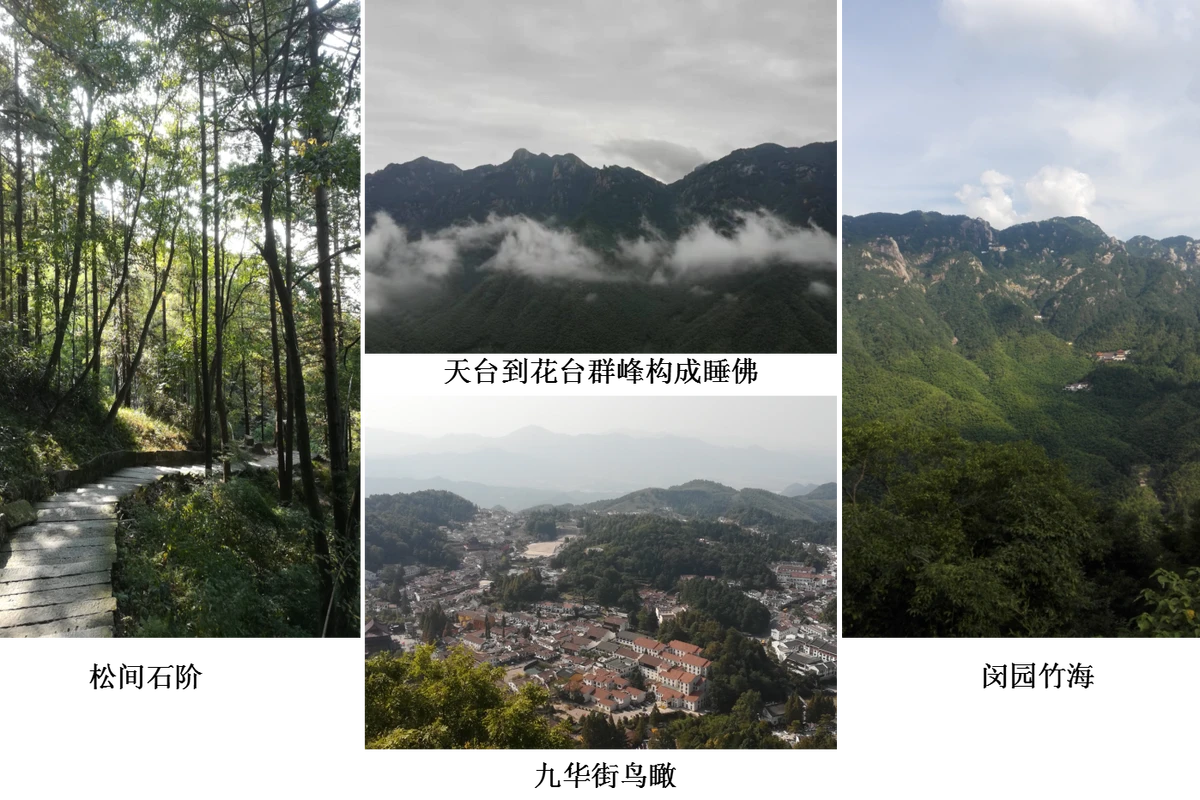
This mountain path is my personal favorite. It basically follows the ridge, walking among pines on stone steps. To the right is an overlook of Jiuhua Street, the Buddha City; to the left is the vast bamboo sea of Minyuan; and ahead are the peaks of Jiuhua from Tiantai to Huatai.
5. Major Temples on Jiuhua Street
Jiuhua Street is the central area of Jiuhua Mountain, a Buddha City where temples stand in abundance, civilian houses are orderly, and monks and laypeople coexist. The following national key temples are not to be missed.
Qiyuan Temple: Located at the entrance of Jiuhua Street at Yingxian Bridge, it is one of the four major monasteries of Jiuhua. The Great Buddha Hall is magnificent, and the three large Buddha statues inside are the largest among all temples on Jiuhua Mountain.
Zhantan Grove (Sandalwood Grove): The Great Compassion Hall, Great Buddha Hall, and Great Vow Hall are lined up in a row facing Jiuhua Street, providing a strong visual impact.
Shangchan Hall: Located halfway up the southern slope of Shengwang Ridge, it is said to have "three extremes": the poorest incense offerings, the best scenery, and the most beautiful courtyard. Here, there is the Water-bringing Guanyin, Golden Sand Spring, and towering ancient trees like the money tree, making it exceptionally outstanding.
Huacheng Temple: It is the original temple of Jiuhua Mountain, the chief monastery, revered as the foremost among all temples on Jiuhua. It now houses the Jiuhua Mountain Historical Relics Museum. The large caisson in the Great Buddha Hall is decorated with eight flying dragons at the octagonal part, plus a curling dragon and a pearl at the top of the caisson, forming a pattern of "nine dragons playing with a pearl."
6. Fenghuang Pine → Tiantai
First, take the scenic area shuttle bus from Huxing Mountain Station on Jiuhua Street to Fenghuang Pine Station. After getting off, there are two choices: take the cable car to Tiantai, or hike from Fenghuang Pine to Tiantai. I'll describe the latter method. Viewing the scenery and entering temples takes about 3 hours. After getting off at Fenghuang Pine Station, turn left down the steps along the stream; do not follow the road to the right. Walk forward. At this time, there may not be many fellow travelers around, as most people take the cable car up. After walking about 400-500 meters, deep in the bamboo groves and beside the rocky streams, more than 20 nunneries, hermitages, and huts are scattered in the Minyuan bamboo sea. This is a peaceful and beautiful spot on the way to Tiantai, blending natural and cultural landscapes.
Fenghuang Pine, praised by Li Keran as "the best pine under heaven," is over 1,600 years old. It is said to have been planted by the Indian monk Beidu during the Eastern Jin Dynasty. It looks like a giant phoenix spreading its wings to fly. The Welcoming Pine at Huangshan is 1,300 years old; Fenghuang Pine is 300 years older than the Welcoming Pine!
A short distance up, you reach Huiju Chan Temple, the largest temple encountered on the way. The surrounding mountain scenery is beautiful, with deep bamboo and trees, evoking the atmosphere of "an ancient temple hidden deep in the mountains." The eighteen arhat statues inside are exquisitely crafted and lifelike.
Along the way, you pass Jixiang Temple, Fuxing Nunnery, Chaoyang Nunnery, Diaogiao Temple, and Guanyin Peak to reach the Ancient Worship Platform. On the rock at the platform, there is a pair of huge, clear footprints. The Ancient Worship Platform is a relatively large temple among the nine major temples of Jiuhua, benefiting from its advantageous location. Here, you meet visitors who took the cable car to Tiantai. From here to Tiantai, there are about 800 stone steps. The flow of people up and down is considerable, and the terrain is relatively steep. It generally takes half an hour.
Tiantai Temple is located at the summit of Tiantai Peak, the highest temple on Jiuhua Mountain. It is usually a must-visit place on Jiuhua. Ascending here, a feeling of pride wells up: "Cleansing the heart, clouds arise; straining the eyes, birds return. When I reach the top, all other mountains look small."
7. Hiking from Tiantai to Huatai
The main purpose of going to Huatai is to enjoy the scenery. There are two different ways: one is to take the scenic area shuttle bus directly from the Tourist Service Center to Huatai Station, then take the cablecar up and down. The other is to hike from Tiantai to Huatai and take the cablecar down from Huatai. I'll describe the latter method, which takes about 3 hours. If you hike from Fenghuang Pine to Tiantai, then hike from Tiantai to Huatai, it does require some physical strength. If you want to save some energy, you can take the cablecar from Fenghuang Pine to Tiantai.
After passing the Yixian Tian (One-Line Sky) on Tiantai, the number of visitors decreases. Continue to Dizang Well, and your only companions are the rustling pines, the long mountain path, and your walking stick.
Postscript: On May 13, 2023, an ordinary weekend, visiting Jiuhua Mountain in this season allows you to appreciate the alpine rhododendrons. They appear beside the road, on cliffs, or in the forest, in branches, clusters, or seas. At noon, I was fortunate to witness the Buddha's light shining. Recorded.


