Self-driving in the Colorful Clouds of Yunnan~~ (Stone Forest, Dali, Shuanglang, Lijiang Dayan, Lijiang Shuhe)
No blue skies and white clouds, no beautiful mood, no detailed itinerary, no thorough preparation—only the company of drizzle and a touch of melancholy—
It seemed fated that I had little connection with Yunnan: I missed it back in May, and if I hadn’t booked the flight tickets and inn two months in advance, I’m sure this trip would have been postponed again.
I hadn’t planned a tight schedule from the start—just hoping to see the magnificent Stone Forest, then follow the ancient city of Dali to Shuanglang to view Erhai Lake, and head to Lijiang Old Town to experience the small bridges, flowing water, and quaint villages. But to my dismay, it rained almost the entire time. Over seven days, it rained for five and a half days. Even the one scenic spot I had—Jade Dragon Snow Mountain—was hidden by clouds. My luck couldn’t have been worse.
Without my usual travel excitement, I didn’t take many photos along the way. I occasionally pulled out my phone to snap a few as mementos.
Not until the last day of the trip did I finally see the beautiful sky that belongs to the Colorful Clouds of Yunnan.
------
Kunming, as a transit hub, doesn’t have many tourist attractions.
On the way back, I only dropped by the Military Academy and Haigeng Dam. The weather happened to be decent, and I ended up with a sunburnt, pitch-black face.
The Stone Forest scenery is quite beautiful, but the domestic ticket prices are far too expensive.
These magnificent landscapes belong to the people—why is it so hard to even take a look?
I had planned to fully explore Dali Old Town, but the rain was torrential. When we left Kunming, there was thunder and lightning, and the windshield wipers were going at full speed.
With no other choice, we bought umbrellas and plastic shoe covers and made a quick tour. The temperature was only 14°C—extremely cold.
We didn’t even enter the Three Pagodas; the ticket had risen to 120 yuan for a combo pass. We took a glance at the entrance and left. On the way to Shuanglang, we passed through Xizhou. The rain gradually eased, but the clouds were still thick.
Shuanglang has become a very popular place in the past couple of years, right next to Erhai Lake, with a chic atmosphere, especially famous for its inns.
Yang Liping’s Sun Palace on Yuji Island is even more renowned. We only stayed one night in Shuanglang. Fortunately, the rain stopped for a few short hours.
On the road to Lijiang, it started raining again. We spent two days in Dayan Old Town, and only half a day was rain-free. The rest of the time we hid on the observation deck of our inn, sipping tea, watching the rain, and shivering in the cold wind—
In Shuhe Ancient Town, we finally welcomed the first sunny day of the seven days. What a relief.
I finally felt like taking some photos.
Lijiang has an astonishing number of dogs; almost every household keeps one. At any time, you can see unleashed big and small dogs running around the alleys. But they are friendly. Sometimes they lie at their owners’ front gates, looking completely at ease. I miss my big dog back home.
Yunnan is famous for its cuisine, but I didn’t find it particularly tasty—just really salty. The prices for dishes in the old town were also extremely high; anything with meat was no less than 58 yuan, and snacks started at 10 yuan—
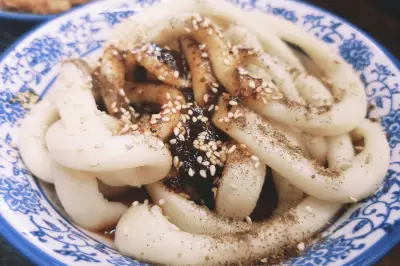
You can’t come to Yunnan without trying rice noodles. I sampled cross-bridge rice noodles, clay pot rice noodles, and braised pork rice noodles. I also tried yak meat, black goat meat, steamed chicken in a clay pot, cured pork rib hot pot, Lijiang baba (flatbread), stir-fried erkuai (rice cake), bamboo-tube rice, stir-fried erkuai (rice block), imperial cake (wangdi gao), grilled milk fan (ru shan), Dongba fried rice, mushroom soup, matsutake mushrooms, chicken pea jelly, shredded seaweed, yellow-braised chicken, and Dali beer (Feng Hua Xue Yue). I also ate some other delicious things whose names I forgot, but I took photos—you can see for yourself.
——
Colorful Clouds of Yunnan (Part 1) · Shuanglang
In Dali, Yunnan, there is a popular couplet: "Shang Guan flower, Xia Guan wind, Xia Guan wind blows Shang Guan flower; Cang Shan snow, Er Hai moon, Er Hai moon shines on Cang Shan snow." These are the four famous scenic features of Dali: Wind, Flower, Snow, and Moon.
Because we had already visited the Old Town and the Three Pagodas when arriving from Kunming to Dali, we had to take the western route from Dali to Shuanglang, passing through Xizhou. Since we hadn’t done much advance research, we drove blindly and asked for directions along the way. Bad luck struck again—the road was under construction, forcing us to make a small detour. On top of that, we encountered a torrential downpour that same morning, which forced us onto a terrible muddy road. Those ten-plus kilometers of muddy, rough road nearly broke our spirits and we almost gave up. Fortunately, we met a kind cement truck driver who led us back to the main road. After that, things went more or less smoothly.
Finally, we saw signs of human habitation, and our anxious hearts settled.
When we arrived in Shuanglang, we spotted Yuji Island and Nanzhao Customs Island.
We found the parking lot of Dajianpang Village, grabbed our simple luggage, and started looking for the inn we had booked in advance: Bandao 63. In Shuanglang, the inn is an essential part of the experience. Since it faces Erhai Lake, we also booked a sea-view room. Bandao 63 is mid-range, quite cozy, and only five to six minutes from the parking lot. Bandao 63 and Haitian Life are two famous neighboring inns, so we followed the signs for Haitian Life and easily found our inn.
We made it to our reserved room. Actually, my favorite seaside room wasn’t available, but the backup one we got was decent enough to accept.
Outside the room was a small terrace with a direct view of Erhai Lake—though the weather was poor, so it didn’t look especially beautiful.
We put down our luggage and, taking advantage of a break in the rain, set out to explore Yuji Island.
Shuanglang is packed with inns, and there are signboards everywhere.
I initially wanted to take a shortcut, but nothing went smoothly: the main road was also under construction, covered in red mud. An old local lady calmly pointed at the muddy path and said, "Just go down this way!" We were speechless. Going back would be too far, and we really didn’t want to walk through that mud. In the end, with no other choice, we closed our eyes and stepped into it—I was truly amazed. On the way to Yuji Island, we passed many chic little shops.
We paid 25 yuan to enter Yuji Island, and the first thing we saw was the filming location of "Five Golden Flowers"—which looked like it was about to be demolished.
After turning through a few alleys, we arrived at the residence of artist Zhao Qing, "Qinglu" (Green Hut). He designed it himself, and it was very beautiful, but we didn’t go inside—just looked around outside.
There was an extended glass yoga corridor.
Since staying here is incredibly expensive, we could only gaze and forget it.
Erhai Lake was right in front of us.
Next to Qinglu was Yang Liping’s house, "Sun Palace." It was also said to be designed by Zhao Qing, very elegant, but it’s a private club and not open for tours or photography.
Taking advantage of a moment with no one around, I sneaked a photo.
Walking along the stone steps, we reached "Moon Palace," which was under renovation and not yet open.
A local grandmother.
After a brief tour, we returned to the island entrance at "Qingchen"—a place with great ambiance.
Our shoes were dirty from the muddy path, so we were too embarrassed to go in immediately. After circling the island, our shoes had dried a bit, so we decided to go in for a drink.
Since it was still early, there were few customers. A few singers were rehearsing their evening performance—it should be nice.
We ordered two glasses of the house-made yogurt.
The design of Qingchen was unique: open-air, without a roof, with the wind blowing through—very comfortable.
There seemed to be some communication issues, probably because we couldn’t understand the dialect well. After dinner (it was already dark), we asked for directions back to our accommodation but got lost several times. In the pitch-black darkness, we struggled for over an hour before finally finding the right way. We finally made it back to the inn—what a relief. The trip to Shuanglang was full of twists and turns.
In the evening, we went to the café of Bandao 63. It was built very cozy; if the weather were clear, we could see stars overhead. Unfortunately, luck wasn’t with us, so we just sat and rested.
Outside the window was Erhai Lake.
The next morning, the sky was still overcast. I no longer asked for clear skies—I just hoped it wouldn’t rain.
It drizzled on and off.
From the balcony, we could see the neighboring Nanzhao Customs Island.
This was our "Erhai Feast"—actually quite nice.
The inn’s small courtyard.
After a simple breakfast, we planned to visit the famous neighboring inn "Haitan Shenghuo" (Haitian Life).
Haitian Life is a youth hostel that is very popular because it has a waterfront platform that attracts tourists from the island, all coming to take photos. Haitian Life is also generous—it allows free entry.
This is the spot—almost every visitor to Shuanglang takes a souvenir photo here.
When we had explored enough, a light rain began again. We returned to the relaxation area of Bandao 63 to rest. The pomegranate in the courtyard.
The waterfront platform of Bandao 63.
We went back to the room to pack up, ready to leave for Lijiang.
Taking photos in the relaxation area.
Around noon, we left Shuanglang. Although it was only a short one-day stay, I had grown to love the place (except for the inconveniences of road construction and the countless giant spiders everywhere).
——
Colorful Clouds of Yunnan (Part 2) · Lijiang · Dayan Old Town
Lijiang—time slows down here.
You no longer have to hurry on your journey, no longer have to face tedious work;
You can even turn off your phone, turn off the internet, and wander leisurely on the cobblestone streets,
Let go of all worries, immerse yourself in the slow rhythm of life,
And let your heart fly freely.
— from "Lijiang Slow Life"
Lijiang is a prefecture-level city.
What we commonly call Lijiang usually refers to Dayan Old Town.
Starting from Shuanglang, it’s only a little over 100 kilometers to Lijiang—two hours’ drive.
It drizzled the whole way, but it was quite smooth.
It is said that all the merchants in Lijiang jointly wrote a letter demanding a mandatory stop to playing the song "Di Da" in the old town, because after years of hearing it, people were sick of it. So indeed, we didn’t hear that song during our stay.
But perhaps because that song was missing, this trip to Lijiang wasn’t as wonderful as I had imagined.
Many people say that once you visit Lijiang, you get "addicted." I wonder if my mood was influencing me, but I didn’t find it particularly charming. Combined with the continuous rain and cold weather, I actually felt a bit cheated.
On Square Street (Sifang Street), I saw many Naxi elders dancing to music, rain or shine. I barged into their group, and an old lady gave me a strange look.
I grabbed a map from the inn and began a leisurely stroll through Dayan Old Town.
Lijiang has become very commercialized—most storefronts sell tea, shawls, African drums, jewelry… There were a few shops with distinctive ethnic-style clothing. I bought several pieces that I liked, intending to wear them for photos.
It had been drizzling all the time, so I probably didn’t pay much attention to the scenery. Now looking at the photos, the small bridges and flowing water are actually quite beautiful.
Following the path, I unintentionally arrived at the Mu Residence. There’s a recent TV series "The Wind of Mu Residence" that is quite popular; it seems to have been filmed here.
Shops selling Lijiang’s characteristic shawls are everywhere.
Not far ahead was Qiyi Street, the famous snack street—every snack starts at 10 yuan. I was stuffing my mouth with food, eating with gusto, when my companion Du insisted on taking a photo of me.
This was a wall of character guessing—many are pictographs, quite interesting.
I kept walking down the path until I was almost out of the old town.
At first, this big cat looked pitiful, tied with a small chain and unable to move freely. It looked cute, so I posed for a photo. But before I could even move, it turned around and slapped me twice—quite ferocious! No wonder it was chained up.
Look at its dismissive expression in the photo with me—hilarious.
We arrived at the windmill scenic spot. There were very few tourists this season.
A must-visit spot in Lijiang.
We roughly circled the old town and then walked back along the bar street.
The famous "One Meter Sunshine" bar.
Bar street: various gimmicks to attract customers.
Looking back at my photos, it seems I hardly took any of the scenery.
We stayed in Dayan Old Town for two days. It rained for a day and a half. At its heaviest, it was moderate rain. We hid on the second-floor observation deck of our inn, drinking tea, watching the rain, and shivering in the cold wind… When we couldn’t stand the cold anymore, we went out with umbrellas to explore. That’s why there aren’t many photos from those two days.
On the evening of the second day, the rain began to weaken. We took our umbrellas and camera and went out to wander the alleys. If we hadn’t gone out, it would have been a wasted trip.
A "divine figure" at the entrance of a bar.
When taking photos, I tossed my umbrella aside and braved the rain.
I don’t have many photos of Dayan Old Town. Tomorrow I’ll post some photos of Shuhe Ancient Town, where we welcomed the first sunny day of our Yunnan trip.
——
Colorful Clouds of Yunnan (Part 3) · Lijiang · Shuhe Ancient Town
If you are on your way to Lijiang, or planning to go,
Then you should either be someone with a story, or someone who is about to have a story in Lijiang.
— from "Lijiang Slow Life"
Shuhe is located at the core of all scenic areas in Lijiang, serving as a hub for visiting Lijiang Old Town, Jade Dragon Snow Mountain, Lugu Lake, the First Bend of the Yangtze River, and the Three Parallel Rivers area.
For this trip to Lijiang, I hadn’t set many scenic spots. The only one I really wanted to see—Jade Dragon Snow Mountain—was thwarted by the continuous rainy weather. In four days, we didn’t even catch a glimpse of the snow mountain—what a pity.
Shuhe Ancient Town has an entrance fee of 50 yuan, but ticketing is not strictly enforced. Those who have been there know that even if there are ticket checkers, you can skirt the right side of the entrance and enter the town directly without paying.
Our luck was at rock bottom. Early that morning, we ventured out in heavy rain to find our way to the ancient town, but we were stopped by a ticket checker before we even reached the main gate. We explained that we were staying in the old town, but it didn’t matter—we had to buy tickets. Fortunately, the inn we had contacted was considerate and sent a car to pick us up, entering the town via another village road.
During our two days in the town, we passed the ticket entrance twice, and we never saw any ticket checkers again.
I have to applaud our incredible "luck."
After we checked into the inn, the rain continued without stopping. I took a lot of photos in the room. In the afternoon, when the rain eased a bit, we ventured out with umbrellas.
That evening, we ate at this restaurant: cured pork rib hot pot. There was a little episode: my companion Du reached into his pocket and found he only had 193 yuan. Too lazy to go back to the inn for more money, he decided to order accordingly. Since dishes in Lijiang are quite expensive, he picked a few that seemed reasonable. The final bill came to 192 yuan. He handed me the remaining one yuan and insisted I take a photo to commemorate it.
People who have been to Lijiang say that Shuhe Ancient Town is much more rustic than Dayan Old Town.
I hadn’t experienced it myself before, but after coming here, I found it to be true.
Shuhe has many natural elements, unlike Dayan which is overly commercialized.
Here, it feels very comfortable.
These two lovely big dogs.
The small bridge and flowing water at "Feihua Chushui" were incredibly pleasant. Sitting here and watching the scenery was beyond words.
Following the path upward, we arrived at the Old Square Street (Lao Sifang Jie). The atmosphere here was truly wonderful.
It was filled with a sense of primitiveness—everywhere covered in horse manure.