Qingdao - Kunming - Dali - Lijiang: A Solo Journey of a Thousand Miles, One Person's Yunnan Adventure.
It's been two weeks since I returned from Yunnan. I promised someone I'd write a travel guide, but I've been too lazy to start. After coming back from Yunnan, I felt a bit down. Maybe if I write a travel journal and recall the days in Yunnan, I'll feel a bit happier. So I began, recalling the short 7-day record of life in Yunnan, some emotions, some amazement, some joy, some admiration—in short, some feelings... bits and pieces. I'm not good with words, and my writing skills are limited, so I'll just go with pictures and a running account.
Because I started working early, I'm over 30 and already have 13 years of "seniority." According to national policy, I'm entitled to a "10-day paid vacation." The company rule allows this 10 days to be split into two "consumptions." Each time, 5 days plus the weekends on either side give me two 9-day vacations each year.
So how to "spend" this single 9-day vacation in a meaningful way without too much trouble, time, or money—that's also a headache. As a miserable single guy with no girlfriend, lover, wife, or "GAHUO" (Qingdao slang for 'mistress'), that's another headache. Initially, there were many destinations: Saipan, Japan, Taiwan, Thailand, Yunnan, Chongqing... a tough choice. Finally, I had to find reasons not to go. Saipan and Japan were a bit expensive, and going alone was too boring. Taiwan—I didn't have time to get the entry permit. Thailand—I didn't want to join a tour group, and I was afraid of the language barrier if I traveled independently. Just then, Ning Hao's "Heartflowering" was released, so I bought a ticket to watch it. I don't know when I developed this "bad habit" of going to the cinema alone, and I usually never watch domestic films, but the iron triangle of Ning Hao, Huang Bo, and Xu Zheng is the only reason I watch Chinese movies. As a result, Huang Bo's loser character's romantic encounter trip to Dali perfectly matched my mood—it felt like a hint from the heavens. So, accompanied by Huang Bo's song "Going to Dali," I booked a ticket to Yunnan.
Because it was independent travel without a travel agency arrangement, planes, trains, buses, hotels—where to go and where not to go were all up to me. There are many places to visit in Yunnan: Kunming, Dali, Lijiang, Tengchong, Banna, Shangri-La, Stone Forest... Yunnan practically exists for tourism; the name "Colorful Yunnan" is well-deserved. Although I had 9 days off, I didn't want to exhaust myself, as I had to go back to work the day after returning, so the trip was shortened to 7 days, meaning some places like Shangri-La and Lugu Lake had to be skipped, but Dali was a must—the main destination of this trip. And also Lijiang... "a hotspot for romantic encounters."
Importance of weather forecast~
From Qingdao to Yunnan, over two to three thousand kilometers, what's the difference in temperature and weather compared to Qingdao? Better to find out.
There are various ways to get information, but I blindly trusted the weather forecast on my phone (iPhone 4s)! Before I left, the forecast looked like this:
From these pictures, you can see that Kunming, Dali, and Lijiang have a temperature difference of over 10 degrees, and Kunming was supposedly raining every day. This damn forecast made me pack both winter and summer clothes. Later it proved to be such a stupid decision; these clothes became a burden and were completely unnecessary. Because temperatures across Yunnan were about the same, and the sun was shining brightly.
Things to bring~
1. Clothes: Kunming is a city of eternal spring, so Yunnan is a province of eternal spring. The temperature in Yunnan is around 20°C all year (except places like Xishuangbanna), only cooler in the morning and evening. In short, whatever spring means to you, prepare those kinds of clothes.
2. Umbrella, sunscreen: Although Yunnan is spring-like all year, it has a rainy season and a dry season. If you hit the rainy season, bring rain gear. I went in November, which is the dry season; reportedly it hadn't rained a drop in a month. For women, sunscreen is a must because the UV rays in the plateau are especially strong—I felt this firsthand after arriving. Before going, I thought a rough-skinned man like me didn't need it, but my face ended up burning painfully.
3. Medicine: Diarrhea medicine, cold medicine, anti-inflammatory medicine, motion sickness medicine, altitude sickness prevention medicine—prepare some of each.
4. Mosquito coils: Some hotels provide them, some don't. If not prepared and you don't bring your own, you'll be unlucky.
5. Toiletries: If you take night trains or stay in hostels, it's best to bring your own towel, toothbrush, soap, etc.
6. Electronic devices: Camera—preferably a DSLR, because you'll find that a compact camera or phone can't capture Yunnan's beauty. Phone—definitely a smartphone with these apps or similar functions: Baidu Maps (navigation, find hotels, attractions, bus transfers), WeChat (communication, sharing or showing off photos, sharing location), Didi Dache (basically useless in Dali and Lijiang), Dianping (find fun places, good food, and discounts), travel website apps (book hotels, flights, train tickets, group deals).
D1: Qingdao 7:20 AM flight to Kunming. Daytime: Yunnan University, Cuihu Park. Evening: Nanping Commercial Street. 10 PM train to Dali, sleep on the train (saves one night's accommodation).
D2: Arrive in Dali in the morning, visit Dali Old Town. 10 AM: join a shared car for a tour around Erhai Lake, visit the Three Pagodas of Chongsheng Temple, Xizhou Folk Village, boat ride to watch cormorant fishing, then to Shuanglang. Stay in Shuanglang.
D3: Morning: watch sunrise. Morning: tour Shuanglang Ancient Town, Nanzhao Style Island, Yuji Peninsula. Afternoon: rent an electric scooter to ride around Erhai from Shuanglang to Wase Town, Xiaoputuo. Return to Shuanglang, stay in Shuanglang.
D4: Morning: wait for people at the hotel, sunbathe, read a book. Afternoon: share a car to Lijiang. Evening: visit Lijiang Ancient Town, Big Waterwheel, Bar Street. Stay in Lijiang Ancient Town.
D5: Morning: visit Shuhe Ancient Town. After lunch: return to Lijiang Ancient Town, continue exploring, Wuyi Middle Road, Lion Hill. Stay in Lijiang Ancient Town.
D6: Jade Dragon Snow Mountain, Blue Moon Valley. After dinner: take the train back to Kunming, sleep on the train (saves another night's accommodation, but tiring).
D7: Kunming: visit Dianchi Lake, sunbathe, read, feed seagulls. 5:30 PM flight back to Qingdao, arrive home at 10 PM.
D8/D9: Continue enjoying the weekend...
Reminder: Yunnan currently has no high-speed rail (according to insiders, high-speed trains won't come until 2017). Currently there are only old "green trains" (actually red ones), which are slow and noisy, very unpleasant. However, there is a tourist express from Kunming, departing daily at 12:10 PM from Kunming, passing through Dali to Lijiang. This train has double-decker sleeper cars (no hard seats), much more advanced and faster than the "green trains," and the sleeper fare is the same as the "green train"—if your schedule allows, definitely choose this one. I learned this from others after the fact, and I was very envious.
Since I bought the tickets a month in advance, they were cheaper—about 40% off. Qingdao-Kunming round trip: RMB 1650.00. The downside was the 7:20 AM flight required an early start. From Bada Gorge, the taxi took about an hour. To avoid missing the flight again, I left home at 5 AM. Afraid I couldn't hail a cab, I used Didi Dache for the first time to book a car, paying cash (still uneasy about mobile payments). The driver was punctual, arriving at 5 AM sharp—thumbs up!
No traffic jams in the morning, I reached the airport in under an hour. Taxi fare: 77 yuan. It was still dark when I arrived. Domestic Departure Terminal 3. The "romantic encounter trip" begins...
Note: Dali, Lijiang, and Shangri-La all have airports, but from Qingdao, the only direct flight is to Kunming. If you depart from a place with direct flights, you can choose to return from Lijiang or Shangri-La, saving travel time.
D1 Kunming~
When I arrived in Kunming, I realized how unreliable the phone weather forecast was—my anxious heart finally relaxed. I thought the holiday would be spent in rain, but the weather was kind, giving us a bright sunny day. Kunming's sky was so blue! But it still couldn't compare to Dali's sky—here's a picture (taken through the airport bus window with my phone).
Although Kunming is called a "city of eternal spring," when I arrived in mid-November, my first impression was that it wasn't much different from a northern provincial capital—rundown urban villages, signs everywhere. But if you stay longer, you discover the city's beauty, especially the sky.
My personal travel habits: I don't join tours because I hate shopping. Also, I travel on a budget. When I arrive in a city, I must take the local bus to experience how locals get around, and avoid taxis if possible. So I used Baidu Maps, which clearly shows which bus to take, where to transfer, etc. Another habit is to visit local universities and commercial streets (though I don't shop, I like to wander) because they're free, scenic, and have local character.
I took the airport bus route to the train station, got off at the second-to-last stop (forgot the name, something like a hotel). Kunming's airport buses have attendants who can introduce local attractions—very considerate, typical of a tourist city—thumbs up! Then I took bus No. 1 (2 yuan) directly to Yunnan University and Cuihu Park (they're just across the road from each other).
Cuihu Park~ Originally part of Dianchi Lake, it was later separated. When I went, the lotus ponds looked bleak due to the season. But it was just the time when black-headed gulls come from the north to winter; the lake was full of them (I've seen them in Qingdao—nothing special).
Since the train wasn't until night, I had plenty of time to kill. Sitting on a bench in the park, soaking up the sun, staring at the sky, was very pleasant.
Yunnan University, a century-old university with a very small campus, but a must-visit for photography enthusiasts.
There are no bells for class changes; the bell tower tells the time. It's been around for 70-80 years (I went on Saturday, so I didn't hear it).
The old teaching building, no longer in use.
Leaving Yunnan University, it was 4:30 PM. I'd only eaten a McDonald's for lunch, so I was starving. Time to find food. The local snack street is reportedly on Nanping Pedestrian Street. Let's go—try Yunnan rice noodles!
This was the first time I saw koi fish raised on a pedestrian street. Do these fish end up in the nearby Sichuan restaurant at night? (There are a lot of Sichuan people in Yunnan.)
Nanping Pedestrian Street isn't much different from pedestrian streets elsewhere in China, except for these remaining archways from demolished buildings—a bit different.
In Yunnan, of course, you can't miss "Yunnan Baiyao"; it's a local specialty. Should I buy some?
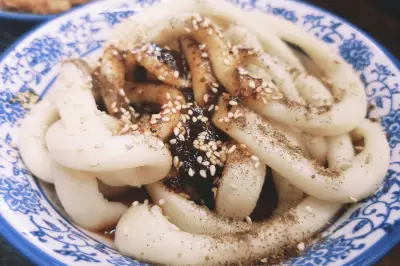
I ate rice noodles at "Qiaoxiangyuan" on the pedestrian street. Honestly, it was my first time eating rice noodles, and I made a big joke. This shop is an old establishment, very busy, and the servers were overwhelmed. I ordered a local specialty rice noodle called "Zhuangyuan Sanxian Rice Noodles." The server brought a plate of ingredients (sliced meat, vegetables, quail eggs, etc.) and a bowl of dry rice noodles—then left. Wait, shouldn't rice noodles have soup? Or is this the "specialty"? Seeing that the server ignored me, I was hungry, so I started eating, treating the rice noodles like zhajiang noodles. Halfway through, the server brought the hot soup. Seeing my eating style, the server looked really awkward, frozen for about 5 seconds. First time in the city, never seen the world—sorry! The server seemed apologetic and gave me another free bowl of rice noodles, showing me to put the ingredients and noodles into the bowl—then I finally experienced the true taste of rice noodles.
After eating and drinking, I wandered the pedestrian street a bit more. When it was time, I went to the train station early. At the end of the pedestrian street is a bus hub with many buses to the train station (if you don't take the bus, it's hard to find a taxi, and you'd have to take an illegal motorcycle). But there were many people, and coinciding with a security check (seems like they were checking for fugitives), it took a full hour to get on the bus. Thinking about the police checking for fugitives on the bus a moment ago, and recalling the knife attack at Kunming train station earlier this year, I felt a bit uneasy—I was heading to "Kunming Train Station"! The place where heroes perform or people get slashed! But when I arrived, I found my worries were unnecessary; there were armed police everywhere, every few steps. I never thought I'd feel so safe seeing police officers. Entering the station became difficult too; the entire square was sealed off, with security checks to enter the square and another security check to enter the hall—more troublesome than boarding a plane. Well, for safety, I accepted it.
After passing two checkpoints, I finally got into the station. Set off, Dali—big bro is coming!
After a night of bumpy ride, I finally arrived at "Dali Bai Autonomous Prefecture" (Dali's official name). It took nearly 8 hours to cover just over 300 kilometers. The train didn't go slowly, but it stopped countless times in the middle of nowhere, not at stations, just waiting. Why? I don't understand! Can any professional explain? Fortunately, it was night, otherwise I would have gone crazy.
Exiting the station before 6:30 AM—looked at the stars in the sky, super beautiful! Before coming, I read travel guides saying take Bus No. 8 to Dali Old Town. I worried the bus stop would be hard to find, but it turned out unnecessary worry. Right outside the station is the No. 8 bus stop. Although crowded, it cost only 2 yuan to reach Dali Old Town—cheap and reassuring. Private cars wanted 5 yuan, but few people took them—unreliable.
Arriving at Dali Old Town, it was just dawn. First, find a place for breakfast. The first restaurant inside the city gate was too crowded, so I didn't enter. I continued to an outdoor breakfast stall (delicious food, wide variety of both northern and southern tastes). This choice completely changed my trip. Here I met my first "romantic encounter."
The first group of "companions" on this trip: three independent travelers from three different places. I had planned to complete this Yunnan trip alone, but my first day in Kunming taught me that traveling alone is too lonely, and it's inconvenient for meals, transportation, and especially having someone to take photos. So I changed my mind—I would travel with companions. The four of us hit it off immediately!
From left to right: ME (Shandong, Qingdao), Xiao Hai (from Beijing, originally Fujian), Da Hai (from Chongqing), Lao Zhong (from Tianjin, originally Hunan). These four solo travelers, from different places with distinct personalities, miraculously teamed up. The following days were spent with these people: sharing cars, sharing meals, sharing itineraries. Later, Xiao Yan and Meng "Pangzi" joined.
Xiao Hai: Internet worker (Qunar.com), reliable, mature beyond his years. Easy to trust, he became our organizer.
Da Hai: Beer salesman, lively, talkative. His personality brought topics and joy.
Lao Zhong: Occupation unknown, mature and capable, photography enthusiast. Like me, not very talkative.
Note: Most people traveling to Dali have similar routes: Kunming - Dali - Lijiang - Shangri-La or Lugu Lake, so it's easy to find travel companions. But do it early—Dali is a good place to find companions, because later groups are already fixed and not keen on adding new members.
The hilarious Da Hai!
This encounter also solved my "transport" problem to Shuanglang. The four of us had similar itineraries, so we shared a car for the tour around Erhai Lake, final destination—Shuanglang. Four people shared 160 yuan, 40 each (shared car: they wait at attractions, pay at the final stop). The car was booked for 10:30 AM, so my tour of Dali Old Town could only be a quick glance.
Wuhua Tower! I didn't even get to the south gate of Dali Old Town (the spot where Yuan Quan and "Zhu Bajie" took a photo in Heartflowering)—a regret.
Distant view of Cangshan Mountain.
Yangren Street (Foreigner Street) had no foreigners.
My original plan was: Dali Old Town, Three Pagodas of Chongsheng Temple, Butterfly Spring (filming location of the movie "Five Golden Flowers"), and if time allowed, Tianlongbabu Film City. But according to the shared car driver, Tianlongbabu Film City was boring, Three Pagodas tickets 120 yuan, Butterfly Spring tickets 60 yuan—just a spring and a big tree with no butterflies. So all four of us changed our plans. Later, I thought the driver might have said that because those places gave him no commission. But his suggested itinerary was pretty good: distant view of Three Pagodas, Xizhou Ancient Town, cormorant fishing...
The Three Pagodas of Dali are very famous; I had seen them on calendars since childhood, so I couldn't miss them. But 120 yuan for a ticket was a bit expensive—a distant view was enough.
Xizhou Ancient Town: entry fee 50 yuan—didn't seem interesting, so we didn't go in. However, we happened to see Liu Dadanao (from "Country Love Story") here.
Liu Dadanao—finally saw him in person, but his head wasn't that big. He's not very famous in the south; none of my companions recognized him.
Cormorants that catch fish are hoisted up by the owner as a reward.
At first, the cormorant show seemed boring, but after experiencing it, the 100 yuan ticket was worth it. A Bai auntie rowed the boat, a Bai "Jinhua" (local term for young women; men are called Apeng) gave commentary, and Bai girls performed—very nice. But most importantly, the scenery along the way. Boating into Erhai Lake, the view was indescribably beautiful.
We could row to a small island in Erhai Lake. The cormorants caught fish—50 yuan each (2-3 jin wild fish), sold as caught. On the island, you could have it cooked for 15 yuan, plus other food available. Very reasonable. Reasonable because compared to the lunch place the driver recommended, it was a bit "shady" (shared car cheap, but they get kickbacks). A fish over 200 yuan, four of us ordered three dishes for 300 yuan total, but the environment, portion, and taste were okay.
This "osmanthus" fish weighed 3.8 jin, freshly caught and cooked, a big bowl—over 230 yuan.
After eating and drinking, we sunbathed for a while, then headed to today's final destination—Shuanglang.
From Xizhou to Shuanglang, we passed through "Shangguan." Dali's famous "wind, flowers, snow, moon" sums up the four great sceneries: wind from Shangguan, flowers from Xiaguan, snow from Cangshan, moon over Erhai. I didn't feel the wind of Shangguan, but the scenery was first-class. Just at sunset, an unparalleled "Jesus cloud" appeared.
After two days and one night of travel, I finally arrived at the hotel I booked—"Ziyan Manor" guesthouse in Dajianbang Village, not far from the legendary "Haidilife" and "Bandao 63" guesthouses. The whole guesthouse was covered with bougainvillea, very distinctive. From upstairs, I could see Erhai Lake—unexpectedly good, worth the 155 yuan per night. Great value.
Xiao Hai and the other two had to return to Dali Old Town and would come to Shuanglang the next day, so I rested alone.
"Shuanglang" is actually an ancient fishing village, close to the shore of Erhai Lake. The first time I heard the name, I thought it was just a scenic spot on the lake, maybe a long corridor. Shuanglang's commercial development is relatively recent, probably within the last 20 years, so it's far less developed than Dali Old Town or Lijiang Old Town. As I read in other travelogues before going, there are houses being built everywhere, construction sites everywhere. The roads aren't great either—some places are still gravel.
Shuanglang Ancient Town has only one main street from north to south, not many entertainment facilities, and its shopping streets and bar streets aren't as bustling as Dali or Lijiang. It looks like an ordinary town to outsiders. But... Shuanglang's natural scenery is unparalleled. Its location is closest to Erhai Lake (Dali Old Town and Xizhou have farmland along the lake). Some famous guesthouses in Shuanglang are built right by the water, like "Haidilife," "Bandao 63," "Bandao Tuolan," offering 270-degree lake-view rooms. So... Shuanglang is a perfect place for sunbathing, daydreaming, watching sunrise and sunset, listening to the lake, and cycling.
Nanzhao Style Island~
Yuji Peninsula~
I went to bed early the first night, so I woke up early (actually not that early) to see the sunrise.
Yunnan is in the southwest, so sunrise is late. Also, Shuanglang is backed by mountains, so the sun appears around 8 AM.
Before the sun came out, I visited the legendary "Haidilife" guesthouse and its famous wooden deck by the lake.
The owner of Haidilife deliberately placed a wine glass there—very stylish!
The sun came out—so dazzling. I ran a long way to find a corner and took some photos (you can also rent a boat for sunrise, 30 yuan per person). When I returned to the hotel, I realized it was an excellent spot for sunrise—I had been looking everywhere but it was right there.
Bougainvillea, remember? The characteristic of "Ziyan Manor" is bougainvillea everywhere.
This place, according to others, is a "regret if you don't go, regret if you go" kind of place. But Xiao Hai, Lao Zhong, and the others wouldn't arrive until afternoon, and we had planned an Erhai cycling trip in the afternoon. With nowhere to go alone in the morning and not liking shopping, I decided to check it out. It turned out to be another discovery—worth the ticket.
Ticket 50 yuan, includes a free ferry. Before going, someone said no one checks tickets, but it seems the policy changed—now there's a turnstile like the subway.
The reason it's worth the ticket is that it's a perfect place for sunbathing and daydreaming—quiet and peaceful. But watch out for this thing—the automatic sprinkler system; it can get you wet.
Earlier I mentioned the use of WeChat: not only for sharing photos, but also for location sharing, creating chat groups. While sunbathing alone on the island, I learned from the group chat that Xiao Hai had a real "romantic encounter" in Dali—with two girls! So our team became six people. Because we had to wait for these two girls, the afternoon cycling was postponed. Truly "forgetting friends for love."
Let me introduce the other two companions on this trip.
Yanzi: A Hunan girl from Shenzhen. Personality—well, steady, refined girl.
Meng "Pangzi": An Anhui girl from Hangzhou. The nickname comes from her own WeChat. Personality: childlike—ha! You can tell from the photo below.
This is Meng "Pangzi," now renamed "Xiaofeixia." This photo can be used to ward off evil spirits!
Because Xiao Hai, Lao Zhong, and the others had to wait for the two girls (Da Hai had gone ahead alone to Lijiang seeking romance), the cycling that was supposed to start at 1 PM was delayed until 3 PM. That gave me time for a nap.
Cycling around Erhai Lake is a major leisure activity in Shuanglang and one of my main reasons for coming. There are rental stalls everywhere: regular mountain bikes, electric scooters, bicycles for two or four people, and motorcycles. Renting is easy—no deposit, just a deposit of your ID card. Prices: bicycles 15-30 yuan/day, electric scooters 40-50 yuan/day, motorcycles 200 yuan/day (fuel yourself).
Xiao Hai wanted to watch the sunset with the girls, so the cycling trip ended up just me and Lao Zhong. We chose two brand-new large electric scooters, each with a range of 70 km on a full charge (smaller ones only about 40 km). Asking price 60, we bargained to 50. Let's go!
From Shuanglang to Wase Town, we cycled along the lakeside; the scenery was absolutely beautiful.
I envy this lifestyle.
Snap of a pretty girl.
After cycling 20 km, we reached "Xiaoputuo," a small island in Erhai Lake. Legend has it that Wu Sangui hid Chen Yuanyuan here.
Now you know why it's called "Xiaoputuo"—like a fairyland.
It was getting dark. Reluctantly, we had to head back.
We returned the same way without stopping, quickly arriving back in Shuanglang; round trip 50 km. Remember to calculate the battery well, or you'll have to push the bike home. On the way back, I realized how wise it was to rent an electric scooter—many cyclists were exhausted, but we were quite dashing. However, do remember to dress warmly; otherwise, the return trip in the afternoon will freeze you to death. Remember.
When we got back to Shuanglang, the sun had already set. The weather wasn't cooperative, so no sunset. Xiao Hai and the two girls waited all afternoon in vain, but accompanying the girls to watch the sunset would have been romantic anyway. Low emotional intelligence, deserved to be single—sigh.
Except for Da Hai, who had gone to Lijiang alone, the remaining five had dinner together. With Xiao Hai, the internet worker, finding good food was easy. A local restaurant with high ratings on Dianping, but hard to find. 35 yuan per person—that's the benefit of sharing meals. Honestly, the dishes were average; the portions were small and not enough.
After dinner, we strolled along the lakeside and bar street, bought some postcards.
The local post office—special!
Bar street, located between Yuji Island and Nanzhao by the lake—hey?! Where did Xiao Hai and Meng "Pangzi" go?
Those two quietly left the group for some alone time—envious, jealous... So this is a romantic encounter.
The fulfilling day ended; I was very happy. On the way back to the guesthouse, childlike Meng "Pangzi" kept shouting, "So happy, so happy!"
D4: Shuanglang - Lijiang
Day 4 in Yunnan. Today I planned to go to Lijiang. Lao Zhong would stay another day in Shuanglang, then return to Kunming and drive to "Puzhehei" (reportedly a newly developed virgin land). Xiao Hai and the two girls would do the cycling they missed yesterday. So the morning gave me plenty of time to spend at the hotel, enjoying a "stay-at-home" life—sunbathing, reading, and also washing and drying my clothes.
The rooftop of "Ziyan Manor"—a perfect place for sunbathing.
The guesthouse even provided a clothes-drying area—thoughtful! With the strong sun, clothes dried in one morning.
The slogan of "Ziyan Manor."
Finally, the cycling trio returned. We found a nearby restaurant (can't remember the name) near the guesthouse. It was almost empty at mealtime, but the taste and portions were good. Paying with Dianping gave us a 20% discount—30 yuan per person for four.
Silver fish fried with eggs—local specialty.
At 2 PM, we shared a car to Lijiang.
Before coming to Shuanglang, I thought it was remote and transportation would be inconvenient. But I was wrong again. Shuanglang's main economy is now tourism. Although there are few state-run long-distance buses, private shared car services are well developed—advertisements everywhere.
Guesthouses usually offer carpooling services. Tell the boss you want to carpool, how many people, departure time, destination, and the boss will post the info. If they can't gather enough people, the boss will take you to the Shuanglang station where local "carpool brokers" will arrange a car—similar to some long-distance minibuses. If your car isn't full, they'll "sell" you to another owner. If you don't want to carpool, there are also coaches to Kunming, Lijiang, Shangri-La. From Shuanglang to Lijiang by shared car (the most time- and cost-effective) costs 90 yuan per person; coach is 80 yuan. Shared cars usually have 6-8 people; the advantage is you can stop to take photos along the way.
We were lucky: 8 people shared a Mercedes-Benz van (2 men, 6 women), much more comfortable than ordinary vans.
Leaving Dali, I felt reluctant. In my heart, I muttered: "Dali, big bro will definitely come back."
Shuanglang is right next to the expressway. Driving to Lijiang non-stop would take just over an hour, but we took over two hours. The driver was a Naxi local from Lijiang, very enthusiastic, introducing things to do and eat in Lijiang all the way, as well as Naxi customs.
Because the carpool in Shuanglang took some time, and we dawdled on the road, it was already dark when we arrived in Lijiang. First, find the booked hotel. Among the four of us, only I had booked; the others were spontaneous, choosing wherever they liked. Although we had been sharing cars and meals, we had been staying separately. Now in Lijiang, the four of us had the same itinerary, so we decided to stay in the same guesthouse to save money.
Lijiang Exclusive Memory Hotel, booked a week in advance at a special price: 98 yuan for a standard twin room. Before going, some suggested switching guesthouses each day to experience different styles, but that was too troublesome, so I booked two nights. The location was good—at the junction of Dayan Old Town and the new city, convenient transportation. At the foot of Lion Hill, crossing the hill leads to Sifang Street in the old town.
Each room in this hotel has its own theme. When we arrived, standard rooms were gone, so the two girls had to squeeze into a large bed room. But that large bed room turned out to be superb—a honeymoon suite. Big red color, with a glass ceiling for stargazing in bed. 135 yuan per night.
After dropping off luggage, we called Da Hai, who had arrived earlier. All five of us went to try the local specialty "preserved pork rib hotpot." There are many such restaurants in Lijiang, but the authentic ones are in Xinshan Market in the new town. Xiao Hai, the internet guru, booked through Dianping. Good thing we reserved, otherwise we wouldn't have gotten a table—it was too popular.
We arrived a few minutes late, and our reserved table was taken. Since we booked through Dianping, the boss was afraid of bad reviews, so he was very apologetic, quickly found us another seat, and gave us free rice noodles as compensation.
This "Lijiang Youyiguo" preserved pork rib hotpot restaurant in Xinshan Market was authentic. Taxi from the guesthouse cost 10 yuan.
One stove for two purposes: hotpot and grill. Grilled pork belly was superb.
Dipping sauce, good!
Five of us ordered a large pot, total after discount: 300 yuan. This was the most satisfying meal in Yunnan, so delicious. After eating and drinking, we began exploring Lijiang Ancient Town.
Lijiang's iconic spot—the Big Waterwheel.
"One Meter Sunshine"—holy land of romantic encounters.
Goodnight, Lijiang!!