Travel with Walk See: Colorful Yunnan
In my previous understanding, Yunnan was a province with many ethnic groups and beautiful scenery, but undeveloped and with many negative news about tour guides. The well-known cities are nothing more than Kunming, which is like spring all year round; Dali and Erhai Lake, which have a strong artistic atmosphere; Lijiang, a bar city for romantic encounters; and mysterious Xishuangbanna. But we shouldn't miss out on delicious food and beautiful scenery just because of some negative incidents. So when planning a trip at the beginning of the year, I chose Yunnan, Xinjiang, or the grassland. At that time, I thought if the group tour was bad, we would travel independently. By chance, I saw a Yunnan tour recommended by a famous public account. The group purchase price was 699 (local reception) for Kunming-Dali-Lijiang-Jade Dragon Snow Mountain, and it had over 10,000 participants with a satisfaction rate of over 95%. At that time, I discussed with my family whether to go and whether it was reliable. After a series of analyses, we unanimously agreed to go on this trip, so we paid and confirmed it. The group purchase was valid for one year. After confirming the travel time, we contacted the butler to communicate about subsequent matters.
By July, the kids had already started summer vacation, which was also the golden time for many families to travel with their children. But this year there were many courses, and the latest end date was early August. So the travel time was set for the middle to late period. After contacting the butler and considering the flight situation, we finally decided to depart on August 21.
Day 1 Arrive in Kunming
After confirming the travel time, the butler sent me a lot of confirmation information, precautions, items to bring, etc. Here, I give a big thumbs up to Butler Keke.
Ding-ding-ding, on August 21, we arrived at Shuofang Airport at 6 a.m. sharp to catch the 7:30 flight. Actually, we got up at 4:30 a.m. Getting up early is tiring, and we also had to prepare breakfast. The kids' dad kept urging us, and finally, we rushed out of the house with our suitcases. It takes 40 minutes to drive from Suzhou to Shuofang via the expressway.
When boarding, we were notified that the flight was delayed. Trains are often delayed, but why can't a plane fly on a sunny day? It turns out that there are many factors affecting takeoff. Probably it was raining heavily in Kunming, and we had to wait for the weather to improve.
After flying for less than 3 hours, we got off, picked up our luggage, and called the local reception. Then we received a flower welcome. Although it was just one flower per person, it was full of sincerity.
The driver from Kunming took us to the hotel, which was the Ibis at the intersection of Kunling Road. We checked in. The room was quite nice, with a beautiful girl at the lobby and distinctive decoration. Dad sat down to rest immediately. Since Yunnan implements real-name tourism, adults need to bring their ID cards, and children need their household registration books. Hotel registration requires face scanning, and even the mischievous children are no exception.
After checking into the room, it looked quite clean.
After resting a bit, we went out to find lunch. Since there were many restaurants near the hotel, I asked the front desk girl which one was good and chose the neighboring Aicai Restaurant. We ordered five dishes and one soup. The fried rice cakes were similar to sticky rice cakes; the salted meat was very salty; the rice soup vegetable soup was very popular, and the kids could drink two or three bowls. The local cuisine is sour and spicy, so we specifically asked the chef not to add chili.
After lunch, we went to visit Cuihu Park, along with Yunnan University and the snack street on Yuanxi Road. From the hotel to the park, we took bus 118 and then transferred to bus 2, which took about 1.5 hours. In the park, we saw people dancing the Guozhuang dance. Mom joined in. The rhythm was strong, suitable for all ages. Just let loose and follow the lead dancer; it's easy to learn.
The environment of Cuihu Park was also nice. The kids saw the boats and clamored to go for a ride. So the four of us went boating, while grandparents continued dancing.
Day 2 Naigu Stone Forest ~ Dianchi Lake ~ Chuxiong
On the first night, we received the itinerary for the second day from the butler and the local reception. We had to set off at 7 a.m., so we got up at 6 a.m.
On the second day, we got up at 5:30 a.m., packed our luggage, woke up the kids, and went to the adjacent restaurant for breakfast. Breakfast was buffet style, with drinks including juice, milk, soy milk, and coffee, as well as small steamed buns, porridge, toast, croissants, fried dough sticks, special rice noodles, small dishes, vegetable fried rice, small apples, corn, and sweet potatoes. It was basically a mix of Chinese and Western, with a good balance of meat and vegetables. The kids directly had two bowls of rice noodles and several cups of juice.
After gathering, we headed to Naigu Stone Forest.
On the bus, the tour guide introduced herself and then started introducing Yunnan and Kunming. In the following travel notes, I will refer to our beautiful and generous guide as Guide Du. The map of Yunnan is very interesting. If you make the standard gesture of Li Yong's Lucky 52, the index finger points to Tengchong, which borders northern Myanmar; the thumb points to Xishuangbanna, which borders southern Myanmar; this is the longest national border. The raw jade collected in Myanmar is processed in Tengchong and Ruili and then sold worldwide.
Kunming is located in the southeast of the palm, and the center of the palm is called Chuxiong. Kunming has three nicknames. Does anyone know what they are? First, as everyone knows, it is called the Spring City, meaning it is like spring all year round, with an average annual temperature of 15°C. Summer is not hot, and winter is not cold. Compared to the 37°C temperature in Suzhou we just left, we don't feel any heat. Second, it is called the Flower City. It is one of the largest flower production bases in China, one of the largest flower distribution centers, and one of the largest flower markets. In Kunming, you buy flowers by the kilogram, not by the bunch or bouquet. There are no flower shops here; you can only buy fresh flowers in the farmers' market or flower market. Flowers are sold electronically here at 1-2 a.m. and end at 5 a.m. The fresh flowers of the day are sent to cities across the country. Third, I guess not many people know it: it is called the Turtle City. This has a bit of a mythical flavor. It is said that the mountains in Kunming are continuous, extending all the way to Sichuan, hence the name Longchong Mountain. Longchong Mountain is also called Snake Mountain. But this snake eats Yunnan and pulls Sichuan, creating Sichuan's reputation as the Land of Abundance, while Yunnan becomes impoverished. In a certain dynasty, a Feng Shui master came, observed this situation, and built six city gates in Kunming. In addition to the normal east, south, west, and north gates, there were a small south gate and a small west gate. This formed a pattern of turtle and snake intersecting, thus resolving this fortune.
In Yunnan, the way of speaking is also very distinctive. Eating is not called 'chi fan' but 'gan fan' (note the fourth tone). Asking if you are full is called 'du zi gan da le mei you'. The names for men and women differ by region. In Kunming, they are called Ahei Ge and Ashima (a woman as bright as gold). In Dali, they are called Apeng Ge and Jinhua. In Lijiang, they are called Pangjin Ge and Pangjin Mei. In Xishuangbanna, they are called Mao Duo Li and Sao Duo Li.
The first stop in the morning was Naigu Stone Forest. 'Naigu' means ancient black. The stone forest is a sword-like karst landform, with patches of black stone forests. It felt like the hometown of monsters. The 86 version of Journey to the West filmed scenes here. 'The king sent me to patrol the mountain' is a very familiar song, right?
Entering this Ruyi Gate (Gate of Wish Fulfillment), we officially entered the scenic area.
Here is the classic 'Butterfly Lovers Meeting' strange rock. It's 30% viewing and 70% imagination. But Grandma's photography skills are hard to describe.
Climbing to the top, you can see the full view of the stone forest. It's truly a black forest, a bit eerie and scary.
After leaving the stone forest, we had lunch and then headed to Dianchi Lake, taking less than 2 hours. It is said that in Yunnan, besides two factories (Kunming Steel and Cement Factory), there are no other factories. So no matter where you go, the air quality is national-level. Green mountains and clear waters, since we can't take the air away, we might as well breathe in more! After returning to Suzhou, we won't have this benefit.
After resting, we continued on the road. It took nearly 3 hours to reach Dali's Erhai Lake. We had dinner, which was the legendary wild mushroom hotpot. Personally, I thought it was just average. There was one dish from Yunnan's Eighteen Oddities: three grasshoppers as a dish.
After dinner, we went to the hotel to rest. It was another hour's drive.
Day 3 Dali and Erhai Lake
On the way from Chuxiong to Dali, we saw many white buildings, some with 5-6 households, some with hundreds. But each house was very unique, painted with their totems, calendars, and other patterns. It was very distinctive. According to Guide Du, the Bai ethnic group has 10 months a year, with 36 days per month. The remaining 5 days are exactly their Torch Festival, which falls on June 25th of the lunar calendar. Like our Spring Festival, they kill sheep and cattle and revel all night for 5 days. We came a bit late, or we could have caught their carnival.
Dali, in ancient times, was an independent country called Nanzhao Kingdom. The 'Duan imperial uncle' from 'Demi-Gods and Semi-Devils' was a real person. It seems he was the 10th king. The Dali Kingdom existed for over 400 years. The architecture here features three houses with one screen wall, and four courtyards with five patios. This screen wall is very similar to Huizhou-style architecture, but not exactly the same. The gate has a 'three drops of water' structure. By looking at the pattern on the first level, you can tell whether the head of the household is male or female. Remember not to step on their threshold, because there is a mythical beast Pixiu protecting them under the threshold.
The house we visited had the screen wall inscribed with 'Nanzhao Zaifu', meaning it belonged to a family named Dong. If it said 'Qingbai Chuanjia', it would be a family named Yang. If it said 'Ziqidonglai', it would be a business family. The Bai screen walls have many different inscriptions, so if you encounter one, you can search online to see which surname it represents.
After visiting the Bai architecture, we went to make Bai tie-dye. An old grandmother taught us a few stitches, then we handed it over to the little guide, who passed it to an old grandfather for tie-dyeing. After boiling water to remove glue, dehydration, and throwing it into a dye vat made from indigo leaf juice, the whole process took less than half an hour. Each of us took the tie-dyed cloth with us.
After that, we visited Dali Ancient City for about an hour. It seemed like there were nine alleys and eighteen streets. The time was too short, just a quick tour. We took photos of interesting and delicious things. We encountered one of Yunnan's Eighteen Oddities: milk made into slices for sale. Taste varies by person; I personally didn't like it much.
After lunch, we went to Erhai Lake. It was said we would drive a JEEP around the lake, but I misunderstood. Circling Erhai Lake is over 150 kilometers, and with many bays, the speed wouldn't exceed 60 km/h. Circling once would take 5-6 hours. Actually, we just drove to some internet-famous spots to take photos.
In the next trip, I want to come to Erhai Lake again, ride a bicycle around the lake for a while.
After visiting Erhai, we gathered and returned to the hotel. Another hour's drive.
Today we stayed in a villa-style hotel. It differed from others in that the bathroom and shower were separate, and the sink was also separate. There was also a small balcony. Compared to the hotel in Chuxiong, it was much better. The hotel in Chuxiong was the Century Star Hotel, rated 4-star, but about the same as a 3-star hotel in Suzhou.
But since we're traveling for fun, we shouldn't be too demanding about accommodation and food, or we might as well stay home and enjoy good food and drinks, right?
Day 4 Yunnan Green ~ Lijiang ~ Jade Dragon Snow Mountain
Since we booked a high-quality tour group, the itinerary included a shopping stop. Regarding shopping, there have been negative news reports about tour guides scolding or withholding ID cards. So after hearing Guide Du's introduction, I was thinking: should I buy or not? If I buy, what price range? If I don't buy, will the tour guide scold me? Honestly, I was very anxious.
From Guide Du's explanation, I learned about past negative incidents. After the revolution led by Ruan Chengfa on April 15, 2017, many travel agencies were shut down, including the largest supermarkets. After a major rectification, there was great improvement. Of course, I also experienced this during the trip. Whether at scenic spots, meals, or accommodation, everything was well arranged. Especially Guide Du, with her rich knowledge and professional dedication. So for today's jade shopping stop, I went with the mindset of learning and understanding. After all, jade accounts for a high proportion of Yunnan's pillar industries. The worries were mainly two: first, would I buy a fake product? Second, would the jade price be inflated?
With these two questions, after breakfast, we took a bus to the largest jade shopping center in Yunnan. Entering, I realized the price range was huge, from hundreds to hundreds of thousands. But thinking of Suzhou jade, the price is basically several thousand. After following the salesperson to identify and compare, I initially wanted to buy a Guanyin, but the kid didn't like it. So I turned to a Ping'an buckle. After nearly half an hour of picking, I finally found one that met my expectations.
Here, I declare I'm not making any advertisement. It's like radish and cabbage, each has its own preference. Being able to find something you like is good. My son also liked it because it has both purple and the green his dad likes. Everyone is happy. I hope it blesses the mischievous child with safety.
After happy shopping, we continued to Lijiang. Due to Lijiang's regulations, we had to switch to a local tour guide from the travel agency's Lijiang branch. We had to say goodbye to Guide Du, who had accompanied us for four days.
Then a big man came up and said to call him 'Pangjin Ge'. In Lijiang, men are called Pangjin Ge, women are called Pangjin Mei. The aesthetic here is different from ours; they consider black and fat as beautiful. Especially Pangjin Ge should have a big belly. A Pangjin Ge with this physique can be exchanged for 200 yaks. This guide was very good at joking. He said he was too popular and called himself Naxi Little Prince, so our group name was changed to 'Prince Group'. Many people laughed out loud. Our Little Prince was a very funny guide, very straightforward. Under his leadership, our group shouted the loudest. At every turn, he said 'Tashi Delek'. Fortunately, he helped us grab the Glacier Big Cable Car for Jade Dragon Snow Mountain. During this peak season, there are 150,000 tourists a day, but the daily capacity of Jade Dragon Snow Mountain is 14,000 people. There are three types of cable cars: large, medium, and small. The Glacier Big Cable Car is the closest to the snow mountain. The internet-famous 4506 elevation is only reachable by this cable car. It was really not easy for Little Prince.
The bus climbed the winding mountain road. We bought oxygen canisters, got the warm lunch pack prepared by the travel agency, picked up or rented down jackets. The holy mountain of the Naxi people, here we come.
At Parking Lot 3, we transferred to an electric car to go to Baishui River and Blue Moon Valley. The water here is melted glacial snow water, rich in minerals, and changes color with the weather.
At Baishui River, we washed our hands and paid homage and made wishes to the snow mountain.
Day 5 ~ Lijiang Ancient City ~ Huanglong Jade ~ Kunming
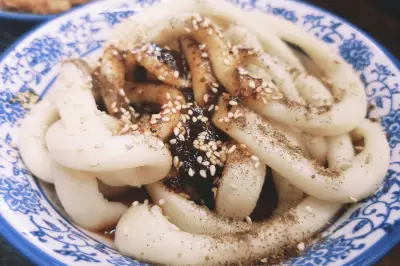
We visited Lijiang Ancient City only after coming down from Jade Dragon Snow Mountain the previous day and checking into the hotel. After storing our things, we went to eat. Finally, we had a chance to eat the Mengzi rice noodles we had seen many times. The broth was boiling chicken soup. After putting in the ingredients one by one, we took a sip of the soup and slurped the noodles. The taste was incredibly fresh.
After dinner, the mischievous kid and other children played throwing stones. After the kid's dad withdrew money from the bank, we decided to go to Lijiang Ancient City. It was about 300 meters from the hotel to the ancient city, quite close. Lijiang Ancient City is a bit different from other ancient cities. It has no obvious gate towers, but 27 entrances. Without a local guide, a directionally challenged person like me would get into a Bagua maze once inside. The alleys are very similar, and you get more and more dizzy. Following Little Prince's instructions, we entered from the North Gate. The landmark is the Mother-Child Waterwheel. We walked south along the water flow, called 'going with the flow'. When we got tired, we walked back along the water, called 'going against the flow'. The goods in the ancient city were dazzling. Besides the common silver shops, jade shops, and tea shops, there were also snack shops, milk tea shops, silk scarf shops, etc., common in other ancient towns. There were really many shoppers.
Day 5: We slept until 7 a.m., washed up, went to the first-floor restaurant for breakfast. The variety was quite rich. We took a bus to Heqing, the origin of Huanglong Jade. Huanglong Jade, one of Yunnan's Eighteen Oddities: 'Houses not lived in, bought to demolish', refers to this jade.
It has the color of Tianhuang (a type of stone) and the hardness of jadeite. It has good hardness, high transparency, and rich colors. Since it is produced in Longling and mainly yellow, it was eventually named Huanglong Jade. The price of this jade is a bit lower than jadeite, ranging from tens to tens of thousands. Some large decorative pieces with good color and complex, exquisite carvings can cost hundreds of thousands.
After visiting the jade museum, we went to the silverware museum. Its purity is 999, much softer than the common 925. Many shops have exquisite silver cups, priced at over a thousand. Of course, the pure silver nine-dragon cups are sold by weight, from 13-14 yuan per gram to over 20.
We browsed until 10 a.m. and then said goodbye to our Naxi Little Prince guide and returned to Kunming. The guide changed to A Mu from Shilin.
When we arrived in Kunming, it was almost 7 p.m. The last meal was the Peacock Feast. It was a farewell dinner with a family from Fujian that we had eaten with for five days.
Day 6 The End
This trip was very rushed. We were out early and returned late every day, sleeping only 6-7 hours. The mischievous kid basically fell asleep instantly. But I gained a lot. Precisely because the main guide or local guides introduced so much content, I was motivated to write this travel diary. Of course, since I received too much information at once, there may be many inaccuracies and omissions in the travelogue, such as the Yi people's preference for males over females, the Bai people's preference for females over males, the different customs and marriage traditions of these two ethnic groups, the Bai's three-course tea, the Ancient Tea Horse Road in Dali and Lijiang, Yunnan's three leaves, the Yi women's three happy bracelets, the crops they grow, etc. I saw, heard, and felt a lot, too much to express in one word.
Since this was my first trip to Yunnan, I took a group tour to scout the area. Next time, when I have more time, I will go again to Erhai Lake, Lugu Lake, Shangri-La, Daocheng Yading, etc. During the 6-day, 5-night trip, the person who accompanied us the longest was Guide Du, the most passionate was Little Prince guide, the best at telling stories was A Du, and the driver Master Ye who took us up and down hills in the four-star tourist bus. Thank you all. You worked hard. Thank you, Walk See, for giving me this opportunity.