Forget Work, Come Eat, Drink, and Play in Yunnan
Many people love spontaneous trips where they just pack up and go, while others prefer to wander aimlessly and enjoy a leisurely journey.
Basking lazily in the sun amid flowers and waters, doing nothing in particular.
Rather than obsessing over famous sights, just gazing at Cangshan Mountain and Erhai Lake, the goal is simply to relax and blend into local life.
Savor unexpected new flavors, befriend people you may never meet again but will always remember, and live someone else’s life in a different place.
Slow Living Destination – Yunnan
Yunnan is a place where colorful clouds pause to rest, a destination often called a 'slow living' haven. It’s a favorite not only for travelers but also a paradise for foodies.
Set foot on this enchanting land, and all you find is unhurried living—no rush to finish endless work or tackle unread emails.
Take your loved one’s hand and stroll together in the afterglow of sunset, then post your blissfully lazy moments and gorgeous photos on your social media.
It’s said that in this world, only love and beauty should never be missed. Come to Yunnan, and you’ll find neither will let you down.
Yunnan fulfills all your fantasies of hidden wonders, romance, and beauty.
Yunnan People’s Hometown Love for Rice Noodles
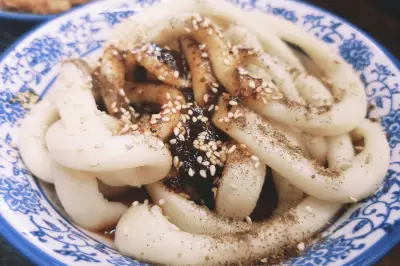
When it comes to local specialties, you can’t miss the food found in every street and alley of Yunnan, fervently loved by locals—'Mixian' (rice noodles).
Image from Gaoshaoke
Yunnan people’s passion for rice noodles is almost obsessive. They can eat rice noodles three meals a day for a week straight, but can’t bear a single day without them.
For Yunnan natives returning home, the first thing they do is find a noodle shop and 'shuai' (slurp down) a bowl of mixian.
Small-pot noodles, clay pot noodles, jar noodles, braised-oil noodles, mixed sauce noodles, quick-boiled meat noodles, stinky tofu noodles, cauliflower noodles...
The soft, springy, and delightfully chewy rice noodles are simmered in small pots, clay pots, or jars with stock for a few minutes, then dressed with all kinds of condiments.
Or they’re quickly blanched in a large pot, served with an array of toppings and Yunnan’s signature sour pickled vegetables.
A ladleful of piping-hot broth poured over, and a bowl of fresh, savory, fragrant, and spicy noodles warms and delights your taste buds and stomach.
Mengzi Crossing-the-Bridge Rice Noodles
Among all rice noodle dishes, the most ceremonious is Crossing-the-Bridge Rice Noodles. Legend has it that a scholar, after repeatedly failing the civil exams, secluded himself on a small island in South Lake of Mengzi to study hard.
His mother would bring him his meals, but by the time she arrived, the soup had turned cold and the dishes congealed. One day, she brought chicken broth; the surface was calm, but underneath the layer of grease, it was scalding hot.
Quick-witted, she realized that chicken fat could keep the broth warm. So she stewed a pot of broth with a whole fat chicken and pork bones, covered it with a thick layer of chicken fat, sliced the ingredients paper-thin, and delivered them to the island, where the hot broth would cook them instantly, along with the rice noodles.
For the first time, the scholar enjoyed a piping hot meal, and found the noodles thus blanched were even fresher and silkier. From then on, the mother’s ingenuity led her to select varied ingredients and continually innovate.
The scholar went on to pass the provincial exam, then the highest imperial exam, became a jinshi, and after ups and downs in officialdom, was dismissed and returned home. Alas, a decade later, he was separated from his mother by death.
One day, he arrived at Baoxing Lou by Suolong Bridge outside Jianshui City, saw bowls of rice noodles, and was overcome with longing for his mother.
So he taught the cooks to prepare the noodles the way his mother had, and the fragrant broth moved those around him to try it themselves—all praised its deliciousness. When asked what this dish was called,
the scholar said, 'I am on this side of the bridge, she was on the other side; I crossed the bridge, and the noodles crossed too. What I’m eating is Crossing-the-Bridge Rice Noodles.'
According to the Mengzi City Chronicles, Mengzi Crossing-the-Bridge Rice Noodles is a renowned Yunnan delicacy, dating back to the late Ming and early Qing dynasties, with over 300 years of history as of 1989. Guo Moruo called it a gorgeous camellia among Yunnan foods.
It has been listed as a national intangible cultural heritage item and stands among China’s Famous Snacks, a shining pearl in Chinese culinary culture.
Today, chains like Jianxin Yuan and Qiaoxiang Yuan have spread this dish throughout Yunnan.
The Romance of Kunming
'In the Spring City, flowers bloom everywhere'—an ancient poem describes the willows and falling petals outside Chang’an, but here, the city abloom with flowers is Kunming, the famous 'Spring City' and 'Flower City,' where it’s spring all year round.
Kunming holds layers of history, once shining brightly on the historical stage. During the war, Peking University, Tsinghua University, and Nankai University merged into the National Southwestern Associated University and relocated here.
Literati like Shen Congwen, Zhu Ziqing, Wen Yiduo, and Wang Zengqi infused the city with cultural ambience, turning it into a romantic haven.
Kunming is like an innocent, lively child. No matter the season, walking down any street, you’ll catch the scent of blossoms and a ceaseless vitality, gracefully displaying her charm.
When you arrive in Kunming, a special ritual awaits. Flowers, often just romantic accents elsewhere, become the most romantic invitation on the dining table here.
All year round, blooming flowers are woven into the cuisine by romantic Yunnan people, turning deep warmth into an intimate, lovey-dovey experience shared with your partner, letting your taste buds savor the romance.
The Romance of Dali: Wind, Flowers, Snow, and Moon
'Cangshan is an inkless painting of eternal beauty, Erhai a stringless zither of ageless music.' Dali is a kingdom of art and attitude, a realm of culture, anciently known as the Nanzhao Kingdom.
Upper Gate’s flowers, Lower Gate’s wind, Cangshan’s snow, and Erhai’s moon—these are the most romantic and artistic of all experiences: the fabled 'wind, flower, snow, and moon.'
Come here to find your own slow living. Whether wandering under the sun in the ancient town or daydreaming by the shores of Erhai, Dali turns life into a poem with its wind-blossom-snow-moon charm.
Erhai Lake purifies Dali into a heavenly purity.
The air is pure, the water crystal clear, nourishing everything naturally.
Plump crucian carp, icy snowmelt from Cangshan, a spicy red broth made by a Bai family, authentic sour papaya—slow-simmered to perfection, they become an authentic sour-spicy fish.
This is the true 'wind, flower, snow, and moon' on a Dali family’s dinner table.
Strolling through the ancient town, a spontaneous journey brings together a chorus of dialects from all over.
Every free spirit here breathes the air of liberty, tasting street snacks that tingle the palate—freedom is the essence of blissful ease.
Dali Carved Plums, according to historical records, were already exchanged as gifts during visits to friends and relatives as far back as the Nanzhao period in the Tang Dynasty.
Local Bai girls learn to make carved plums from childhood, a skill that marks a maiden’s dexterity and grace.
As tradition, before marriage, they must present a plate of exquisitely carved plums as a betrothal gift to the groom’s family.
Another must-try in Dali is the Rushan (milk fan) recommended by 'A Bite of China.'
This is a Dali specialty—sheets of dairy with a rich milky aroma, deep-fried to a crispy, moreish delight.
Or grilled soft over a flame, rolled up, and drizzled with rose sugar syrup. That sweetness seeps out from the bottom of your heart.
These ubiquitous street snacks embody the industriousness and wisdom of the Bai people, transforming their hard work under stars and moon into a lingering, sweet intimacy.
Jianshui’s Purple Pottery
The purple pottery of Jianshui, like the ancient city itself with over a thousand years of history, is renowned far and wide.
Jianshui purple pottery dates back to the late Song Dynasty, with over 900 years of production. History has it: Song for ceramics, Yuan for blue-and-white, Ming for coarse ware, Qing for purple pottery.
One of China’s intangible cultural heritage artisans, Jianshui purple pottery master Ma Chenglin.
Wang Zengqi once wrote: 'The best steam pots are those made in Jianshui. Nowadays, steam pots are made in many pottery regions like Yixing in Jiangsu.
But I find that chicken steamed in pots from elsewhere just doesn’t taste as good as those made in Jianshui.'
Jianshui Steam Pot Chicken is a unique and famous dish with a long and distinguished history. As early as the Qianlong reign of the Qing Dynasty, steam pot chicken was already popular in southern Yunnan.
Legend has it that it was invented by a chef named Yang Li at Fudeju in Lin’an Prefecture (now Jianshui). When the emperor inspected the region, the magistrate sought delicacies to please the sovereign, offering a reward of 50 taels of silver for the best dish.
Yang Li, poor and with a sick mother, combined local hot pot and steamed bun techniques to invent the steam pot. He even risked his life to climb Swallow Cave to collect bird’s nests, intending to make a bird’s nest steam pot chicken.
Unfortunately, the pot was stolen, and Yang Li was charged with deceiving the emperor and condemned to death. Fortunately, the emperor inquired into the truth, spared his life, and renamed Fudeju to 'Yang Li Steam Pot Chicken.'
Since then, steam pot chicken gained immense fame, becoming a renowned Yunnan dish. The recipe then was simple yet hearty; modern versions have refined it while retaining the rich aroma.
'Water-made soy milk, a wonder under heaven; fire-baked tofu, fragrance beyond the clouds.' This refers to Shiping tofu, adjacent to Jianshui, with a history of several hundred years and widespread renown.
Shiping tofu is made using local underground 'sour water,' giving it a delicate fragrance, tenderness, and flavor unmatched by any other. Pan-fried, deep-fried, or stir-fried, it’s an absolute delicacy.
Handmade tofu
But the most distinctive way is with friends gathered around a charcoal fire, grilling the tofu slowly on a rack—that’s the tastiest.
A golden, crispy skin encasing tender tofu, one bite releases a burst of aroma that lingers in your mouth.
Rich Ethnic Flavors
Yunnan is where you’ll encounter the most ethnic minorities in China, and its cuisine is steeped in strong ethnic elements, each with distinctive charm.
Warm and unpretentious, these communities preserve the most primal ethnic flavors that excite and challenge your palate.
The sour and spicy Dai dishes are as graceful as a Dai maiden in her slim silhouette.
The Hani Long Street Banquet
The Hundred-Insect Feast, a test of courage and daring
This blessed land has nurtured an abundance of food. To truly unlock Yunnan, you must navigate its map with a foodie’s eye, seeking out the flavors that suit you best.
Travel is about breaking free from routine, gaining a different perspective.
In this restless society, we’ve lost the serenity to discover, appreciate, and enjoy beauty. Come to Yunnan, set aside desires and anxieties, and settle in like a local.
Knead romance and artistry into everyday life, simmering each ordinary day over a low flame.
Then there are fresh vegetables to pick, flowers blooming throughout the mountains, fiery red chilies drying in the courtyard, and jars of freshly made pickled vegetables.
In the fields outside the door, rapeseed flowers blanket the land, grass is forming its seeds, and the wind is rustling through the leaves…
Everything is so beautiful. Come to Yunnan, turn life into poetry, and slowly stew your days into sweetness.