Through High Mountains, Into Rainforest — A 17-Day Tour of Mount Emei, Shangri-La, Xishuangbanna, and Kunming
The destination for 2020 was Yunnan. With a lingering craving for Chengdu's cuisine and the easy access from Chengdu to Yunnan, the original plan was to start this year's trip from Chengdu. However, the sudden COVID-19 outbreak in early 2020 brought great uncertainty to travel, so I hadn't been able to decide whether to go. Having been cooped up at home for over half a year and feeling rather down during the pandemic, I wanted to get out for some fresh air. So I booked train tickets to Qingdao and a hotel there, planning to first go to Qingdao, which was closer to Tianjin, to enjoy the sea breeze. Two days before departure, seeing that the domestic epidemic situation had become relatively stable and long-distance travel was possible, I finally decided to go to Qingdao first, then to Mount Emei in Chengdu and Yunnan.
Total expenses for Mount Emei and Yunnan (for 2 people): 19,723.25 yuan, including:
Transport: 6,567.42 yuan, Accommodation: 3,776.60 yuan, Entrance fees (including scenic shuttle buses, cable cars, etc.): 2,862.00 yuan, Shopping, meals, local transport and miscellaneous: 6,517.23 yuan.
Due to a flight delay, we arrived at Chengdu Shuangliu Airport around 2 p.m. After collecting our checked luggage, we had already missed the early afternoon high-speed train from the airport to Mount Emei, so we had to wait at the station for the 6 p.m. train. We arrived at the Mount Emei high-speed train station after 7 p.m. Fortunately, the city of Emeishan is not large, and the hotel owner we booked with came to pick us up right on time.
After settling in at the hotel, we went out for dinner. Mount Emei is very close to Leshan, so many Leshan delicacies can also be found here. Since we planned to stay overnight at the Golden Summit, we first bought some food supplies needed for tomorrow's mountain trip. Later, we noticed a restaurant called Niu Mantang Qiaojiao Beef with many diners, so we decided to start our first meal in Mount Emei there.
We ordered a medium portion of Qiaojiao beef, and it arrived as a large pot brimming with beef, beef offal, and vegetables. The beef and offal were very tender, and the beef soup was delicious. Soaking rice in the broth made it even tastier.
After filling up on Qiaojiao beef, we returned to the hotel to rest and prepare for the next day’s Mount Emei journey.
Last night while eating out, we noticed a shop selling Mount Emei-style tofu pudding, with a plaque reading “Intangible Cultural Heritage.” This morning we came to try it, curious to see how it differs from the northern tofu pudding we’re used to.
The tofu pudding here contained crispy meat and many fried toppings, which felt a bit greasy and hard to get used to.
Mount Emei Tofu Pudding
After breakfast and storing our luggage, we embarked on our Mount Emei journey.
Mount Emei is a sacred site of Samantabhadra Bodhisattva and one of China's "Four Great Buddhist Mountains." With its steep terrain and beautiful scenery, it is renowned as "Emei's Beauty Under Heaven." Religious culture, especially Buddhist culture, forms the core of Mount Emei's historical and cultural identity. All its architecture, statues, ritual implements, as well as ceremonies, music, and paintings, exude a strong religious atmosphere.
First, we took a bus to Fuhu Temple at the foot of the mountain.
Fuhu Temple, also known as Fuhu Chan Monastery, Shenlong Hall, or Huxi Abode, is adjacent to Baoguo Temple. Destroyed during the Ming Dynasty, it was rebuilt in the eighth year of the Shunzhi reign (Qing Dynasty) and renamed "Huxi Abode." Later, due to tiger attacks in the vicinity, the monks built a Zunsheng pillar to ward off the tigers, and the temple was renamed "Fuhu Temple" (Temple of Subdued Tigers). Emperor Kangxi once inscribed the plaque "Ligou Yuan" (Garden Free of Dust) for Fuhu Temple.
Stepping through the temple gate, we were greeted by an expanse of lush, sky-obscuring greenery. There weren’t many visitors here, and the serene atmosphere gave a sense of detachment from the mundane world. Walking up stone steps and passing through Xijin Forest, we soon saw the temple with a plaque reading "Huxi Abode."
In the rear courtyard to the right of the Mahavira Hall stands a bronze Huayan Pagoda cast during the Ming Dynasty, within a pavilion. The pagoda is 5.8 meters tall with 14 tiers, and its body bears over 4,700 small Buddha statues and the entire text of the Avatamsaka Sutra. This bronze pagoda is considered the finest in China due to its antiquity, grand size, and superb casting.
Fuhu Temple – Huayan Treasure Pagoda
Fuhu Temple – Huayan Pagoda Pavilion
After leaving Fuhu Temple, we strolled along a mountain path and soon arrived at Baoguo Temple.
Baoguo Temple is the first temple on Mount Emei, the seat of the Mount Emei Buddhist Association, and the center of Buddhist activities here. In front of the mountain gate stands a pair of stone lions carved during the Ming Dynasty, lifelike and majestic, guarding this famous sacred monastery like sentinels. In the 42nd year of the Kangxi reign (1703 AD), Emperor Kangxi drew from the Buddhist concept of “four benefactions and four requitals” and personally inscribed the plaque “Baoguo Temple” (Temple of Requiting the Country).
This is a must-visit spot on Mount Emei, so there were many people; it wasn’t as peaceful as Fuhu Temple.
It was nearly noon when we left Baoguo Temple. We walked to the Baoguo Temple Passenger Transport Center to take a bus to the Golden Summit, passing by a stone-carved corridor and the First Mountain Pavilion along the way.
Mount Emei – Stone-Carved Corridor
Mount Emei – Stone-Carved Corridor
Mount Emei – Stone-Carved Corridor
Mount Emei – First Mountain Pavilion
The sightseeing bus from Baoguo Temple Passenger Transport Center goes directly to Leidongping Parking Lot, a journey of two hours. From the parking lot, you can walk to the lower station of the Golden Summit cable car at Jieyin Hall, then take the cable car up; those with good fitness can also hike up. The mountain path from Jieyin Hall to the Golden Summit is quite steep, and walking takes about an hour and a half. To conserve energy, we opted for the cable car. The uphill stretch from Leidongping Parking Lot to Jieyin Hall is relatively easy and scenic; we strolled, pausing to take photos, and reached the cable car lower station in just over half an hour. The Golden Summit cable car cabins are large, like bus carriages, holding about 30–40 people, and in just over ten minutes we arrived at the upper station. Our hotel, the Golden Summit Hotel, was right at the exit of the upper station.
It was less than a ten-minute walk from the hotel to the Golden Summit. After dropping off our luggage, we set out.
The Golden Summit is the most concentrated area of temples and scenic spots on Mount Emei, gathering its essence and serving as the symbol of the mountain. Also known as Huazang Temple, it was first built in the Tang Dynasty, with a roof covered in tin tiles; during the Yuan Dynasty it was also called the “Silver Summit.” From the Golden Summit, one can witness the four great wonders of Mount Emei: sunrise, sea of clouds, Buddha’s light, and sacred lanterns.
At the highest point of the Golden Summit stands a rare treasure called the “Golden Summit Bronze Hall,” built in the 30th year of the Wanli reign of the Ming Dynasty (1602) at the request of Master Miao Feng, with donations from the Prince of Lu’an of Western Shu. The hall is 8 meters high, 4.8 meters wide, and 4.3 meters deep, with double-eaved carved ridges and windows locked with embroidered palm patterns, entirely welded from bronze components. The roof tiles are gilded, gleaming brilliantly in the sunlight and visible from miles away, hence the name “Golden Summit.”
Our luck was good—the sky cleared as we reached the summit. Even before climbing up, we could see the golden statue of Samantabhadra with Four Faces and Ten Directions shining dazzlingly in the sunlight. Ascending the high stone steps, the terrain opened up suddenly, and the towering statue along with the Golden Summit gleamed brilliantly against the blue sky and white clouds.
Looking around from the summit, we took in all the surrounding peaks and could even see Wanfo Summit in the distance.
Wanfo Summit is the highest peak of Mount Emei at 3,099 meters, with sheer cliffs soaring into the sky. A flat plateau rises abruptly, towering over the crest of the “Great Brightness Mountain.” It is not only the highest scenic and nature reserve among the Four Great Buddhist Mountains but also the highest World Natural and Cultural Heritage site in China.
Unfortunately, the path to Wanfo Summit is now closed, so we could only gaze at it from the Golden Summit.
Mount Emei Golden Summit – Distant View of Wanfo Summit
Around 5 p.m., tour groups and visitors staying at the foot of the mountain gradually descended, and the bustling crowds disappeared. Only those of us staying on the summit to photograph the sunset remained. We waited until the sun had fully set before returning to our hotel.
Mount Emei Golden Summit – Sunset
Before dawn, we went back to the Golden Summit, where many people had already gathered, all waiting for the sunrise.
As light began to appear on the horizon, the crowd stirred. Gradually, the sky grew brighter, and the edges of the white clouds were dyed golden-red by the sun. At first, only a tiny sliver of dark red sun peeked over the cloud edge, then slowly more than half emerged. Soon, the bright red sun leaped above the clouds, bathing the surrounding peaks and the Golden Summit in a layer of gold. The Samantabhadra statue and the summit's great hall gleamed brilliantly in the morning glow.
Mount Emei Golden Summit – Sunrise
The Golden Summit Bathed in Morning Light
Mount Emei Golden Summit – Distant View of Wanfo Summit
Once the sun was fully up, we contentedly returned to the hotel. After breakfast, we prepared to descend. From an observation deck near the cable car upper station, we saw distant snow-capped mountains, the snowy peaks shining ever brighter under the sun. On the way to Leidongping, we also encountered some Mount Emei monkeys.
Mount Emei Golden Summit – Distant View of Snowy Mountains
Mount Emei – A Chance Encounter with Monkeys
We took a bus from Leidongping Parking Lot to Wannian Temple Parking Lot, then a cable car up to Wannian Temple.
Wannian Temple is one of the eight major temples of Mount Emei. It houses three treasures: a Buddha tooth relic, palm-leaf sutras, and an imperial seal. The temple contains many inscribed steles, the most famous being the “First Mountain Stele” handwritten by the Song Dynasty calligrapher Mi Fu. The Beamless Brick Hall, the temple’s second hall and also known as the Samantabhadra Hall, was built during the Ming Dynasty entirely from bricks, without a single piece of wood, pillar, or tile—a magnificent sight.
We descended on foot from Wannian Temple along stone steps, passing by White Dragon Cave. Also called White Dragon Temple, it was founded by Master Biechuan during the Jiajing reign of the Ming Dynasty. Behind the temple, there were originally two caves known as Upper and Lower White Dragon Caves, said to be where the legendary Lady White Snake cultivated herself, hence the temple’s name.
White Dragon Cave is small; a quick tour takes about ten minutes. Continuing downhill, we soon arrived at Qingyin Pavilion.
Qingyin Pavilion was originally called Niuxin Temple in the Tang Dynasty, and during Emperor Xizong’s reign, Master Huitong of Jiangling renamed it Woyun Temple. In the Ming Dynasty, Master Guangji took the phrase “Why need strings and bamboo when mountains and waters have pure sound” from the Jin Dynasty poet Zuo Si’s poem “Inviting Hermits” and renamed it Qingyin Pavilion (Pure Sound Pavilion). The pavilion has only one hall, enshrining the Three Saints of Huayan: Sakyamuni Buddha in the center, Manjusri Bodhisattva on the left, and Samantabhadra Bodhisattva on the right. In front stands the “Jie Wang Pavilion.” Though small, Qingyin Pavilion is embraced by mountains and waters, exuding beautiful scenery. Its layout embodies the concept of “harmony between nature and man,” making it a classic example of Chinese Buddhist temple garden architecture. One of Mount Emei’s Ten Scenes, “Two Bridges with Pure Tones,” is located here.
This is another must-visit spot on Mount Emei, so it was crowded, turning what should be a tranquil place into a noisy one. We lingered briefly, then took a bus down to Baoguo Temple Passenger Transport Center.
At the foot of the mountain, we retrieved our stored luggage and headed to the Mount Emei high-speed train station. With time to spare, we immediately changed our tickets to the next available train to Chengdu.
By the time we settled into the hotel, it was already dinner time. We found a hotpot restaurant called Yuanji Chuanchuanxiang near the hotel online and kicked off our culinary journey in Chengdu.
Chengdu Chuanchuanxiang Hotpot
Today we planned to rest in Chengdu and wander around in search of local snacks.
Early in the morning, following navigation, we found a shop specializing in Chengdu snacks called Xiaomingtang Dandan Sweet Water Noodles. We ordered Chengdu-style dandan noodles and several other snacks, all of which tasted great.
Last time in Chengdu, I had visited Jinli at night. After breakfast, we decided to explore Jinli in the daytime. We saw a vendor selling sugar-oil fritters on the roadside and bought some to try—not bad.
Jinli was still crowded during the day, but without artificial lighting, the buildings revealed a rustic charm.
Passing by the Three Kingdoms Tea Garden, we happened to catch a Sichuan opera performance. Tired from walking, we went in to rest. The program was rich, including acrobatics, magic, water sleeve dances, and the highlight—Sichuan opera’s unique stunt: face-changing.
Face-changing is an important part of Sichuan opera performance art. It is a special technique used to portray characters, a romantic method to reveal a character’s inner thoughts and emotions, and an artistic treasure created and passed down by generations of Sichuan opera performers. The techniques roughly fall into three types: “smearing,” “blowing,” and “pulling.” Sichuan opera brings face-changing to the stage, turning it into a unique art form with exquisite skill.
We enjoyed the performance while sipping tea.
After the show, because I remembered seeing some Jian ware tea sets in Kuanzhai Alley last time and wanted to buy a set to take home, we headed back to Kuanzhai Alley. But after wandering around for a while, we couldn’t find that shop and gave up. Reading online that Kuixinglou Street, not far from Kuanzhai Alley, had many snacks, we decided to have dinner there.
Kuixinglou Street is a short street lined with restaurants, many of them hotpot places. We bought an egg puff cake from a roadside stall—taste was acceptable. Noticing a shop called Shejianpaidui Sichuan Snack Collection with many customers, we ordered a few snacks there. I had expected a specialist snack shop to be delicious, but the ones we tried were just average.
Early in the morning, we flew from Shuangliu Airport to Lijiang, arriving after a 1.5-hour flight. We had booked a hotel in Shuhe Ancient Town, which included airport pickup, and the driver was already waiting for us. The drive from the airport to Shuhe took about an hour, so we reached the hotel around noon.
We used the afternoon to visit the Mu Mansion within the ancient city of Lijiang and stroll around the old town.
The Old Town of Lijiang, also known as Dayan Ancient Town, is one of two ancient towns in China successfully inscribed as a World Cultural Heritage site in their entirety. Its streets are built along the contours of hills and by waters, paved with red breccia, featuring sites like Sifang Square, Mu Mansion, Wufeng Tower, and the Great Waterwheel.
The Mu Mansion originally served as the government office of the hereditary Mu chieftains of Lijiang. Situated at the eastern foot of Lion Hill in the old town, it was first built during the Yuan Dynasty (1271–1368) and reconstructed in 1998 as the Ancient Town Museum. Covering 46 mu (about 3 hectares), the mansion has 162 rooms large and small, with a central axis 369 meters long. The Sanqing Hall, Yuyin Pavilion, Guangbi Pavilion, Hufa Hall, Wanjuan Tower, Council Hall, and Zhongyi Archway are arranged neatly from west to east. Eleven plaques personally inscribed by emperors of various dynasties hang inside, reflecting the rise and fall of the Mu family. The TV drama Mu Mansion Story, which tells the stormy history of the Mu chieftains, was filmed here.
The Mu Mansion is vast in scale, its architectural layout resembling the Forbidden City in Beijing.
After leaving the Mu Mansion, we wandered along the old town’s streets and ended up at Sifang Square without realizing it.
Sifang Square is the heart of Lijiang Old Town, said to have been built by the Mu chieftain of the Ming Dynasty in the shape of his official seal. It was a crucial hub on the Ancient Tea Horse Road, where merchants gathered from all over since the Ming and Qing dynasties, creating a melting pot of cultures and a center for economic and cultural exchange.
Turning into a small lane off Sifang Square, flowers bloomed everywhere along the way. At the end of the lane was a must-see spot in the old town—the Great Waterwheel.
Lijiang Old Town – Great Waterwheel
After exploring the old town, it was dinner time. Outside the old town, we found a hotpot restaurant called Amala Paigu and ordered the must-try cured spare ribs hotpot, along with side dishes like water shield (Shuixing Yanghua). The pot arrived crammed with cured ribs, and it tasted fantastic. Even after we were stuffed, plenty remained uneaten.
Lijiang Cured Spare Ribs Hotpot
With plenty of time today, we planned to take a bus to the Yuzhu Qingtian (Jade Pillar Piercing Heaven) Scenic Area. Leaving the hotel in the morning, we caught bus 111 at the entrance of Shuhe Ancient Town, transferred to bus 17 to Yuhu Village, then walked along the road to the scenic spot.
Yuzhu Qingtian is part of the Jade Dragon Snow Mountain scenic area, about ten li from the old town. Together with Yushui Village, Yufeng Temple, Dongba Valley, Dongba Wanshen Garden, and Dongba Kingdom, it forms the “Three Jades and Three Dongbas.”
Yuhu (Jade Lake) is a man-made lake dug under the order of the Mu family before the Ming Dynasty. The Mu family built a summer palace, the Jade Dragon Academy, and a deer farm by the lake. The earliest inhabitants of Yuhu Village were those who guarded the palace and raised deer for the Naxi king.
On the cliff beside the lake, four large characters “Yu Zhu Qing Tian” (Jade Pillar Piercing Heaven) are carved, inscribed by Yang Bi, the first appointed magistrate of Lijiang. This inscription not only captures the magnificence of Lijiang’s snowy mountains but also serves as a cultural relic directly linked to the important historical event of “gaitu guiliu” (replacing native chieftains with imperial officials). The lake water is crystal clear with swaying waterweeds, and on fine days, the blue sky and white clouds set off the reflection of the towering Jade Dragon Snow Peak in the lake, as if nature itself has settled to the bottom. “Yuhu Reflection” is the first of the Twelve Finest Scenes of Jade Dragon Snow Mountain, praised by Naxi poets of the Ming and Qing dynasties.
Today, the Yuzhu Qingtian scenic area mainly focuses on introducing Dongba culture and traditional Naxi customs, with exhibition halls displaying Dongba script and Naxi folklore. Few visitors come here; lush trees sway gently, and the still reflections in Yuhu Lake resemble an oil painting rich in color. Unfortunately, it was overcast, so we missed seeing the reflection of Jade Dragon Snow Mountain.
Yuzhu Qingtian Scenic Area
Yuzhu Qingtian Scenic Area
Yuzhu Qingtian Scenic Area
Yuzhu Qingtian Scenic Area
Leaving the scenic area and following a path next to the parking lot, we came to a large meadow. Wildflowers of all kinds bloomed across it, and with just the two of us there, we could fully enjoy nature’s beauty. Crossing the meadow led to Yuhu Village. The village roads are paved with stones, and the houses are built of stone, blending seamlessly with nature. The village is big; while strolling, we happened upon a building with a sign reading “Joseph Rock’s Former Residence.”
Rock was the foreign scholar who first comprehensively introduced Naxi culture to the Western world. In 1922, Joseph Rock entered Yunnan from the Thai-Myanmar border as an explorer, writer, and photographer for National Geographic and Harvard’s Arnold Arboretum, and then lived at the foot of Jade Dragon Snow Mountain for 27 years.
Yuhu Village – Passing Through the Large Meadow
Yuhu Village – Passing Through the Large Meadow
Yuhu Village – Joseph Rock’s Former Residence
After returning from Yuhu Village, we had intended to explore Shuhe Ancient Town, but a sudden downpour sent us back to the hotel to rest.
No trip to Lijiang is complete without visiting Jade Dragon Snow Mountain, and today was our day to go.
Jade Dragon Snow Mountain, the main peak of the Yunling Range in the Hengduan Mountains, is a young limestone block-fault mountain. Its 13 peaks are arranged north to south, with the highest, Shanzidou, reaching 5,595 meters. It is snow-capped year-round and features the temperate oceanic glacier closest to the equator in Eurasia, making it the northernmost perpetually snow-covered mountain near the equator. The developed scenic spots include Glacier Park, Ganhaizi, Blue Moon Valley, Spruce Meadow, and Yak Meadow. There are three cableways: a large one to Glacier Park, a medium one to Yak Meadow, and a small one to Spruce Meadow.
With thick clouds and overcast skies, we decided to skip Glacier Park and head first to Yak Meadow at 3,700 meters elevation, then to Blue Moon Valley. Private vehicles can only go as far as the visitor center at Ganhaizi, after which we took a scenic shuttle to the cable car station and rode up.
Yak Meadow is called “Gezhangu” in Naxi, where “ge” means high mountain meadow, “zhan” means arranged like stars, and “gu” means a corner or area, thus “an alpine meadow dotted like stars.”
The cable car traveled through the mountains as the fog thickened. Stepping out, we were instantly enveloped in dense mist with very low visibility. We walked along, photographing dewy flowers and grass, hoping the fog would lift.
Jade Dragon Snow Mountain – Yak Meadow
Jade Dragon Snow Mountain – Yak Meadow
Jade Dragon Snow Mountain – Yak Meadow – Snowflake Temple
After waiting over an hour and seeing no sign of the fog clearing, we reluctantly took the cable car down. We got off at Blue Moon Valley to explore.
Meltwater from Jade Dragon Snow Mountain flows down the eastern foot through a valley. Because the water is blue and the valley is crescent-shaped, it looks like a blue moon set at the mountain’s base from afar, reminiscent of the Blue Moon Valley in James Hilton’s novel Lost Horizon, hence the name. As the river flows, it forms four larger pools blocked by the terrain, called Jade Liquid Lake, Mirror Pond Lake, Blue Moon Lake, and Listening to the Waves Lake. The shores are lushly vegetated, with distant snowy peaks as a backdrop.
The lakes in Blue Moon Valley vary in shade, presenting different blues. Boardwalks connect the lakesides, allowing close access to the water. Perhaps because the poor weather hid the mountain, crowds gathered here, making the place bustling and noisy.
Jade Dragon Snow Mountain – Blue Moon Valley
Jade Dragon Snow Mountain – Blue Moon Valley
Jade Dragon Snow Mountain – Blue Moon Valley
Jade Dragon Snow Mountain – Blue Moon Valley
Jade Dragon Snow Mountain – Blue Moon Valley
Jade Dragon Snow Mountain – Blue Moon Valley
After finishing Blue Moon Valley, our day at Jade Dragon Snow Mountain came to an end. Back from the mountain, we strolled around Shuhe Ancient Town.
Shuhe Ancient Town is one of the earliest settlements of the Naxi ancestors on the Lijiang plain. It is a well-preserved important town on the Ancient Tea Horse Road, a living example of the Naxi transition from agricultural to commercial civilization, and a model of town formation through trade and caravan activities.
On the edge of the ancient town, we came across a small shop selling native chicken rice noodles. A bowl was 12 yuan, with soft, smooth noodles and a rich chicken soup.
Lijiang Delicacy – Native Chicken Rice Noodles
From Lijiang to Shangri-La, there is only road transport for now. To visit Tiger Leaping Gorge along the way, we booked a shared car online from Lijiang to Shangri-La, which could stop at Upper Tiger Leaping Gorge for an hour and a half.
The Jinsha River, originating from the Geladaindong Snow Mountain in Qinghai, rushes thousands of miles only to be suddenly blocked by Jade Dragon and Haba snow mountains. The once calm river turns furious, surging into the vast chasm between the two mountains and carving a long, narrow gorge—this is the famous Tiger Leaping Gorge. It is the first major gorge on the Yangtze River, renowned for its perilous beauty and grandeur, one of China’s deepest gorges. The name comes from a legend about a tiger jumping across the river on a central rock. It includes Upper, Middle, and Lower sections, plus a high trail.
Upper Tiger Leaping Gorge is the narrowest part. In a river section about 30 meters wide, a huge boulder rises 4–5 meters in midstream, lying like a sudden high waterfall, splitting the torrent in two with thunderous waves. Legend says a tiger once used this rock to leap from the Jade Dragon side to Haba Snow Mountain, hence its name: Tiger Leaping Rock.
The car stopped on the roadside. Descending steps, we saw a stone statue of a leaping tiger by the river, about 3 meters tall including the base—a landmark of Tiger Leaping Gorge. From there, we entered the gorge, where towering mountains rose on both sides. The river was studded with jagged rocks. The water surged between the two mountains, roaring like a tiger charging downhill, swift as lightning, with spray flying and the valley echoing—a spectacular sight. The foaming waves rushed and swirled into misty wreaths, creating a rare natural spectacle.
After exploring Upper Tiger Leaping Gorge, we continued driving. The car made a brief stop at Xiaozhongdian, where a sea of flowers bloomed. In September, the starthistle (Langdu) flowers were in full bloom, their fiery red blossoms set against green mountains and grass forming a beautiful picture.
Shangri-La – Xiaozhongdian – Starthistle Flowers
Shangri-La – Xiaozhongdian – Starthistle Flowers
Around 2 p.m., we arrived at the East Gate parking lot of Dukezong Ancient Town in Shangri-La.
Dukezong Ancient Town has a history of over 1,300 years and is the largest and best-preserved Tibetan residential complex in China. It was once a hub on the Ancient Tea Horse Road, a window for cultural exchange between the Tibetan highlands and Yunnan, and an economic link for Sichuan-Tibet-Yunnan trade. A major fire in 2014 destroyed most of its buildings, and the current old town has since been rebuilt.
Our hotel was near the North Gate. With luggage in tow, we thought about taking a taxi, but it was hard to get one at the East Gate parking lot, so we called the innkeeper to pick us up.
Night falls late in Shangri-La, so after settling in, we took a taxi to Songzanlin Monastery, not far from the ancient town.
Ganden Songzanlin Monastery, also known as Guihua Monastery, is the largest Tibetan Buddhist monastery in Yunnan Province and one of the famous monasteries in the Tibetan region. It is a center of the Gelug (Yellow Hat) sect in Sichuan and Yunnan, holding great significance throughout Tibet, and is known as the “Little Potala Palace.” Built against a hill, it resembles a fortress, epitomizing Tibetan religious culture and sculptural art. The architecture is resplendent with gilded copper tiles, elaborate roof ornaments, and a vast, majestic assembly hall where many Buddha statues are enshrined, flanked by exquisite murals and decorations—earning it the title “Tibetan Art Museum.”
We first visited the museum opposite the visitor center, which displayed many beautiful thangkas and a three-dimensional four-sided mandala, exquisitely crafted.
After the museum, we took a shuttle from the visitor center to the monastery. I had read that Lamuyangcuo Lake in front offers a reflection of the entire monastery. After getting off, we walked around the lake’s artificial trail. The water was clear, with lush waterweeds, and ducks occasionally frolicked and foraged. In a brief moment when the sun peeked through clouds, we captured the monastery’s reflection, with the gilded tiles of the main hall sparkling in the sun.
The admission ticket includes a guided tour, where the guide gathers individual visitors and leads them inside with explanations. We finished walking around the lake just as a guide was about to take a group in, so we joined them.
Like typical Tibetan Buddhist architecture, Songzanlin Monastery has its two main halls, Zhacang and Jikang, towering in the center, surrounded and flanked by eight Kangcan buildings and monk quarters, arranged in varied heights and layers, giving a clear three-dimensional profile that enhances the majestic main structures. The Zhacang, meaning monastery in Tibetan, is where monks study scriptures and doctrines.
Ganden Songzanlin Monastery
Ganden Songzanlin Monastery
Ganden Songzanlin Monastery
Tibetan cuisine and yak meat hotpot are local specialties in Shangri-La. Back from the monastery, we went to a highly-rated restaurant inside the ancient town called Zai Shui Yifang Specialty Hotpot. The staff recommended a combo platter of yak meat and black pork, a wild vegetable platter, and barley pancakes. When we tried to order more, they strongly advised against it, fearing we couldn’t finish. Both the yak meat and black pork were tender, and the vegetable platter featured various seasonal greens. In the end, we were full without even finishing.
Shangri-La Yak Meat Hotpot
We booked a direct tourist bus from Dukezong Ancient Town to Pudacuo National Park and boarded at the parking lot in front of Moonlight Square in the morning. On the way, we bought yak milk and barley pancakes from vendors—delicious.
The small hill east of Moonlight Square is the famous Guishan Park. Bright sunshine and pure blue skies, along with a gleaming golden prayer wheel, form the most beautiful picture. At the park entrance, there’s a large crystal-clear pool fed by ancient well spring water, safe to drink. Many townspeople draw their domestic water from here.
Ancient Well at the Entrance of Guishan Park
On either side of the square are the Red Army Long March Museum and the Diqing History Museum. With some time before the bus, we visited both. The Long March Museum is actually a Tibetan temple, housing a main hall where many local elderly women come to worship. The Diqing History Museum displays some historical artifacts.
Red Army Long March Museum
Red Army Long March Museum
Diqing History Museum
The direct bus was originally scheduled to depart at 10 a.m., but due to a staff mistake we were delayed, arriving at the park around noon.
Pudacuo National Park lies in the heart of the “Three Parallel Rivers” World Natural Heritage area in northwestern Yunnan, at altitudes between 3,500 and 4,159 meters. It consists of the Bitahai Nature Reserve (an internationally important wetland) and the Shudu Lake area of the Haba region of the World Heritage site, with Bitahai, Shudu Lake, and Milithang subalpine pastures as its main parts. It features geological landforms, lakes and wetlands, forests and meadows, valleys and streams, and rare flora and fauna, preserved in a primitive state—one of Shangri-La’s main attractions.
To protect a rare fish species—the schizothorax—Milithang and Bitahai are currently closed; only the Shudu Lake area is open.
From the visitor center, we took a park shuttle to the Shudugang River trekking area, and from there we had to walk 3 km to the Shudu Lake area. Only a few passengers got off here; the rest went directly to the lake. Since we had enough time, we got off to trek.
The treking area has a trail winding through high mountains and gorges. Since few visitors come, the environment is largely undisturbed and quite pristine. Dense primeval forest blocks out the sky, with thick, tightly packed green canopies shielding from wind and rain. Walking through the lush woods, we hardly felt we were at an altitude of over 3,000 meters.
Pudacuo National Park – Shudugang River Trekking Area
Pudacuo National Park – Shudugang River Trekking Area
Pudacuo National Park – Shudugang River Trekking Area
Pudacuo National Park – Shudugang River Trekking Area
Pudacuo National Park – Shudugang River Trekking Area
The end of the trek brought us to the parking lot of the Shudu Lake area.
Shudu Lake is surrounded by verdant mountains where tall, stout spruce and fir trees reach into the clouds. Broad meadows are lush with waterweeds, and the lake teems with wild ducks, ruddy shelducks, and other waterfowl.
Following the boardwalk, a vast lake came into view, and shallow areas were thick with aquatic plants. Perhaps because of the overcast sky, the scenery wasn’t as stunning as we had imagined.
Pudacuo National Park – Shudu Lake
Pudacuo National Park – Shudu Lake
Pudacuo National Park – Shudu Lake
Pudacuo National Park – Shudu Lake
We returned from the park at 4 p.m., got off at the East Gate of Dukezong Ancient Town an hour later, and went straight to Guishan Park.
Climbing a steep flight of steps, we soon reached the Han Temple, behind which stands the world’s largest prayer wheel. Looking up, the wheel is about five stories high, truly magnificent. The body is solid bronze gilded, with reliefs of Manjusri, Samantabhadra, Avalokitesvara, and Ksitigarbha bodhisattvas on the upper section, and the Eight Buddhist Treasures on the lower section. Inside it contains 1.24 million items including mantras, true words, and various Buddhist treasures, weighing about 16 tons. To turn such a huge wheel, it takes a dozen or more people working together. Turning it clockwise once is equivalent to chanting the Buddha’s name 1.24 million times; three full turns bring blessings and good fortune.
From the park, we overlooked the entire city of Shangri-La: smoke curling from chimneys, the shimmering waters of Black Dragon Pond—all in full view.
Guishan Park – Prayer Wheel
We joined others to turn the prayer wheel three times, hoping for all to go well. After the park, craving a Tibetan meal, we searched the old town and found a small eatery called Zangwei Xinqiao Snacks. We ordered barley noodles, stir-fried Tibetan pork slices, hand-grasped tsampa, and butter tea. The tsampa was sweet and delicious, the butter tea rich and creamy, and the noodles and pork were also very tasty.
Hand-Grasped Tsampa and Butter Tea
Barley Noodles and Stir-Fried Tibetan Pork Slices
Fully sated, we continued wandering in the old town and stumbled upon Shambhala Old Street, a quaint, antique lane.
We had booked three nights in Shangri-La, but feeling a bit unwell, we decided to check out early and return to Lijiang the next day.
Early the next morning, we left Shangri-La by car and arrived in Lijiang by noon. In the afternoon, we visited Black Dragon Pond Park, not far from our inn.
Many buses go from the old town to Black Dragon Pond Park. Inside the park, there is a crystal-clear spring pond, along with ancient buildings harmoniously arranged with the landscape: the Dragon God Shrine, Deyue Pavilion, Suocui Bridge, Jade Emperor Pavilion, and relocated structures like the Liberation Forest Gate Tower from Fuguo Temple (originally from Zishan, Ming Dynasty) and Wufeng Tower.
On clear days, you can photograph Jade Dragon Snow Mountain reflected in the pond. Unfortunately, the thick clouds during our stay prevented us from seeing the mountain at all.
Leaving the park, about a kilometer along the Jade River brought us to Lijiang Old Town. Many travel guides recommend No. 88 Snack Shop, so we headed there. After navigating there and ordering four snacks, we were told three weren’t available, so we quickly left to find food elsewhere.
Our backup was Zhongyi Market, a place many locals frequent, which has a food night market after 6 p.m. every evening.
Our flight to Xishuangbanna was in the evening, so we had a full day. We decided to revisit Yushui Village to delve into Dongba culture again.
Taking bus No. 6 from the old town, the terminal is Yushui Village Scenic Area.
Yushui Village lies at the foot of Jade Dragon Snow Mountain. It is a sacred place for preserving Dongba culture, as well as a base for Baisha Fine Music and Leba Dance. The village is natural and simple, nestled among mountains and waters with beautiful scenery, a place with unique ethnic cultural charm.
Entering the area, the first thing we saw was the World Memory Heritage Dongba Ancient Literature and Cultural Monument. Walking up the mountain path, we reached the Nature God Ritual Ground at the top, which is the source of Lijiang’s water. The area also includes a Dongba temple, a folklore courtyard, and other exhibits explaining Dongba culture, offering deep insight into Dongba and Naxi traditions.
Yushui Village – Dongba Script
After Yushui Village, walking down the road for about half an hour brought us to Yufeng Temple.
Yufeng Temple sits at the southern foot of Jade Dragon Snow Mountain, 13 km from Lijiang Old Town. It was built in the 39th year of Kangxi’s reign (1700). At its peak it had nine courtyards; now only the main hall and two smaller courtyards remain. Its Tibetan name, Zhaxi Qupeilin, means “Auspicious Dharma Propagation Garden,” and it is one of Lijiang’s five great Buddhist monasteries, alongside Fuguo Temple, Puji Temple, Wenfeng Temple, and Zhiyun Temple.
Yufeng Temple’s “Ten Thousand Camellia Blossoms” tree is world-renowned. Planted by the 8th Great Situ Rinpoche, Chokyi Jungne, a leader of the Karma Kagyu sect, it is nearly 500 years old. From the beginning of spring to early summer, over a hundred days, more than 20 batches totaling over 20,000 vivid blossoms bloom in succession, earning it titles like “World King of Camellias” and “Earth’s Finest Tree.”
Sadly, we missed the blooming season and didn’t get to see the spectacle of ten thousand blossoms.
Yufeng Temple – “Ten Thousand Camellia Blossoms” Tree
Yufeng Temple – “Ten Thousand Camellia Blossoms” Tree (image caption)
Exiting Yufeng Temple, we caught a bus No. 6 back to the old town. We picked up our luggage from the inn and headed to Lijiang Airport for our journey to Xishuangbanna.
Xishuangbanna is a Dai-inhabited region. Due to a flight delay, we arrived very late the night before at our hotel in Gaozhuang Xishuangjing, Jinghong, the capital of Xishuangbanna, and couldn’t see the surroundings. This morning, looking out from the balcony, we saw the hotel garden and streetsides blooming with flowers, with banana trees and tall coconut palms laden with fruit. The buildings are mostly white, markedly different from inland styles, exuding strong Southeast Asian flavors.
Gaozhuang Xishuangjing means “Nine Pagodas and Twelve Villages” in Dai. With a master plan of “one river, two gates, nine pagodas, twelve villages,” it aims to recreate the ancient prosperity of Jinghong as a bustling “city within a city,” open to the international market and welcoming millions of tourists.
We had arranged with Mr. Yuan, our airport pickup driver, to rent his car for a trip to Wild Elephant Valley today. He came to pick us up right on time at 9 a.m.
To see wild Asian elephants in China, you must go to Xishuangbanna; and to see them in Xishuangbanna, you must visit Wild Elephant Valley. Xishuangbanna, historically known as the “Elephant Riding Kingdom,” is the only habitat of Asian elephants in China. The valley, located at the junction of the eastern and western sections of the Mengyang Nature Reserve, serves as a central corridor for the elephants. It’s crisscrossed by streams, covered in dense forest with tropical rainforest scenery, home to about 50 elephant groups totaling 300–350 individuals. Through elevated walkways, a rainforest sightseeing cable car, a museum, a breeding base, and a performance school, visitors can safely observe wild elephants without disturbing them, making it China’s only place for close encounters with Asian elephants and a “bridge of communication between humans and elephants.”
Upon entering, we caught the elephant show right on time, so Mr. Yuan took us there first. Elephants are very intelligent; trained, their performances are lively and amusing.
Wild Elephant Valley – Elephant Show
Wild Elephant Valley – Elephant Show
Wild Elephant Valley – Elephant Show
After the show, Mr. Yuan showed us the butterfly garden, orchid garden, and other spots, then led us to the elevated walkway and said he’d wait at the exit.
The walkway is over 1,000 meters long, averaging 15 meters above ground. With luck, you might spot wild elephants below. We didn’t see any, but walking through the dense forest on the walkway allowed us to closely observe high-growing rainforest plants from a unique perspective.
After the valley, Mr. Yuan suggested visiting Jinuo Ethnic Village, but I preferred Manting Park, so we decided to first head back to Jinghong for lunch, then go to the park.
Manting Park is the oldest park in Xishuangbanna. Once the royal garden of Dai kings, the Dai call it “Chunhuan,” meaning “Garden of the Soul,” with over 1,300 years of history. The area embodies three themes: Dai royal culture, Buddhist culture, and Dai folk culture. With hills, watercourses, and rich ethnic scenery, it’s a natural village-style park.
At the entrance, the first thing we saw was a full-body bronze statue of Premier Zhou Enlai. The premier is dressed in Dai attire, holding a water bowl in his left hand and an olive branch in his right. To the left are two bodhi trees planted by a Thai princess symbolizing Sino-Thai friendship.
The park features both natural landscapes and cultivated exotic flowers and garden structures. Vines twist through the woods, shaded paths wind along, and grassy lawns stretch by the lake. The most distinctive elements are the various buildings, imbued with strong Dai flavor. Walking in, one feels a return to nature, a delightful blending of the natural and the artificial—pleasing to the eye and soothing to the spirit.
Passing the Dai king’s temporary palace, crossing a covered bridge over the lake, and rounding a white pagoda, we reached the famous Xishuangbanna Zongfo Temple (General Buddhist Temple), renowned across Southeast Asia.
In Dai, it is called “Wabajie” and is the pilgrimage center for Buddhist followers in Xishuangbanna. Before liberation, it was the sacred place where the supreme ruler Chao Pianling (meaning Lord of the Land) and other chieftains worshipped, and it is the highest-ranking temple in Xishuangbanna.
The outer walls of the temples are adorned with gilded images of Buddhas, mythical beasts, and lotuses, all resplendently golden.
Xishuangbanna Zongfo Temple
Xishuangbanna Zongfo Temple
Xishuangbanna Zongfo Temple
Xishuangbanna Zongfo Temple
Xishuangbanna Zongfo Temple
Xishuangbanna Zongfo Temple
We heard that the Starlight Night Market in Gaozhuang is beautifully lit and wanted to see it at night. Mr. Yuan said it gets lively after 8 p.m., so after Manting Park, we went back to the hotel to rest a bit, then headed out at 8.
The Starlight Night Market is on the banks of the Lancang River behind Gaozhuang’s Big Golden Pagoda Temple. Looking down from the temple steps, stall after stall spread out in a brilliantly lit expanse—truly beautiful.
Gaozhuang Starlight Night Market
Gaozhuang Starlight Night Market
Gaozhuang Starlight Night Market
Gaozhuang Starlight Night Market
We browsed the market, which was similar to tourist markets elsewhere, with stalls selling souvenirs, fruits, and local barbecue snacks.
Both the Wangtianshu (Parashorea) Scenic Area and the Xishuangbanna Tropical Botanical Garden of the Chinese Academy of Sciences are quite far from Jinghong, so we booked day tours for the next two days. Today was Wangtianshu, and per the guide’s text message, we waited at the Gaozhuang Visitor Service Center early for the tour bus.
Wangtianshu Scenic Area is located in the Bubeng National Nature Reserve north of Mengla County, Xishuangbanna, spanning 864.4 hectares, and is a key tourist area. Here grows the iconic tree of the tropical rainforest—the parashorea, a member of the Dipterocarpaceae family. Towering straight like swords piercing the sky, these trees reach 70–80 meters, earning names like “Forest Giant” and “Forest Prince.” In 1974, botanist Cai Xitao conducted field studies and identified the species, proving the existence of tropical rainforest in China and making it one of the world’s most complete forest-type countries. In 1986, Prince Philip personally came to Xishuangbanna to verify, confirming the parashorea’s presence, and later publicized it abroad, proving tropical rainforest exists near 21° north latitude and establishing China as one of three regions with tropical rainforest.
Arriving at the area near noon, we first had lunch and rested. Afterward, we boarded a boat from the Bubeng Dock to tour the beautiful Nanla River.
The Nanla River Tropical Rainforest Sightseeing Zone, dubbed the “Amazon of the East,” is the first stop in exploring the parashorea rainforest. The 4.3-kilometer stretch from Bubeng Rainforest Dock to Wangtianshu Rainforest Dock winds through a landscape of dense, multi-layered rainforest on both banks, with strange aquatic vegetation painting a truly picturesque scene.
Wangtianshu Scenic Area – Nanla River
Wangtianshu Scenic Area – Nanla River
Wangtianshu Scenic Area – Nanla River
The boat docked at the Rainforest Dock, and after disembarking, we faced the day’s highlight: the Wangtianshu Canopy Walkway.
In the 1990s, American botanist Moore, to closely observe the parashorea rainforest from multiple angles, collaborated with the local government to build an unexpected “canopy walkway” suspended 36 meters in the air and stretching 500 meters from treetop to treetop. Made with thick steel cables between tall parashoreas, suspended on steel ropes with nylon safety nets and railings, aluminum alloy ladders as treads, and connecting to wooden platforms built around trunks, it has become a world-famous spot for observing China’s tropical rainforest.
Walking the walkway, everyone carefully savored the thrilling yet slightly scary sensation of moving through the crowns.
Wangtianshu Scenic Area – Canopy Walkway
Wangtianshu Scenic Area – Canopy Walkway
Wangtianshu Scenic Area – Canopy Walkway
After the canopy walk, we took a rainforest stroll. There are two famous trails: the Cai Xitao Trail and the Philip Trail, named after the botanist and Prince Philip, Duke of Edinburgh, president of the World Wildlife Fund.
Walking in the woods, birds sang overhead, and we were mesmerized by lianas, epiphytes, ferns, and especially the brutal strangling phenomenon.
Wangtianshu Scenic Area – Large Buttress Roots
Iconic Tree of Tropical Rainforest – Parashorea
Wangtianshu Scenic Area – Strangling Phenomenon
Around 4 p.m., we began our return journey. I had originally planned to go to Tengchong for hot springs after Xishuangbanna, but on the way back to Jinghong, I received a text that our confirmed flight from Xishuangbanna to Tengchong had been canceled. My mood instantly soured. The original plan was disrupted, so I had no choice but to cancel the Tengchong trip and re-plan. I hurriedly called to cancel the Tengchong hotel and car rental, got refunds, and rebooked flights. After that flurry, I had no mood to explore further; we grabbed a roast chicken from Manfeilong Roast Chicken on the way and returned to the hotel to rest.
Early morning, again at the Gaozhuang Visitor Service Center, we boarded the bus—today’s destination: Xishuangbanna Tropical Botanical Garden, Chinese Academy of Sciences.
Also known as Menglun Botanical Garden, it’s located on Huludao (Calabash Island) in Menglun Town, Mengla County, Xishuangbanna. It is China’s largest botanical garden in area, with the richest species collections and most specialized plant sections, integrating scientific research, species conservation, and public education. The garden is divided into east and west zones. The east zone is for research, with only the tropical rainforest area open to the public; the west zone is the tourist area where diverse plant collections are showcased.
We toured the west zone first. Starting at the Aquatic Plant Garden, the giant-leaved Victoria water lilies were especially eye-catching, and many people took photos. We then passed through the Palm Garden, Exotic Flowers and Rare Plants Garden, Celebrity and Famous Trees Garden, National Trees and Flowers Garden, and others, ending at the Vine Garden. The guide explained various plants as we walked, but unfortunately we came in the wrong season, missing most flowering periods, and couldn’t remember many names.
Xishuangbanna Tropical Botanical Garden, CAS
Xishuangbanna Tropical Botanical Garden, CAS
Xishuangbanna Tropical Botanical Garden, CAS
Xishuangbanna Tropical Botanical Garden, CAS
Xishuangbanna Tropical Botanical Garden, CAS
Xishuangbanna Tropical Botanical Garden, CAS
Xishuangbanna Tropical Botanical Garden, CAS
Xishuangbanna Tropical Botanical Garden, CAS
Some in the tour group rested at the Vine Garden, while we followed the guide on an electric tram to the east zone’s Green Stone Forest Scenic Area.
The tropical rainforest in the east zone of the garden has been protected and restored since 1974 and now largely exhibits tropical rainforest characteristics.
In the Green Stone Forest area, we were surrounded by dense, multi-layered primeval forest where vines twisted everywhere. The survival struggle here is brutal; over millions of years, plants evolved bizarre phenomena like cascading roots, giant buttress roots, and strangler figs.
Xishuangbanna Tropical Botanical Garden, CAS
Xishuangbanna Tropical Botanical Garden, CAS
Xishuangbanna Tropical Botanical Garden, CAS
From the Green Stone Forest, the guide led us to the Tropical Rainforest area. Stepping in, hot, humid air hit us. Parasitism, strangling, giant buttress roots—these were everywhere; survival of the fittest knows no exception.
Xishuangbanna Tropical Botanical Garden, CAS
Xishuangbanna Tropical Botanical Garden, CAS
Xishuangbanna Tropical Botanical Garden, CAS
Everyone says Xishuangbanna’s fruits are delicious, but the ones we bought in Jinghong were just average. The guide suggested we try the fruit stalls at the garden entrance, saying their fruit is grown naturally without fertilizers or pesticides. After the tour, we bought small pineapples, mangoes, and bananas there, and indeed they were wonderfully sweet, very different from what we’d had in Jinghong.
On the way back, we chanced upon a restaurant called Yuhan Dai Family Hand-Grasped Rice. Wanting to try Dai-style hand-grasped rice, we decided to eat there. We ordered a set for two; a bamboo tray lined with banana leaves was piled with various treats. The pineapple rice was sweet and tangy, and the mixed vegetable soup was light with a hint of sweetness.
Xishuangbanna Hand-Grasped Rice
After dinner, on the way back we passed the Big Golden Pagoda Temple. It wasn’t dark yet, and the temple wasn’t illuminated, but it still gleamed beautifully under the sunshine. Looking down, only a few stalls were being set up. Few people were around, so we lingered a while before returning to the hotel.
We took a midday flight from Xishuangbanna and arrived at Kunming Airport in just over an hour. From there, we caught an airport bus to Kunming Railway Station, then walked to the hotel—by then it was already dinner time.
Kunming’s famous foods are crossing-the-bridge rice noodles, steam pot chicken, and wild mushroom hotpot. For our first dinner, we chose mushroom hotpot. We took a taxi to a restaurant called Duocaizhinan Yunnan Traditional Wild Mushroom Hotpot at Wanda Plaza. There were so many mushroom varieties, many I’d never heard of. On the staff’s advice, we ordered porcini, coral mushrooms, verdigris mushrooms, and a type called “water white onion,” with a native chicken broth base. After the broth boiled, the staff added the mushrooms. After 15 minutes, they took a sample of the broth—a precaution against poisonous mushrooms—and then we could enjoy.
Kunming Wild Mushroom Hotpot
Today’s main plan was the Western Hills Forest Park in Kunming. Leaving the hotel in the morning, we followed navigation for quite a while before finding the bus stop.
Western Hills Forest Park is located 15 km in the western suburbs of Kunming, amid undulating peaks with verdant forests, singing birds, and beautiful scenery. From a distance, the range looks like a “Sleeping Beauty” reclining by Dianchi Lake. Dense vegetation stays lush year-round, with ancient temples like Huating Temple, Taihua Temple, and Sanqing Pavilion hidden among tall bamboos and deep woods.
The bus arrived at the Western Hills Park visitor center, then we took a park shuttle to the Longmen (Dragon Gate) area. At the entrance, we first took a cable car to Lingxu Pavilion at the top, where we overlooked the vast, misty Dianchi Lake.
Dianchi Lake, also called Kunming Lake, is stunningly beautiful: a vast expanse of blue waves dotted with sails, a scene to enchant. It is the source of the Pudu River, a tributary of the Jinsha, and the largest freshwater lake in Yunnan, known as the “Pearl of the Plateau.”
From Lingxu Pavilion, looking into the distance, water and sky merged into one, and the entire 500-li Dianchi Lake lay before us—truly refreshing.
Western Hills Park – Distant View of Dianchi Lake
Western Hills Park – Distant View of Dianchi Lake
Descending stone steps past the “Dragon Gate Wonderland” archway, we approached the park’s highlight: Longmen Grottoes.
Longmen Grottoes sit at the end of Western Hills Forest Park, stretching from Sanqing Pavilion in the north to Datian Pavilion in the south. The complex is built into the cliffs of Luohan Hill, the main peak, with nine tiers and eleven pavilions. The stone carvings include pathways, chambers, railings, caves, and statues. Known for being unique, perilous, and secluded, it stands as the premier attraction in Western Hills, the largest and finest Taoist grotto in Yunnan.
Western Hills Park – Longmen Grottoes
Western Hills Park – Longmen Grottoes
Western Hills Park – Longmen Grottoes
Western Hills Park – Longmen Grottoes
Western Hills Park – Longmen Grottoes
After the grottoes, we took the shuttle to Taihua Temple.
Taihua Temple, nestled in the heart of Taihua Hill in Western Hills Forest Park, is surrounded by green trees and bamboo, standing grandly. Inside, pavilions, corridors, and ponds create a tranquil, curvaceous layout. The Mahavira Hall is the center, flanked by covered walkways linking to side pavilions and terraces, the architecture uniquely artistic. The ancient, elegant style pairs with the vast Dianchi and steep Taihua peaks, forming a mesmerizing, serene tableau.
Due to age, most areas are not open to the public.
From the left of Taihua Temple’s entrance, the old Taihua footpath descends for about half an hour to Huating Temple.
Huating Temple was originally called Dayuanjue Zen Temple, founded in the 14th century. It was rebuilt under monk Xiangcheng in 1462, and expanded and renamed Huating Temple in 1688. Its halls are magnificent, making it a famous Buddhist site in Kunming.
It was already 5 p.m. after Huating Temple. We took the shuttle back down, then another bus to Guandu Ancient Town.
We’d be heading back to Tianjin tomorrow. Last time, the Guandu baba (flatbread) and flower cakes we bought in Guandu Ancient Town tasted great, so we wanted to bring some back. We headed straight to Li’s Honest Baba Shop, but the flower cakes were sold out, so we just bought some large babas.
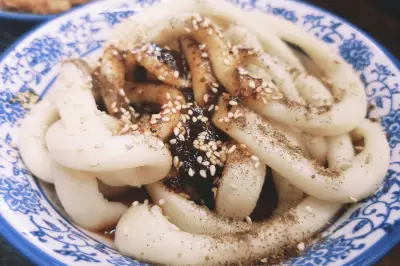
At the ancient town entrance, there was a branch of Qiaoxiangyuan Crossing-the-Bridge Rice Noodles, perfect for trying Kunming’s specialty. Besides regular versions, they had set meals named Scholar, Jinshi, and Top Scholar. We chose the popular Jinshi set, which came with soup and rice noodles plus cured meat, fish slices, and other ingredients. We quickly blanched the ingredients in the scalding soup, then added the noodles. The noodles, soaked in the fragrant broth, were chewy, smooth, and delicious.
Kunming Crossing-the-Bridge Rice Noodles
Kunming, the famous “Flower City,” has Asia’s largest cut flower market. Our flight to Tianjin was at 6 p.m., so there was time to visit a flower market. Looking online, Shangyi Flower Market was said to be the city’s largest and most comprehensive professional flower wholesale market, so in the morning we took a bus from Kunming Station directly there.
But it turned out to be not that large; in just over an hour we had wandered around twice.
Kunming Shangyi Flower Market
Kunming Shangyi Flower Market
Kunming Shangyi Flower Market
Where was Asia’s largest cut flower market? Checking again, we realized it was at Kunming Dounan Flower Market, so we transferred to the metro and headed there.
Dounan Flower Market is hailed as the “barometer” of China’s flower market and price setter. Over 80% of Yunnan’s cut flowers and those from neighboring regions enter here, and from here they’re sold across China and to over 50 countries including Japan, Thailand, and Vietnam—it’s said that 7 out of 10 cut flowers in China come from Yunnan.
The market is huge. The first floor mainly sells dried and fresh cut flowers, stalls overflowing with blooms. Perhaps due to the season, the variety wasn’t huge—mostly types common in the north, but much cheaper. The second floor is all succulents, with countless varieties rarely seen in the north.
Kunming Dounan Flower Market
Kunming Dounan Flower Market
Kunming Dounan Flower Market
Kunming Dounan Flower Market
Kunming Dounan Flower Market
Kunming Dounan Flower Market
Kunming Dounan Flower Market
After the flower market, our Yunnan trip came to an end.
October 2020