Southeast Yunnan: Boundless Scenery
I visited Yunnan once many years ago, I think it was 2001. At that time, it was a family of three, and we signed up for a premium tour, 15,000 per person, visiting Kunming, Dali, Lijiang, and Jiuxiang. That was my family plan: we traveled every year. The wind, flowers, snow, and moon of Kunming's Dianchi Lake, the ancient city of Dali, Jade Dragon Snow Mountain, and the underground river karst caves of Jiuxiang are still deeply impressed in my memory.
I like playing games, but only single-player games, especially the 'Chinese Paladin' series; I haven't missed a single installment. I think there are seven or eight of them. Many of them mention the ancient Nanzhao Kingdom, a mysterious country, which I have long yearned to see.
This is my second trip to Yunnan, this time to the southeastern part of Yunnan.
D1: Fly to Kunming, 260 km to Mengzi, stay in Mengzi.
D2: Visit the Mengzi campus of the National Southwestern Associated University, stay in Mengzi.
D3: 128 km, visit Yuanyang Rice Terraces, 165 km to Jianshui Ancient City, stay in Jianshui.
D4: Continue visiting Jianshui Ancient City, 197 km back to Kunming, stay near the airport.
D5: 28 km, visit the Golden Temple, return to the airport for departure.
I packed a few things at home and set off, a group of six people.
Upon flying into Kunming, Yunnan, I picked up a rental car at the airport.
After three hours, we drove to Mengzi, the capital of the Honghe Autonomous Prefecture.
Honghe Hani and Yi Autonomous Prefecture is located in the southeast of Yunnan Province, China. It has Mengzi, the political, economic, military, and cultural center of southern Yunnan; Gejiu, the world's tin capital; Jianshui, a national historical and cultural city; Shiping, a famous cultural place; Hekou and Jinshuihe, two national ports; and a culture of tin, ceramics, and terraced fields. Honghe is a microcosm of Yunnan's economy, society, humanities, and nature, the birthplace of Yunnan's modern industry, and China's land passage and bridgehead to ASEAN.
First stop: Mengzi, the capital of the autonomous prefecture.
The Mengzi campus of the National Southwestern Associated University by the South Lake of Mengzi.
Entering through the East Gate, also called Sweet Water Well, first dug in the early Ming Dynasty, 3 zhang deep, with a well mouth diameter of 4 chi, the inner walls all built with stone strips, surrounded by well railings. It was once the main source of drinking water for the teachers and students of the National Southwestern Associated University.
The main purpose of going inside was to see the exhibition about the Associated University.
National Southwestern Associated University.
After the outbreak of the War of Resistance Against Japan, teachers and students from several prestigious schools endured hardships and detours.
After a long journey of 68 days, they completed a literati's Long March steeped in tragic colors.
The Southwestern Associated University is a unique miracle in China's educational history, a world-class university that we once possessed.
I also saw Mr. Wang Zengqi from Gaoyou.
Wang Zengqi (March 5, 1920 – May 16, 1997), a native of Gaoyou, Jiangsu, was a contemporary Chinese writer, essayist, playwright, and representative of the Beijing School writers. He is known as a 'lyrical humanitarian, the last pure literatus in China, the last Chinese scholar-official.' Wang Zengqi achieved considerable success in short story writing and also delved into drama and folk literature. His works include 'The Love of a Young Monk,' 'Collection of Evening Flowers,' 'Flowing Water,' and 'Essays from Late Cui.' In the autumn of 1935, after graduating from junior high school, he was admitted to the Senior High School of Nanying Middle School in Jiangyin. In the summer of 1939, he traveled from Shanghai via Hong Kong and Vietnam to Kunming, and was admitted to the Department of Chinese Literature at the National Southwestern Associated University as his first choice. In 1950, he served as an editor for 'Beijing Literature and Art' published by the Beijing Federation of Literary and Art Circles. In the winter of 1961, he wrote 'One Night at the Sheepfold' with a brush. In 1963, 'The Night of the Sheepfold' was officially published. In January 1981, 'A Different Disposition' was published in 'Yuhua.' In December 1996, he was elected as a consultant at the Fifth National Congress of the Chinese Writers Association.
From the inscriptions, it can be seen that the unwillingness of a large number of intellectuals to yield and their determination to pursue learning gave rise to a phenomenon of brilliant stars in various disciplines, providing inexhaustible nourishment for the survival and development of China's humanities during wartime. The Southwestern Associated University also became an important position for inheriting Chinese culture and highlighting the national spirit.
They held firm to their cultural position under extremely harsh conditions, continuing the story of the millennium-long song of the Chinese cultural lineage.
'Resolute, firm, persistent, and steadfast' is the university motto.
The National Southwestern Associated University was a comprehensive university established in Kunming after the start of the War of Resistance Against Japan when universities moved inland. On November 1, 1937, the National Changsha Temporary University, formed by National Peking University, National Tsinghua University, and Private Nankai University, opened in Changsha (this day also became the anniversary of the Southwestern Associated University). Due to continuous Japanese bombing of Changsha, in mid-February 1938, approved by the Ministry of Education of the Republic of China, the Changsha Temporary University moved west to Kunming in three groups. In April 1938, it was renamed the National Southwestern Associated University. [1] From the decision of the Ministry of Education of the Republic of China in August 1937 to establish the National Changsha Temporary University, until July 31, 1946, when the National Southwestern Associated University ceased operation, the Southwestern Associated University existed for a total of 8 years and 11 months. 'It established the scale of academic freedom internally and earned the title of a stronghold of democracy externally,' preserving important research forces during the war, cultivating a large number of outstanding talents, and making outstanding contributions to the development and progress of China and the world.
For dinner, we drove around a big circle and finally settled at a restaurant called Yi Pian Hong Tu Cai Guan (Red Earth Restaurant). We ordered several dishes with unfamiliar names. Some were delicious, others we weren't used to, but we ate very happily.
Our accommodation happened to be near the Honghe Sports Stadium. The previous evening, we took a walk to look for breakfast spots.
Jinhua Yuan Mengzi Cross-Bridge Rice Noodles.
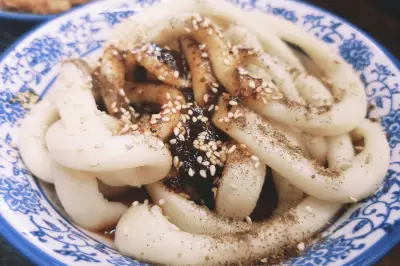
Authentic Yunnan cross-bridge rice noodles, 30 yuan per serving, completely overturned my previous impression of cross-bridge rice noodles. What we were eating was not breakfast, but culture and taste. Nearly 30 small dishes were freely added to the soup bowl and heated for eating. The flavor was unique, the eating method novel, pleasing both the eyes and the stomach. Surprised and delighted, we shouted our satisfaction.
The bowl was an especially large one, somewhat like a hot pot. There were many cups and plates, all clean. Meat and vegetables were well matched. We could choose thick or thin rice noodles, and there was no limit. We savored them slowly, afraid of breaking the mood. Such a delicacy is unforgettable for life.
After the meal, we arrived at the Yuanyang Hani Rice Terraces.
Although the angle was different and the season different, we could still truly feel the charm of the terraces.
Yuanyang Rice Terraces are the masterpiece left by the Hani people for generations.
At the visitor center, there was an exhibition on the Hani Rice Terrace cultural landscape.
The terraced fields cultivated by the Hani people of Yuanyang change with the terrain. On gentle slopes with large areas, large fields are cultivated; on steep slopes with small areas, small fields are cultivated, even in ditches, on ridges, and in crevices. Thus, the terraces range from several mu to as small as a dustpan, often covering thousands or tens of thousands of mu on one slope.
The terraces are a landscape painting of mountains and waters that the Hani people have been 'carving' for over 1,300 years without ceasing.
Yuanyang Rice Terraces are the core area of the Honghe Hani Rice Terraces. The Honghe Hani Rice Terraces are a spectacular farming civilization created by the Hani and other ethnic groups using special geographic and climatic conditions. They are vast and majestic.
The entire village is Hani.
A water mill: water power drives the waterwheel, which in turn rotates the millstone. But at this time, the water had dried up.
Three pictures form a complete set of mechanisms. Water mills, water grinders, and water pestles are common here.
These earth walls seem handmade, sturdy and ancient.
This child showed me the way. I said I would take a picture of him. Then he reached out his hand asking for money. But I was a long way from the car, had not a penny on me, and it seemed he couldn't understand what I said, so I had to flee in panic.
Approaching evening, we drove to Jianshui. However, this section of G245 was indeed not easy to drive: the road wound around mountains and was full of potholes. But the magnificent scenery along the Honghe River was indeed a feast for the eyes.
Jianshui, called Butou in ancient times, also named Badian. During the Tang Nanzhao period, Huili City was built, translated as 'Jianshui' in Chinese, under the jurisdiction of Tonghai Dudufu. During the Song Dali Kingdom period, it belonged to Xiushan Jun Abai Department. In the Yuan Dynasty, Jianshui Zhou was established; in the Ming Dynasty, it was called Lin'an Prefecture. In the Qianlong period of the Qing Dynasty, Jianshui Zhou was changed to Jianshui County. Its history of 3,400 years has earned it the reputation of a 'famous cultural place' and 'Zou Lu of southern Yunnan.'
Nanzhao Kingdom (738-902), an ancient country name, named after its predecessor 'Mengshe Zhao,' because it was located south of the six zhao, hence called Nanzhao. It was an ancient kingdom that rose in the Yunnan area in the 8th century, founded by Pi Luoge, leader of the Mengshe tribe, in the 26th year of Tang Kaiyuan (738). In the 2nd year of Tianfu (902), Zheng Maisi, a descendant of Tang native Zheng Hui, overthrew Nanzhao, proclaimed himself king, and established the 'Great Changhe Kingdom.' At the end of the Sui Dynasty and the beginning of the Tang Dynasty, there were six relatively powerful small states in the Erhai area, each ruled by a king, known as the Six Zhao: Mengxi Zhao, Yuexi Zhao, Langqiong Zhao, Dengtan Zhao, Shilang Zhao, and Mengshe Zhao. Mengshe Zhao was located south of the other zhao and was called 'Nanzhao.' With the support of the Tang Dynasty, Nanzhao successively conquered various tribes in the West Erhe River area, destroyed the other five zhao, and unified the Erhai area. In 784, Yi Mouxun changed the country name to 'Dali' (there is also a saying that 'when Yi Mouxun first came to power, he changed the country name to 'Dali Yun''); in 794, Yi Mouxun submitted to Tang and changed the country name back to 'Nanzhao.' In 860, Shilong rebelled against Tang again and changed the country name to 'Dali.' In 878, Longshun changed the country name to 'Dafengmin,' until its fall.
Here, the sky became dark later than in Jiangsu. I checked the map; by longitude, it should be nearly two hours later. At 6 p.m., it was still bright.
We checked into a guesthouse called Lin'an Story. Jianshui was called Lin'an in ancient times; later in 1914, because it had the same name as Lin'an in Zhejiang, it was renamed Jianshui.
After a hearty dinner, we toured the night scenery of Jianshui Ancient City. This is the Yinghui Gate, the city tower of Jianshui, majestic and imposing. The 'Chaoyang Tower' on it has the inscription 'Xiong Zhen Dong Nan' (Mighty Guard of the Southeast), and on the back is 'Jin Xia Liu Yun' (Endless Rosy Clouds). This building was built 28 years earlier than Beijing's Tiananmen Gate. Its architectural style is a combination of Yuan and Ming architecture. The scenic spot is in the center of the ancient city, facing east. It was originally the eastern military defense fortification of Lin'an Wei in the Ming Dynasty. Chaoyang Tower can be called a treasure of ancient architecture, the first tower of Yunnan Prefecture, and a symbol of Jianshui, a national historical and cultural city.
Zhu Family Garden: The owner, Zhu Chaoying, wrote a significant chapter in the Lin'an anti-Qing uprising of 1911. We also saw Sun Family Garden, Liu Family Courtyard, and other traditional residences from the Republic of China period, reflecting the economic and social life of that time and the prosperity of the old streets.
This is also the Hanlin Mansion on Hanlin Street. 'A family produced three generals.'
The whole wood carving, resembling dragons and elephants, exquisitely beautiful, shocking the soul!
Everywhere, the folk customs of southern Yunnan, exquisite architecture, beautiful patterns, carved dragons and painted phoenixes, are breathtaking.
The ancient city under moonlight seemed even more mysterious and charming.
'Liang Yi Suo Yue.' Suo Yue refers to a place of great military importance. In the Ming and Qing dynasties, Jianshui was the seat of Lin'an Prefecture, the political, economic, and cultural center of southern Yunnan, and also a military stronghold.
Because I walked fast and was greedy for beautiful scenery, I soon got separated from the group. I ran alone through Chaoyang South Street, North Street, Tudi Temple Street, Jiaoguatang Street, Taishi Street, Mashi Street, Randeng Temple Street, Guandi Temple Street, Yongning Street, South Main Street, and North Main Street.
For breakfast, attracted by a sign reading 'Food on the Tip of the Tongue' on Hongjing Street, I had a bowl of braised pork trotter rice noodles.
After visiting Tianjun Temple, we went to the Yunnan Provincial Education Commissioner's Examination Hall. Inside was a display of scholarly objects.
'To examine the past and prove the present, one must care about national affairs; to worry before others and rejoice after, one must keep this in mind as a scholar.'
'Sweet potato rice noodles, tofu, grass sprouts, yellow essence, chicken fir mushrooms are all delicacies; child student, scholar, successful candidate, metropolitan graduate, presented scholar, number one scholar are all students.'
The 'Gongsheng Ming' memorial arch.
Jianshui Confucian Temple, one of the top ten Confucian temples in China. Pictured is the solemn 'Taihe Yuanqi' arch at the entrance. The arch is a three-bay structure, the central bay about 9 meters high, of stone and wood. On both sides of the base are stone carvings of lions, elephants, qilins, and dragons.
Built in the 22nd year of Zhiyuan of the Yuan Dynasty (1285 AD), it has a history of over 700 years. After more than 50 expansions and renovations, the area has reached 76,000 square meters, ranking among the top large Confucian temples in the country. It was built in imitation of the layout of Qufu Confucian Temple, with 1 hall, 2 side halls, 2 halls, 2 pavilions, 5 shrines, and 8 arches, forming a large architectural complex.
The 'Xuehai' (Sea of Learning), also called Pan Pool. The pond has rippling clear water, dotted with lotus flowers, and willow branches gently brushing around.
'Zhu Si Yuan Yuan' (Origin of Zhu and Si), with 'Wan Shi Zong Shi' (Teacher for All Ages) on the back. 'Zhu Si' refers to the two rivers of Confucius's hometown, the Zhu River and the Si River. Confucius was born at the confluence of these two rivers. 'Zhu Si Yuan Yuan' signifies the long history of Confucianism. This arch was built in the 43rd year of Qianlong of the Qing Dynasty (1778). It is a typical five-bay, three-doorway ancient archway building with a wood and stone structure, 9 meters high, 23.7 meters wide, and 7.7 meters deep, covering an area of 180 square meters. It is carved with huge dragons, unicorns, lions, and elephants, with exquisite bracket sets, a masterpiece of architectural art in harmony with nature.
Behind the arch, four more arches with brick and stone bases and earthen and wooden tops are arranged east-west, each also 9 meters high, inscribed respectively with 'De Pei Tian Di' (Virtue Matches Heaven and Earth), 'Dao Guan Gu Jin' (The Way Transcends Past and Present), 'Sheng Yu You Zi' (The Saint's Domain Starts Here), and 'Xian Guan Jin Yang' (Nearby Admirable Office).
Lingxing Gate is a wooden archway on the central axis of the Confucian Temple. According to ancient legend, Lingxing is the literary star in the sky. Naming it thus means Confucius is a star descended from heaven, symbolizing that Confucius can be compared to the celestial star that bestows teachings and cultivates talents.
Xingtan (Apricot Altar), with a stone tablet inscribed 'Si Wen Zai Zi, Gu Jin Zhi Shi' (This Culture is Here, Teacher of All Ages). Surrounded by ancient cypress trees, it appears solemn and majestic.
Dacheng Gate (Gate of Great Accomplishment), a single-eave hip-and-gable roof structure with a raised-beam framework. 'Dacheng' means Confucius's thought gathered the great way of ancient sages to achieve his own saintly virtue.
The 22 lattice doors on the front are carved with birds and beasts, hollowed out and three-dimensional, in various forms.
Dacheng Hall (Hall of Great Accomplishment) is supported by 28 columns. The 12 columns in the front porch are stone, each 5 meters high, weighing 5,000 kilograms, carved from a single piece of bluestone. The two columns on the left and right of the main door are carved with dragons coiling around, called 'stone dragon embracing columns.'
In the Xuehai (Sea of Learning) is the Sile Pavilion, connected to the island causeway by a three-arch stone bridge.
In the Confucian Temple, I also bought a ceramic cup to use in the office. Because my previous drinking cup was a Yixing zisha (purple clay) cup, a square-bottomed cup made by a famous artist, and it was taken away by someone unknown.
Leaving Jianshui, we drove a long distance, passing through Yuxi to Kunming.
Kunming is a national historical and cultural city. As early as 30,000 years ago, humans lived and multiplied around Dianchi Lake. In 278 BC, the Dian Kingdom was established with its capital here. In 765 AD, the Nanzhao Kingdom built Tuodong City, marking the beginning of Kunming's city establishment. During the late Ming period, the Yongli regime of the Southern Ming established its capital in Kunming. Kunming has a subtropical plateau mountain monsoon climate, with a mountain plateau landform, surrounded by mountains on three sides and facing Dianchi Lake to the south. The scenery along the lake is beautiful. Due to its low latitude plateau, it has a 'spring-like all year round' climate, enjoying the reputation of 'Spring City.'
The Golden Temple (Jin Dian) is located at the foot of Mingfeng Mountain on the eastern outskirts of Kunming. Because the main hall is cast in brass, it shines brightly under the sun, casting a golden glow over the green valley and forest, hence the name. It is also called the Copper Tile Temple. The famous Golden Temple is part of the Taihe Palace of Taoism, first built in the Ming Dynasty (1602). It is one of the four major copper temples in China and the best preserved. In the 10th year of Kangxi (1671), the Pingxi Prince Wu Sangui renovated it, giving it a long history. After hundreds of years of wind and rain, Kunming's Golden Temple has taken on a mottled and antique appearance, but it is better preserved than the Golden Temple on Wanshou Mountain in Beijing's Summer Palace and larger than the Golden Temple on Wudang Mountain in Hubei. It is the largest existing pure copper cast temple in China.
The entrance archway at the north gate of the Golden Temple, a three-bay structure with a somewhat Tibetan style.
'Enter the Heavenly Gate, boundless clear light all in sight; come to the Golden Temple, much spiritual energy in the heart.'
'Parrots announce deep spring; jade steps bring refreshing air from heaven and earth; Dian clouds open to a beautiful scene; the scenery of the Golden Temple changes through the ages.'
The bell tower at the highest point of Mingfeng Mountain.
Three stories, with 36 upturned eaves, a glazed roof finial, about 30 meters high.
On the third floor of the Golden Temple hangs a large copper bell, 2.1 meters high, with a circumference of 6.7 meters at the mouth, wall thickness 15 cm, weighing 14 tons. It is the third largest copper bell in China. The bell bears the inscription 'Made on an auspicious day in the second month of the 21st year of Yongle of the Great Ming' (1423 AD). Originally hung at Kunming's Xuanhua Tower (near the Jinri Tower southwest), it was moved to the ancient pillar park when Xuanhua Tower was demolished. To protect this cultural relic, the government moved it to the Golden Temple and allocated funds to build this bell tower in 1983.
On the second floor walls hang legends about the bell casting during the Yongle period of the Ming Dynasty.
Climbing to the third floor, one can overlook the scenery of Kunming City.
'Crowing at dawn at Mingfeng, nine dragons running to court, two phoenixes linking wings.'
'A few bell strikes clear the sea and land; myriad lanterns reflect on the tower.'
'Purple air from the east embraces the Golden Temple; colorful clouds appear over Yunnan protecting the divine bell.'
Walking through the historical and cultural corridor, we can see various materials about Wu Sangui and Chen Yuanyuan.
Because Wu Sangui led the Qing troops through the Shanhai Pass and made contributions, the Qing government broke the rule of not granting princely titles to non-royals and made him the Pingxi Prince. 'All the armies mourned in white; a fury for a beauty made him rebel.' Wu Sangui left many legends about himself and Chen Yuanyuan at the Yunnan Golden Temple scenic area at the foot of Mingfeng Mountain east of Kunming. Here, a special exhibition hall for Wu Sangui and Chen Yuanyuan was set up, using large comics to simulate the love story between the Pingxi Prince and the Suzhou beauty Chen Yuanyuan. There are stone carvings of Chen Yuanyuan's poems and a gentle, graceful statue of Chen Yuanyuan in the garden and by the lake.
The ancient crape myrtle tree planted during the Wanli period of the Ming Dynasty is over 400 years old.
'Bell tolls at Golden Temple; camellias bloom at Mingfeng.'
Kuixing Tower on Taihe Palace.
'With a writing brush, he dots the head of the tortoise; with a loyal heart, he measures virtue; with wise eyes, he judges talent.'
The Golden Temple, the main hall and the two flanking pavilions are all cast in bronze, shining brilliantly and dazzlingly, hence the name 'Golden Temple.'
'Majestic guard of southern Yunnan, seven stars shine, mountains and rivers are bright; divine spirit reaches the North Pole, a sword flies to clear the sea and land.'
'The Great Way is impartial; wind, thunder, rain, dew are all teachings; the thunderous sound transforms all creatures, whether moving or growing, all are spring.'
Wondrous creativity, exquisite beyond compare.
An exhibition of old objects from the Golden Temple displays many cultural relics.
Second Heaven Gate: 'Northern Guard of the Mysterious Capital.'
Passing through the Third Heaven Gate, Second Heaven Gate, and First Heaven Gate in sequence, we arrived at the west exit.
'You can skip Dianchi, but you must visit the Golden Temple' – such is the charm of the Golden Temple. The Golden Temple is the main building of the scenic area, a double-eave, flying-eave, imitation wooden structure square building with exquisite carvings, well-proportioned, and beautiful in form. A purple forbidden city surrounds the Golden Temple, highlighting its majesty. All components of the hall are cast in copper, using a total of 250 tons of copper, making it the largest pure copper building in China. The bronze statue of the Zhenwu Emperor enshrined in the Golden Temple hall is very conspicuous. According to legend, Zhenwu Emperor is the son of Pangu, who became the third Heavenly Emperor after the Jade Emperor abdicated. He gave birth to the Yellow Emperor and the Flame Emperor and once incarnated as Fuxi. The Zhenwu Emperor enshrined in temples is generally depicted with disheveled hair and bare feet, sitting upright in the hall, with statues of the tortoise and snake generals, or golden boy and jade girl beside him. It is said that the former are guardian gods, while the latter record the merits and demerits of the three realms for Zhenwu. However, the Zhenwu Emperor at Kunming's Golden Temple is unique; folk legend says that the image resembles the Pingxi Prince Wu Sangui, showing his ambition to become emperor.
Speaking of Wu Sangui, there is also a connection with Gaoyou, Jiangsu. The stone lock he used for practicing martial arts is still preserved in Liu'an Village, Jieshou.
Wu Sangui (1612–1678), courtesy name Changbai. Han Chinese, born in Jinzhou, Liaodong, at the end of Ming and beginning of Qing. His ancestral home was Liu'an Village, Jieshou Town, Gaoyou City, Jiangsu. He was about 1.73 meters tall, a military examination graduate, son of Wu Xiang, the general of Jinzhou, and nephew of Zu Dashou. He was appointed commander based on his military achievements and his father's influence. In the late Tianqi period of the Ming Dynasty, he once led about twenty retainers to rescue his father from 40,000 Manchus. His filial and brave deeds were known throughout the country, earning him the reputation of 'bravery surpassing three armies, filial piety heard in nine frontiers.' He briefly stayed in Beijing and got to know many nobles, officials, and literati. Wu Weiye called him 'the fairest marquis in his youth.' In the fourth year of Chongzhen (1631) August, Huang Taiji launched the Battle of Daling River. Wu Xiang fled during the reinforcement, causing the entire army to be annihilated. Zu Dashou surrendered to Qing, Sun Chengzong was dismissed, Wu Xiang was imprisoned, and Wu Sangui was promoted to Liaodong General-in-Chief, guarding the Shanhai Pass. Historical records say Wu Sangui's troops were 'exceptionally brave and motivated,' the last effective cavalry force at the end of the Ming Dynasty.
Wu Sangui was a lucky man. History gave him many opportunities, and he unhesitatingly seized them and achieved his goals. Status, honor, money, beautiful women – everything was available. He was a figure who embodied various contradictions during the transition from Ming to Qing. No one else in that period was as long-lasting, prominent, changeable, and noticeable as Wu Sangui. In the 12th year of Kangxi, he rebelled against Qing and proclaimed himself King of Zhou. In the 17th year of Kangxi, he declared himself emperor in Hengzhou, Hunan, with the country name Da Zhou and the era name Zhaowu. He also began to grow his hair and change to Ming attire. That autumn, he died of illness in Changsha. His grandson Wu Shifan succeeded him and retreated to Yunnan. In the 20th year of Kangxi, Kunming was besieged; Wu Shifan committed suicide, and the remaining soldiers surrendered. Wu Sangui's descendants were completely wiped out, including infants. Wu Sangui was destined to be the emperor of the Great Zhou, but he conquered half of the country for the Qing Dynasty. He dared to lose his kingdom for love and caused the death of the great hero Li Zicheng. Many tragedies and helplessness shaped his colorful and complex personality: he had genuine feelings of 'a fury for a beauty'; he also had the cruelty and greed of loving the kingdom more than beauty; he was fickle, faithless, served Ming and betrayed Ming, allied with Li Zicheng and defeated Li Zicheng, surrendered to Qing and rebelled against Qing... the good and evil of life all burst forth in him... However, as one of the legendary figures in history, Wu Sangui was the most crucial piece on the historical stage at the end of Ming and beginning of Qing. He once influenced the direction of history. Therefore, later evaluations of him are mixed, both praising and criticizing, praising and blaming. It is difficult to outline his true character and the bizarre, ever-changing life events he brought about.