Yunnan | Sweet, Sour, Bitter, Spicy, Salty: The Ultimate Flavors of Southeast Yunnan
In our great culinary nation, right next door to the 'foodie provinces' of Sichuan and Guizhou, Yunnan's cuisine always seems to be slightly overshadowed. When most people from other provinces think of Yunnan food, the first things that come to mind are the Cross-Bridge Rice Noodles found everywhere, and the wild mushrooms that have recently become a craze for their supposed 'little people' hallucinations.
Actually, Yunnan's cuisine is far richer than we realize. Its diverse terrain nurtures a multitude of ingredients, with wild produce unmatched elsewhere. The varied customs, cultures and lifestyles of its many ethnic groups breed different cooking methods and flavor habits. Bordering Sichuan, Guizhou, Guangxi and Tibet, and also Myanmar, Laos and Vietnam, Yunnan's different regions each boast distinct styles and tastes that have seeped into one another, creating the all-embracing 'Yunnan Flavor'.
Even the smallest southeast corner of this enormous province is enough to gorge happily and exclaim in delight. Over nine days and roughly 1,000 kilometers of driving, we rumbled across the fertile land of southeastern Yunnan, passing through nine cities: Kunming, Mile, Mengzi, Hekou, Jianshui, Yuanyang, Honghe, Shiping and Yuxi. In every city, we tried to find the most authentic food through local eyes. Wild mushrooms flooding the market in the rainy season, Mile's braised chicken rice noodles, Mengzi's Cross-Bridge Rice Noodles, Hekou's Vietnamese rice-noodle rolls, Jianshui's tofu and steam-pot chicken, Yuanyang's Hani-style dipping-water chicken, Shiping's live fish and barbecue, Yuxi's eel rice noodles... To a native, these might seem slightly touristy due to their strong regional markers, perhaps not the daily staples. But for a first-time visitor to Yunnan, tasting unfamiliar fresh ingredients and experiencing novel flavors is enough to become a treasured memory of the trip.
Looking back at the stunning rosy clouds, swallowing the last thick broth at the bottom of the noodle bowl. A free spirit leaps from the tip of the tongue, impatient to tell the story of this elegant walk across the taste buds. The scent of distant food becomes a soul's signpost, tirelessly guiding the footsteps forward.
Sweet, sour, bitter, spicy, salty—the ultimate flavors are all in southeast Yunnan.
The crisscrossing overpasses of this provincial capital sometimes have several stacked layers; one careless moment and you're on the wrong route. A direction-challenged female driver always arrives about ten minutes later than planned. The city is immense and all-encompassing, with ancient archways standing right next to modern high-rises. Here alone you can sample delicacies from all over Yunnan. Wild mushrooms, rice noodles, flower cakes, and many old Kunming street-flavors piece together our fragmented moments in Kunming.
On the menu were mushrooms I'd never heard of: milk-cap mushrooms, coral mushrooms, tiger-paw mushrooms, skin-picking mushrooms... we ordered blindly, relying on imagination. Once the free-range chicken broth came to a boil, we added all the mushrooms at once and simmered them for nearly twenty minutes, anxiously watching the timer tick down—many are toxic before they're fully cooked, so eating was strictly forbidden until the alarm rang.
The beeping pierced the Emerald City gate. From under the lid gushed a pure, unpretentious fragrance from the mountains, moist with earth, the breath of the lush rainy-season forest. The soup kept boiling; a thick layer of fat was punched up by the force beneath, constantly changing shape.
Soup-making is the most back-to-basics way to enjoy mushrooms. The abundant oil in the chicken broth traps the heat, coaxing out the mushroom's aroma and blending it into the soup. First, ladle out a bowl of soup; its heat lingers. A soft sip—the umami arrives gently on the tongue, without aggression. Faint at first, within seconds it envelops the entire palate, giving a light, floating sensation. A few more mouthfuls, and that savory freshness spreads through the body, roaming inside. Unlike seafood's aggressive assertion on the senses, mushroom fragrance is graceful and mild, unworldly. When it arrives, it's as if the taste buds are rebooted, leaving a lasting aftertaste in the body.
The mushrooms in the pot were stunning. After dozens of minutes of stewing, their porous structure had drunk the soup fully. We asked a server to mix the most authentic dipping sauce and rolled the steaming mushrooms through the oily sauce before eating. Each mushroom had a distinct texture: bamboo fungus and matsutake were delicate, spongy, soaking up more broth that burst in the mouth when chewed; black boletus and milk-cap were a bit rougher, chewy, almost like meat. As we chewed, each unique aroma cleansed the heart. Surely on our first night in Yunnan, with the scent of mushrooms, we'd dream of returning to the dense rainy-season mountain forests.
Full of curiosity, our first meal in Yunnan was the legendary 'see-little-people' mushroom—Jianshouqing. This is actually a collective term for a group of boletus mushrooms that turn indigo-blue when bruised. If not properly prepared, they can cause diarrhea, vomiting, or even hallucinations. But in a reputable restaurant, after proper cooking, almost all of them are harmless. The 'headiest' way to prepare them is to fry them in plenty of oil with dried chilies and sliced garlic until the moisture evaporates and the mushrooms are thoroughly cooked. The dry, chewy slices carry the fragrant burn of chili and garlic—the more you chew, the deeper the aftertaste. After this plate, we finally understood why locals risk poisoning for the sheer pleasure.
After a long day of travel, we were starving. Luckily, we'd pre-ordered a steamer of matsutake steamed dumplings to console us while waiting for the mushroom soup countdown. The slightly large dumplings had a generous filling where we could clearly see little chunks of matsutake. Mixed with the meat, the matsutake fragrance was unobtrusive yet unmissable, adding an extraordinary freshness to the simple filling.
【Eatery Info】 Yimen Congshan Wild Mushroom Mansion · Zhajing Old Hot Pot
The century-old Jianxinyuan is one of the few true 'China time-honored brands' in Kunming. Its story dates back to the late Qing Dynasty when the imperial examination system, 1,300 years old, was abolished. Three Kunming scholars, borrowing the method of Guizhou's intestine-blood noodles, launched the first 'intestine-blood rice noodle' and it became an instant hit. Later, Jianxinyuan replaced the fatty intestine with a combination of crispy fried bits, Yunnan-style cold sliced pork, five-spice tofu and blood curd—creating the 'crispy-blood rice noodle', the shop's signature dish ever since. At the Baoshan Street branch, long queues still form every day. With limited seating, people squat on small stools at the doorstep, holding their bowls.
A bowl of crispy-blood rice noodle doesn't wow at first. The broth is the familiar rich cross-bridge base, the noodles are the usual smooth rice noodles, but the toppings are solidly generous: big chunks of blood curd crowd one corner, the tofu skin is that thin, resilient Shiping kind, and there are crispy fried bits that soak up the soup. The soul is probably the dense layer of fragrant but not fiery chili oil on top. Through the limited lens of an outsider's palate, it's still just a bowl of rice noodles with lots of ingredients. The more ordinary, the longer it lasts—that might be a rice noodle's philosophy of survival.
【Eatery Info】 Jianxinyuan Cross-Bridge Rice Noodles
The lady at the counter worked deftly, one packing, the other handling payments. In the back, several chefs were busily wrapping rose-petal filling into pastry skins and popping them into the oven. The huge oven was neatly lined with soft embryos waiting for heat and time to color their cheeks gold and release a gentle fragrance from within. Freshly baked flower cakes are not to be missed. The warm scent is fleeting; with a slight pressure, the pastry skin crumbles. Under the buttery, floury aroma, the floral fragrance blooms from inside. Jasmine is refreshing, rose intense. The pastry turns to powder the moment it enters the mouth, swirling with petals, dancing, radiating sweet energy. In the city of eternal spring where flowers bloom everywhere, I ate a whole sweet floral bomb.
【Eatery Info】 Jiahua Flower Cake
After only one night in Kunming, we headed straight to the next destination. Over 130 kilometers away, Mile City is famous not only for its Buddha but also for its stunning braised chicken. To taste the most authentic braised chicken rice noodles, you must go to Zhuyuan Town on the outskirts. After bumping through a dusty gravel road, we reached the town center. The not-so-wide main street was chaotically lined with cars and e-bikes—parking was a headache, inching into gaps while dodging large oncoming vehicles. On both sides, headscarf-clad women sold snacks and fruit; the dense tree canopies almost hid shop signs, but the two most common characters were 'braised chicken'. Next came the welcome. Braised chicken shops, big and small, sell braised chicken/innards on one side, while on the other, boiling water is kept ready to blanch rice noodles or rice-noodle sheets. They add the braised chicken's gravy and top it with a few chunks of chicken—this is the beloved local street food: braised chicken rice noodles/sheets. A steady stream of customers arrived. The auntie skillfully grabbed a chicken, cleaver in hand, dismembered it, then blanched the noodles, poured the broth, added chicken... all in one smooth motion. A bowl trembling with heat was carried by the diner to a low table.
The dark braising sauce was savory and aromatic. The chicken meat was tender with the special spice fragrance. Add the shop's own chili oil, and the aroma grew richer and longer. The chicken, shredded into fine strips, was fluffy, not hard or dry, perfectly delicate. The rice noodles were smooth, the sheets resilient—hard to tell which was better. But the sheets, wrapping more broth, delivered more of the braised chicken's essence to the mouth. Most customers were locals: kids after school, office workers on break, neighbors who all knew each other. Five yuan a bowl, an almost universal market price, was an unspoken understanding. The two fellows at the next table sat with legs apart on the low stools, boldly adding two big spoonfuls of chili to their bowls, then gently stirring, lifting their bowls, and slurping them down like a whirlwind. Before we could react, like magic, the hot soup had turned into beads of sweat on their foreheads, rolling down into the dust.
Guides recommended two neighboring shops; unable to decide, we tried both. My companion joked, 'Kids make choices, adults take both,' but really, a five-yuan bowl, though fantastic value, is not huge—normal eaters might need an extra portion. Each shop's braising formula differs, so the broth and chicken taste distinct. On the right, Baocimei Braised Chicken Rice-Noodle Sheets had a lighter broth, chicken fine and springy—'the mild school'. On the left, Yang Shusheng Braised Chicken Shop, with a touch of Sichuan pepper, was heavier in flavor, the chicken slightly drier—'the bold school'. Hard to pick a winner; we suggest trying right then left, light to heavy.
【Eatery Info】 Baocimei Braised Chicken Rice-Noodle Sheets; Yang Shusheng Braised Chicken Shop
An article once said that in a year, Yunnan people eat enough rice noodles to knit a sweater for the earth. With a long history, rice noodles were first recorded in the Northern Wei's 'Qimin Yaoshu'. Over centuries, they've evolved into countless forms and methods. Among Yunnan's many styles, Cross-Bridge Rice Noodles remain the most iconic. Piping hot chicken soup arrives at the table; you immediately add ingredients in the order 'first raw, then cooked': first the quail egg yolk, then the meat and fish slices coated in egg white are swirled into the soup, followed by chives, tofu skin and other garnishes along with the noodles. A sprinkle of chrysanthemum petals, cilantro and scallions on top, and a bowl of 'Chrysanthemum Cross-Bridge Rice Noodles' is born in your own hands.
In the eyes of a local gourmet, a 'presentable' bowl demands excellent soup, good toppings, and fine noodles. The soup should use free-range chicken, old duck, pork bones and Xuanwei ham bones, simmered for six to seven hours, then filtered until it's crystal-clear and fragrant. The toppings must suit the season and balance meat with vegetables without clashing flavors. The noodles must be Yunnan's own fermented rice noodles, which retain the rice aroma and have tiny pores inside to soak up the soup better.
We sought out three highly-rated Cross-Bridge Rice Noodle shops, only to find they'd all closed early in the afternoon. In this city where many businesses run on a 'Buddhist schedule', online info is often inaccurate—early closings, sudden days off, renovation are common. Eating sometimes depends on luck and fate. So we randomly picked a roadside shop; its window also sold fast food, and many locals were having a few meat and veg dishes for their meal. 'Chrysanthemum Cross-Bridge Rice Noodles' seemed to be for outsiders only. The noodle sets ranged from over ten to dozens of yuan, depending on the number of toppings. Minutes after we sat, the auntie from the back kitchen brought out the prepared tray. In a fluster—worried the soup would cool too fast while we took pictures—we finally added everything in rough order and watched the heat make the meat slices curl slightly, then turn white and cook through.
The thick layer of fat on the chicken soup looked temptingly rich. A spoonful to the lips: the broth was clear and not insipid, refreshing yet full of umami—that's probably the most exquisite part. I lifted a few noodles still clinging to some chrysanthemum petals; already a feast for the eyes. The petals had no strong flavor, but we learned that adding them to the rice noodles serves two purposes: to balance the 'heatiness' of the chicken soup in summer and to enrich the visual colors—a masterstroke that gives the bowl both form and spirit.
【Eatery Info】 Hongxinyuan Chrysanthemum Cross-Bridge Rice Noodles
Though it was past the usual breakfast time, we were startled by the shop packed with customers. The friendly owner first took us to the front to choose a set—different prices for different numbers of side dishes. Behind the glass, golden pork trotters, fried pork skin, crispy pork, tenderloin, egg dumplings could all be chosen. Without the local in front of us as a guide, we'd have been lost. The owner placed the selected meat and garnishes and poured in a 'soul broth'. With a splash, steam rose from the bowl. Then it was 'DIY, satisfaction guaranteed'. Rice noodles and sheets were set aside in bowls, self-serve, no extra charge. The rice noodles were traditional white, the sheets perhaps made with red rice, a faint pretty pink. If you like them chewy, dump them straight into your soup; if softer, give them a quick blanch in the boiling water.
The pork trotters were deep-fried then braised in soy sauce, cut into suitable pieces—not too soft, not too hard, crispy-fragrant, without the usual greasy stickiness. You could eat several without feeling cloyed. Unlike Cross-Bridge Rice Noodles, the pork bone broth here had been skimmed of fat, leaving only pure, clean, full-bodied soup. Once immersed, the meat's surface pores, from deep-frying, thirstily sucked up the broth. Bite, soup spurts, meat fragrance bursts. A few drops of homemade chili oil, the spicy oil mixing with the broth, bring a morning's fresh clarity. The owner said her trotters were deep-fried then braised, so they're light and not greasy; with the low-oil broth, they're perfect for breakfast. Many locals eat a bowl before work or before heading out of town. Sitting by a low table in the courtyard next to the skylight, I lowered my head for a sip of soup, a bite of trotter, then looked up at the sky here. Watching the locals come in, sit, drink soup, eat noodles, stand, stretch and slowly leave—only then does the day truly start. Small-town time is always so graceful and unhurried, each morning unfolding slowly like a scroll.
Mornings start with a bowl of rice noodles, late nights often end with another. One by one, crystal-clear noodles weave time, slowly knitting it into years in this little town.
【Eatery Info】 Yangji Hejiayuan
The barbecue shops here barely have menus. All ingredients are skewered and displayed in a chiller; diners pick their own. Every shop has its specialty—this 'Wacheng Roast Chicken' is most famous for its roasted black-bone chicken. Every part—wings, wing tips, skin, head, liver, frame—turns into magical flavors on the boss's grill. While waiting, we wandered next door. The two shops were so close you could order from one and have it delivered to the other. The neighbor, 'Jinping Mengla Barbecue', specializes in Mengla Dai-style barbecue. Inside, the owner was wrapping minced meat in green leaves like origami, then skewering them and grilling until the leaves wilted. That's a Dai specialty: fragrant leaf-wrapped meat. The leaf, 'haoyaoluo' in Dai, is a pepper-family plant with natural aroma. Usually, the parcel is deep-fried or grilled and eaten leaf and all, giving an indescribably delicious fragrance. Dai and Hani people like to cook with banana flowers. The yellow tubular blossoms are washed, finely chopped, seasoned, marinated, then wrapped in banana leaves and heated over the fire. The resulting banana flower is soft and glutinous, looking and feeling like fully cooked scallions but with a subtle banana aroma and a sweet finish.
Perhaps because of the chicken's dark skin, the skewers didn't look like much, even slightly charred, but in the mouth they were all crispy-fragrant with a good chew. Especially the skin, roasted as thin as a sheet of paper, with zero greasy feel. The accompanying chili sauce was fiery. When it comes to handling spice, the southwest provinces truly concede to no one. The passion-fruit lemon chicken feet brought the unique sweet-sour freshness of Yunnan, calming the fiery heat of the grilled meat and chilies. Suddenly a heavy rainstorm blew in, washing away much of the day's scorch. Ten minutes later, the rain stopped, the air sweet, clear and delightfully cool. Mengzi's cool night had finally arrived.
【Eatery Info】 Jinping Mengla Barbecue; Wacheng Roast Chicken
The streets were near empty. The number of taxis threading through the lanes was surprising. Travel agencies that once filled the small town were still closed. Fewer tourists meant most shops were idle, gradually shutting down. Once-bustling commercial streets—digital stores, gold shops, brand stores—still opened their doors, but the quiet was poignant. The whole town oozed a sense of melancholy after prosperity. Every morning, when the border gate opened, streams of Vietnamese women used to come across the river, carrying Vietnamese goods and food to sell on every street. Domestic tour groups in matching T-shirts or caps, led by local guides, would cross to Lao Cai in Vietnam for a taste of the exotic. Now, with the pandemic, it had all come to an abrupt halt. The border gate was deserted, save for the sentries and a handful of photo-taking travelers. No Vietnamese women, no tour groups. The once-noisy town had suddenly gone silent.
This was a mom-and-pop shop, the husband Chinese, the wife Vietnamese. The rice-noodle roll recipe was likely brought by the wife. Fillings were simple: mushroom-pork or scallion-pork, two kinds, 2 yuan each. Once we ordered, she got busy. Rice batter was steamed in a thin layer, then lifted with a long chopstick, smeared with filling, and rolled up with the same chopstick. The whole process took seconds; within minutes, the rolls piled high on the plate. The dipping sauce was DIY: the shop had a base of fish sauce and soy sauce; you added cilantro, bird's-eye chili, and the soul of it, fresh lime juice. That bowl of sauce was the finishing touch for these seemingly ordinary little rolls. The mushroom-pork was fragrant and not greasy; the scallion-pork used raw scallions, slightly 'aggressive'. The sauce—sour, hot, salty and savory—was an absolute star, reminding me of days slurping pho in Ho Chi Minh City, every bowl elevated by the chili paste and lime. When the pandemic ends, I'll travel a thousand miles for another date with pho.
【Eatery Info】 Jiexin Huayuan Vietnamese Rice-Noodle Rolls
On the exotic-style street near the port, a few restaurants served superb Yunnan-Vietnam cuisine. The restaurant's terrace hovered above the river; in fine weather, you could sit in the breeze and gaze at Vietnam across the water. The waitstaff were mostly Vietnamese, fluent in Chinese, serving dishes that blended Yunnan and Vietnamese flavors—something you could only get in this neighborhood. Vietnamese deep-fried spring rolls were like fried versions of the rice-noodle rolls, cut into sections, golden, crispy, one bite each. The filling was minced meat, wood ear mushrooms, carrot, and vermicelli—a very traditional 'Chinese' combination. Here, it was hard to define whether a dish was Chinese or Vietnamese. The two culinary traditions constantly collided and rubbed against each other, eventually embracing and blending, creating a unique Yunnan-Vietnam flavor.
Granny's mashed potato and scrambled eggs with papaya flowers were both worth trying. Minced potato was cooked with chilies, scallions and garlic, transforming into a rice-killer. Papaya flowers folded into the egg pancake gave it a refreshing taste, the slight bitterness a pleasant surprise. Perhaps because we weren't overly hungry after a day of eating, we muttered praise but felt it lacked a heart-fluttering wow factor. When we lifted the egg pancake, the pool of oil on the plate was enough to fill a small bowl—maybe that was the 'heart-fluttering' special feature.
【Eatery Info】 Doudouwu
Jianshui Ancient Town had an imposing, grand strength. Inside the city gate, the road suddenly became a stone-paved path. Passing one imposing stone arch after another, threading through clusters of shop signs, one intersection led to many others, one alley's end was another alley's beginning. The ancient town seemed to have no end, so getting lost was common. But it was never boring. On the main streets, there was the predictable 'commercial prosperity': tea shops, purple pottery, Hanfu, ethnic accessories—all the clichés of every old town. Turning into a side lane, we found a different life: the cries of hawkers fading into the distance like clouds; an auntie roasting tofu surrounded by eager people, their eyes thirstily following her long chopsticks; a cat and a dog meeting at a lane entrance, glancing at each other then walking side by side into the depths. Upstairs on the veranda of our guesthouse, roofs connected as far as the eye could see. A few ancient buildings' tiles stood out among the newer houses. The town seemed limitless.
Beyond the city, the Ximen area still held onto its original vitality. Narrow lanes hard for cars to pass through, slightly shabby old houses, rows of utility lines and countless 'roast tofu' signs slicing up the sky. We parked at the lane entrance and strolled, a 'reserve' to find Jianshui's old life. The roast tofu here is mostly inch-square white tofu placed on the grill; under the heat, the surface yellows and hardens, while the inside puffs up into a little ball. Nip open a corner, and steam rushes out. Beneath the somewhat crispy skin, the inside is soft and glutinous, with a deep soybean fragrance. Dip it in the sauce, and the porous tofu soaks up all the flavor, offering an endless aftertaste. Yunnan people revere Jianshui tofu mainly because of the water here. Ancient wells are almost a landscape of the town, often with multiple openings clustered together, their walls deeply furrowed by years of ropes. The most famous is Ximen Daban Well, also called 'Pupoquan'. Its water is cool, sweet and perfect for drinking, brewing tea, and making tofu. To this day, it's still the main drinking water source for residents; you'll always see men with two large buckets emerging from the winding lanes, fully laden.
Nearby, many workshops use the well water to make tofu. Under shabby eaves and dimly lit doorways, some without even a sign or name, you'll find a different world: a large machine in the center of the room, with the whole family busy at their tasks, churning out endless baskets of tofu cubes. Thanks to its prime location by Daban Well, Banjing Tofu Workshop has become one of the largest in the area. Stepping inside, the air is thick with tofu. The production room is on the ground floor, rows of large steamers hissing. On the other side, a worker wraps a piece of tofu in a cheesecloth, pulls it tight, kneads it a few times, and the tofu is shaped into uniform little cubes.
Up the worn wooden stairs, the second floor offers a help-yourself tofu snack bar for 5 yuan. Freshly made soy milk, tofu pudding, and firm tofu were all steaming hot. We ladled up the rich, fragrant soy milk, the silky-smooth tofu pudding, the thick, mellow firm tofu... then asked the auntie to mix a bowl of authentic chili dipping sauce. They also had fried tofu and fried tofu skin—dried, sliced tofu that when fried felt almost like lard cracklings, incredibly savory. With a whole 'tofu feast' assembled, we sat down to savor it slowly. Outside, the clank of buckets against the stone wall of Daban Well drifted up.
【Eatery Info】 Banjing Tofu Workshop
Lin'an Restaurant inside the ancient town looked at first like a famous, tourist-filled old-brand restaurant, plastered with honors. But once inside, the warm, friendly service was a pleasant surprise. By noon, the main hall was packed, including many local families having weekend meals. Their steam-pot chicken, we heard, was made the time-consuming traditional way—started steaming every morning, sold from noon till it ran out. You buy a ticket at the entrance, queue at the designated window to collect your dish, and then carry a trembling little steam pot on a tray back to your table. Along the way, the aroma rushed eagerly into your nostrils. The essence of 'steam-pot chicken', they say, is steaming. The chicken and flavorings are placed in the pot with a chimney in the middle; the pot sits atop a soup pot full of water, and the steam cooks the chicken while the condensate becomes the precious soup. Unlike boiled chicken stock, the soup here is clear beneath a layer of fat, intensely fragrant and delicious. Even the ginger slices, having absorbed so much essence, become tasty. Confucius said: 'There is no such thing as being too refined in food.' Every sip of the clear chicken soup in the purple clay pot is the distillation of a long journey.
【Eatery Info】 Lin'an Restaurant
Just like locals, squat by the tofu grill, slurping rice noodles and picking up a piece of steaming grilled tofu whenever your hands are free. The heat of the tofu and the fire of the chili flip-flop on the tongue—too hot to close your mouth—so you take another mouthful of cool rice noodles to 'calm the shock'. That's Jianshui people's exclusive joy when it comes to 'eating'.
【Eatery Info】 Lin'an Restaurant
Qing-tou mushroom is perhaps the most common mushroom in Yunnan woods. Its cap is pale green, and even cooked, it still has a faint green hue. The texture is plump, thick and tender, with a refreshing mountain flavor between the fibers. Stir-fried with plenty of oil, chili and celery, the ingredients complement each other beautifully. So far, qing-tou mushroom is my all-time favorite fungus.
At Jianshui's old brand, Baoxing Lou, in a lovely old house with a courtyard, the back door opens onto a charming street. The steam-pot tofu balls arrived steaming, pure white and plump, looking adorable in the broth. Made from tofu and minced meat with crushed peanuts, they had a soft, glutinous feel punctuated by a bit of crunch—a richer, more novel texture. Like the steam-pot chicken principle, the ingredients' essence was concentrated in the soup, but the balls' porous bodies had absorbed a good deal of it. With every chew, the savory juice bloomed in the mouth.
【Eatery Info】 Baoxing Lou
Go native. In Jianshui, barbecue joints always spring up around tofu grills. From morning till late night, the embers in the fire pit never die, the auntie's chopsticks keep flipping tofu, and new tofu is added constantly. One group finishes and leaves, another sits down, picks up chopsticks, mixes dipping sauce, and grabs tofu—all in one seamless flow. In barbecue style, Jianshui seems to have its own school: grilled water bamboo shoots are a 'regional limited edition', most common here; every part of the pig is fully utilized—pork belly, skin, palate... brushed with special sauce, dusted with chili powder, fragrant and spicy. The grilled gourd was a stunning surprise: sliced thick, grilled soft, brushed with sauce, then dipped in chili powder when eaten. The texture was like zucchini yet different, plain yet crisp and refreshing, utterly addictive.
After the daytime bustle falls away, the city is a bit quiet at night, but the occasional barbecue stall glows with nocturnal energy under dim streetlights. People gather in small groups under a big tree or around the fire. A few skewers later, my mouth was on fire. A delivery rider arrived with icy-cold milk sweet rice wine, sending sweet, cool relief to my burning mouth. Taste is the most enduring memory. Even if, years later, I can no longer recall the ancient town's walls or its breeze, I will still remember that one night here, when such delight danced on my tongue.
【Eatery Info】 Lao Qujiang Renhe Barbecue
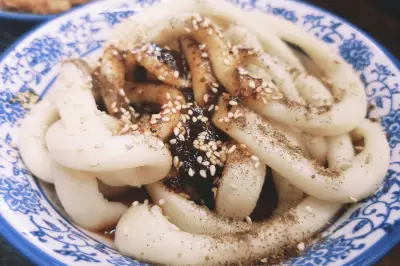
The owner boils the soup, customers fetch their own noodles—it seems to be the unspoken rule in this region. One bowl hearty, one bowl light, two bowls of rice noodles seem to cover all tastes. The intestine was well cleaned; the blood curd was irregularly shaped, which held even more broth and felt more flavorful. Though the soup had a layer of red oil, it was fragrant but not spicy, very tourist-friendly. The three-delicacy rice noodle's highlight was definitely the crispy pork: the clear chicken broth and the crispy pork's gaps, soaked with soup, were explosively savory. After the bowl, I felt refreshed. Beside me, a group of girls in traditional Hani dress walked by, their smiles seeming to gather all the warm beauty of the ancient town's morning light.
【Eatery Info】 Huayuan Xiaochi
The drive from Jianshui to the Yuanyang rice terraces caught us off guard. We'd checked before—less than 100km, easy—but once on the road, the GPS showed winding mountain roads all the way; reaching our guesthouse inside the scenic area would take nearly four hours. Most of the way was unpaved gravel, big trucks in front and behind, one sharp turn after another... For four hours, my nerves were taut, completely unable to enjoy the scenery. When we finally stopped and looked around, the green mountains rolled on, and the emerald rice paddies were neatly divided into shapes, layer upon layer stretching to the horizon. The paddies and the sky seemed so close, drawing together until they embraced at the vanishing point. A northern kid, seeing such an immense expanse of lush terraced fields for the first time among mountains, couldn't contain my excitement. I jumped out, camera clicking from every angle, wishing I could pack this mountain beauty into my bag to carry on the road.
For generations dependent on the land, farming civilization met the majestic mountains here, carving out a natural wonder that stuns in any era. The terraces follow the mountain's contours, cascading in all sizes; the rice inside looked velvety-smooth from afar. Between the high mountains and deep valleys, nature's way was respected yet neat and orderly, as if God had sculpted this piece of art with His hands. We'd booked a 'sunrise-view room', hoping to see the sun's rays ignite the green from the edge. Two mornings in a row, when we sleepily drew back the curtains, thick clouds pressed right against the window, inside and out a uniform white. The cool morning green struggled through gaps in the clouds, only to be brushed back into pale silence. That's the summer climate here. Just as night was about to lose its hold, the dominating mist gathered secretly, taking over the mountains, blanketing the fields and the people. Only when daylight broke and warmer sunshine called in unhurried gusts to help, the clouds lazily rolled over and drifted to the other side of the mountain.
In the morning, we drove to Laoyingzui (Eagle's Beak) Terrace, a wild viewing spot not over-developed. We parked on a gravel platform by the road, descended a few steps over a chaotic stone path, and reached an uneven but fenced platform jutting out like an eagle's beak. Looking down at the terraces, they seemed even more staggeringly beautiful, with village houses dotted among them like tufts. The thick clouds drifted visibly closer, almost throwing themselves at us, but under the warming sun, they lost the haughty dignity they'd had at dawn. Near the tea factory viewpoint, a path descended into the fields. A few minutes down, we were among the rice. Close up, the surgically precise carving was even more awesome. The uniformly tall rice seedlings clustered upward, the edges of each step neat and orderly, extending all the way up like a staircase.
Being in the mountains naturally makes you feel tiny as mayflies. But in this endless green, we felt small yet not desolate. The mountains were still raw and wild, but human wisdom had planted seeds here that grew into a miracle of civilization. Now the mountains were primal but not barren, wild but not barbaric. Generations of tiny human figures have walked among them for centuries, step by step, shovel by shovel, draping this natural grandeur with the light of civilization.
Yunnan's chickens all seem to be 'athletes'. Free-ranging for years makes their meat exceptionally firm and chewy. Cooked, the skin and meat remain intact, the skin gleaming with tempting oil. With little fat, you can eat plenty without feeling greasy. Plain poached chicken with a dipping sauce, returning to basics, preserves the most unadorned fragrance of the chicken. Living in the mountains, going back to simplicity with this food, we couldn't help but be grateful for nature's most primitive gifts.
We ate the lemongrass fried pork ribs two days in a row; my companion without hesitation named it the trip's No. 1 dish. The ribs seemed to have been boiled with spices first, still juicy inside, then fried again with lemongrass until crispy. When eaten, they were crispy outside and tender inside, the golden shell breaking to release juicy meat, not dried out by the hot oil. Chewing carefully, the faint lemongrass aroma seemed to drift from a distant place, subtle but undeniable—the crowning touch to this fried dish.
In the terrace scenic area, many family-run restaurants were nearly empty in the off-season, but this one was nearly full every night. The shop's name came from the traditional Hani fire-pit. Commonly used across Yunnan, the fire-pit opened the earliest chapter of human improvement in living conditions: heating, tea-making, food preparation all depended on it. The family sitting around it, enjoying cooked food, is the beloved way of eating for Hani families. The mountain night was especially quiet, except for the lights still shining in the shop, carrying the hum of conversation through the dark night. I felt as if I were one of them, sitting around the steaming fire-pit with Hani people, grilling food and sipping tea, enjoying the honest, colorful bounty of the mountains.
【Eatery Info】 Hani Fire-Pit
The Hani-style sautéed beef was minced meat stir-fried with mint leaves, Sichuan pepper and bird's-eye chili. The chili's kick mingled with the mint's freshness—Hani people are indeed skilled at using herbs to create unique flavors. Just as we got up to pay, we saw a group sitting around the tea table at the entrance, drinking tea and grilling tofu over the fire. The owner warmly invited us to join. So we sat shoulder to shoulder with strangers, each with a dish of dipping sauce, blowing on freshly grilled tofu as we ate. Meanwhile, the owner poured boiling water over the just-roasted tea leaves; the clear tea soup floated with wisps of fragrance. Chatting, we learned that everyone was a stranger, diners passing through or from nearby villages. The owner, who had invested in a guesthouse and restaurant here, had settled into the mountains. In his spare time, he drank tea, admired the view, talked with different people, or waded into the paddies to catch fish in the evening and shared drinks with friends. Sipping tea and chatting, from drinking to tasting, from the annoyances of city life to the leisure of mountain living, hours slipped by unnoticed. 'In the mountains, silence seems ancient; days are long like mini years.' Time flowed slowly in the crackle of the fire-pit, becoming the most unhurried years of life.
【Eatery Info】 Huawowo Hani Tusi Cuisine
Shiping Ancient Town had a completely different flavor from any old town we'd seen. Inside the walls, the flagstone streets were smooth and wide, leading in all directions to aged houses. Their mottled bricks, faded wooden beams, and plaques with old-style calligraphy were all still there. Even as high-rises sprouted on the land behind, the old town clung tightly to the ground, gathering and settling the power of ages, brewing a mellow fragrance. No loud hawking, no deafening speakers. The shops along the streets were open, selling ordinary daily necessities. As if predicting tourists would never buy their wares, the shopkeepers chatted among themselves, showing no special interest in camera-slinging visitors. Here, we could roam freely without dodging souvenir traps.
At night, the old town went to sleep even earlier. Only a few red lanterns on windowsills glowed dimly. Even the barbecue stalls, usually only open at night, had closed by early evening, returning the town to the silence of a dark night. Afraid that a single stir, a sharp light might disturb this thousand-year dream.
Yilong Lake, next to Shiping county, is the southernmost highland freshwater lake in China. Where there's a lake, there's fish. Along the shore, fish restaurants cluster. Each had its own small pond; you picked a fish, they scooped it out, quickly killed and bled it, and chopped it into chunks. When it reached the table, the flesh was still a clean pearly white. Into the boiling water, a few minutes later, the fish was so tender that a gentle nudge separated it from the bone. The dipping sauce was strong but didn't mask the fish's freshness—the more I ate, the more I found it fiery and satisfying. Vegetables and tofu were self-serve, portioned per table, with refills. The delightful surprise was the small shiitake mushrooms in the soup; the fish broth seeped entirely into the gills of the mushroom cap. One bite, and juice burst out—another joyful tongue experience. If hot pot felt too plain, the restaurant could also make salt-and-pepper or braised fish chunks. It took forever, but the taste didn't match the wait—good for novelty, not for true satisfaction.
【Eatery Info】 Longjing Fish Farm
The braised ingredients already had a mild spicy flavor. After grilling, they were brushed with chili sauce while still hot, and, as if that wasn't enough, thickly dusted with chili powder. Eaten hot, the chili burn was infinitely magnified by the heat, detonating in the mouth like an atomic bomb. A tearing, scorching sensation made me momentarily wonder: had I swallowed a fireball? Or a knife? In one corner of the hall, free warm soy milk was available; I suddenly understood the boss's merciful intent. Thank goodness for the grilled gourd—a 'clean stream' with chili powder served separately so you could dip to your own taste. Its crisp, fragrant texture was a relief; otherwise, facing this table of enthusiastic barbecue, I'd have been eating through tears. The small live shrimp from the reservoir were perfect for drunken shrimp. The bowl came covered, many shrimp still struggling... seemed cruel, but once I steeled myself and put one in my mouth: the meat was as bouncy and plump as jelly, easily slipping out of the shell, wrapped in the rich sauce. Sucking and chewing, savory freshness filled my mouth, a total delight.
【Eatery Info】 Pengyou Barbecue
Soy milk and fried dough sticks are the standard Chinese breakfast combo, and Yunnan is no exception. A breakfast shop inside the old town became the liveliest hub early in the morning: people heading to work, taking kids to hobby classes, or setting out for a day trip would all swing by for a hearty ten-minute breakfast before rushing into their day. Some regulars had their own combinations. Freshly steamed sticky rice, soft and glutinous, was soaked in the soy milk. The sticky clumps dispersed, no longer hard to chew, each grain coated in soybean fragrance. A warm bowl down, and sweat seemed to seep from every pore, leaving you refreshed. The pickled-cabbage beef rice noodles here used red rice noodles made from Hani red rice. They were exceptionally tender and soft, lacking the chewiness of ordinary noodles, but an impeccable match for any broth or topping.
【Eatery Info】 Ximen Shitang
Fuxian Lake lies to one side, Hongta Hill stands on the other—the city is a genuine fengshui treasure. The famous composer Nie Er was born here, and traces of this great figure are everywhere: the Nie Er Museum, Nie Er Park, and sculptures themed on the national anthem scattered in the parks... A city outstanding in people and land nourishes and commemorates a great soul in its own way. Every journey eventually returns to a spiritual sojourn; tasting food, after all, is nourishment for the soul. So ending our journey in this small city couldn't be more fitting.
Eels were flash-fried in hot oil, then added with seasonings and pork bone broth, simmered to a topping. The rice noodles were blanched, bone broth poured over, topped with the 'hat', plus mint, chives and cilantro. A bowl of eel rice noodles was done. It was sour-spicy, fresh and fragrant; the eel was fresh, not fishy, soft without any sign of overcooking; the noodles were tender but not mushy, with a faint fermented tartness. Every texture, every ingredient was just right. Only in Yunnan can any rice noodle, in an instant, completely and utterly conquer your taste buds.
【Eatery Info】 Dingji Tianjian Eel Rice Noodles
The shop's 'stir-fried assorted mushrooms': at first I thought it meant many types mixed together. When it arrived, there was only one kind, so I suddenly realized the mushroom was named 'assorted mushroom'. The skin was slightly reddish, the inside a clean milky white. Stir-fried in generous oil, it glistened with a coat of oil outside. In the mouth, it was pure savory delight. Only after eating Yunnan's mushrooms did I know that the mushrooms I'd eaten before could only be called 'mushrooms'.
【Eatery Info】 Hongyuan Fandian
【Eatery Info】 Guo Shifu Bingxifan
At one entrance, a whole row of snack stalls: fragrant, satisfying pork-belly grilled erkuai, icy, rich bagged Thai-style milk tea, Dai-style seasoned mango rarely seen elsewhere, and dried beef that first had to be hammered soft on a stump then shredded and tossed... Many authentic Yunnan treats were here. At the other exit of Xiaomiao Street, the big yellow-and-green sign of Daijia Suanduoli was especially eye-catching. By late afternoon, many dishes were already sold out—showing how much locals adored these sour-spicy snacks. This snack street area in the center of Yuxi was actually made up of Xiaomiao Street, Renmin Road and Xinxing Road. By evening, it was so crowded you had to brush past people. Compared to Xiaomiao Street's many not-so-everyday phone shops, Renmin Road and Xinxing Road had more old-brand eateries, pushcart snack stalls and cheap clothing shops. Many delicacies were hidden in this hubbub.
Dried yellow peas are soaked, peeled, and ground with water into a slurry; the pea milk is boiled, bubbling with a 'puchi puchi' sound. After boiling, it's filtered, cooled, sliced, and dressed for a cold salad—Yunnan people's beloved pea jelly. The snack street's 'Hongji Cold Rice Noodles' is an old brand, and pea jelly is one of their signatures. Kunming's sweet soy sauce is essential, plus sugar, vinegar, chili, topped with chive segments and meat sauce. The colorful, refreshing dish is ready to go. In the middle of the road, a tricycle stably claimed 'C position'. Granny Ma, selling steamed cakes and lotus-root starch, had been here for years. The cakes were limited; arriving late meant they might be gone. The hand-whipped lotus-root starch was thick and gooey, the steamed cake placed firmly in it, won't budge even if shaken. The cake was dense—alone, it's dry and choking, but the lotus-root starch perfectly remedied that. The thick starch enveloped each bite of cake; the sweetness and moisture were just right. Though a dessert, it could easily be a meal.
Or after dinner, find a cozy shop, sit by the roof eaves on the second floor, try the Yunnan traditional 'paoluda' and homemade osmanthus aged yogurt. Watch people pass by, and maybe encounter a curious cat living on a rooftop—an ordinary night with its own surprises.
Night fell. Lingering on the final aftertaste of this long journey, we walked back to the hotel. Xiaomiao Street was still brightly lit, the nearby malls still buzzing. This city, how unwilling to sleep. A bright moon hung in the sky, its face occasionally veiled by drifting clouds. On our last night in Yunnan, the warm yellow streetlights looked more and more like that lamp back home. A shy evening breeze gently brushed the passing traveler bound for home, caressing her hair, her skin, her footprints and her shadow.
'A date with the tip of the tongue—until we meet again.'
Travelogue Contents
1. Yunnan's Culinary Quest in the Pandemic Era
2. 【First Stop】 Kunming
3. Wild Mushroom Hot Pot
4. Crispy-Blood Rice Noodles
5. Flower Cakes
6. 【Second Stop】 Mile
7. Braised Chicken Rice Noodles & Rice-noodle Sheets
8. 【Third Stop】 Mengzi
9. Chrysanthemum Cross-Bridge Rice Noodles
10. Pork Trotter Rice Noodles
11. Mengzi Barbecue
12. Papaya Cool Water
13. 【Fourth Stop】 Hekou
14. Vietnamese Rice-Noodle Rolls
15. Yunnan-Vietnam Cuisine
16. 【Fifth Stop】 Jianshui
17. Jianshui Tofu
18. Steam-Pot Chicken
19. Cold Rice Noodles
20. Water Bamboo Shoots Stir-fried with Meat Slices
21. Jianshui Barbecue
22. Intestine-Blood Rice Noodles
23. 【Sixth Stop】 Yuanyang
24. Hani Dipping-Water Chicken
25. Stir-fried Sweet Bamboo Shoots
26. 【Seventh Stop】 Shiping
27. Live Fish Hot Pot
28. Shiping Barbecue
29. Soy Milk with Sticky Rice
30. Milk Sweet Rice Wine
31. 【Eighth Stop】 Yuxi
32. Eel Rice Noodles
33. Soy Sauce Chicken
34. Icy Rice Porridge
35. Yuxi Snack Street
Travel Information
Hotel Index
Strategy Index
Air Ticket Index
Website Navigation
Travel Index
Cruise Index
Corporate Travel Index
Affiliate Cooperation
Distribution Alliance
Friendly Links
Enterprise Gift Card Procurement
Insurance Agent
Agent Cooperation
Hotel Joining
Destination & Scenic Spot Cooperation
More Cooperation
About Ctrip
About Ctrip
Ctrip Hot Spots
Contact Us
Join Us
User Agreement
Privacy Policy
Business License
Security Center
Ctrip Content Center
Intellectual Property
Trip.com Group Algorithm Disclosure