Three Visits to the Land of Colorful Clouds: Encountering a Double Rainbow after the Rain in Dali, and Venturing to Lugu Lake
2020 was a surreal year, but it didn't stop us from traveling. As the pandemic eased slightly, we drove to Guangxi and Guizhou. Just as summer started to settle in, we set off on a journey to Yunnan.
The Land of Colorful Clouds
To me, it always had a mysterious aura. Perhaps this mystique comes from its being a key frontier region in the southwest. Perhaps it's from certain books I’ve read — like 'Candle in the Tomb: The Worm Valley of Yunnan,' which I had just revisited before the trip.
Third Visit to Yunnan
This was my third trip to Yunnan as a tourist. And this time I brought my parents along — the three of us traveling together in Yunnan.
In 2014, I did an independent trip with a friend, hitting Lijiang and Dali, while Kunming was just a brief layover before flying to Chengdu. Back then, I hadn’t thought of recording it in writing.
In 2018, my company organized a trip to Yunnan, and we visited Lijiang and Shangri-La, using Lijiang as a transit hub for round-trip flights. That trip was more of a team-building activity.
This time, we departed from Changsha by car, with Kunming again serving as a layover. After a short stop in Kunming, we headed straight to our main destinations: Dali and Lugu Lake, on the border of Sichuan and Yunnan.
In early July, my mother fractured her right foot, so the most special aspect of this trip was her insistence on traveling 'with injury.' In the trunk, besides our usual luggage, the most important items were a wheelchair and a pair of crutches. That’s also why, after careful consideration, we chose to drive from Changsha to Yunnan.
Changsha-Kunming-Dali-Lugu Lake-Changsha
[Vehicle Check] The most important tool for a road trip is, of course, the car. We love road trips, so before every departure we thoroughly check the vehicle: besides luggage and snacks, we check tire pressure, brakes, engine oil, coolant, etc., and also ensure the warning triangle and fire extinguisher are on board.
[Sun Protection] Don’t skip the sunscreen clothing, skincare, and facial masks! Yunnan is a high-altitude region with intense sun, even on cloudy days it can be harsh. So precautions are a must. I remember in 2014, my first time in Yunnan, I didn’t protect well and ended up with a noticeable 'panda arm' tan.
[Bring Warm Clothes] Although we went in August, when many places were sweltering — for example, Changsha was issuing daily heat warnings with temperatures around 36°C, and the outdoor feel-like temperature often exceeded 40°C — once in Yunnan, it was a summer retreat. The diurnal temperature range is large. During our days there, the lowest temperature we encountered was 11°C at Lugu Lake, and the highest was 26°C in Kunming. At night, you definitely need a blanket. At Lugu Lake, we even turned on the electric blanket.
[Footwear] Yunnan’s rainy season is typically June to August, i.e., summer vacation time. There's plenty of rain — sometimes showers, sometimes continuous. Before our trip, both Dali and Lugu Lake had seen almost two weeks of rain. But we were very lucky: during our days in Yunnan, we only encountered a brief shower in Shuanglang Ancient Town (and saw a rainbow afterward), and half a day of rain at Lugu Lake; the rest was all sunny. Since this is the rainy season, it's wise to bring ample footwear.
[Toiletries] You can use what the hotels provide, but we usually bring our own for hygiene and to avoid waste.
In 2014, during my independent trip with a friend, Kunming was just a one-night layover before my flight to Chengdu; I didn’t go anywhere. This road trip, Kunming also wasn’t a main stop, but because my aunt was spending two summer months there to escape the heat, we made it a stop to visit family. We stayed one night in Kunming and only visited the Yunnan Provincial Museum across from her residence and the nearby Dianchi Lake Haigeng Park.
Dianchi, also called Kunming Lake, sits at an elevation of 1,886 meters. It’s the largest freshwater lake in Yunnan, known as the 'Pearl of the Plateau.' Since Haigeng Park was close to my aunt’s place, we went there.
Address: 1318 Dianchi Road, Xishan District, Kunming
Hours: 8:00–21:00
After parking, we quickly got onto the pedestrian path. The thousand willow trees in the park bear witness to Haigeng's three decades of change.
A very calm heron stood there for a long time — I observed it for just as long.
Seagulls are only seen in winter (from November to March), so now is a great time to watch them. In August, there are no seagulls at Dianchi, but there are pigeons! As long as there's food, a flock will gather. These pigeons are so used to being fed that they have no fear of humans at all.
They all came in groups to scramble for food. My parents had wanted to feed seagulls before coming to Yunnan; in the end, no seagulls to feed, but feeding pigeons turned out to be just as fun.
From Haigeng Park, we drove to the nearby Haihong Wetland to catch a glimpse of the 'Sleeping Beauty.'
The 'Sleeping Beauty' is actually West Mountain, composed of Huating, Taihua, Luohan, Guabang peaks, etc. From a distance, the range resembles a young maiden lying on her back by Dianchi Lake, with hair flowing. Unfortunately, that morning Kunming was cloudy, so the Sleeping Beauty wasn’t very clear, but if you looked closely you could still make out the 'head, chest, belly, and legs.'
I love visiting museums everywhere — they're a great way to learn local history. After watching the TV show 'National Treasure,' I especially wanted to see the Yunnan Provincial Museum. The new museum is in Guandu District, Kunming, north of Guangfu Road, west of Baoxiang River. Its unusual reddish-copper exterior makes it visible from afar.
The new museum has become a Kunming landmark. The main building's plan is a square-ring shape, inspired by Yunnan's traditional 'Yikeyin' (single-seal) courtyard houses. The reddish-copper color reflects Yunnan's reputation as the 'Kingdom of Nonferrous Metals,' and the narrow vertical slits running through multiple floors symbolize the 'Stone Forest.'
Address: 6393 Guangfu Road, Kunming, Yunnan
Hours: Tuesday–Sunday, 09:00–17:00 (entry stops at 16:30, closed Mondays)
Admission: Free. Individual visitors can enter through security without a ticket.
In the front plaza stands the Yunnan float from the 2019 National Day parade, adorned with a green peacock, elephant, colorful garlands, landscapes, and auspicious clouds — very exquisite.
To the east of the museum, directly opposite the entrance, is the Yunnan Grand Theatre. Its architecture resembles a woven hat, called 'Crown of Yunnan,' also a city landmark.
You can't bring in smartphone gimbals or tripods; you can store them for free at the entrance, then go through security. I had made a reservation via the museum's WeChat account, but they didn't check my ID or reservation.
Near the entrance is a floor plan. The museum has three floors. First floor: Chinese Painting and Calligraphy, Contemporary Art, and temporary exhibition halls (a Mosuo special exhibition until Feb 28, 2021). Second floor: Yunnan history exhibitions — 'Ancient Yunnan,' 'Light of Civilization,' and 'Dominance of Nanzhong.' Third floor: 'Miaoxiang Buddhist Kingdom,' 'Opening Frontiers,' and 'Century of Change.' During my visit, the 'Century of Change' hall was under renovation, so the exhibits were not complete.
Take the elevator up; start on the second floor, then third, then first. Enter the world of Ancient Yunnan —
This area is likely most interesting for kids. It starts with the evolution of marine life, dinosaurs, mammals, then goes to the discovery of Yuanmou Man. I remember the first chapter of my primary school history book was about Yuanmou Man's discovery and its significance.
Passing through Ancient Yunnan, we enter Bronze Age Yunnan. If you've seen 'National Treasure,' you'll recognize this exhibit: the Gilt Bronze Cowrie Container with Knight. Actor Li Guangjie passionately guarded the ancient Dian Kingdom's story around this artifact.
Dian nobility used it to store cowrie shells, a form of currency. It symbolized status, was used in ancestor worship, and recorded social events. It has tiger-shaped handles on the sides, four oxen on the lid, and a gilded knight figure that represents a noble warrior — conspicuous and imposing, like a 'golden-armored deity.'
The 'Ox and Tiger Bronze Table' also made me stop for a long time. Though not featured on 'National Treasure,' it's one of the museum's treasures. There's a saying: 'In the north, the Galloping Horse Treading on a Flying Swallow; in the south, the Ox and Tiger Bronze Table,' which shows its status. It's a ritual object from the Dian Kingdom: a standing ox with long, upturned horns, its back sloping down to form a table surface. At the tail, a smaller tiger is climbing and biting the tail. Under the ox's belly, there's a small horizontal calf. The ox and tiger are cast in one piece; the calf was separately cast and welded underneath. A masterpiece of Chinese bronze art and a rare ancient cultural treasure.
This 'Hanging Figure Bronze Spear (Western Han)' wasn't in a prominent spot, but it caught my eye. It's a ceremonial weapon, used by Dian kings to display military power. Its distinctive feature: near the blade on each side hangs a tiny naked figure, finely detailed, with drooping hair, bent body, and hands tied behind its back. Historians think these represent captured Kunming people.
From the Bronze Age, we move into the Eastern Han to early Tang period. This section is my favorite, because the artifacts are exquisitely beautiful.
Even the tiniest pieces are carved with exquisite expressions and postures.
If you've seen 'National Treasure,' you'll recognize this: the 'Silver-gilt and Jewel-inlaid Golden-winged Bird of the Dali Kingdom.' The golden-winged bird, wings spread, is an enduring totem of the Dali people. At the museum entrance, there's an enlarged version. If you visit the Three Pagodas of Chongsheng Temple in Dali, you'll see a similar large totem in the front square.
What impressed me most was the fried grasshoppers and fried bamboo worms. I thought the bamboo worms were tastier.
This special Dai meal gave me a taste of a wide variety of dishes — all rare delicacies that I usually don't get to eat. A wonderful experience.
Ever since my 2014 independent trip with a friend to Dali, I've always been nostalgic about its local culture. Back then, we had limited time: we stayed in Dali Old Town, climbed Cangshan Mountain, went to the Demi-Gods & Semi-Devils film city, visited the Three Pagodas of Chongsheng Temple and Tianjing Pavilion, and went to Nanzhao Love Island on Erhai Lake. But the weather was lousy, so we didn't see Dali at its best. This time, as soon as we decided on this Yunnan road trip, Dali was the first place I locked in.
Historically, Dali was the economic, political, military, and cultural center of Yunnan, famous as a land of literature. A must-see in Dali is Dali Old Town.
Address: 42 Yita Road, Dali City
Parking: Several lots available, maximum fee 50 yuan/day
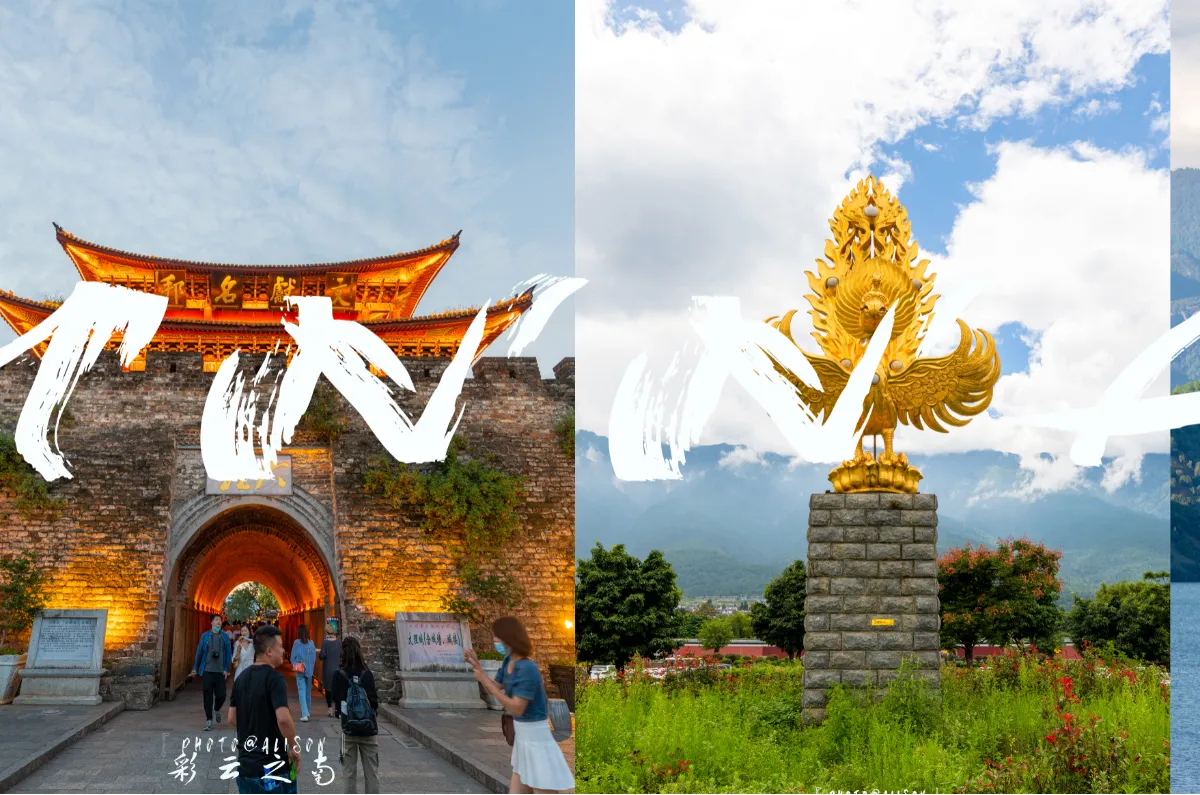
My strongest memory of Dali Old Town is the southeast gate tower. In 2014, I stayed in the old town, very close to that gate. This time, I chose a quieter inn on the east side near the Guozixuan parking lot, but I still walked through the pedestrian street to revisit the southeast gate.
When I arrived, the tower lights weren't on yet. I waited; around 8 p.m., they lit up, instantly taking me back to what I saw in 2014.
Next to the southeast gate is Longquan Lane. Built in the style of the old Shanggong Lane of the Dali Kingdom, it's a square-ring layout with white walls and grey tiles, very atmospheric. Pass through its archway and you'll see dragon spring water gushing out, echoing the name of Cangshan's Dragon Spring Peak.
Walk straight from the southeast gate along the main road, and you'll reach Wuhua Tower.
First built in the Tang Dynasty, it originally had four tiers: a base plus three floors, and was where the Nanzhao kingdom entertained distinguished guests. Over a thousand years, it was burned and rebuilt many times. The last remnants were from the early Ming Dynasty, but they were also demolished. The Wuhua Tower we see today was built in 1998.
Foreigner Street (Yangren Street) is a blend of Dali's ancient charm and Western influences. I photographed this archway back in 2014, and when I passed by again, I couldn't help but snap another shot. The old town has become much more commercialized since 2014, so I didn't go deep inside this time.
Dali Confucian Temple served as both the prefectural and county temple in ancient times, and is a landmark of Dali Old Town.
Dali Chenghuang City (City God City) is probably a recent development; inside are eateries and shops selling local specialties. The old town is getting livelier, with more and more bars. If you like bustle, it's a great place to stay and wander around.
My mother's night stroll in the old town, posing with her crutch.
The most common shops in the old town are rose pastry shops. The three most popular brands are Changyangji, Panxiangji, and Jiahua. All offer free shipping for orders over a certain amount, though the threshold differs. In 2018, I bought Panxiangji pastries in Shuhe Ancient Town, Lijiang, so this time I tried the other two brands. Even close to 10 p.m., there were still queues at these flower pastry shops.
Besides rose pastries, there are other specialty cakes, all good options for souvenirs.
Though these brands have online stores, buying in person lets you sample, and you can see the production date. Some shops even offer 'made today' rose pastries with a shorter shelf life of just 15 days.
The Three Pagodas scenic area is very close to Dali Old Town, besides Cangshan and the Demi-Gods & Semi-Devils city. In 2014, my friend and I visited the Three Pagodas of Chongsheng Temple and Tianjing Pavilion; this time we didn't go inside. If you haven't been, it's worth buying a ticket to explore.
Address: Sanwenbi Village, north gate of Dali Old Town; a 10-minute walk north from the gate.
Hours: 8:00–19:00
Ticket: 75 yuan
Passing by the Garuda Plaza at the entrance, we parked and walked onto the square to take distant photos of the pagodas and the silver-gilt garuda statue.
Behind the garuda statue are the Three Pagodas and Cangshan's Yingle Peak.
Compared to the entrance fee for the pagoda park, this plaza is free. It has a 6.9-meter-tall double-sided garuda statue and exquisite stone sutra pillars. From here you can see the pagodas and also Erhai Lake.
Under the blue sky and white clouds, the stone carvings looked magnificent.
Haishe Park and Xizhou Ancient Town are adjacent, so they're good to visit together. In the morning, we drove from Dali Old Town, passing through Xizhou, to Haishe Park. The park entrance was under repair, so we could only drive close by; a villager collected a parking fee. The wetlands around the park are photogenic, but you need to walk about 200 meters or take a horse cart. Considering my mother's mobility, we opted for the horse cart.
After getting off the cart, everyone took a photo with the horse.
The weather shifted from cloudy to clear, with layered clouds reflecting on the water.
Little grebes played in the wetland; I spotted at least five swimming around, occasionally chirping.
Since Haishe Park was closed for renovations, we didn't stay long — about half an hour was enough.
After Haishe, on the way to Xizhou, along Township Road 033, we found a rice paddy that was perfect for photos. Many rent-a-car travelers were posing on their car roofs. This very paddy became a trending topic during the National Day holiday — the beautiful rice field that was trampled by visitors.
The weather cooperated; the layered clouds gradually parted, revealing the sun's full face.
Compared to bustling Dali Old Town, Xizhou Ancient Town is much quieter. It's an important Bai minority settlement, with the largest and best-preserved collection of Bai residential architecture. The layout is classic: 'three houses and a screen wall' or 'four buildings around five courtyards.'
Address: 18 km north of Dali Old Town
Parking: Several lots, typically 10 yuan for the first hour, 2 yuan each additional hour
Sifang Street in the center is actually a small square surrounded by shops, not large but lively.
Pass through the Hanlin Archway and you're at Sifang Street.
In the square stands a stone archway called 'Timing Fang' (Name-Plaque Arch), built in the Ming Dynasty after several local scholars passed the imperial exams. Xizhou was once a military stronghold of Nanzhao, with advanced culture. The other side of the arch is inscribed 'Glorify the Past and Inspire the Future.' A local saying goes: 'Eighty judges of the second rank, countless provincial graduates and tribute scholars,' showing how many talents Xizhou produced.
Xizhou has four great families: Yan, Dong, Yin, and Yang. From the late Qing to the Republican era, their businesses along the Tea Horse Road reached overseas, their economic power almost unmatched in Dali. The strongest was the Yan family. Yan's Mansion, right by Sifang Street, is the largest and best-preserved Bai-style building in town. Admission costs 18 yuan.
Around Sifang Street are mainly small specialty shops selling Yunnan crafts and snacks.
Compared to Dali Old Town's modernization and commercialization, Xizhou is better for a leisurely stroll. If you prefer a quiet vacation, I recommend staying in Xizhou.
A covered corridor of an inn in the ancient town.
Of course, Xizhou also has handicraft workshops. The scent of roses wafting from this shop's entrance was intoxicating.
Here roses aren't for sweethearts — they're for making handmade rose pastries! You can give the finished pastries to your sweetheart.
Fresh-out-of-the-oven handmade rose pastries, glistening.
There's plenty of creative souvenirs in Xizhou. Cute cat figurines made me, a cat lover, stop.
This shop does handmade prints, and also sells coffee, desserts, and creative products. Grabbing a coffee upstairs and gazing at the old streets is delightfully relaxing.
Don't miss the tie-dye crafts in Xizhou. Many shops sell them. If you're interested in the technique, look for the Puzhen Tie-Dye Museum in Zhoucheng Village. It's a national-level intangible cultural heritage protection and production base for Bai tie-dye, and China's first Bai tie-dye museum, offering hands-on experiences.
After Xizhou, let's talk about another ancient town by Erhai Lake — Shuanglang Ancient Town.
Since we're at Erhai Lake, you can't miss Shuanglang after Xizhou. I spaced them over two days, so we could take our time one town per day.
Shuanglang is in the northeast of Dali City, on the northeast shore of Erhai Lake, almost facing Xizhou across the water. It's known as the 'Number One Town for Cangshan-Erhai Scenery.' From Shuanglang, you can visit Nanzhao Love Island.
Address: 50 meters west of Township Road 078, Dali, by Erhai Lake with distant views of Cangshan
Admission: Free; shuttle bus inside extra.
Parking: Several lots, typically 10 yuan for the first hour, 2 yuan each additional hour.
We purposely set out for Shuanglang in the afternoon when the sun was less scorching. We parked near the south gate and walked in. There was a long downhill slope, quite different from the flat streets of Dali Old Town and Xizhou. The further you go, the busier it gets.
At first the sun was still strong, but soon a sudden shower arrived — perhaps brought by a passing cloud.
Some tourists quickly opened umbrellas; we hadn't brought one, so as the rain got heavier, we ducked under a shop awning.
Luckily, the rain didn't last long, and the sun came right out. The stone-paved streets were wet from the shower.
As dusk approached, the streets of Shuanglang had very few visitors. The roads here are wider than in Xizhou, and after the rain they seemed even more spacious. I loved that quiet, comfortable pace.
Spotted a young artist earnestly painting by the roadside.
Passing by Yujilou Restaurant, the architecture itself made me pause. At first glance, Bai-style buildings do resemble Huizhou architecture — both use white as the main color — but 'powdered walls and painted murals' are a distinctive Bai feature, and Bai buildings have more decorative embellishments, often with temple-style eaves and upturned corners, giving a more imposing look.
We walked along the main road to Kuixing Pavilion. Shuanglang's Kuixing Pavilion has three stories; on the second floor is a statue of Kuixing, the god of literature, said to dot the brush. Locals often come to pray for their children's academic success.
The three tiers are wider at the bottom and narrower at the top, looking very stable and imposing.
In front of Kuixing Pavilion stands a lush, verdant Chinese banyan tree.
After dinner in the town, we strolled to Shuanglang's Love Coast, where there's a row of shops and restaurants. Before sunset, this was the most crowded area we encountered.
At the Love Coast, we saw a rainbow after the rain. At the time, it just looked like a rainbow. If I hadn't later scrutinized my photos, I never would have realized it was a double rainbow!
A double rainbow occurs when light reflects twice inside water droplets, creating a second, larger concentric rainbow outside the primary one, with reversed colors. The inner rainbow, the primary bow, has red on the outside and blue on the inside, and is brighter; the outer, secondary bow has blue on the outside and red on the inside, and is fainter. Can you spot it?
Just before sunset, we left Shuanglang to drive back to our Erhai-side inn, and we saw a different side of Erhai Lake compared to the bright midday views.
Dali has four famous scenic themes: the wind at Xiaguan, the flowers at Shangguan, the snow on Cangshan, and the moon over Erhai.
But Erhai is not just about the moon. Under blue skies and white clouds, and after rain, it's incredibly beautiful. That morning, we checked out of our Dali Old Town inn and drove along the lake road to Wase Town, opposite the old town. From Zhongcun onward, the road hugged the water; the lake was crystal clear under the blue sky, stunningly beautiful. Later, after the rain, sunlight broke through the clouds onto the lake surface with striking intensity.
Standing on the shore, watching the stones being lapped by Erhai's waves.
The afterglow before sunset painted the sky, and the lake reflected the light. The gathering clouds seemed to promise more rain that night, but it brought an unexpected surprise.
That evening, a crescent moon hung in Dali's sky, and many stars were visible. The rain waited until we were asleep before sneaking in.
The next morning, another surprise greeted us. Did you spot it? Yes, a rainbow again appeared over Dali's sky.
Yunnan has lots of delicious food. What should you eat there? In August, there's plenty to try.
[Stir-fried Wild Mushrooms with Tea Oil] We arrived at the perfect season for wild mushrooms, so almost every restaurant had mushroom dishes. We had this at Jiulong Restaurant in Xizhou's Zhoucheng Village. The mushrooms were crisp, the tea oil added freshness — delicious.
[Stir-fried Wild Chive Greens] A simple leafy vegetable, fragrant after a quick stir-fry.
[Sour and Spicy Carp] A classic Dali dish. The sourness stimulates saliva and cools the heat, while the spiciness dispels dampness and whets the appetite. Flavorful and tangy, if you like Guizhou's Kaili sour soup fish, you'll love this.
PS: Remember the Puzhen Tie-Dye Museum in Zhoucheng Village? It’s only a 5-minute walk from Jiulong Restaurant.
[Yunnan Red Three Chop] One of Yunnan's famous dishes: tomatoes, red pork, and red chilies. Slightly sour and fragrant, perfect with rice.
[Fire-roasted Pig Skin] A Bai specialty. In Dali, the Bai people slaughter pigs daily and roast the skin over straw fire. With dipping sauce, it reminded me of Sichuan's garlic paste pork belly. The roasted skin is chewy — worth a try.
[Yunnan Steam Pot Chicken] The chicken soup is full of original flavor, extremely savory.
[Tossed Tree Bark and Tree Flowers] This is unique, but I didn't quite acquire the taste. Maybe you will.
[Bai-style Stone Plate BBQ] The most common chain restaurants in Dali Old Town are stone plate barbecue places. The stone-grilled meat is pretty good.
[Spicy Crayfish] Even in Dali, I couldn't resist my craving for flavor-packed crayfish. They weren't as big as the ones in Changsha, but still quite tasty, in a numbing-spicy style.
[Wind Flower Snow Moon] When in Dali, don't forget to sip a few bottles of the local 'Wind Flower Snow Moon' beer.
I have the beer, do you have stories to share?
During our three-day stay in Dali, since my parents were first-timers, I chose two nights in Dali Old Town and one night at an inn in Wase near Erhai. It was late summer, the off-peak season, so accommodation was affordable, well-located, and good value.
The inn in Wase had a room right by the lake, with a balcony perfect for enjoying the sea views.
From the balcony, I used a telephoto lens to capture Xiaoputuo Island nearby, and faintly visible across the lake were the Three Pagodas of Chongsheng Temple. The lake rippled a deep green.
And the balcony wasn't just for views — we had a simple tea party, but the snacks were plentiful.
After three days in Dali, we headed to our next stop: Lugu Lake.
The route from Dali: Dali-Lijiang Expressway, then Lijiang-Ninglang Highway, then Ninglang-Lugu Highway — about 350 km, roughly 6 hours. The Lijiang-Ninglang and Ninglang-Lugu roads are winding mountain roads. In good weather, the scenery is gorgeous, but rain makes landslides common. Drive carefully!
On the Lijiang-Ninglang road, you won't miss this view — a filming location for Zhang Yimou's movie 'Riding Alone for Thousands of Miles.'
Driving along the Lijiang-Ninglang road toward Lugu Lake, you'll pass several '18-bend' viewpoints with parking spots. The road runs alongside the Jinsha River.
A group photo at one of the viewpoints.
En route, we stopped at a service area that many drive past. It actually has a 'Sky Mirror' — a popular photo spot. They charge for professional photos, but taking your own is free.
Back in 2014, my friend and I wanted to go to Lugu Lake, but we ran out of time. This time, it was the second main destination. Lugu Lake is a high-altitude tectonic fault lake, the highest lake in Yunnan and the third-deepest freshwater lake in China.
Address: Bordering Yanyuan County, Sichuan, and Ninglang County, Yunnan, jointly administered. Eastern part: Lugu Lake Town, Yanyuan; western part: Yongning Township, Ninglang.
Tickets: We entered from the Lijiang side. Regular price 70 yuan/person; until Dec 31, 2020, half price at 35 yuan. We got the discount in August — great value.
Other: Elevation 2,685m, maximum depth over 90m.
We arrived on a splendid sunny day. After scanning our tickets at the gate, we drove in. There's a parking lot near the entrance. Important! Don't miss the Lugu Lake Viewpoint right by the entrance. From there, you can see almost the entire lake.
In the Mosuo language, the pig trough boat is called 'Rigu,' essentially a dugout canoe. It's hollowed from a single log, pointed at both ends, and named because it resembles a long pig trough. Lugu Lake was isolated, and the pig trough boat was the only means of transport. It's paddled by 2–3 people manually, which minimizes pollution.
A pig trough boat ride is a must-do at Lugu Lake, best with good weather. We had blue skies and calm waters that mirrored the sky. After dropping our luggage, we headed to the pier for the boat I'd been longing for.
There are several piers on the Yunnan side: Sanjiacun, Daluoshui, and Lige. We stayed between Daluoshui and Sanjiacun, so Sanjiacun Pier was just a 5-minute drive. There was a photo spot at the pier where many tourists took pictures.
Each boat needs 8–12 passengers to depart. Since we were few, we had to share with others, so we waited about half an hour to gather enough people.
Price: 50 yuan/person to Liwubi Island, 80 yuan/person for a full island loop.
Time: 1.5–2 hours round-trip to Liwubi; loop takes longer.
From the boat on the lake, we gazed into the distance. The local boatman chatted with us the whole way. On the return, the clouds parted, making the sky even bluer, and the sun lit up the surrounding mountains beautifully.
Liwubi Island, together with Xiewa'e Island and Lige Island, are known as the Three Penglai Islands of Lugu Lake.
We walked up the island's path, glimpsing the opposite shore and boats through the trees. The island isn't big; after docking, a winding trail leads to the top. At the end is the Tibetan Buddhist Liwubi Temple, preceded by three white stupas.
Around the temple are prayer wheels; turn them clockwise to pray.
We took the same boat back to Sanjiacun Pier.
On our second day at Lugu Lake, we drove around the lake.
The weather wasn't great — it drizzled all morning, the real rainy spell of our trip. Recent heavy rains in Sichuan and Yunnan had caused many landslides, so we drove extra carefully.
A loop around the lake is about 70 km, all mountain roads, passing villages and small towns. Our route:
Sanjiacun – Daluoshui Village – Luoshui Lover's Beach – Lige Viewpoint – Lige Island – Sichuan-Yunnan Border – Dabei Hailuo Temple – Luyuan Cliff – Libai Lover's Beach – Shenji Terrace – Haoren Xiaochi – Goddess Bay – Zha'eluo Pier – Grass Sea – Walking Marriage Bridge – Langfang – Sanjiacun
You'll notice we skipped Gemu Goddess Mountain (also called Lion Mountain), the highest peak at 3,770m. Because of my mother's injury and the bad weather, we couldn't manage it. But the views from other points were still wonderful. Gemu Mountain will have to wait for next time.
From May to October, the lake has floating water weed flowers — I captured that beauty.
Near Langfang Village, a landslide-damaged road just reopened. Around the lake, you'll encounter several such stretches, so drive carefully in bad weather.
When people mention Lugu Lake's Lover's Beach, they often think of Libai Beach on the Sichuan side. But there are two: Libai in Sichuan, and Luoshui in Yunnan. Both are water's-edge rocky beaches. If you have time, don't miss either.
First from our inn was Luoshui Lover's Beach. We parked for free on the open ground opposite. Despite the drizzle, there were quite a few tourists. There's a stone sculpture with 'Lover's Beach' carved on it for photos.
Standing on the rocks facing the vast lake, I felt completely at peace.
After Luoshui Beach, we drove to Lige Viewpoint.
Lige Island, along with Liwubi and Xiewa'e, forms the Three Penglai Islands. This is a must-photograph spot on the loop. Near Lige Island there's a viewpoint with limited parking. Looking down, the island and lake form a heart shape.
To the right of the viewpoint, a path leads down to a white stupa surrounded by stones. In Tibetan Buddhism, the stupa represents the four elements: earth (square base), water (sphere), fire (cone), and air (crescent), with a top symbolizing spirit, all representing the cycle of existence.
The Mosuo people have been influenced by Tibetan Buddhism, and the Xiaoluoshui Dabei Hailuo Temple is the largest in the area. Go through the gate and up a path lined with prayer flags to reach the temple. The mountaintop overlooks the lake — great for photos. Inside, no photos allowed; remove your shoes. Outside, the prayer wheels make great subjects. Beside the temple is the Yang Erche Namu Museum (a singer from Lugu Lake), admission fee required.
Continuing around, we reached the Sichuan-Yunnan border, a distinctive spot. Crossing it, we officially entered Sichuan. There's a sign introducing the Sichuan side of the scenic area.
Luyuan Cliff is where underground water feeds the lake, and the deepest point exceeds 90 meters. On the cliff is a huge mani pile and countless prayer flags fluttering on the rockface. At 2,722m, the viewing platform offers a panorama of the lake, with the fluttering flags creating a special scene.
Descending from Luyuan Cliff and passing Dazu Pier, we reached Libai Lover's Beach. It's the main venue for the Mosuo's annual mountain and lake festival and a popular spot for young people to meet. Libai Beach is larger and more crowded than Luoshui.
In front of the beach, patches of water weeds float on the surface. There's a pig trough boat replica for photos, and a floating bridge you can walk on.
A visit to Goddess Bay is a must, and passing Shenji Terrace is unavoidable. It's the Mosuo's altar, where families come during the sea and mountain festivals to worship Mother Lake Lugu and Goddess Gemu Mountain. At 2,780m, it commands a sweeping view.
Before going to the Walking Marriage Bridge, we drove to Zha'eluo Pier. It also has a pig trough boat feature, and you can take a boat to tour the Grass Sea. When we arrived, it was drizzling and dark clouds hung low. Few tourists were there; we sat in a moored boat for photos.
Going back from the pier, you reach the Walking Marriage Bridge. It's the only bridge over the Grass Sea, a shallow area with dense reeds, hence the name. It's where Mosuo lovers meet; the Mosuo practice 'walking marriage' — men don't marry, women don't wed, but they have visiting relationships. A famous spot not to be missed.
The bridge is close to Lugu Lake Town, about a 30-minute walk or a short drive. Traditionally, during the day, Mosuo adults express interest through song and dance at gatherings. If a man fancies a woman, they agree to meet, and at midnight he visits her flower chamber (the women's private rooms). Men call their lovers 'Axia,' women call them 'Azhu.' As night falls, 'Azhu' stroll across the bridge for their rendezvous.
When it comes to food at Lugu Lake, the most memorable is this unassuming but famous little eatery among travelers: Haoren Xiaochi (Good Person Snacks). If you've watched the first season of 'Dear Inn,' you'll recognize it. In episode 8, Liu Tao and Wang Ke visited. It's near Goddess Bay in Yanyuan County, Sichuan. We passed several landslide areas to get there, with signs warning 'Road ahead collapsed, turn back,' but we found it. Be very careful. The shopfront is very basic, but the sign is clear. We parked right out front; it wasn't busy that day.
Inside, the walls are covered in pennants from traveler groups. You don't order — it's a set meal at 40 yuan per person (used to be 30). Four dishes: sugar-tossed tomatoes, a stir-fried green vegetable, matsutake mushroom chicken stew, and matsutake lake fish stew. Unlimited refills, all freshly made. The owner, Zhao Fahao, is energetic and blunt, with some quirky 'rules' he loves to announce:
1. 'Smell this chili powder — I added matsutake mushrooms to it. You must dip the free-range chicken in it. I won't say it's the best chicken; you’ll know after you taste it.' (He even showed us what matsutake looked like and let us sniff.)
2. 'Don't ask for rice; I'll tell you when it's time. Don't worry, I've been doing this for years and have a way to make sure you're satisfied.'
3. 'Eat slowly. Soon you'll have fish like you've never tasted in your life — you'll want more. The actress Liu Tao ate here for a whole week once.'
4. 'I'll get new bowls for the fish soup. First, taste the soup and see what real deliciousness is. There's no MSG, chicken powder, or garlic in it — if you find any, I'll pay you 100,000 yuan. This soup is made with the water used to soak the matsutake mushrooms, so it's naturally fresh and fragrant. A boss from Zhejiang once offered 200,000 for the recipe, but I didn't sell it. Finish the soup, then you can help yourself to rice. Make yourself at home; if you need more food, just say so.'
Despite the owner's theatrical spiel, his matsutake chicken and fish really are delicious — not the thirsty-after-eating kind, but a lingering freshness. After the meal, Goddess Bay is just a short walk. If you're at Lugu Lake, give this internet-famous eatery a try.
If it's your first time at Lugu Lake, I recommend staying near Daluoshui Village, the most developed area with many inns, better transport, dining, and even a pharmacy. There's also a rural credit cooperative for cash.
Though my third Yunnan trip, it was my first to Lugu Lake. Since the long mountain drive from Dali would be tiring, I chose a place near Daluoshui, just a 10-minute drive from the Lijiang-side entrance, convenient for both arrival and departure. The inn is called Nian Inn, between Sanjiacun and Daluoshui.
We parked right at the door. Inside is a secluded courtyard where all guests are treated like friends, chatting over tea about hometowns, travel tales, or future journeys. The inn serves meals (paid) and pour-over coffee, with a cozy little dining room facing the lake. The owner has two friendly Alaskan Malamutes: Jiu Jiu (female) and Pi Pi (male). Don't mistake them for a couple — they're more like brothers who can't stand each other. During our stay, the owner had taken Pi Pi to Lijiang, so we only got to pet Jiu Jiu. She's well-behaved, mostly sleeps, but if you have food, she'll follow you eagerly.
The inn has three floors; the courtyard and reception are on the ground floor (second level due to slope). Rooms are limited. I booked a ground-floor room for my mother's convenience. It was spacious; I'd asked the owner to remove the children's tent, leaving plenty of room for two open suitcases and my camera bag. The room had a large balcony facing the lake — not directly lakeside, but a nice angle, avoiding dampness and noise. The housekeeper was wonderful, giving us a full overview and suggested routes upon arrival, and offering free shuttles to Daluoshui and Sanjiacun piers. Thumbs up!
That evening, after the boat ride, I set up my tripod on the balcony before sunset and took a stunning lake photo (the original is 170MB, but uploaded quality is compressed). On our first night, with clear skies, I captured the starry sky over Lugu Lake.
Time is limited; we can't take the scenery with us, only memories. Until next time! As a bonus at the end of this road trip: On the return from Lugu Lake, we drove another 5 hours of winding downhill roads, reaching over 3,200m altitude. We passed through a sea of clouds — it felt like driving above the clouds.
Descending, we passed through Huaping County, Yunnan's largest mango-producing area, a China National Geographical Indication product. Orchards covered the hills; farmers sold mangoes from simple roadside stalls at just 2–3 yuan per jin, with discounts for bulk. If not for our road trip, we'd never have stopped, never sat in a farmer's shed chatting for half an hour, and never tasted the superb Shengxin mangoes straight from the orchard. The farmer cut open several for us to try — thick, juicy, and incredibly sweet. Before leaving, we bought some to take away. As a huge mango fan, my biggest regret was not being able to bring the whole orchard with me!
The whole trip took 8.5 days, covering over 4,100 km. The highest pass was over 3,200m down from Lugu Lake. Driving allows gradual altitude adaptation, so high-altitude sickness isn't a big concern, though individual conditions vary. If you get carsick, be warned: the mountain roads to Lugu Lake are really, really winding. If you're planning a Yunnan trip, I hope this travelogue helps!
Table of Contents:
1. Three Visits to the Land of Colorful Clouds
2. Route Plan
3. Pre-trip Preparations
4. 'Spring City' Kunming: Second Time as Transit
5. Dianchi Lake: Pretending to Feed Seagulls, Spotting Herons
6. Yunnan Provincial Museum: Cultural Hub Radiating to South & Southeast Asia
7. Eating in Kunming: A Variety of Dai Dishes
8. Dali: What You Miss Will Return
9. Dali Old Town: Inescapable Commercialization
10. Three Pagodas of Chongsheng Temple: One Big, Two Small, Three Pavilions
11. Haishe Park: Closed for Renovation
12. Xizhou Ancient Town: The First Bai Town
13. Shuanglang Ancient Town: Double Rainbow after the Rain
14. Erhai Lake: Beautiful from Every Angle on a Drive
15. Eating in Dali: Steam Pot Chicken, Wild Mushrooms, Sour-Spicy Fish
16. Staying in Dali: Choose from Old Town, Ancient Towns, or Lakeside
17. Dali to Lugu Lake
18. Lijiang-Ninglang 18 Bends: Scenic Mountain Roads along Jinsha River
19. Lugu Lake: A Tear Drop of the Mosuo Goddess
20. Pig Trough Boat: The Lake's Only Transport, Human-Powered and Pollution-Free
21. Liwubi Island: One of Lugu Lake's Three Penglai Islands
22. Around Lugu Lake: Best by Car or Charter
23. Luoshui Lover's Beach: One of Lugu Lake's Lover's Beaches
24. Lige Island: Beautiful Peninsula-Island
25. Dabei Hailuo Temple: Lugu Lake's Largest Temple
26. Sichuan-Yunnan Border: Lively Statues and Lake Introduction
27. Luyuan Cliff: Source of Lugu Lake's Water
28. Libai Lover's Beach: Lugu Lake's Second Lover's Beach
29. Shenji Terrace: Gateway to Goddess Bay
30. Zha'eluo Pier: Great Spot for Boat Tours of the Grass Sea
31. Grass Sea Walking Marriage Bridge: Mosuo Lovers' Meeting Place
32. Eating at Lugu Lake: 'Dear Inn' Fame, Haoren Xiaochi
33. Staying at Lugu Lake: A Quiet Inn with Garden, Cute Dogs, and Great Service
34. Bonus: Huaping County Mangoes, a National Geographical Indication
35. END
Travel Information, Hotel Index, Guide Index, Flight Index, Site Navigation, Travel Index, Cruise Index, Business Travel Index, Join Cooperation, Distribution Alliance, Friendly Links, Corporate Gift Cards, Procurement, Insurance Agents, Agency Cooperation, Hotel Joining, Destination & Scenic Area Cooperation, More Cooperation, About Ctrip, Ctrip Hot Topics, Contact Us, Jobs, User Agreement, Privacy Policy, Business License, Security Center, Ctrip Content Center, Intellectual Property, Trip.com Group Algorithm Public Notice