Southern City Daily: Winter at the 500-Li Dianchi Lake / A Chill Weekend for Kunming Youth
This year, Kunming's winter seems much colder than usual. Compared to many other cities outside the province, it still lives up to its name as the Spring City.
Kunming's winter this year has had several cliff-like temperature drops; one day it's 13 or 14 degrees, the next it plummeted below zero. After finally warming up with several sunny days, we just wanted to escape for a weekend and 'eat lotus root'!
Eat lotus root? It means chill! For two days on the weekend, we became like new tourists in our own city, going to our favorite restaurants and taking photos at places we love.
For our big photo plan, and because the recent weather is so gorgeous it moves you to tears — during the day it's like summer instantly, and the temperature difference between morning and evening plunges you into deep winter in a second — even for just a weekend getaway, we stuffed the trunk with all kinds of clothes, ready to change outfits for every location. Experiencing all four seasons in a day is the right way to appreciate Kunming.
So in the photos that follow, you'll see us changing into countless looks in a single day!
This itinerary was very much tailored to our preferences: in the morning, we went to a breakfast shop from our childhood; on the first day, we revisited Kunming's old buildings and streets; on the second day, we left the city center to explore those less-crowded, scenic spots that only locals know. So instead of a day-by-day account, I'll present this travelogue as a local youth's ultimate weekend guide!
'Gai' in Kunming dialect means 'street.' Yunnan dialect is actually quite similar to those in Guizhou, Sichuan, and Chongqing — hence the saying 'Yun-Gui-Chuan are one family.'
The old streets we love are almost all in Kunming's city center.
I heard from my mom that when she was young, Zhengyi Road was lined with plane trees on both sides. Now only a section still has them, which is a pity.
In autumn and winter, the plane trees on Zhengyi Road turn withered yellow, but they're covered with colorful lights.
(A very retro hotel near Shuncheng Shopping Center)
Behind Zhengyi Road, 'Kunming Old Street' still retains the basic appearance of the original old houses. Despite being renovated by the government in recent years into a commercial street and snack hub, I still can't help but love it.
(The old street at night)
You might think it's just another internet-famous street when you walk in, but if you pass by the Dongfang Bookstore here during the day, you'll feel a moment of peace.
At night, the old street has far fewer people. The newly renovated buildings look splendid on the outside, but those that still have their old wooden structures feel much more atmospheric to me.
Walking down the old street, you'll reach the famous Jiubei Lou (Wine Cup Building), located on Guanghua Street near Zhengyifang, opposite the old flower and bird market.
In front of the solemn Victory Hall (Shengli Tang), two curved buildings stand opposite each other, their facades a faint yellow. After the victory in the War of Resistance, the architect designed these wine-cup-shaped buildings to symbolize 'toasting victory with a pair of cups.'
(On the way to Jiubei Lou, the ground is brightly lit)
Standing beneath Jiubei Lou at night feels like being transported to a European city. Neon lights illuminate the bustling urban scene, and as night deepens, passersby all raise their phones to snap a photo of the building under the veiled moonlight.
We stood opposite the entrance of Victory Hall, chatting about how we'd never actually been inside, while waiting for the camera's long exposure to capture the shot.
This historic old neighborhood connects to what was once the heart of downtown Kunming — Nanping Street. Many out-of-town tourists think Nanping Street is a must-visit, but locals actually don't go there often, much like Nanjing Road in Shanghai or Zhongshan Road in Xiamen.
When we were kids, in elementary school we'd spend whole weekends in bookstores on Nanping Street; in middle school we'd go there to watch movies with classmates; in high school we shifted to the commercial areas and cinemas near Zhengyifang.
Then in college, every weekend we'd take a shuttle bus from Victory Hall to school, so this old neighborhood is woven into all our childhood memories.
Speaking of childhood memories, I have to mention this alley — Jingde Lane — a place both Rose and I share fond memories of.
This lane leads out to the main road — Xunjin Street. My elementary school was opposite Rose's middle school, and students from both schools had to pass through Xunjin Street, so Jingde Lane was a place we passed every day.
We knew about this lane, but for years we'd never ventured inside. Until one taxi ride, the driver took us through a shortcut along this interesting little alley.
It's been called the 'pretend you're in Shanghai' lane on a certain social platform. While at first glance we also thought there were Shanghai vibes, Kunming is Kunming, and this is part of its own charm.
Due to historical reasons, Kunming has many charming small Western-style houses, not as ubiquitous as in Shanghai but with their own distinct flavor. On Jingde Lane, a Western-style building left the deepest impression on me: a large balcony, circular rusted iron railings, and a triangular attic. I keep wondering whose former residence this might have been.
Nowadays, Jingde Lane is lined with plane trees. In autumn, leaves flutter down, and at the corner, there are artistic murals and bricks. The whole lane is photogenic from every angle.
Kunming isn't huge, and if you want to see red-billed gulls in the city in winter, you must go to Cuihu (Green Lake). In summer, Cuihu is covered in lotus blossoms; in winter, it welcomes guests from Siberia — the red-billed gulls.
For locals, Cuihu is mainly for night runs, strolls, dog walking, and there used to be many nightclubs and bars around it, making it a nighttime party spot for young people.
(Provincial Library near Cuihu)
Take a taxi to the provincial library near Cuihu, and you can start with a retro photo session. The European-style architecture and flower beds with seasonally changed blooms — it's really one of my favorite spots.
There are plenty of historical residences around Cuihu, but I'd bet 90% of Kunming locals have never stepped inside Jiangwutang (the Military Academy). This yellow military school sits on the main street by the lake, and until recently, I was also among that 90%.
This weekend, on a whim, we decided to go see what Jiangwutang is really like.
After scanning health codes and queuing to enter, we first visited several exhibition rooms and learned about its history. The Yunnan Military Academy is a famous institution in modern Chinese history. In the center of the exhibition rooms is a large lawn, where flash mobs occasionally take place; it's very lively on weekends.
Most visitors are tour groups and young out-of-towners. We were drawn to the red wooden doors; the midday sun was so hot it felt like summer again, so we changed into summer clothes and stopped to take endless photos.
Jiangwutang now even has a café. Sitting on the second floor, you can gaze out the window and instantly be transported back in time.
Nowadays, many scenic spots in China sell themed ice pops, and Jiangwutang is no exception. The rose-flavored one is delicious, with a rich milky and rosy taste.
If you ask me which old street to experience in Kunming at night, I'd also recommend Nanqiang Street in the city center.
At night, the temperature in Kunming drops significantly. During the day we could wander in short sleeves, but at night we had to bundle up in thick coats. This is one of the 'Eighteen Oddities of Yunnan': dressing for all seasons at once.
We arrived at Nanqiang Street at its peak evening hour. Nearby is the once-bustling Xiangyun Food City. Although business there isn't bad now, I've long forgotten what year it was when I went there as a child with my mom for a buffet.
Near Nanqiang Street, there are many old shops in Kunming. For example, the sweet soup shop at the alley entrance has been around for years.
The interior is still like the 1970s. The food is tasty and reasonably priced, popular among young people. Many nearby middle schoolers come here, and the walls are covered with sticky notes, which reminds me of doing the same thing in junior high with classmates.
Nanqiang Street became even more vibrant when the street vendor culture was heavily promoted last year, turning into a new night market for Kunmingers. Though Kunming had night markets before — at 7 p.m., Wenhuaxiang (Culture Lane) was like Chiang Mai's weekend market, where residents drove in to set up stalls; office workers by day, they transformed into stall owners by night.
In high school, I also cycled with friends to set up a stall on weekends, which I miss very much. Later, due to restrictions on street vending, Wenhuaxiang's night market was completely shut down.
So when the Nanqiang Street night market arrived, every young person was thrilled. One after another, small booth houses, with groups of young people gathered around tiny beer stalls.
Beer, barbecue, hotpot — these taste-bud-tingling foods and alcohol ferment slowly with the joy of youth at night. At night, Nanqiang Street is festooned with lanterns everywhere, rich with a New Year's flavor.
From local snacks to Mexican tacos, from one end of the street to the other, the world's cuisines satisfy your taste buds. Along the roadside, there are also various artisans; an old granny carefully weaves tiger-head shoes for children.
We walked past a vendor making bamboo dragonflies, and he glared at us fiercely, so we backed off.
We bought a candied hawthorn skewer, strolled out of the night market, and found Kunming as lively as ever on a weekend. On the way to the parking lot, we passed through high-rises and alleys. We walked along a crowded sidewalk, passed by a retro hotel entrance, went through an alley between buildings, and behind the parking lot was an old cinema.
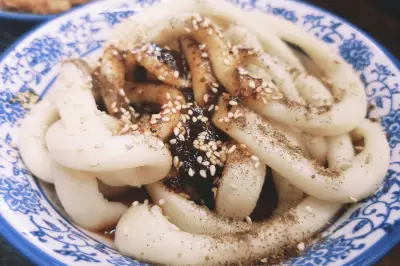
For many old Kunmingers, mixian (rice noodles) can be part of all three meals.
Breakfast isn't complete without 'hua mixian' (here 'hua' means to heartily tuck into a bowl of noodles). For a quick lunch or dinner, every Kunminger's first thought is to 'shuai yi wan mixian' ('shuai' is similar to 'hua' — the essence of Yunnan dialect).
When it comes to mixian, I know you can find so-called rice noodles in many places outside the province. But when I went back to my grandma's in Chongqing and tried mixian there for the first time, I could only exclaim: how is this Kunming mixian?! And when I hear some out-of-province friends say Kunming mixian is terrible, I feel even more determined to defend its honor!
There isn't just one type of mixian; different regions eat different thicknesses. Kunmingers only eat thick rice noodles, what we call 'suan jiang mi xian' (fermented rice noodles). Friends from Honghe prefer thin rice noodles, or 'gan jiang mi xian' (dried rice noodles). Older aunties at the market will only ask 'suan jiang or gan jiang,' rarely 'thick or thin.' (The word 'me' is another dialect essence here, meaning 'or'.)
And there are over a dozen ways to prepare mixian. Even xiaoguo mixian (small pot noodles) comes in varieties like fresh meat or stinky tofu. Other methods include directly adding toppings, like mixed sauce or braised pork.
There's also Muslim-style da su beef mixian. And of course, a uniquely Kunming style is douhua mixian (rice noodles with tofu pudding). I swear you can probably count on one hand the number of times you can find it outside the province.
Just downstairs from my home are two old brands: one called Tieshan Xiaoguo Mixian, the other LuoboTou.
In my foodie opinion, Tieshan has bigger chunks of fresh meat, but I personally prefer LuoboTou.
LuoboTou is also a time-honored Kunming mixian shop. Its signature soul is stinky tofu mixian. When ordering, you can choose to add chive flowers. For me, chive flowers, pickled vegetables, and tomatoes have always been the standard for classic Kunming xiaoguo mixian.
LuoboTou later added changwang mixian (with intestine and blood) and sanxian (three delicacies) mixian. Rose's morning favorite is changwang, while mine is douhua!
Speaking of Kunmingers' breakfast, da su beef noodles are the choice for 80% of people. The first beef noodle shop Rose tried in Kunming, and the one I often ate at during elementary school, is this:
It's not really a famous local institution by word of mouth, but just because it's very close to both our homes, it's become our regular spot.
The essence of Kunming beef noodles lies in the noodles: they must be freshly rolled by hand, cooked not too soft. Add a few pieces of tender braised beef, and you must include their homemade secret old sauce.
And a ladle of fresh beef broth — one mouthful and it's utter satisfaction.
Bianjing Xiaochi (Border Snacks), which became popular in summer because of a 'lychee pineapple' dish, also offers delightful surprises with winter limited items.
A seasonal dessert blending Malaysian pandan and sticky rice, with just the right sweetness. The lemongrass beef pot is also an appetizing wonder, served with rice in a retro rice cooker, where you help yourself to as much as you want.
Hand-beaten chicken and beef meatballs, dipped in Yunnan's 'border' special dip, instantly transport you back to the tropics.
The garlic chicken feet seasoning is so good that even mixed with rice, you'd polish off three bowls!
At Bianjing Xiaochi, if you arrive late, you really won't get a seat. The shop isn't big, but customers stream in one after another.
The earliest street in Kunming known as artsy and literary — Wenlin Street.
There's a Yunnanese restaurant we often go to, and its style clearly dates back to the last century. Although there are many branches, my favorite is the one on Wenlin Street. If you go late at mealtime, you'll have to wait for a table; diners range from young post-00s to grandparents.
Their squirrel-shaped fish is one of my favorites, but this time we passed because it had too many bones.
Salted egg yolk corn is a must-order, with the perfect balance of sweet, salty, and crispy.
For the first time, we ordered the niuba hu baicai (beef brisket with cabbage), which we hadn't tried before. The scrambled eggs in it elevated the soup's umami to the extreme.
On Wenming Street, the most popular old Guandu snack shop, Liuhuan. We unknowingly wandered nearby in the evening, but several snack spots we wanted to try had closed early. The crowd at Liuhuan was noticeably thinner than at mealtime. We made plans to meet a friend nearby for dinner, but fried rice and set meals were already sold out at this hour.
Papaya water, brown sugar tofu pudding, xiaoguo mixian, jar mixian, and fried erkuai are always must-orders.
Not eating xiaoguo mixian several times in Kunming is truly something you'll regret. After all, a friend from Shanghai said that back home, you can't get the authentic version; the one genuine delivery option costs 38 yuan a bowl, while in Kunming, you can be satisfied for just 10 yuan.
'Doucao' is another word full of soul in Yunnan dialect. Literally, it means dressing nicely or handsomely and going out to show off — that's called 'doucao.' Another meaning is just going out to hang around somewhere, taking a spin around a place — that's also 'doucao.'
As local fun-seekers (with a strong emphasis on 'hao' fourth tone), last year we discovered many places even locals didn't know. When we shared them on social media, each spot basically exploded. This winter weekend, we revisited a few of the most photogenic places, since we had a rental car — of course we'd go wherever the photos are best!
Weekend trips are always so spontaneous, and the most convenient thing is renting a car and going on a whim. We chose our favorite, LianDong Cloud rental.
Another reason we rented a car was that a nearby forest was perfect for car photography! So when picking up the car, we specially chose an SUV to better fit the outdoor setting. Of course, the pickup point also had sedans, and white was an option—it can meet all kinds of travel needs. We drove to the forest for a picnic, full of anticipation, setting off early in the morning and taking photos all around the urban area and its surroundings!
First, here's a romantic sunset photo from last summer.
This is a road we discovered in the city that runs parallel to the high-speed rail tracks. It's an internal road for a certain unit, but outside vehicles can also pass through; there aren't many cars or pedestrians. Right next to the second ring road, just navigate to Liangting Middle Road, and you'll see the railway tracks.
When we posted this set of photos on a certain platform last year, it went viral and became a must-visit spot for local photographers. It's hard to see such a gorgeous sunset in autumn and winter; in summer, Rose and I cycled there and could zone out for an entire afternoon.
Sitting on the stone steps by the road, waiting for sunset from the scorching midday sun until it dipped below the horizon, the sky gradually turning blue-purple — it was truly the most beautiful moment of summer.
Doesn't it give off 'Your Name' vibes!
This winter weekend, we came back early in the morning, originally intending to see a 'train sunrise,' but we woke up too late and arrived close to noon.
At noon, there were far fewer cars, and the sun was directly overhead. We realized we couldn't take many portrait shots, so we parked the car aside and quietly waited for a train to pass.
Here you can always hear the sound of trains grinding against the rails; the sound arrives even before the train does.
When no cars pass, the whole road is eerily quiet. Sitting on the stone steps, waiting for the train opposite, with old railway tracks and residents' vegetable plots behind, for a moment it feels like you're not in Kunming but transported to some Japanese seaside town.
Waiting for a train to go by is healing, especially at dusk. Sitting here for just ten minutes is bliss.
Photos like this make it hard to believe it's Kunming. The 500-li Dianchi Lake is as captivating as the blue sea right now. Although pollution control hasn't reached perfection, compared to a few years ago when the water was green, stank, and was choked with water hyacinths, now Dianchi, with the high-altitude cable car along Hubin Road, really has a bit of a seaside town feel.
On the way to Haigeng Dam, we always pass this 'seaside road.' After crossing a drawbridge, you get directly onto this road.
Opposite is the 'West Mountain Sleeping Beauty.' Parking isn't allowed on the roadside, so we parked near the cable car's lower exit and walked back. There aren't many passing cars, and you'll see plenty of people leaning against the white guardrails taking photos.
From travel photographers to groups of girlfriends snapping shots, this has become a photo check-in spot. Standing under the redwoods opposite, with leaves blown onto the road, the autumn-winter colors aren't as vibrant as summer, but still subdued and beautiful.
A little artificial dock with black tires and chain rails — it's like going back to a summer seaside town.
Sunset at Haigeng Dam is actually gorgeous. Since school days, I'd come here with my bestie whenever we had the chance. I remember one evening years ago, we released sky lanterns here and made wishes.
If it weren't a bit far from the city center, it'd probably be one of my regular haunts. After all, it lets us southern kids feel like we're in a coastal city.
Two years ago, we took a Dianchi cruise — the first time for locals to ride a Dianchi ferry, and it was a wonderfully strange experience. Being tourists in your own city is both novel and familiar. This year, the seagulls arrived even earlier, trickling in by mid-November. By midday at Haigeng Dam, it was already crowded.
As usual, you'll encounter a seagull feed vendor every three meters, and along the roadside, 'old masters' wielding cameras and touting seagull photo ops are everywhere.
The winter fairies glide lightly overhead, creating a fresh and healing scene. Gulls resting on the water look like little white boats at anchor, scattered across the surface.
We scanned with a telescope, standing at the guardrail, looking at the mountains opposite, the lake opposite, the seabirds opposite.
The love for Haigeng seems to stem from these Siberian friends arriving on schedule every year, bringing a sense of surprise amid familiarity. This way, we can always be new tourists in our city, discovering her beauty at different times.
The first time I went to Xiaoxiao was when Rose cycled me there. Xiaoxiao Highway is a place only a small number of locals can find.
Xiaoxiao is a village near a reservoir north of Kunming. Its pink exterior walls make it seem like an artsy little village, provided you ignore the big red characters painted on the walls.
The winding roads here are dubbed 'Kunming's Akina Mountain' by local youth. So if you come during the day, you'll definitely see plenty of young gearheads; on weekends, motorcyclists ride by in groups one after another.
(Rose, who secretly wanted to ride, today silently became my driver)
Even because of young people's fondness, a 'Fujiwara Tofu Shop' was opened right on the roadside halfway up the mountain, mimicking Initial D, except here they sell milk tea.
In the middle section of Xiaoxiao Highway, there's a secret forest that's the hottest spot for Kunmingers on autumn weekends. While not all locals know this road called Xiaoxiao, they're definitely familiar with Dianwei Village inside.
Drive through the village and reservoir, cross a bridge, and you'll first reach Dianwei Village.
The village still has traditional rammed-earth houses. Wind through the village, and you'll reach the final destination: the red metasequoia forest.
In January, Dianwei is much quieter, and the surrounding vegetation is even more withered and yellow. Though it's past the most beautiful season for red metasequoias, there are still plenty of aunties visiting on weekends.
We drove past the tourist crowds to a slightly more spacious spot. The redwoods around us only had a touch of reddish-brown at the tips; looking out, the whole forest seemed chilly and desolate.
We suddenly felt a bit of regret about coming in January; everything was just too withered and yellow. In November, it's stunning at sunset, so we were a bit disappointed. So we just decided to check the God's-eye view of ourselves.
As the drone lifted, these ordinary sights to the naked eye suddenly became grand from above, as if we were in a desolate desert.
The little blue car stood out even more in the brown-yellow world.
Following the dusty tracks, we drove straight ahead to a denser area visible from the drone. Only then did we realize that the withered, yellow forest actually had its own unique beauty, albeit a bit lonely.
I stood in the low grass, snapping away at Rose. Though someone claimed 'no more photos,' they still struck a pose in front of the car.
We drove further into the depths of the forest. Sure enough, good scenery requires searching. The car entered a brown-yellow metasequoia grove, like arriving at a wetland. Here, the trees grew more densely together, as if autumn had paused right here — indeed much more beautiful than the desolate trail at first.
When on a road trip, the car is the best photo prop. The trunk could actually fit both of us. The drone's low-battery warning sounded, so we hurriedly took photos and didn't even have time to jump onto the car and sit.
With Rose stepping deeper into the woods, he seemed like the lead in an emotional film. Dappled light flickered between the trees; the surroundings were so quiet only the two of us were left. After watching a sunset, we left Xiaoxiao.
On the second day, Rose took me to an off-the-beaten-path spot he and his friends had discovered: Kunming's version of a 'Nordic forest.'
It's about an hour and a half's drive from Kunming, but we took a wrong turn up the mountain and ended up driving an extra 40 minutes on a gravel road before getting back on track. When I woke from a nap, I opened my eyes to see winter farmland left fallow, with tiny grass shoots peeking through, making everything look vibrant and full of life.
The afternoon sunlight on the car windows had a lovely airy feel; I thought such a scene couldn't be more beautiful.
In Yunnan, you really see cattle and sheep everywhere — not just on Shangri-La's grasslands. When I came to my senses, right ahead was a herd being herded along by a dog.
The cattle's big white faces were inexplicably cute.
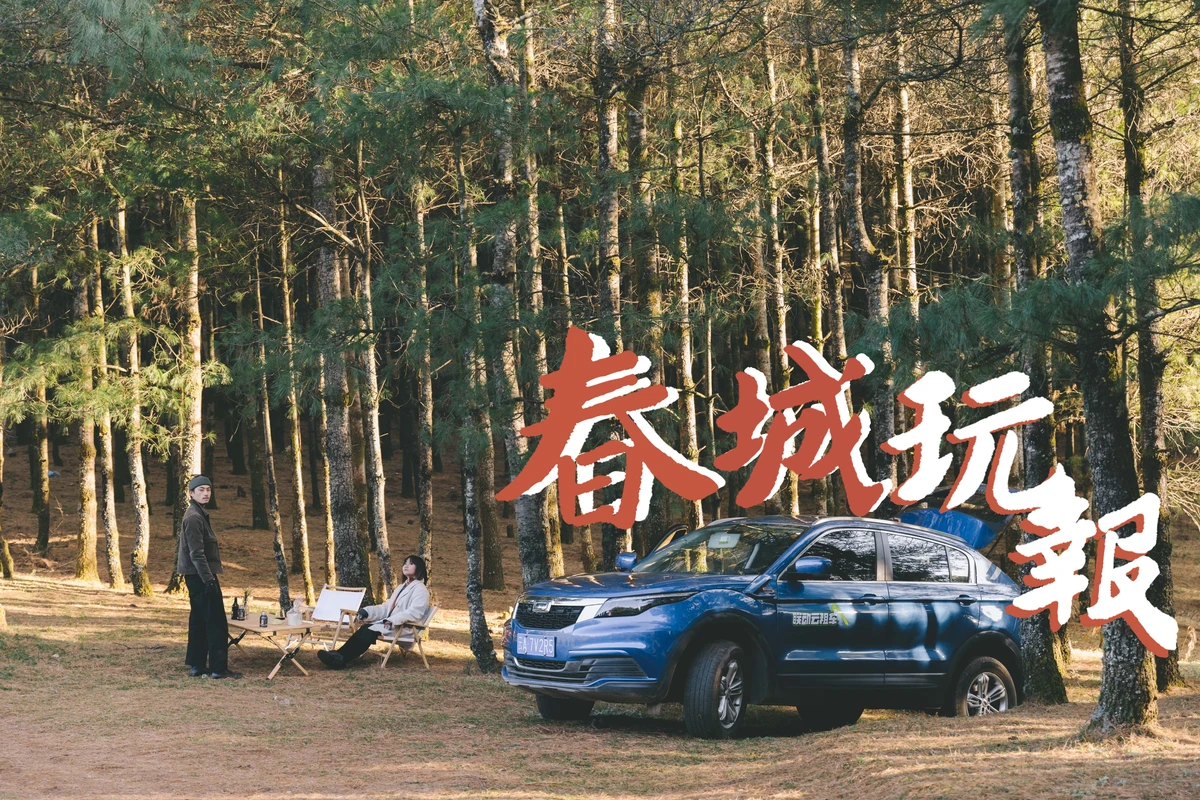
After winding around the mountain roads, we finally found a relatively flat area. We set up a table and chairs, but gave up on the canopy out of exhaustion, and at that moment the sunshine was warm and cozy.
Rose drank coffee, I cracked open a beer. After busy days, we could finally pause and enjoy an afternoon just for ourselves.
Unlike previous times when we'd prepare a full picnic spread just for a few photos and then rush home, this time we just brought our favorite cinnamon rolls and pineapple buns. A simple afternoon tea felt so much more comfortable.
We parked the little blue car next to us, and together with the forest, it looked absolutely stunning.
Sunlight filtered through the trees, sprinkling faint spots of light on us. The fallen pine needles on the ground were warm to the touch, soft underfoot.
We sat chatting and taking photos of each other, while passing cars gave us long looks, full of envy.
The little clearing in the forest where we set up camp was indeed photogenic from any angle — perhaps it was the sunlight that enhanced the atmosphere. After all, sunlight is the world's best filter.
I spotted a camera angle between the trees. I thought Rose would move the canopy's 'golden cudgel,' but instead, as soon as the tripod was set up, he dashed over and sat down ready for a photo. The soft light before sunset cast beautiful layers on the pine leaves.
Rose kept waiting for a breeze; standing on the road there was none, but stepping back under the trees, the gentle wind was just right.
Before leaving, we went deeper into the woods and collected many pine cones. Rose took one look and said what on earth had I picked, none with a good shape! So he circled around to the forest behind our car and gathered a few fresh ones, then contentedly packed up to head home.
The sunset glow formed lovely shapes among the trees, but the nightmare was that right after taking these last two photos, my camera crashed to the ground and the lens was done for. Riding the winter evening breeze home, yet it didn't feel like winter at all; at that moment, it just felt like spring was coming. Even though the lens broke, I maintained a zen attitude and raised Rose's camera to take photos as a tribute.
I love how the sunlight brings out the blurred textures on the car window — it's truly a sunset joyride, a cinematic scene.
In the distance, a patch of forest on higher ground looked like a landscape painting through the car window. On both sides were yet-to-be-cultivated fields, and Rose had another brainstorm: 'Maybe the grass in these fields is planted specifically for these cattle and sheep.'
The forest village seemed to fall asleep in the sunset, and the outlines of distant mountains were still unclear. We descended amid hazy fog, only to encounter the most beautiful sunset of these two days.
Passing through Longtan Nao Village, we stopped at an S-bend and waited for the egg-yolk-like sun to slowly sink.
The sun reduced us inside the car to mere silhouettes.
Recalling how we were just silhouettes in the car that day — it was undoubtedly the most delightful scenery of this winter weekend.
Travelogue Contents
1. Spring City Youth's Chill Weekend (Eating Lotus Root)
2. Let's Go, Hit the Old Streets
3. Jingde Lane
4. Yunnan Military Academy (Jiangwutang)
5. Nanqiang Street
6. What to Eat? (Dian dialect: 'Eat what?')
7. Where to Show Off? (Dian dialect: 'Go where to doucao?')
8. Kunming's 'Your Name' — Liangting Middle Road
9. Kunming's Little Kamakura — Hubin West Road
10. Visiting Siberian Guests — Haigeng Dam
11. To 'Akina Mountain'! — Xiaoxiao Highway
12. Picnic in a 'Nordic Forest' — Dashao Forest
Travel Information
Hotel Index
Guide Index
Flight Index
Site Navigation
Travel Index
Cruise Index
Corporate Travel Index
Partnership
Affiliate Program
Links
Corporate Gift Card Purchase
Insurance Agency
Agency Cooperation
Hotel Franchise
Destination and Scenic Spot Cooperation
More Cooperation
About Ctrip
Ctrip News
Contact Us
Jobs
User Agreement
Privacy Policy
Business License
Security Center
Ctrip Content Center
Intellectual Property
Trip.com Group
Algorithm Disclosure