Beautiful March Scenery in Yunnan
Colorful Yunnan has always been a place I longed for. From March 8 to March 21, 2021, we embarked on the first leg of our Yunnan self-driving tour. Before departure, we made thorough preparations. After selecting the destination, we finalized the specific itinerary: fly directly to Kunming, then rent a car. The route was: airport - Yuanmou - Dongchuan - Yiliang - Luoping - Bamei - Puzhehei - Yuanyang - Jianshui - Fuxian Lake - Kunming - airport.
We booked flights, hotels, and car rental online. Everything was done on the internet. All that was left was to wait for departure.
Around 11:30 am on March 8, our flight landed smoothly at Kunming Changshui Airport. We called the car rental company, and soon a car came to the terminal to pick us up and take us to the rental company (right next to the airport). We signed the contract, inspected the car, and then our self-driving trip began. Our first stop was Yuanmou. The advantage of this arrangement was that we didn't have to enter Kunming twice.
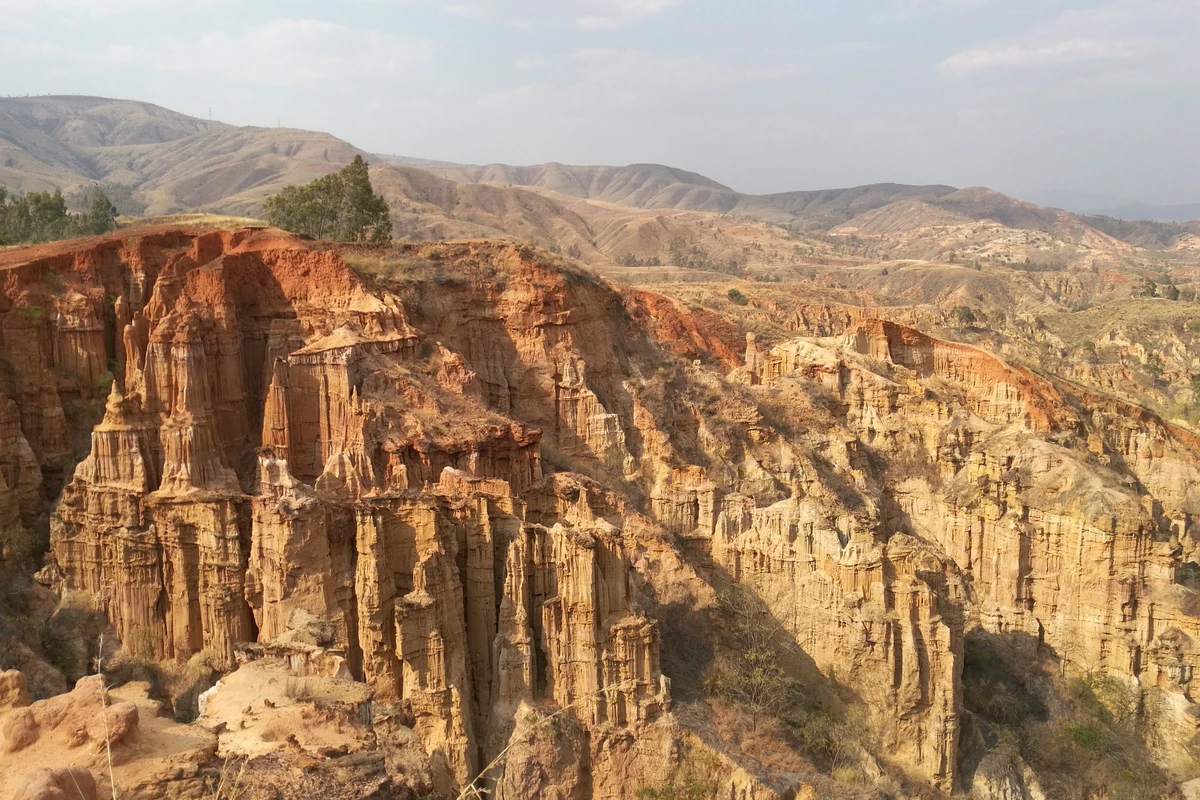
It is about 190 km from Kunming Changshui Airport to Yuanmou. The entire journey was on expressway, taking a little over two hours. We arrived at the booked hotel around 3 pm. After a short rest, we went to the Wumao Tulin (Earth Forest) Scenic Area. The scenic area is about 20 km from the county town. The best way to visit is to take the scenic area's electric car to the top of the mountain, then walk downhill along the exit route. Wumao Tulin is similar to Bryce Canyon National Park in the United States, only less imposing and not as red in color. The best time to visit is at dusk during sunset. Unfortunately, the sun was a bit weak that day. Two hours is enough for the visit.
Yunnan has three kinds of forests: Stone Forest, Earth Forest, and Sand Forest. I feel that each successive forest is less impressive. We would pass by the Sand Forest, but it was not worth a visit.
From Yuanmou to the Dongchuan Red Land, it is about 200 km. The first 170 km on the expressway was very good, but after getting off the expressway, the mountain road was poor. We arrived at Lepuwa around noon. There are many guesthouses and a few restaurants at Lepuwa. We found a restaurant for lunch and then began sightseeing.
The beautiful spots were Jinxiu Garden, Qicai Slope, and Luoxia Valley. At Qicai Slope, you need to walk down from the parking lot; there is no sign, so it's easy to take a wrong turn. Luoxia Valley is beautiful at both sunrise and sunset. When staying in the Red Land, it's best to choose accommodation at Luoxia Valley.
Currently, the Red Land does not charge an entrance fee, but cable cars, parking lots, etc., are under construction, so it may become a paid scenic area soon.
The Jiuxiang Underground Inverted Stone Forest is just a karst cave, but it is quite nice. What impressed me was the Yincui Gorge, with lush greenery and a pool of clear blue water. Unfortunately, the boat ride was too short.
We stayed near the entrance of the scenic area. During the day, there were many tourists, but by 6 pm, hardly anyone was around. Our hotel had more staff than guests. The huge parking lot had only one other car besides ours. And a highly-rated restaurant we found online had not a single person! Fortunately, a tout led us to a farmhouse restaurant near the scenic area, where we had a dinner that exceeded our expectations.
The Yiliang Cherry Blossom Valley (Sakura Valley) had been heavily advertised this year. Tempted and since it was on the way, we decided to take a look. Indeed, the roads and parking lot were well built, and because it was close to Kunming city, there were a huge number of tourists. However, we didn't see the dozens of varieties of cherry blossoms as advertised; only the local Yunnan cherry blossoms were in full bloom. From an ornamental perspective, they were not as good as the early cherry blossoms in Japan.
The rape flowers in Luoping were one of the highlights of this trip. The Jinji Peak Conglomerates and Luoshi Tian (Snail Field) in Luoping need no introduction—everyone knows them. They are indeed beautiful, and we didn't miss them. But what I want to recommend is the rape flowers at Majie. If you are self-driving, you must go! The roads wind through the mountains, and the rape flowers at Songmao Village, Chetu Village, Gegang, etc., are in no way inferior.
We arranged two days in Luoping. Originally, we planned to visit Jiulong Waterfall Cluster, but because the scenic area was temporarily closed, we decided to go to Duoyi River and Lubuge Small Three Gorges instead. The road from the county town to Duoyi River was in very poor condition—twisty mountain roads, many heavy trucks, and potholes. The Duoyi River scenic area is somewhat similar to Xiaoqikong, but not as spectacular or rich. The boat trips at Lubuge Small Three Gorges had only three trips per day during the off-season. We didn't know that, but luckily we arrived around 1:30 pm and just caught the 2:00 pm trip. However, the boat was delayed by twenty minutes. And this two-hour boat ride did not bring us any surprises—it was quite ordinary. By the way, the road from Lubuge back to Luoping County was very good.
There is no expressway from Luoping to Bamei. We had to take the same road we took yesterday to Duoyi River. This 150 km journey took me nearly three hours to drive, with not only many twists and potholes but also a very narrow section.
Bamei had been under renovation for a while and only reopened in late February this year. We happened to catch it. The parking lot and visitor center were huge, making it look like a standardized AAAA-level scenic area. A chill ran through my heart: Could this still be a paradise away from the world? Indeed, later experiences confirmed my worries. After buying tickets, we first took a scenic electric car for about 8 km. The road was brand new and very good, but it felt too long—as if the length justified the 180-yuan ticket. After the electric car ride, the most anticipated part was entering the village by boat through a cave waterway. However, the attitude of what seemed to be the management staff at the boat dock was unbearable: they acted as if they didn't care, causing chaos; boarding the boat became a scramble. What a mess! Although the water cave was unique, our mood was ruined.
Most accommodations in Bamei have poor conditions, with few bathrooms offering dry-wet separation. Plus, it's inconvenient to get in and out, so most tour groups choose to stay in the county town dozens of kilometers away. The scenic area is not large; a loop back to the parking lot takes about 4 to 5 hours. There is no need to stay inside the scenic area, but that makes it a bit rushed.
We stayed inside for one day. Taking a walk in the early morning was quite nice—fresh air and beautiful environment. But the tranquility of the paradise had been broken, and we could no longer feel that sense.
Leaving the village does not retrace the route. From our guesthouse to the dock, there was a distance; the guesthouse's tuk-tuk only carried luggage. To return to the parking lot, we had to take two boat rides. Between the two boat rides, there was a scenic shuttle that pretended to be a miniature train. Poor management again; it took us a full two hours to get back to the parking lot.
Bamei has become a "proper" scenic area, but its unique character has quietly disappeared. I actually dislike this kind of tourism. I call it "standardized tourism." Tourists are like products on an assembly line; once at the scenic area, they have no choice but to follow the prescribed way.
Puzhehei is very large, with many ways to explore. The scenic area management is quite good. Accommodation can be chosen in villages around the core area, with many options. You can tour by boat, by car, or on foot. On sunny spring days with a gentle breeze, walking is truly pleasant. Self-driving travelers are recommended to go to Leshui Cave for a bird's-eye view of Puzhehei, then descend to Luoshui Cave to watch the sunset. It is really beautiful. If you have a chance, you can stay a few more days and leisurely pass the time.
The Yuanyang Rice Terraces have several terraces: Laoyingzui, Bada, Duoyishu, Aichunlan, Azhuke, Laoyingzui, etc., each with its own characteristics. You need to buy a ticket to enter the scenic area. Actually, the ticket only gives access to two viewing platforms: Bada Terrace and Duoyishu Terrace—one for sunset, the other for sunrise, and each can be entered only once. There used to be a Laohuzui (Tiger Mouth) Terrace, but it was closed due to a landslide. When we arrived at the terraces, we just caught the sunset at Bada. The parking lot was full, and the viewing platform was packed with people and cameras. We could only squeeze in for a quick look. The more than 3,000 terraces shimmered gold under the setting sun, truly magnificent, but the crowds made it unpleasant.
The next morning, we went to Duoyishu for sunrise, still crowded, but the viewing platform had multiple levels and was large enough, so it wasn't too cramped.
Azhuke and Aichunlan are relatively close. Laoyingzui is farther away, passing through a messy town and a narrow road.
If you want to watch the sunset, there is a viewing spot on the road from Bada Terrace to Qingkou Terrace, offering a similar view to the Bada viewing platform, and it's free! Only by seeing the Yuanyang Rice Terraces can you understand what "spectacular" means. The best time to view the terraces is during the irrigation season, and at sunrise or sunset.
From Yuanyang to Jianshui, there are generally two routes: one takes part of the Tianhou Expressway, a bit of a detour; the other is G245. We took G245, entirely without expressway. Our experience was that it wasn't as difficult as the locals said; it just involved crossing a few mountains.
For us, Jianshui was only a quick stop. We saw the Shuanglong Bridge and the Zhu Family Garden. Shuanglong Bridge is beautiful. Zhu Family Garden is small but should also be nice, although the surrounding skyline has been completely ruined.
Yunnan has three major lakes: Dianchi Lake, Erhai Lake, and Fuxian Lake. To put it in perspective, Fuxian Lake is China's largest lake by water volume, the deepest plateau deep-water lake, and the second deepest freshwater lake (the deepest is Kanas Lake). With the rise of resort tourism, countless vacation apartments, hotels, and restaurants have been developed around the lake. We picked a lakefront vacation apartment. Indeed, the lake view was unbeatable—the water was blue and clear.
Because of overdevelopment, there were many unfinished buildings around our apartment. And the huge vacation apartment building we stayed in had only a few lights on at night.
Around Fuxian Lake, there are many scenic spots. We visited Luchong Scenic Area, a national 4A scenic area. The area is very large, backed by mountains and facing the lake, with ancient trees providing shade. It features Bijia Mountain, ancient banyan trees, and many recreational activities. Restaurants, accommodation, and souvenir shops are all available. But since it wasn't peak season or a weekend, there weren't many tourists.
On March 18, we returned to Kunming. Before entering Kunming city, we stopped by Laoyuhe Wetland Park along the way, mainly to see tulips. But they had already withered. Many wetland parks have been built along Dianchi Lake, about a dozen. It's impossible to visit all of them.
In Kunming city, we did not visit the popular Western Hills, Golden Temple Park, or Daguanlou Park. Instead, we chose Haigeng Park and Kunming Botanical Garden. Haigeng Park is just a green belt along Dianchi Lake, one of the better-managed spots in Kunming—clean and tidy. The western garden of the Botanical Garden was closed, and we didn't see many camellias in the eastern garden, which was very disappointing. However, the adjacent Heilongtan Park gave us a pleasant surprise: the azaleas blooming on the small hill made our trip worthwhile.
For two weeks, we galloped across the land of Yunnan, basking in the sunshine, and touring Yunnan's mountains and rivers. Self-driving brought us relaxation, joy, and freedom.