Kunming Western Hills
During the Jiajing reign of the Ming Dynasty, Yang Shen praised the Western Hills in his 'Annals of Yunnan’s Mountains and Rivers': 'Green cliffs stretching thousands of zhang, clear waters running for a thousand xun, moon reflected in the limpid waves, clouds resting on the summit, a splendid scene in Yunnan.'
The Western Hills sit on the west bank of Dianchi Lake, also known as Biji Mountain (Green Rooster Mountain). In the Yuan Dynasty, they were ranked first among the 'Eight Scenic Spots of Southern Yunnan.' In the Ming Dynasty, Kunming’s Western Hills, along with Xiushan in Tonghai, Weibaoshan in Weishan, and Jizushan in Binchuan, were collectively known as the 'Four Great Scenic Mountains of Yunnan,' with the Western Hills at the top. Among the 'Six Sceneries of Kunming,’ they were praised as ‘Biji Autumn Colors’; in the Qing Dynasty’s ‘Eight Sceneries of Kunming,’ the ‘Moonlit Night on Dianchi’ referred to the night moon over Dianchi and the Western Hills; and today, they are part of the ‘Sixteen Sceneries of Kunming’ as ‘Sleeping Beauty Mountain, Soaring Dragon Gate.’ Viewed from afar, the peaks resemble both a colossal reclining Buddha and a beautiful maiden lying on her back with bent legs by the lakeside, her dark hair flowing into the sea. Hence, the Western Hills are also called ‘Reclining Buddha Mountain’ and ‘Sleeping Beauty Mountain.’
The Huating Temple, Taihua Temple, Sanqing Pavilion, Nie Er’s Tomb, and the Yulan Garden are tucked away in lush forests and tall bamboo groves. The Longmen Grottoes are carved into the sheer cliffs, while a thousand-mu mini stone forest clusters on the Flying Cloud Peak of Luohan Mountain. The majestic lake-and-mountain scenery, enriched by a profound thousand-year history and culture, endows the Western Hills with a unique, mysterious charm that attracts visitors from home and abroad. The Western Hills are the very symbol of Kunming’s ‘Golden and Green Lakes and Hills,’ embodying grandeur, peril, uniqueness, elegance, and beauty all in one!
To be honest, my visit to the Western Hills was inspired by this old photograph.
A group photo of commanders of the Chinese Expeditionary Force taken at Longmen on the Western Hills in 1943 during the War of Resistance against Japan; those in the photo include Xiao Yisu, Huang Xiang, Qiu Qingquan, Zheng Dongguo, Bao Jing’an, Du Yuming, Frank Dorn, Wang Lingyun, Joseph Warren Stilwell, Zhao Gongwu, Huang Wei, Yu Dawei, Liu Yunhan, and others. In the front row, the little girl is Huang Minnan, the eldest daughter of General Huang Wei.
As time was limited, I didn’t visit Huating Temple, Taihua Temple, or the Yulan Garden. A 10-yuan bus ticket took me to the lower cable car station; Nie Er’s Tomb is nearby. A 25-yuan cable car ride brought me to the upper station, and from there I walked downhill, focusing solely on the Longmen Scenic Area. The Longmen area consists of two parts: Sanqing Pavilion and the Longmen Grottoes.
Sanqing Pavilion is a complex of nine levels and eleven pavilions. What are the nine levels?
The first level is the Southern Nunnery Ruins, with the Prince Liang Summer Pavilion and Yilan Pavilion;
the second level is today’s Lingguan Hall;
the third level is the Sanqing Pavilion, which includes the Sanqing Pavilion and Feiyun Pavilion;
the fourth level is the present Zhenwu Hall, with the Doumu Pavilion and Xiantian Pavilion;
the fifth level is the Lingxiao Bao Pavilion;
the sixth level is the Jade Emperor Pavilion, including the Seven Saints Hall and the Jade Emperor Pavilion;
the seventh level is Phoenix Rock’s Holy Parents Hall, with the Hanxu Pavilion;
the eighth level is Ciyun Cave, with the Zhujia Pavilion;
the ninth level is the Longmen Stone Archway, with the Datiange Pavilion.
A thousand xun of green shade; a roar at Longmen startles the vast sea, three echoes from immortal pavilions resound in the azure sky.
Green Wave Tower: Wind and waves of eternity arise from the mortal realm, mist and rain over the lake ascend the high terrace.
Dianchi Lake seen from the window of Green Wave Tower.
Mountain Gate, Luohan Cliff.
Clouds and mist now and then spread over the world below; at night, bells and chimes resound through all heavens.
From the Luohan Cliff mountain gate up to Lingguan Hall, seventy-two steps symbolize the seventy-two earthly fiends.
On the back of the gate is inscribed ‘Realm of the Three Purities’.
Stand where you are, you must aim for the highest; raise your head, there are still many above you.
Lingguan Hall enshrines Wang Lingguan, guardian of the mountain gate.
Glittering light shines like gold, the still reflection is a sunken jade disc; tier upon tier of green peaks tower, flying pavilions glow with cinnabar.
The first line is from ‘Memorial to Yueyang Tower,’ the second from ‘Preface to the Pavilion of Prince Teng’—both antithetical and perfectly fitting.
Red-faced and bearded, clad in golden armor and a scarlet robe, his three eyes glaring, he holds a wind-fire wheel in his left hand and a steel whip in his right—fiercely majestic and mighty.
His name is Wang Shan, a second-generation disciple of the Taoist Lin Lingsu and a guardian deity of Taoism, praised in folk as: ‘With three eyes he observes all under heaven, with one whip he awakens earthly people.’
Born before heaven and earth, tracing back through the ages, the lamp in this pavilion passes on the ultimate origin that is without ultimate; revered as the ancestor of the Way, look up to the three-platform tripod soaring into the clouds, mystery within mystery.
Stone carvings of the Three Purities; Sanqing Pavilion was originally the summer palace of the Prince of Liang. From Lingguan Hall to Sanqing Pavilion, there are 36 steps, symbolizing the 36 heavenly spirits.
Gaze into the distance to the towering Taihua, vast cosmos holds up half the sky; the expansive sea fills your bosom, boundless sights and breezes lean against the storied pavilion.
Transforming the tortoise and snake, by art creating a blessed realm on the spiritual mountain; with the people in mind, the immortal abode subdues demonic forces on this ultimate land. Written by Sun Kaiyi, calligraphy by Yang Zhefang from Kunming.
Feiyun Pavilion: Legends of Longmen, with eight mural paintings.
A perilous tower rises from the cliff side, ridges like screens, the sea like a mirror, boats like leaves, towns and villages like paintings, not to mention the sceneries of the four seasons, mornings and evenings, clear or overcast—pray, which traveler past or present has grasped these myriad sights?
From the highest peak, touching the heavens, caves with clouds, cliffs with springs, pines sighing like waves, birds and flowers, forests and ravines full of feeling. Hard it is to linger in one’s homeland, when duty calls across mountains and rivers. Recalling eight years of hardships, I come to revel in these golden and green lake-land hills.
Holy Parents Hall, inscribed by Liang Ziqin from Yanshan in midsummer of the gengchen year.
At the seven-bend mystery’s origin, true qi is stored and blessings extended; from the nine heavens, mercy and virtue shine and their fragrance lingers. Written by Zhao Chun from Heqing.
The Supreme Ultimate divides to form heaven and earth, heaven the father, earth the mother, creating the primordial qi of the cosmos;
the Two Modes separate into yin and yang, yang of heaven, yin of earth, gestating the spiritual essence of the world.
Sea-Viewing Place, inscribed by Chen Jiuling, a local.
‘Sea of Clouds, Stone Forest.’ Calligraphy by Pingshan.
A path showered with red rain (petals), a thousand woods spread green shade. Written by Fu Zonglong of the Ming Dynasty.
Perilous steps of a thousand xun, layered in green mist; a flying tower juts from the cliff, overlooking gathering waves.
Better leave it stubborn as it is; who came again to chisel apart chaos? Since it’s so bizarre, I too desire to smash the void.
On the cave ceiling, the Taoist Wu Laiqing carved a colored phoenix holding a book. According to legend, when the Yellow Emperor was at the Luo River, a colorful phoenix brought a book, which Great Yu received and then brought order to the realm; this depicts the legend of the ‘Luo River Offering the Book.’ This stone chamber is also called Phoenix Rock.
The stone house was excavated under the Taoist Zhao Lian during the Jiajing reign. On the main wall are inlaid six stone tablets, including the ‘Inscription on the Farewell Banquet by Dianchi Lake’ and other poems.
Further up lies the Longmen Grottoes. The countless steps along the way and the reliefs, stone carvings, and caves dotted along the route were all painstakingly chiselled bit by bit by Qing Dynasty craftsmen using primitive tools. The entire project took 72 years to complete—truly spectacular.
Pluck a golden lotus, crossing from the Southern Sea to bring vast benefits; carve a stone chamber, seated in meditation on the Western Hills, radiating light.
What pleasure! Beyond the bustling noise; what a sight to behold! Amidst the misty ethereal realm.
On the back: ‘Buddha Valley, Clouds Deep’.
The sea rises, clouds hang low; arriving here is truly no ordinary realm. Cliffs high and paths winding, reaching the top is another cave-heaven.
Construction began in the 46th year of Qianlong (1781) and was completed in the 3rd year of Xianfeng (1853). It includes three sections: the Old Stone Chamber, Yunhua Cave, and Datiange Pavilion. Sheer cliffs tower, and a winding, cantilevered tunnel was carved into the rock, with many inscribed poems on the stone path.
‘A long song recalling the picking of bracken,’ from the Tang poet Wang Ji’s ‘A Field View,’ praising the integrity of Bo Yi and Shu Qi.
Originally, to go from Sanqing Pavilion to Longmen, one had to cross a wooden plank walkway clinging to the cliff; as people passed, it creaked loudly, and in the wind, one’s heart trembled. During the Qianlong reign, the Taoist Wu Laiqing raised funds to excavate a stone tunnel, which took fifteen years.
Yunhua Cave was excavated by stonemasons organized by the famous Kunming scholars Yang Rulan and his son Yang Jitai, spanning thirteen springs and autumns.
Once you ascend Longmen, your status multiplies a hundredfold! Inside the cave, a cliff inscription reads: ‘The mountains are high, the rivers long.’
Look up with a smile, as if only five chi from heaven; lean at the rail, right in the center of the water.
Beyond the balustrade, a bright mirror opens; sitting still, it’s like being by the Weak River; auspicious clouds rise from the cliff edge, coming here is like roaming in Penglai.
Outside the cave, clouds dwell and rosy mists curl; on the sea, waves go and the moon comes. Inscribed by Li Qi of Huafeng.
From compassion, a drop of sweet dew descends to form seeds of intelligence; at the place of resonance, three thousand pure waters are sprinkled to bloom flowers of wisdom.
Ciyun Cave, reverently inscribed by Liu Shu, a disciple from Kunming.
‘Extend Progeny to the Mortal World,’ reverently inscribed by Liu Shu, a disciple from Kunming.
‘Guarded by Clouds and Mists,’ by disciple Wang Kun.
Dusty stone steps, swept by the breeze; cavern abode with no door, sealed by white clouds.
Carving the rock reveals Putuo, bringing the five hundred li of Dianchi into the Buddha’s sea; helping all to the other shore, may a thousand holy hands all turn into boats of compassion.
The stone chamber marks a sacred trace; Kunming’s lake is no different from the Southern Sea. Devas and mortals gaze upon the Dharma image; Huashan is indeed the Fragrant Mountain. Erected by the devotee Tang Zhizhong and the later scholar Shen Chaoyang from Kunming.
Star Bridge locked in Buddha’s land, as if by the shore of the Southern Sea; a cave-heaven’s stone pavilion split open, just like inside Putuo’s crags. Inscribed by Hao Liang, a local, and reverently erected by Wang Kun.
Every step is difficult; make sure your foot stands firm. Measure yourself against the heavens—then keep your mind calm and peaceful. Written by Zhao Heqing of the Qing Dynasty.
Under the door frame, an ingot is carved; all visitors touch it for good luck, happiness, and success in everything.
Longmen: Heaven and earth float as in a mirror; sun and moon dance like two pellets.
Above Datiange Pavilion, an image of the South Pole Immortal Elder is carved on the cliff.
Datiange Pavilion includes the Longmen stone archway, a platform, a stone chamber, an incense burner, and more.
‘Heaven Reflected in the Sea Mirror,’ erected by scholars and commoners of Yunnan in the 30th year of Daoguang, inscribed by He Guiqing, a local, and calligraphy by Yang Yinkui.
Datiange Pavilion, written by Ni Yingyi, a local, in the autumn month of the bingwu year of Daoguang.
This mountain’s breath directly communicates with the Emperor on High; at any time, looking up or down, one is far above the mundane. Respectfully inscribed by Qian Kuangzhe, a local.
Filial piety and loyalty practiced, sage spirits endure from past to present; truly with civility and martial prowess, mountains and rivers gather the full vitality.
Grasping the Dipper, touching stars, flying cranes soar by the cliff; surveying rocks and inspecting the pool, the landscape lies within the palm.
The peaks wind and paths twist as if climbing to heaven; the cave is narrow, the ravine deep, as if entering a dream. Written by Cao Fan, calligraphy by Zhao Morong.
At the center is Kui Xing (Star of Literature), flanked by Guan Sheng (Guan Yu) and Wenqu Xing (Star of Culture). The statue of Kui Xing is the most vivid: his right hand holds up a divine brush, his left grasps an ingot serving as the inkwell for the divine brush; his right foot tramples a turtle’s head (the character 鼇), while his left foot is raised backward, its sole holding a winnowing-basket-shaped ‘dou’ (Bushel) as he twists his body to dot the Big Dipper. The ghost-like head forms the radical of ‘kui’, the kicked-back left foot is the long hook stroke, and the golden bushel under his sole is the right side of the character ‘dou’—a delightful embodiment of Chinese pictographic character creation.
Behind Kui Xing is a relief depicting immortals in a cloud-cave paradise. On the north wall is carved the ‘Tract of the Quiet Way of Wenchang,’ and on the south wall the ‘Great Lord Guan’s Scripture to Awaken the World.’
Guan Yu’s Red Hare steed.
Noble spirit fills the universe, long have the sages of old and new been peerless; utter loyalty pierces sun and moon, how great the hero of the cosmos.
Don’t just sit and watch; realize your duty is inescapable. Even if you find quiet pleasure, it is merely a moment stolen from the busy life.
‘Penglai Fairyland,’ reverently inscribed by Yang Bencui of Longmen Huashan.
The south side of the stone chamber features a golden dragon spouting water.
On the north, a leaping carp.
The carp that leaps over Longmen transforms into a dragon; those that fail are given a red dot on their foreheads and sent back. The red spot on the forehead of a Yellow River carp signifies it failed to jump the Dragon Gate.
The stone incense burner, facing Dianchi Lake, is engraved with two poems by Na Wenfeng, a jinshi of the Qianlong era, ‘Presented to Taoist Wu,’ praising Master Wu’s achievements in opening the mountain and carving the caves:
Poem 1: Ten thousand drills and hammers reveal a master talent, cutting an immortal terrace on the steepest cliff. Need not a natural Buddha cave be born, it rivals the Dragon Gate split by Great Yu. Purple bamboo shade springs from the heart of the book, auspicious clouds and dew rise from the palm. Kunming’s lake is just like viewing the Southern Sea—not in vain the dreams of those bygone years.
Poem 2: Stone-carving surpasses even the skill of molding stones, vying to follow Pangu in splitting the sky. Once the mists are pierced, heaven and earth become distinct; sun and moon newly divide, chaos opens. The world can be contained in a pot, mountains and rivers reflected in a mirror for the future. Doubt not that such a place exists on earth; only that Liu Lang was allowed to return here.
Cloud-Piercing Cave, composed by Yu Shaoliang.
Great Yu carved the Dragon Gate, Pangu split open the sky terrace.
Morning rain, the hidden dragon lightly emerges from the sea; at sunset, the winding stone steps snake through the void.
Inviting passing travelers to drink the beauty of words, using the rushing stream in place of string and pipe music.
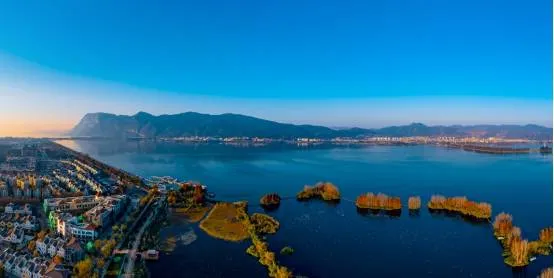
And here’s another beautiful photo of Dianchi Lake.