On the Road – Dali in Winter
On November 24, 2022, I boarded a flight to Kunming once again. The circumstances were special – during the COVID-19 pandemic! Amid doubts, various nucleic acid tests, and an unknown future, we still set out. This travelogue is written to commemorate the entire process of epidemic control measures shifting from strict to relaxed, which we happened to experience.
November 24: Tianjin – Kunming
November 25: Kunming – Dali – Tengchong
November 25–26: Tengchong Ginkgo Village
November 27–30: Tengchong (Heshun Ancient Town, Tengchong Hot Springs, etc.)
December 1–3: Tengchong – Dali – Wuliangshan Cherry Blossom Valley (Weishan Ancient Town)
December 4–7: Wuliangshan Cherry Blossom Valley – Dali Erhai Lake
December 7–9: Dali – Kunming
December 10: Kunming – Tianjin
Since there were two of us traveling, we only made a rough plan, thinking we would stop and go as we pleased. We didn’t buy round-trip tickets either, wanting to be flexible. It was this decision that allowed us to stay in control during this trip full of changes. At the same time, my carelessness cost us quite a bit, but that’s a later story.
Actual itinerary:
November 24: Tianjin – Kunming (3-hour flight)
November 25: Kunming – Dali – Tengchong (Ginkgo Village) (first leg: high-speed rail; second leg: nearly 4 hours self-driving)
November 25: Tengchong – Dali Ancient City (Dali Ancient City)
November 26: Dali (Cangshan National Geopark) – Shaxi Ancient Town (over 2 hours drive)
November 27–28: Shaxi Ancient Town (ancient town, Heihui River, Librairie Avant-Garde)
November 28: Shaxi Ancient Town – Haishu Park (Zhoucheng)
November 29: Haishu Park – Shuanglang Ancient Town (Xizhou Ancient Town, Shuanglang Ancient Town)
November 30: Shuanglang Ancient Town
December 1: Shuanglang Ancient Town – Dali Ancient City (self-driving along Haidong Highway)
December 2: Dali Ancient City – Weishan Ancient City – Wuliangshan Cherry Blossom Valley (first leg: nearly 2 hours, many mountain roads; second leg: over 1 hour highway, fewer mountain roads)
December 3: Wuliangshan Cherry Blossom Valley – Dali Caicun Village (over 3 hours drive)
December 4–5: Caicun Village (cycling along the West Erhai Ecological Corridor)
December 5: Dali – Kunming – Dongchuan Red Land Scenic Area (Luoxiagou) (nearly 4 hours: 2 hours highway, 2 hours mountain roads)
December 6: Dongchuan Red Land Scenic Area – Kunming Dianchi Lake (over 3 hours: some mountain roads, mostly highway)
December 7–8: Old town of Kunming (public transport)
December 9: Kunming – Tianjin
The journey begins:
November 24
At 10 p.m., we boarded the flight to Kunming. Earlier in the day, because of the nucleic acid screening, we hadn’t done a single-tube test. The results hadn’t shown up on Tianjin Digital Epidemic Prevention by 7 p.m. With an uneasy feeling, we took a taxi to the airport. Chatting with the taxi driver, we learned that we could first check the nucleic acid result on Jinxinban and then check Tianjin Digital Nucleic Acid again – it might update. We quickly tried, and miraculously, our nucleic acid report had been available since afternoon but just hadn’t updated on Digital Nucleic Acid. After checking through Jinxinban, it updated. At the airport, we showed our health code, travel history code, and nucleic acid certificate and smoothly reached the boarding gate. The airport was very quiet – probably due to the pandemic and the late hour. Most passengers were young people; there were very few like us.
November 25
We arrived in Kunming at 1 a.m. After getting off, we took an on-arrival nucleic acid test and weren’t required to wait at the airport. We filled in the Yunnan Health mini-program and went smoothly to the airport hotel to rest.
At about 8 a.m., we got up, took a taxi to Kunming Railway Station, bought high-speed rail tickets on the spot, and arrived in Dali three hours later. We took another nucleic acid test upon exiting the station, without needing to stay, and went straight to the car rental company.
We used our usual car rental website. Since we arrived earlier than expected, our reserved car wasn’t back yet, and the cars available on site had tires that looked overly worn – not satisfactory. So we contacted the platform to cancel, and rented a satisfactory car from a nearby rental company (Hexie Car Rental). We drove straight to Tengchong. Despite small hiccups, everything went smoothly.
The midday sun in Dali warmed the car body, but inside we felt scorching heat – and it was winter!
After four hours on the highway, we arrived in Tengchong. Although it was a highway, it was winding. After exiting the highway, we took another nucleic acid test.
On the 25th, we actually took three nucleic acid tests. It took nearly an hour of mountain and village roads (40 km) to reach Ginkgo Village. We finally arrived in the evening.
Accommodation: Pinxing Shiguang Inn (booked on Ctrip) (the room was spacious, the courtyard large, but it had a squat toilet – might be inconvenient for those not used to it)
November 26
We got up a little after 7 a.m.; the sky was still dim. It was a mountainous area, so it got light late, and the weather was quite cool – we needed a thin down jacket. Ginkgo yellow is a highly seasonal sight, so based on past experience, this period would usually be crowded with tourists.
In the deep autumn of “trees in golden fall, mountains in chilly hues,” Ginkgo Village is a tranquil and dreamlike place. It is the number one ginkgo kingdom in the world. In front of and behind houses, yellow leaves danced in the air, exceptionally beautiful. It can let your soul drift freely among the gold. Walking through it, you marvel at the spectacular sight of trees shining like gold. The village was golden everywhere; stepping on thick fallen leaves gave a tangible sense of golden autumn.
In the early morning, the village was still quiet. Walking along the paths, we saw that almost every household ran a guesthouse. With open gates, tourists could freely enter courtyards to admire and take photos.
The sun slowly rose, golden light spreading into every corner. In the curling cooking smoke, we could always see the Tyndall effect in the air. We walked excitedly, taking in the sights, capturing moments that caught our interest with the camera. Everything was so beautiful! Little did we know what awaited us next.
At the Ginkgo Square, we suddenly realized that it wasn’t crowded as many travel guides claimed – it was very sparse, quite strange. Was today special? Around 10 a.m., we returned to the inn for breakfast. Bad news came: all tourists had to leave Tengchong today because Tengchong was going into a silent lockdown! Nothing could be more disheartening. We had traveled thousands of miles to see the ginkgo and soak in hot springs. We only saw the ginkgo for three hours; forget about the rest. The inn owner drove us to get a nucleic acid test. We reluctantly said goodbye and drove back to Dali, arriving at about 4 p.m.
Accommodation: Dali Qingshe Landscape Beauty Inn (Rongyaju) (booked on Ctrip) (close to March Street, etc. The inn is far from the main road, so without a car, dragging luggage would be inconvenient)
The courtyard of our inn was surprisingly large.
A very large ginkgo tree.
Time seemed to shuttle between spring and autumn.
We entered a farmhouse courtyard.
The movie "Wu Xia" was filmed in this courtyard.
An ordinary farmhouse yard.
Nearly 800 km of travel for only three hours of sightseeing – it would be dishonest to say there’s no regret.
In the evening, we strolled through Dali Ancient City. Seeing the ancient city gate, I recalled bringing my son here in the 1990s. Back then, he was shorter than me; now he is the father of two children. Time flies! I took a photo at the same city gate where we had taken pictures before and sent it to my son via WeChat. He replied, “I vaguely remember we took a photo here.”
November 27: Morning at Cangshan – afternoon arrival at Shaxi Ancient Town
The snow on Cangshan is a symbol of Dali. Normally, people just view Cangshan from afar; few actually climb it. In fact, more locals go there. There was no snow on Cangshan yet. We quickly looked up information: Cangshan is a national geopark with three cable cars: Ximatan, Gantong, and Zhonghe. Ximatan was too high, Zhonghe too low, so we chose Gantong.
No crowds on the cable car – no waiting. From the cable car, we could see Erhai Lake. At the end, we continued hiking, saw the Zhenlong Chess Game, Qingbi Stream, and finally reached the Cangshan Grand Canyon viewing platform. Then we decided on a downhill route. We could take the cable car down or walk. Walking had two options: one was to go back to the Zhenlong Chess Game and descend to Jizhao Nunnery, then to Gantong Temple; the other was to take the Jade Belt Road first (4.5 km long) and then descend. We chose the first option to walk down.
Along the way, there were babbling streams and lush green trees. Since we walked a long section of canyon road, our stamina was manageable. Time flew as we walked and took photos. We missed the vegetarian meal at Jizhao Nunnery! The succulents in the nunnery were more than I had ever seen. After drinking a pot of tea there, we continued down to Gantong Temple. Our Cangshan trip ended. Cable car and ticket: 85 yuan per person – one of the few ticket expenses on this trip.
Seeing that it was still around noon, we decided on the spur of the moment to go to Shaxi Ancient Town. My understanding of Shaxi came from a photo. Even though I knew it was edited, I was still stunned and wanted to see it in person.
While refueling, we saw a McDonald’s, so we bought two portions and ate in the car while driving. After three hours, we arrived at Shaxi Ancient Town.
Shaxi Ancient Town is located in Jianchuan County, between Dali and Lijiang. It’s not easy to drive from Dali. Shortly after leaving Dali, we had to pass through a village. The road was very narrow, making us wonder if we were on the right path. Following the navigation, we exited the village and started winding mountain roads. The roads were narrow and sharply curved, and the sunlight was shining directly ahead, dazzling us. After crossing the mountain, there were more village paths. Many roads were under construction, covered in dust. Amid the flying yellow earth, we finally reached Shaxi Ancient Town! Near the town, the road improved and the dust disappeared. Perhaps because it’s hard to reach, it has been preserved.
Xu Xiake once described Shaxi as a land abundant in grain. Shaxi Ancient Town belongs to Jianchuan, an important node on the Ancient Tea Horse Road. Shaxi is the only ancient market preserved along the Tea Horse Road. In the past, it must have been a bustling, lively place with endless caravans and merchants. Now it has returned to tranquility, hidden in the mountains, becoming a meditation haven for many travelers.
The photo that attracted me was of the Heihui River beside Shaxi Ancient Town. In the evening, we hurried to the Heihui River but still missed the sunset glow.
Walking through the ancient town’s serene streets, finding food became a priority. We found a mushroom hot pot restaurant and ate heartily. After continuous driving and hiking, we felt a bit tired, so we went to bed early. Tomorrow, we would see the scenery that brought me here.
In the evening, we queued for a nucleic acid test. The line was quite long.
Accommodation: Jiujiuzhiyue Inn (booked on Ctrip). The owner was a very artistic girl.
November 28: Shaxi Ancient Town
At dawn, when the sky was barely pale, we got up and rushed to the Heihui River. On the Yudai Bridge, we saw the morning mist. The sun slowly rose, casting light on the riverbank and treetops. The scenery was indescribable – only to be seen with our own eyes. Instantly, we felt that the hardships of the journey were worthwhile.
Heihui River in the early morning.
The sun slowly rising.
The Yujin Bridge, over 100 years old.
During the day, we wandered around Shaxi Ancient Town, ate, and slept. In the afternoon, following the recommendation of the inn owner, we visited Librairie Avant-Garde. This was the second Librairie Avant-Garde we had been to. These bookstores are usually located in remote villages, each with its own character. We read some books, drank Yunnan local coffee (a bit sour), and spent a leisurely day.
Before leaving Shaxi, we saw no one at the nucleic acid testing site, so we got tested again.
Grand stage of Shaxi Ancient Town.
November 29: Shaxi Ancient Town – Erhai Haishu Park (Zhoucheng)
After returning from Shaxi, we originally planned to stay one night at Xizhou Ancient Town. We drove around Xizhou but found the accommodation unsatisfactory. So we randomly tapped on the map near Erhai Lake, and it took us to a natural village with no lodging. We then tapped near Haishu Park and found a guesthouse. The good thing during the pandemic was that there were few people, so we wouldn’t be left without a place to stay. We found a guesthouse by Erhai Lake. The room was very small, but we could see the sunrise from the room. Not wanting to search further, we stayed despite the small size.
After resting a while, we went directly to Zhoucheng. Zhoucheng is very small, with just one street entirely filled with tie-dye shops. Many shops offered experiences. We chose to visit the Tie-Dye Museum to learn about its history. Unexpectedly, the museum also had an experience center – probably more expensive, but we wouldn’t have to go elsewhere. So we made a free-style tie-dye tablecloth. The tie-dye master taught us how to roll, bind, and stitch the cloth. After finishing, we dipped it in natural indigo, rinsed, removed the threads, rinsed again, and finally spin-dried.
A unique, freely imagined tablecloth appeared before us. We were delighted and amazed. Although most of the work was done by the master, we felt a great sense of accomplishment. We will definitely do it again next time – and do everything ourselves!
In the evening, we returned to Erhai Lake. Haishu Park was under renovation, so we didn’t go in. We walked along the lake and found this area very primitive with little human intervention. The trees, wetlands, and seagulls were all very natural. Only the long, winding ecological corridor showed signs of human construction. Some people were leisurely cycling on the corridor. Everything was quiet. After nightfall, the surroundings were quite dark.
November 30: Haishu Park – Shuanglang
After watching the sunrise, we went to Xizhou Ancient Town for a short visit – only a 10-minute drive. Xizhou and Zhoucheng are on opposite sides of the road, very close. In winter, Xizhou lacks the spring flower sea, summer rice fields, and autumn golden hues, so the scenery was diminished. We wandered around the ancient town, visited a few courtyards, drank some coffee, and ate cheesecake – there wasn’t much else to do. We decisively decided to go to Shuanglang.
We also took a photo at the iconic corner building.
Not many tourists; many shops were closed.
In just over an hour, we arrived in Shuanglang. The weather was really hot. My husband went out under the blazing sun to find accommodation by Erhai Lake.
This time we didn’t book online. When he returned, we checked in directly.
The guesthouse by Erhai Lake had no parking; we had to park in a public lot, which was expensive – over 50 yuan a night, nearly 60 yuan. Lesson learned: next time, we need accommodation with parking.
Shuanglang is a small fishing village on the east bank of Erhai Lake, far from the city’s hustle and bustle, extremely quiet. It was also a necessary stop on the Southern Silk Road. The streets paved with cobblestones and bluestones are weathered and clear, as if washed by lake water or time. Rows of old houses exude ancient charm, with low eaves and high stone corners, low-key yet stubbornly accompanying the surroundings.
Many alleys in Shuanglang lead straight to the lake, creating a very artistic atmosphere. Everyone’s experience differs, and preferences vary, but it’s hard not to fall in love with Shuanglang. It’s a well-developed resort with architectural styles and facilities that are international, resembling foreign vacation destinations! The coastal scenery is pleasant, dining and accommodation convenient. Even during the special period, we saw relatively more tourists here.
Note: Visiting Yang Liping’s Sun Palace and Moon Palace in Shuanglang requires advance reservation. We overlooked this, and by the time we remembered, the slots for the next day were full, so we didn’t visit.
Before dinner, we hurriedly took a nucleic acid test.
On the main street, we saw a beautiful flower and took photos with it. But after returning home, while watching a documentary, I realized it was Datura flower, which has narcotic effects – don’t touch it casually. Oh my!
Accommodation: Dengfeng Lai Inn (by Erhai Lake; from the balcony we could see Nanzhao Island; breakfast served was good)
December 1: Shuanglang – Haidong Highway – Dali
Today we started our lake loop. In the morning, we bought tickets for Nanzhao Scenic Island. The ticket office told us that in December, scenic spots in Dali Prefecture offer free entry to tourists from Tianjin. What luck! If we had gone yesterday, we would have had to pay. Nanzhao Scenic Island is small; we took a ferry from Shuanglang. A quick tour didn’t take long; the scenery was nice. We took photos and left the island around 10 a.m. Feeling we had already seen what we wanted, we did another nucleic acid test and then drove away from Shuanglang, starting the Haidong Highway journey.
Tip for touring Erhai Lake: it’s best to go clockwise so that parking is on the correct side and you don’t have to cross the road frequently.
First stop on Haidong Road: a popular spot – an abandoned wall. It was actually hard to find. First, we saw a sign for Luwo Mountain with a Guanyin temple. We got out, climbed up to look – not the right place, but the view was nice.
Continuing, we saw roadside coffee stalls. We drove past them, turned right, and after about 50 meters, saw an opening in the highway fence. We went down, the path steep. After a short walk, we saw the abandoned wall. Further in, there was a cave and a lone tree. The view was superb! There were clouds in the sky, making the photos look like backdrops.
Second stop: Wase Pier – messy trees, leisurely locals.
Third stop: Xiaoputuo – seagulls flying. Parking cost us 10 yuan, and we stayed less than 15 minutes. We just looked from afar; it was a bit of a rip-off. We bought snacks and skipped lunch.
Fourth stop: Luoquan Peninsula.
Haidong Road greatly resembled the Great Ocean Road in Australia.
Fifth stop: Dali’s Santorini – the biggest rip-off of the trip. Don’t believe travel guides that compare it to Santorini. It’s actually a hotel, and hotels prioritize privacy for guests. So don’t treat it as a scenic spot; all facilities are for guests, not tourists. Either stay there or don’t go.
We originally planned to stay on Jinsuo Island for a night. But the fifth stop ruined our mood, and we would have to take a ferry to the island while leaving the car on the opposite shore. Coincidentally, a fellow traveler had been in Dali for many days, so we went to where she was staying, had dinner, chatted, and had a pleasant time.
Accommodation: Dali Yixiang Qiuju Inn (the cheapest of the trip – 72 yuan/night, right by the roadside, very convenient)
December 2–3: Dali – Weishan Ancient City – Wuliangshan – Dali
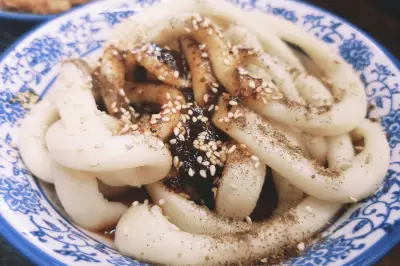
After over an hour of mountain roads, we reached Weishan Ancient City. Weishan is the birthplace of the Nanzhao Kingdom, even more ancient. Local saying: “Eat in Weishan, play in Dali.” Indeed, we ate their rice cakes, boiled sweet peanuts, and drank roasted tea – all very good. For lunch, we had “one noodle” – a single noodle in a bowl, and a whole pot is also one noodle. It tasted great. While walking, volunteers reminded us to wear masks because the epidemic had become severe recently.
We saw a testing point and got tested. Since arriving in Yunnan, we had been testing almost daily to facilitate accommodation and sightseeing. Most accommodations required a 48-hour nucleic acid test.
Leaving Weishan Ancient City, we took the highway and exited at Wuliangshan Cherry Blossom Valley exit – about an hour’s drive. We arrived at Viewing Platform 1. The Cherry Blossom Valley viewing platform, strictly speaking, is Area 1, which is large with many paths to different viewpoints. Viewing Platform 2 is where you go into that famous photo. This photo was taken at Area 1, showing a distant view of Area 2.
After arriving at Area 1 in the afternoon, we walked around and took photos to familiarize ourselves with the terrain for the next morning.
December 3: We set out early, again to Area 1, to capture the sea of clouds and sunrise. We followed the road until we saw a row of public buildings, then turned left uphill. At the top was a guesthouse called “Photography Home,” which had the best spot for photographing the sea of clouds, with a viewing platform. Because we took too long searching, we missed the sunrise but captured the sea of clouds! The cherry blossoms in the morning light looked very different in color from those during the day.
After shooting the sea of clouds, we took photos of blossoms on the roadside, which were already close to their normal daytime color.
The cherry blossom petals in the valley are unique – very different from Japanese cherry blossoms. The petals are denser and more vibrant.
Area 2 has more orderly tea plants. If you like portrait photography or tea garden scenery, you might prefer Area 2.
A great regret: the photos my husband took at the Cherry Blossom Valley on the second day were lost after we returned home. They simply vanished. We suspect that when transferring photos from the camera to the computer, we unplugged the power cable, causing incomplete import. When we came back later, assuming the import was complete, we formatted the camera’s memory card. All the morning photos I have are mine. Every time I think about it, I feel heartbroken. In years of travel, this is the first major mistake.
Choosing Yunnan in winter this time was mainly to see ginkgo and cherry blossoms – highly seasonal landscapes. The heavens didn’t cooperate: the pandemic forced us to leave ginkgo in haste, and we carelessly lost precious photos from the cherry blossom valley.
Accommodation at the Cherry Blossom Valley was very basic. There is a guesthouse at the spot for photographing the sea of clouds, another on the road to Area 2, and a row of houses near the entrance to Area 1. Anything else requires going down the mountain.
December 3–5: Cherry Blossom Valley – Dali – Erhai Caicun Village
From Wuliangshan, we returned to Dali, returned the car, took a taxi to Caicun Village, and settled down by Erhai Lake.
The West Erhai tour officially began.
The landscapes of West Erhai and East Erhai are quite different. First, the mode of travel: on the east side, you drive; on the west side, the ecological corridor only allows walking and cycling. Secondly, the east road runs along the lake with mountains on one side and sea on the other; while on the west side, it’s villages, then wetlands, and then the lake. So West Erhai is more scenic and delicate, while East Erhai is more grand.
We chose to rent bicycles because we were staying in Caicun. We planned to ride toward Langqiao (Corridor Bridge), which was 16.8 km one way – 33.6 km round trip. Bicycle rental was 10 or 20 yuan per day. After breakfast (after 9 a.m.), we set off and returned to Caicun around 4 p.m., taking 7 hours. We stopped frequently, ate lunch at Panxi Village, and didn’t feel too tired. The next day, we went to Longkan Pier.
We stopped at almost every village and lakeside spot. The wetland and Erhai scenery were unforgettable. Morning and evening light spilled onto the lake and trees; seagulls fluttered around. The iconic trees made for excellent photos, and many young couples were taking wedding photos.
This wasn’t our first time in Dali, but it was our first time observing and exploring Erhai Lake so thoroughly. It was truly memorable.
Perhaps we were too mesmerized by the scenery that we forgot to take a nucleic acid test, which set the stage for the next part of our journey.
Accommodation: Tinger Homestay (right by Erhai Lake, very clean. Drawback: about 600 meters from where the taxi dropped us, a bit inconvenient with luggage)
Everywhere were “S” curves.
Longkan Pier’s iconic tree.
Morning at Caicun Pier.
December 5: Dali – Kunming – Dongchuan District
We took the high-speed rail back to Kunming, arriving a little after 1 p.m. We took a nucleic acid test at the station, rented a car, and planned to go to Dongchuan District, intending to stay there and go up the mountain the next morning. After nearly 2 hours on the highway, we arrived in Dongchuan District. When we reached the hotel, our nucleic acid test was 49 hours old, so our travel code showed 72 hours. We explained to the front desk that we had taken a test at Kunming station at 1 p.m., but the result hadn’t come out yet. They stressed that according to the latest requirements, a 24-hour nucleic acid test was needed, so we couldn’t check in.
In the latter part of this trip, we had stopped booking hotels in advance and just checked in upon arrival. No choice. We first went to a supermarket to buy fruit and snacks. Let me say, Yunnan fruits are really sweet. After eating, we decided to go up the mountain directly. We saw a testing point and took another test.
We selected a hotel in Luoxiagou on the navigation and continued driving. The sky was getting darker; the sun sets early in the mountains. The mountain roads were rugged and difficult. After more than an hour, just before complete darkness, we reached the hotel on the navigation. The front desk was quite reasonable: they still required a nucleic acid test result, but since it was late, they said we could wait in the lobby until the result came out, then check in.
They also said that recently nucleic acid results were slow, and the authorities were strictly checking hotel guest records. Since the checkpoints on the road had been removed, they couldn’t be careless. We had no choice but to wait.
There were no other guests – only us and two female staff. They made us two bowls of rice noodles, which served as dinner.
Heaven blessed us; around 7 p.m., the nucleic acid result came out. We checked in. The wind was strong at night. The large hotel was empty except for the four of us – a bit creepy. Traveling with many people is annoying; with too few, it’s also uncomfortable.
Accommodation: Liuzhu Shiguang Boutique Inn (quite good for a scenic area inn; room spacious, cleanliness acceptable)
December 6: Dongchuan Red Land – Dianchi Lake
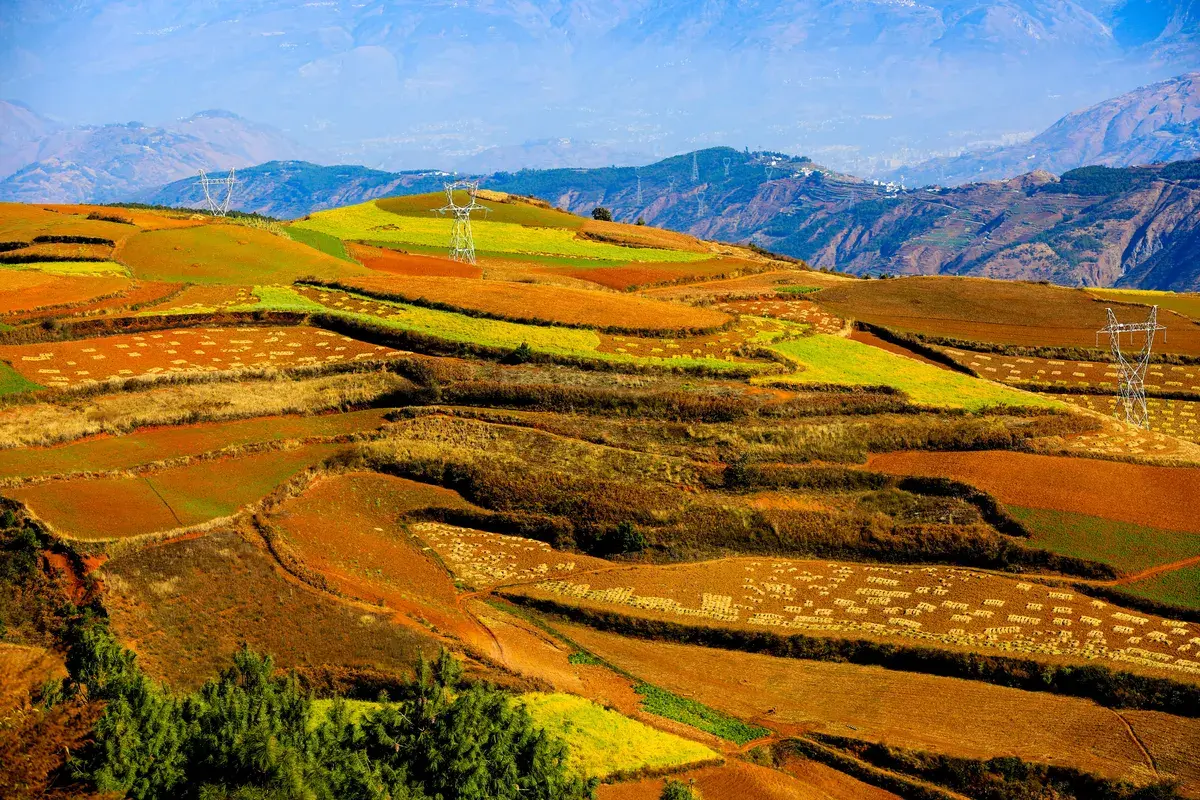
Early morning, 200 meters from the inn, we reached the viewing boardwalk. No one else was there – just us. The wind was strong. We quietly waited for the sunrise. Intermittent clouds and mist in the mountains obscured the view, making it seem less impressive. But as the sun slowly climbed over the mountain peaks, and despite large clouds occasionally blocking the light, the fields and villages of Luoxiagou were revealed under the sunlight – magnificent. The wisdom of Chinese farmers was fully displayed.
After returning from Luoxiagou and having breakfast, we visited two more spots: Jinxiu Garden and Lepu Ao.
Distribution of the Dongchuan Red Land scenic area:
From our actual experience, when going from Kunming to the Red Land, avoid going through Dongchuan District, which adds a detour and long mountain roads. Instead, go directly to the scenic area, pick key spots you’re interested in, stay one night to see sunrise and sunset, or simply go early and return late. Most of the road is highway with only a little mountain road, which is more convenient.
In the afternoon, we returned to Kunming.
In winter, Dianchi Lake is a must-visit in Kunming, so choosing accommodation near Dianchi was the obvious choice.
We stayed at Dianchi Xuyuan Homestay – highly recommended. It’s right by Dianchi Lake; from the community’s side gate, cross the street and you’re on the Dianchi Lake viewing road. Sunny Coast.
Here, we finally saw crowds, and seagulls were everywhere. We bought bread and interacted closely with the seagulls. Everyone was beaming. Nature’s gifts are truly wonderful.
The nucleic acid test from Dongchuan District was slow – results only came out this afternoon, which facilitated our next itinerary.
December 7–9: Kunming
December 7: we had to return the car. First, we went to Haigeng Park and then Honghai Wetland Park. There were fewer seagulls than near our accommodation. It was very windy; the scenery was so-so.
Since returning the car would reduce our mobility, we decided to stay in downtown Kunming for more freedom. We chose to stay near Kunming Old Street. In retrospect, staying near Cuihu Lake would also have been convenient for sightseeing.
First, we visited the Yunnan Military Academy (Jiangwu Hall); then Southwestern Associated University was closed. Then we went to the faraway Kunming City Museum. For the rest, we explored the city on shared bicycles.
At this time, the epidemic prevention policies underwent dramatic changes. Almost all nucleic acid testing points were removed. On the 8th, while wandering, we saw one and quickly got tested. They were about to close the point; we and one other person became the last three at that point. We felt this might be our last nucleic acid test. Starting from the 8th, health codes and travel history codes were no longer checked anywhere.
We visited the Dazhuan Farmers Market, Nie Er’s former residence, strolled through old Kunming, and ate a lot. Again, Yunnan fruits are incredibly sweet. Especially a type of small pineapple – the sweetest we had ever tasted. We bought three bags to bring home, originally planning to share with friends. But due to the outbreak in Tianjin, we had to stay home and ended up eating all the fruit ourselves (fresh fruit doesn’t keep).
This building appears in almost every photo taken in Kunming. At first, I wondered why it was so thin and arc-shaped. Later, I learned it’s part of the Anti-Japanese War Memorial Hall. It’s shaped like a wine glass; the monument stands in the center, and the arc-shaped building is the rim of the glass. So we took a photo as a souvenir.
Accommodation: Kunming Yuebo Siheyuan Hotel (an inn converted from an old house, great location, but comfort in old houses is somewhat lacking)
December 9: Kunming – Tianjin
At the airport today, everything was back to how it was three years ago. No one checked our health code, travel history code, or nucleic acid test report. We returned home in a daze.
Regrets from this trip: not being able to explore Tengchong, losing photos, and plane tickets – we should have booked them 4–5 days earlier. During the trip, we kept checking and saw the return ticket price hadn’t changed much (around 300 yuan), so we didn’t book in time. By the 6th, when we wanted to book the 9th return flight, it had risen to over 1,000 yuan – a costly mistake.
Renting cars in Dali and Kunming went very smoothly, especially the rental company in Dali. When returning the car, we couldn’t find a car wash and offered to pay for it, but they refused.
This trip focused mainly on natural scenery with few entrance fees. We also benefited from the discount for Tianjin residents. This was our second self-driving trip to Yunnan, and it felt just as good as the first. It’s worth coming again. See you next time!