Kunming | Wrapping Up 2022 in the Land of Colorful Clouds
Fourteen days traveling alone
saying goodbye and welcoming with a journey
Foreword—a departure that was deliberate and fully prepared
What does ‘deliberate’ mean? It was inseparable from the bigger picture at the time. To put it simply, when I set off, my dad was on his third and a half day of testing positive, and my mom on her second day. Aside from one night I spent in hotel quarantine, we had all been living together. The virus strain in Tianjin came with fairly severe symptoms—many of my classmates’ fevers shot straight to 38°C, 39°C, even 40°C. My parents’ cases were relatively mild, but they still had fever, body aches, and a throat that felt like swallowing razor blades. My thinking was: as long as I didn’t have a fever on departure day, I’d go. I could rest at the hotel in Kunming. I was confident I could take care of myself and had prepared ibuprofen (later I realized I’d brought the wrong kind—sustained-release capsules that don’t lower fever at all, but I didn’t end up needing them), Lianhua Qingwen, cooling patches, a thermometer, and two antigen tests.
On the 14th, in that Tianjin hotel room, I was actually agonizing. I was terrified that any symptom would appear. From what I knew at the time, if symptoms surfaced during the day, you’d be sure to spike a fever by night and definitely couldn’t fly to Kunming on the 15th.
I had never paid such close attention to my body’s sensations before—head, throat, windpipe, lungs, appetite, limbs. That slight leg pain barely registered then.
On the 15th, fortune smiled on me. No fever, just a mild soreness in my windpipe that didn’t affect anything. I set off.
The journey to the “Land of Colorful Clouds” officially began.
The poet Yang Shen once wrote: “The weather is always like early spring, flowers bloom through all four seasons” to praise the spring city of Kunming’s pleasant climate—no sweltering summer, no bitter winter. Winter arrived in Tianjin right on cue, and I longed for Kunming’s warmth, so I made it my first stop.
Picking up where I left off: the flight from Tianjin to Kunming was uncomfortable. Extremely dizzy, the descent felt especially heavy with that zero‑gravity sensation, and my stomach rebelled. When I got off the plane and went to collect my luggage, my legs hurt so badly I could barely stand. I felt… I’d caught it too.
At least I landed safely. At least I’d booked an airport pickup. And best of all, I saw that long‑missed warm sun right after landing.
While chatting with the driver, thinking ahead to the rest of my trip, I asked about getting PCR tests (I was preparing for a later visit to Macau, and this would trouble me for days—a longer story). I also learned that hotels near Kunming Changshui Airport were generally surrounded by desolate, unsafe‑looking surroundings. I decided to cancel the airport‑area hotel I’d booked for an early flight and switch to the city center, which would also make testing easier. I remarked on how lush the vegetation still was; she grumbled that it’s the same color year‑round here and she wanted to see a northern winter. I found out that the local seasonal fruit is Chu oranges, that COVID symptoms here tended to bring lower fevers but more coughing. Later the driver mentioned her child—he turned out to be my age, studying an engineering‑related major at a very good university.
This was the first person I’d met in this unfamiliar city.
The hotel was right on Nanping Pedestrian Street, with huge windows and a spacious room. I’d asked for a high floor, and looking down I saw very few people on the street—clearly many Kunming residents had also tested positive. My legs still hurt, but I thought it would be rather nice to recover in this room.
Dinner time came. Kunming was beginning to cool down but not yet cold. Though ordering delivery was convenient, I decided to go to a very famous restaurant nearby. (I have a high pain tolerance; compared to appetite and curiosity, leg pain is nothing.)
Compared to Tianjin’s biting northwesterly wind, Kunming’s breeze was gentle and soft.
It wasn’t wild mushroom season, but for my first meal here I still wanted mushroom hot pot. The chicken broth was incredibly fresh, though I regretted not ordering a mixed mushroom pot (I was afraid I couldn’t finish it alone). I got bamboo fungus and baoji tofu on the side. I had the server mix a dipping sauce the way locals eat it—it paired perfectly. It was my first time trying baoji tofu; after cooking it’s so soft it falls apart, so you have to scoop it with a spoon. The texture is incredibly tender, with barely a hint of beaniness, not as silky as soft tofu but more like tofu puffs with tiny air pockets, able to soak up the broth and the mushrooms’ umami.
Online rumors say that in Yunnan, when you have hot pot they don’t give you chopsticks right away—usually because you’ve ordered poisonous mushrooms that need to be thoroughly cooked. I’d ordered safe ones, so I wasn’t worried. Even so, the server still took a small sample of the broth to keep on file.
Sipping the warm chicken soup, I felt the pain ease quite a bit. On the way back I also strolled around the neighborhood.
After washing up, I video‑called my parents and T. Then the pain got worse, and my whole body felt heavy and hot.
All right… let me sleep and let my immune system do its work! I placed plenty of water, ibuprofen (the wrong kind), and the thermometer within easy reach.
At midnight, 2 a.m., 4 a.m., 6 a.m.—I woke up every two hours, groggy, feeling a bit warm and still leg pain. An old injury I thought had healed hurt even more than my legs. When morning came I checked my temperature: 37.9°C…
This was my second day in Kunming. After waking up, my temperature was down to 37.8°C. Even though I had a fever and aches all over, my head didn’t hurt and I felt clear‑headed. I decided to go down for the hotel buffet breakfast. Given my condition, I chose a window seat and wore an N95 mask whenever I wasn’t eating. Because of the pandemic, the hotel had very few guests—only a handful of people at breakfast.
After eating, without checking my temperature again, I felt okay enough to head to a well‑known farmers’ market.
📍 Daguan Zhuanxin Farmers’ Market
A market is like a mirror of a city, reflecting the lives of its people, revealing their warmth and tastes.
They say this is the most complete and freshest market in Kunming proper. It felt like mostly locals came here—full of life and Kunming flavor. When it’s wild mushroom season, there’s even a dedicated trading area on the second floor. Now, though, there were still plenty of things to see, including many ingredients rare in the north. If you come on an empty stomach, you can definitely fill up.
I returned loaded with goods and headed back to the hotel to eat!
After the meal, my whole body ached and my temperature was 38.3°C. I lay down for an hour, but lying still only felt worse. Looking at the beautiful view outside, I decided to go out for a walk while the sun was still shining.
Before leaving I tidied up my trash—didn’t want to give Kunming a reason to dislike me!
Outside, the air wasn’t cold. I jammed both hands into my pockets, tilted my head up at 45°, closed my eyes, and let the sunlight pour freely over my face. It felt so good, as if I were already half cured.
A pedestrian street that once was and will be again thronged with people was, when I went, nearly empty—adding a sense of ease and allowing me to slow down and wander. I prefer quiet lanes, so I felt very lucky to be able to step out and savor the simple, pure scenery in such a special time.
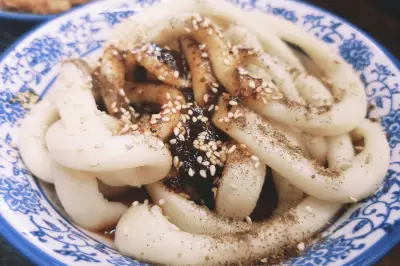
A snack shop featured on CCTV—I mainly chose it for the value, reasonable portions, and variety. The setting was indeed very nice; by the window on the second floor, a soft breeze felt wonderful. I wanted to try a little of everything. If you can’t handle spicy food, say so in advance; it seems Yunnan people can handle their spice. The fried er kuai in the middle was spicy; the desserts were a perfect palate cleanser, especially the ice jelly and sweet rice wine. They were delicious. The ice jelly was light and airy, packed with tiny bubbles; the sweet rice wine was sweet and pleasing. This was also the first time I’d ever eaten fermented rice on its own—theirs leaned sweet with only a faint alcoholic note, very easy to enjoy.
After eating, I truly felt less awful. No more wandering; time to rest back at the hotel!
Before bed, my fever showed signs of breaking, and my body wasn’t as sore.
The next morning, I clearly felt relaxed all over—the fever was gone. That day my throat didn’t hurt and I wasn’t coughing. However, a cold front arrived right on schedule. They say Kunming has “no cold rain in four seasons, but once the rain comes, winter sets in.” A light rain didn’t affect getting around much, but the temperature dropped to around 5°C. Yesterday’s warm sunshine had vanished, leaving a touch of gloomy gray.
My mood, though, was unaffected—breaking the fever felt wonderful. After breakfast, I bought freshly baked flower cakes to mail to my parents and T. But since all the couriers had tested positive, even air‑shipped parcels weren’t guaranteed to arrive on time!
Simao er kuai with stir‑fried chicken, old‑Kunming spicy‑cool poached pork, and ham skin with red bean soup were truly distinctive. The chicken was crispy outside, tender inside; the er kuai was sticky and chewy—a fun pairing. The soup was spicy, with red beans that were soft and grainy, and the ham skin had been thoroughly cleaned of fat, eliminating any porky smell. The two ingredients went together without a trace of dissonance. The poached pork had a refreshing hint of mint, a completely different flavor from Sichuan’s garlic‑infused boiled pork.
Later I strolled to the Jinma Biji Archways. I’d heard about a spectacle: as the sun sets, its golden rays shine on the Biji Archway from the west, casting its shadow onto the eastern street; at the same time, the moon rises in the east, its silver light falling on the Jinma Archway, throwing its shadow onto the western street. The two archways’ shadows slowly draw closer and finally meet. This is the “Jin Bi Jiao Hui” phenomenon, said to happen only once every sixty years. Legend has it that it occurred during the Daoguang reign of the Qing Dynasty.
If you’re just passing by, snapping a photo is enough—you won’t catch that spectacle! Plus, as is the case with many ancient Chinese wooden structures, they’ve been rebuilt time and again through dynastic changes; what you see today are early modern reconstructions faithful to the original.
I moved to a villa by Dianchi Lake. The room was huge; too bad in winter, staying on the balcony was a bit chilly. But having the mountain‑and‑lake view right before my eyes was satisfying enough!
Winter, seagulls, and the promise of Dianchi Lake
When I went, a light rain had just passed; it was overcast, but the seagulls were as spirited as ever, not shy in the slightest. Snowy white feathers, bright red beaks, they snatched bread without hesitation. I was a bit afraid to feed them; watching others, a single outstretched hand brought many swooping over. A little intimidating.
📍 Dianman Lou
A ceremony‑filled bowl of crossing‑the‑bridge rice noodles, eaten piping hot! First sip the broth—rich and bursting with flavor. The noodles glide down smoothly. Leave the rainy day’s chill outside the window!
That day I was still in the recovery phase after COVID; my throat started to hurt. In winter, Kunming relies on warm air for heating, so the room felt quite dry. Combined with the aftermath of the virus, it was helpless.
The next morning, my throat hurt even more. I drank lots of water, followed my parents’ advice, and didn’t take any medicine.
After eating, my throat felt noticeably better. How mysterious.
I bought a ticket for the Ethnic Village, but when I got to the gate, something felt off. After a back‑and‑forth with Ctrip, I finally found out the village was closed. There was an A4 notice on the main gate. Really frustrating.
I changed plans on the spot, dragged my luggage to the Yunnan Provincial Museum, and planned to head straight to Dali after the visit.
A museum is not just a collection and juxtaposition of artifacts; it’s a gathering of spirit. To get to know a place quickly, a museum and a market are my must‑visits—places where you find the customs and humanity of streets and alleys, as well as layers of history. These deeply attract me and drive me to keep exploring, keep moving forward.
Take a guess what this object was used for.
Many of the bronzes in the Yunnan Provincial Museum reflect ethnic minority cultures, with more vivid depictions of animals, quite different from relics in the Central Plains. There were also lots of Buddhist artifacts, and musical instruments—especially drums—were plentiful. The layout was standard, but the artifacts were well worth seeing.
Cangshan Mountain and Erhai Lake—poetry and the distant horizon.
But also the mundane reality right in front of me.