Yunnan Travel: Notes on a Half-Day Independent Tour in Kunming (Photos)
Kunming, the capital of Yunnan Province, is a city I have visited many times before. On my recent eighth trip to Yunnan—an 11-day journey through southeastern Yunnan—it was the first stop, and this 'Spring City' felt especially warm and welcoming.
Kunming Airport (Photo by Feng Ganyong)
At 10:30 a.m. on March 3, 2023, our group took Capital Airlines flight JD5629 from Beijing Daxing Airport. After a 3-hour, 6-minute flight, we arrived at Kunming Changshui Airport at 13:36, more than half an hour ahead of schedule. I've been to Yunnan eight times, and six of those arrivals were at this airport—surely a sign of some special connection.
Kunming street scene (Photo by Feng Ganyong)
Since that day was a free day and we arrived in the afternoon, I didn't want to waste any precious time. After dropping my bags at the Jiaoyuan Hotel, I set off on a memorable half-day independent tour of Kunming.
Street sign at Yongdao Street (Photo by Wang Jue)
After a quick online search, we decided to first visit the Former Residence of Nie Er. We hopped in a taxi and told the driver our destination. He knew the way well, and in just over ten minutes we arrived at Yongdao Street in Wuhua District. Since the street is pedestrian-only, we strolled through the alleyways and finally reached No. 73–74 Yongdao Street—Nie Er’s former home.
Photo in front of Nie Er's Former Residence (Photo by Wang Jue)
I looked at this modest little courtyard. If not for the black plaque over the door inscribed with the four yellow characters '聂耳故居' (Nie Er Former Residence), it would be hard to tell it apart from any other house on the street. Yet this is where one of China’s great musicians, Nie Er, was born.
Chengchuntang (Photo by Feng Ganyong)
According to records, in 1905 (the thirtieth year of the Guangxu reign), Nie Er’s parents came from Yuxi, Yunnan, to Kunming to make a living. They rented this place and opened a small medical clinic, calling it 'Chengchuntang.' On February 14, 1912, Nie Er was born right here. In 1920, unable to afford the rent, the family moved to No. 13 Weiyuan Street Vegetable Market, leaving Yongdao Street behind.
Entering Nie Er's Former Residence (Photo by Feng Ganyong)
In 1943, when the Yunnan provincial government began building Yunrui Park on the site of the former Governor-General's Office of Yunnan and Guizhou, Yongdao Street was widened. Houses on both sides were demolished and rebuilt 4–5 meters back. The new structures remained two-story, wood-and-earth buildings with shops below and living quarters above.
Overlooking the small courtyard (Photo by Feng Ganyong)
After the founding of New China, Nie Er’s third brother, Nie Xulun, and others came looking for their former home. They confirmed it was the site of today’s No. 73–74 Yongdao Street. To commemorate the place, they even hung the original 'Chengchuntang' plaque above the door of No. 73 for a photo.
The room where Nie Er was born (Photo by Feng Ganyong)
I entered the small courtyard, which faces east and has three two-story wood-and-earth rooms. I climbed the stairs to the second floor. The room on the right was Nie Er’s parents’ bedroom, and that is where Nie Er was born—on a sleeping cabinet in this very room.
Instruments used back then (Photo by Feng Ganyong)
The two adjacent rooms are exhibition spaces displaying numerous photos, relics, and personal items from Nie Er's three stages of life—in Kunming, Shanghai, and abroad. The violin he played as a child and other instruments, along with his musical scores, are particularly eye-catching.
Nie Er's graduation certificate (Photo by Wang Jue)
Also on display are copies of some of Nie Er’s original song manuscripts, including 'Little Worker' and 'Song of Cold and Hunger,' which left a deep impression on visitors.
A corner of the exhibition room (Photo by Feng Ganyong)
In his short life, Nie Er left behind more than 30 immortal songs, including the 'March of the Volunteers,' 'Road Building Song,' and 'Graduation Song.' The 'March of the Volunteers' was later adopted as the national anthem of the People’s Republic of China.
War of Resistance Victory Hall (Photo by Feng Ganyong)
A short walk to the right from Nie Er’s former home brings you to Kunming Old Street. Here you’ll find the War of Resistance Victory Hall, which houses the Monument to the People’s Heroes. Around it is an open garden square; the symmetrical western building of the Jiubei Lou (Wine Cup Building) is a particularly distinctive sight.
View of the Wine Cup Building (Photo by Feng Ganyong)
Kunming Old Street’s history dates back to the Kingdom of Dali, passing through the Yuan, Ming, Qing, Republican, and New China periods to today. The existing layout gradually took shape during the Kangxi reign of the Qing dynasty when the Governor-General of Yunnan and Guizhou established his office here. The surviving buildings largely reflect the historical features of the Republican era.
Photo on Kunming Old Street (Photo by Feng Ganyong)
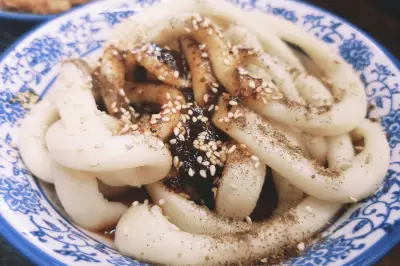
Guanghua Street, part of the old quarter, runs 435 meters from Zhengyi Road in the east to Wuyi Road in the west. It is the only surviving street that retains Kunming’s old-world charm. Here you can enjoy authentic small-pot rice noodles, sift through all sorts of quirky Yunnan antiques, and visit century-old pharmacies. With its timeworn and unassuming character, Guanghua Street embraces both the past and present of Kunming.
A corner of an old street building (Photo by Wang Jue)
Jingxing Street, another old quarter, is always teeming with people—locals and visitors alike—shopping or simply strolling. You can find all sorts of unusual items here. Jingxing Street holds countless childhood memories for Kunming locals and offers endless delights for visitors.
Street scene on the old street (Photo by Wang Jue)
Kunming Old Street has witnessed more than 900 years of history and cultural accumulation, harbouring rich memories of bygone days. It is not only the best-preserved and last remaining old neighborhood in the city, but also one of the most important symbols of Kunming as a renowned historical and cultural city.
Green Lake Park (Photo by Feng Ganyong)
After visiting Nie Er’s former home and the old streets, we drove on to Green Lake Park. This was my third visit to the park, but this time coincided with the active season for red-billed gulls, and the sight of flocks of birds in flight was still spectacular. With its shimmering water, shaded by green trees, dotted with pavilions and towers, the park is beautiful and known as the 'Jade of the City.'
Beautiful scenery in Green Lake Park (Photo by Wang Jue)
Green Lake is situated at the western foot of Wuhua Hill in downtown Kunming, right at the city’s center for sightseeing. Its name—’Green Lake’—comes from the emerald waters on all sides, the verdant bamboos in all seasons, and the green willows in spring and summer. A poem describes it: 'Ten acres of lotus, a world of fish; half the city’s willows caressing pavilions.' It is often called the 'emerald' set in the heart of Kunming.
Cherry blossom umbrella landscape in the park (Photo by Feng Ganyong)
Looking back, before the Yuan dynasty, when Dianchi Lake’s water level was higher, this area was a small bay outside the city wall, dotted with rice paddies, vegetable gardens, and lotus ponds, hence called 'Caihaizi' (Vegetable Sea). A poem by Li Zhuan said: 'The waters of Kunming stretch three hundred li; the Vegetable Sea merges with it as one.'
Statue of Nie Er (Photo by Feng Ganyong)
Today, Green Lake Park is one of the most beautiful parks in Kunming. Besides its unique scenery, visitors can also soak up a strong cultural atmosphere. The prestigious Yunnan University is nearby—once a place where literary figures like Shen Congwen, Zhu Ziqing, and Wu Mi would sip tea, browse books, and discuss everything under the sun. The park also has a statue commemorating the people’s musician, Nie Er.
Red-billed gulls in flight (Photo by Wang Jue)
What makes Green Lake especially enchanting these days are the snow-white red-billed gulls that arrive from November to the following March, migrating from the far north to spend the winter here—faithfully, year after year.
Photo taken at Green Lake Park (Photo by a passerby)
It’s safe to say that watching the red-billed gulls is the biggest draw for visitors. 'Gull-watching at Green Lake' has naturally become one of Kunming’s most popular sights.
Jinma Memorial Archway (Photo by Feng Ganyong)
At 6 p.m., we finished at Green Lake and took a taxi to the last stop of our half-day tour: the Jinma Biji Archways. Located at the intersection of Sanshi Street and Jinbi Road in the city center, these twin gates stand 12 meters tall and 18 meters wide, with exquisitely painted beams and brackets. The eastern arch, facing Jinma Mountain, is called the Jinma (Golden Horse) Archway; the western one, facing Biji Mountain, is called the Biji (Green Rooster) Archway. Together they are a symbol of Kunming. Built during the Xuande period of the Ming dynasty, they have a history of nearly 400 years.
Photo by the Biji Archway (Photo by a passerby)
According to records, when the sun is about to set, its remaining rays shine on the Biji Archway from the west, casting its shadow onto the eastern street. At the same moment, the moon rises in the east, its silvery light falling on the Jinma Archway and casting its shadow onto the western street. The two shadows slowly move closer until they finally meet. This is the rare spectacle of 'Jinbi Intersecting Shadows,' said to occur only once every 60 years. Legend has it this phenomenon was witnessed once during the Daoguang reign of the Qing dynasty.
Biji Archway (Photo by Wang Jue)
The Jinma Biji Archways were demolished in the late 1960s. In the past, 'Jinbi Intersecting Shadows' was listed as one of Kunming’s 'Eight Scenic Sights.' In 1998, during the widening and reconstruction of Jinbi Road, the Kunming municipal government rebuilt the two archways. Today, this famous city landmark draws countless visitors from home and abroad who come to admire it and take photos to capture a beautiful moment. Thus, my half-day independent tour of Kunming came to a perfect close. (Text and photos: Feng Ganyong)