Yunnan Travel: Exploring the Yunnan Museum and Guandu Ancient Town (Photos)
Yunnan Travel: As sightseeing at Dongchuan Red Land concluded, the ten-day trip reached its final day. At 14:25 on March 12, 2023, the group returned to the Yusheng Hotel in Kunming where they were staying. With a day and a half of free time left in Kunming, the reporter was unwilling to waste these beautiful moments. So, after dropping off luggage and taking a brief rest, he headed to the Yunnan Provincial Museum.
Yunnan Provincial Museum (Photo: Feng Ganyong)
It so happened that the hotel was not far from the museum; a ten-minute taxi ride got him there. In front of the museum, he saw this pagoda-style building, founded in 1951, with a seven-story main tower and three-story side wings. Inside, the exhibition building soars over 40 meters high, with exhibition halls on the first to third floors covering a total area of 4,200 square meters. Twelve massive round pillars stand at the front, while the golden spire on the roof gleams with a red star – majestic and uniquely designed, it was deeply impressive.
A photo at the Yunnan Provincial Museum (Photo: Tian Gen)
On the landing between staircases, the first thing the reporter and his companions saw was the museum’s treasure they had already glimpsed in travel guides: the famous Warring States period bronze ox-and-tiger statue. Seeing the real object after its picture stirred an inexplicable mix of excitement and wonder.
Bronze Ox and Tiger Statue (Photo: Feng Ganyong)
Stepping closer, they saw the main bronze figure of a large ox standing with its back naturally sloping like a table; at the tail, a scaled-down tiger bites the ox’s tail. Beneath the ox’s belly, a hollow space houses a small ox fitted sideways. It is said this artifact was cast using a mold, with the big ox and tiger cast in one piece, while the small ox was cast separately and then welded on. The ox-and-tiger bronze table is a ritual vessel of the ancient Dian people, combining ox and tiger in an unusual design.
Entering the museum (Photo: Feng Ganyong)
After admiring this precious artifact, the reporter and his group began a tour of this comprehensive Yunnan Provincial Museum. Having done some research beforehand, they had a certain understanding of the museum. They knew it now has nine departments: the collection and preservation department responsible for conservation; the social education department that introduces exhibitions to the public; the authentication station in charge of relic identification and acquisition; editorial office for the museum journal Yunnan Cultural Relics; as well as collections of books and reference materials, among others.
Exhibition hall of Enchanting Buddhist Kingdom (Photo: Feng Ganyong)
Strolling through the various exhibition halls, the reporter visited displays including “Enchanting Buddhist Kingdom,” “Hundred Years of Turmoil – Modern Yunnan,” “Ripples of Good Deeds – Selected Donations to Yunnan Provincial Museum,” and “Ancient Yunnan,” among many others. It was truly enlightening and eye-opening.
Gold Buddha statue in the collection (Photo: Feng Ganyong)
As a major province rich in ethnic cultures, Yunnan Provincial Museum has, over more than 50 years, gathered through archaeological excavations, surveys and collections, social acquisitions, and donations over 190,000 bronze items, ancient coins, ceramics, old paintings and calligraphy, stele rubbings, stamps, and various handicrafts – the largest collection of cultural relics in Yunnan.
Colored cliff carving figure (Photo: Feng Ganyong)
Among the thousands of precious artifacts, about a thousand are recognized as national first-class cultural relics. The museum’s historical relics overwhelmingly come from archaeological digs – a remarkable achievement.
Group painting of ethnic unity (Photo: Feng Ganyong)
At the same time, Yunnan is a border region where many ethnic minorities live, rich in ethnic and frontier cultural connotations. On the second floor, the Intangible Cultural Heritage Exhibition displays a variety of Yunnan’s minority heritage: hand-tied dyeing, batik, silverware, hand-pressed traditional Pu’er tea, and much more – all well worth a visit.
A corner of the military uniform exhibition (Photo: Feng Ganyong)
Furthermore, to celebrate International Women’s Day, the museum hosted the exhibition “Preferring Military Garb to Red Dresses – People’s Liberation Army Women’s Uniform Exhibition,” a distinctive show that systematically traces the evolution and development of PLA women’s uniforms. In short, the visit to the Yunnan Provincial Museum, with its rich and varied documentary collections, was highly rewarding – well worth the trip.
Photo at the Ancient Yunnan exhibition (Photo: Tian Gen)
At 16:45 that day, the reporter and his companions finished their tour. A short walk away lies Kunming’s famous Guandu Ancient Town. This place is dense with cultural monuments and historical sites, packed with humanistic landscapes. In an area of less than 1.5 square kilometers, there are sights from the Tang, Song, Yuan, Ming, and Qing dynasties – including five hills, six temples, seven pavilions, eight shrines, and more.
Photo at the Guandu Ancient Town memorial archway (Photo: Tian Gen)
Looking back through history, as an age-old town, Guandu was once a renowned ferry crossing in central Yunnan and one of Kunming’s historic and cultural townships. By the Tang and Song dynasties it was already a major market town on the east shore of Dianchi Lake; it was established as a county seat alongside Kunming in the Yuan dynasty, and by Ming and Qing times had become a thriving commercial and handicraft center.
Stepping into Guandu Ancient Town (Photo: Feng Ganyong)
As a scenic tourist destination, Guandu had long been a treasured spot where high officials built villas and retreats, and where celebrities and scholars lingered. “So many travelers come and go, horses’ hooves trampling the frost at dawn”; “Wine flags here invite me to drink, boat music sees me home” – the ancient Guandu was steeped in the sounds of traditional music.
Food street in the ancient town (Photo: Feng Ganyong)
According to historical records, Guandu Ancient Town in its heyday was a scene of unprecedented splendor. Entering the town then, one would see the vast Dianchi Lake with clear blue waves, gulls playing and fish fattening; the boundless sky with clouds unfurling and rolling endlessly. Flocks of wild birds frolicked in the lakeside reeds; hundreds of cypress trees climbed Luofeng Hill from base to summit, a thick cascade of green.
Photo in a corner of the ancient town (Photo: Feng Ganyong)
The sound of bells and chimes from the town’s temples drifted through morning clouds and evening rain, mingling with the clear recitations from the academy. The towering multi-eaved pagoda and the Vajra Pagoda pointed to the heavens, as if deities were wielding great brushes to praise heaven and earth and bless the human world. Among a large apricot forest on the shore, herd boys played hide-and-seek, full of childish joy; visitors composed poems, drank wine, played chess, and enjoyed flute melodies.
Lingyun Pavilion (Photo: Feng Ganyong)
The town’s streets were bustling with people and vehicles. During temple fairs, not only townsfolk but residents from neighboring counties flocked there. On the open grass west of Wugu Temple, the sea of people was incredibly lively, far surpassing any ordinary market of the time. At night, a string of bright red lanterns rose on the ferry’s beacon tower, guiding official boats and fishing vessels slowly in; on moonlit nights, the reflection of Yuntai Temple shimmered in the pool whose water was always crystal-clear, the temple’s image rippling in the breeze. On the Vajra Bridge, one could almost hear whispered secrets.
The ancient ferry crossing of Guandu (Photo: Feng Ganyong)
But with the passage of time, the lake shore gradually receded, and Guandu’s natural landscape changed dramatically. The old temple buildings grew dilapidated, some even demolished, and the renowned Vajra-based pagoda subsided more than a meter, forming a huge pit. Time flowed on, and with the march of history, Guandu Ancient Town revived once more. Many of its historic sites were restored.
Fa Ding Temple (Photo: Feng Ganyong)
After taking a photo in front of the grand archway of Guandu Ancient Town, the reporter strolled in to explore. Along the streets, shops stood side by side, lively and bustling. One standout on the snack street is Li’s Simple Bakes Shop, which sells distinctive baba cakes at 3 yuan each – affordable, delicious, and really tasty.
Li’s Simple Bakes Shop (Photo: Feng Ganyong)
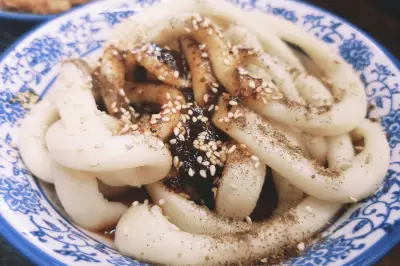
No wonder the reporter had to queue a long time. There are quite a few varieties, filled with sesame paste, sesame-peanut, rose, or bean paste. “Baba” is a local term for flatbread or griddle cake; it’s one of Kunming’s most famous snacks, with many preparation methods and rich flavors. If only there were such a shop in Beijing.
Delicious baba cake (Photo: Feng Ganyong)
Within the ancient town, the reporter visited sights old and new one after another: Yunzi Chess Academy, Fa Ding Temple, Fu Shou Pool, the ancient ferry crossing, the Vajra-based pagoda, Wen Yuan Pavilion, Lingyun Pavilion, and more. He snapped photos ceaselessly, capturing scene after scene of Guandu Ancient Town.
Yunzi Chess Academy (Photo: Feng Ganyong)
The Yunzi Chess Academy primarily hosts high-level Go tournaments, displays exquisite Yunzi chess pieces, and showcases Yunzi products. The academy’s design is unique: upon entering, one sees a yin-yang diagram inlaid with black and white Yunzi stones; in the main hall, a chessboard floor is laid with black and white pebbles. The Yunzi exhibition center collects and presents precious Yunzi sets of various styles. As a base for intangible cultural heritage transmission, it has hosted three national-level joint exhibitions of intangible cultural heritage since 2011.
Vajra-based Pagoda (Photo: Feng Ganyong)
Among the historical sites, the Vajra-based pagoda in front of Miaozhan Temple is especially worth mentioning. It is the most famous and eye-catching national key cultural relic among Guandu’s religious structures. Of the dozen or so Vajra pagodas surviving in China, Miaozhan Temple’s Vajra Pagoda is the earliest built and has the longest history.
Tuzhu Temple in the ancient town (Photo: Feng Ganyong)
This Vajra pagoda, complemented by the two multi-eaved brick pagodas of Miaozhan Temple, not only embodies the Buddhist spirit of “all-embracing” and “practicing both exoteric and esoteric teachings” but also, architecturally, creates a spectacular composition of staggered heights forming a triangular layout – the core of Guandu’s ancient architectural complex. The Vajra-based pagoda was originally a commemorative tower at the site where Shakyamuni attained enlightenment beside the Niranjana River in Gaya, India, called the “Great Pagoda of Buddhagaya.” It is also known as a “mandala,” meaning “sacred altar.”
Small pagoda beside the base (Photo: Feng Ganyong)
At each corner of the base stands a small square pagoda, guarding the tall pyramidal central pagoda. The five pagodas represent the Five Dhyani Buddhas: the large central pagoda stands for Vairocana; the surrounding four, clockwise, represent Akshobhya, Ratnasambhava, Amitabha, and Amoghasiddhi. Guandu’s Vajra-based pagoda consists of two main parts: the base and the pagoda body. The base is a perfect square in plan, each side 10.4 meters long and 4.7 meters high. The bottom of the base is open, with four arched gates facing north, south, east, and west that allow pedestrians, vehicles, and horses to pass through.
Wenyuan Place in the ancient town (Photo: Feng Ganyong)
Atop the base, five pagodas rise. The central main pagoda is 16 meters high, with four smaller pagodas at the corners, each 8.84 meters. The main pagoda is grand and imposing; the smaller ones are delicate and exquisite. Both main and small pagodas consist of a Sumeru base, body, neck, and spire, but their styles and forms differ. The contrasting sizes and harmonious proportions are very pleasing. The soaring elegant spires cluster and rise like bamboo shoots after rain, competing to break through the soil, light and graceful, with a sense of upward motion.
A corner of Guandu Ancient Town (Photo: Feng Ganyong)
As part of this Yunnan journey, the reporter’s afternoon and a half of free time in Kunming, spent first at the Yunnan Provincial Museum and then at Guandu Ancient Town, was truly rewarding. There is still one final day tomorrow; the reporter already has a plan to make the most of his last day in Kunming. (Text and photos: Feng Ganyong)
(Source: China News Network)