Yunnan Travel: A Visit to Haigeng Park and Yunnan Ethnic Village (Photos)
My 11-day Yunnan journey finally came to its last day, still an independent tour in Kunming. After some research, I set my sights on two places: Haigeng Park and Daguan Pavilion.
Haigeng Park (Photo: Feng Ganyong)
At 8:30 a.m. on 13 March 2023, I left my hotel and took a taxi to Haigeng Park, which lies along the shore of Dianchi Lake. After about half an hour's drive, I arrived at the destination.
Looking across Dianchi Lake to the Western Hills (Photo: Feng Ganyong)
Only then did I realise Haigeng Park is an open green space stretching 2.5 kilometres along the Dianchi waterfront. Passing the commemorative stone at the entrance, I reached the vast expanse of Dianchi Lake.
A photo by Dianchi Lake (Photo: Wang Jue)
Along the lakefront, visitors were everywhere, laughing and playing. My first impression was that this is a perfect spot for leisure and holidays. Because the park is so long, I strolled only a short section between two piers, but I captured plenty of Dianchi’s beautiful scenery.
People and birds enjoying themselves by Dianchi Lake (Photo: Feng Ganyong)
In Haigeng Park, painted pavilions, stone boats, the sea-view promenade, lush lawns, brilliant cherry blossom groves, luxury yachts, and the seaside leisure plaza all greeted my eyes. The sight of thousands of seagulls that come here in winter and spring, being fed and mingling with people, exuded natural harmony and romance.
Livestreaming by Dianchi Lake (Photo: Feng Ganyong)
Beside Dianchi Lake, I saw a dozen or so young and middle-aged men and women dancing and gesturing as they livestreamed. Each one put on an idiosyncratic performance, fully throwing themselves into the smartphone lens – quite amusing.
Watching seagulls soar at Haigeng Park (Photo: Feng Ganyong)
Haigeng, as its name suggests, is a causeway across the lake. Originally it was a wedge-shaped long dyke thrusting from east to west into Dianchi Lake. It starts at Haigeng Village in the east and ends at the foot of the Western Hills in the west, stretching 5 kilometres in total. Its width varies from 60 to 300 metres, splitting the 300-plus square kilometres of Dianchi into two: the vast Dianchi to the south and "Grass Sea" (Caohai) to the north.
A pier by Dianchi Lake (Photo: Feng Ganyong)
Built in the early 1960s, the park is about 200 metres wide from north to south and covers 750 mu (50 hectares). Across the water, it echoes the Western Hills, Daguan Pavilion and other scenic spots, forming a seamless tourist area. The causeway is roughly 4.5 kilometres long and varies in width from 40–50 metres to 200–300 metres.
Cycling sculpture (Photo: Feng Ganyong)
Entering Haigeng Park, I spotted a bicycle sculpture on the lakeside. It instantly reminded me of a wonderful time on 10 November 2017, when I took part in the "2017 China Cycling League Yunnan Kunming Final & Kunming Round-Dianchi Highland Cycling Invitational".
Recalling that reporting trip (Photo: Feng Ganyong)
In Haigeng Park, visitors can enjoy two special sights. One is a pair of century-old eucalyptus trees with intertwined branches – one tall and stately, the other graceful and charming – like a devoted couple gazing hand in hand over Dianchi Lake. The other is the Sleeping Beauty Mountain. Only from Haigeng can you truly see the mountain’s likeness: clear features, graceful curves, flowing hair, forming a magnificent picture with the setting sun. The scene changes with the seasons, but always remains beautiful and harmonious.
A giant tree by the water (Photo: Feng Ganyong)
Dianchi Lake, on which Haigeng Park leans, was called the "sea" by the ancients. Today, the long dyke is lined with green trees, speedboats send up white spray, the azure sky, deep blue waters, emerald lawns and crisp air all present a seaside atmosphere that only the sea could offer. Only here can you truly grasp the feeling of "high skies, light clouds and a mind as broad as the ocean".
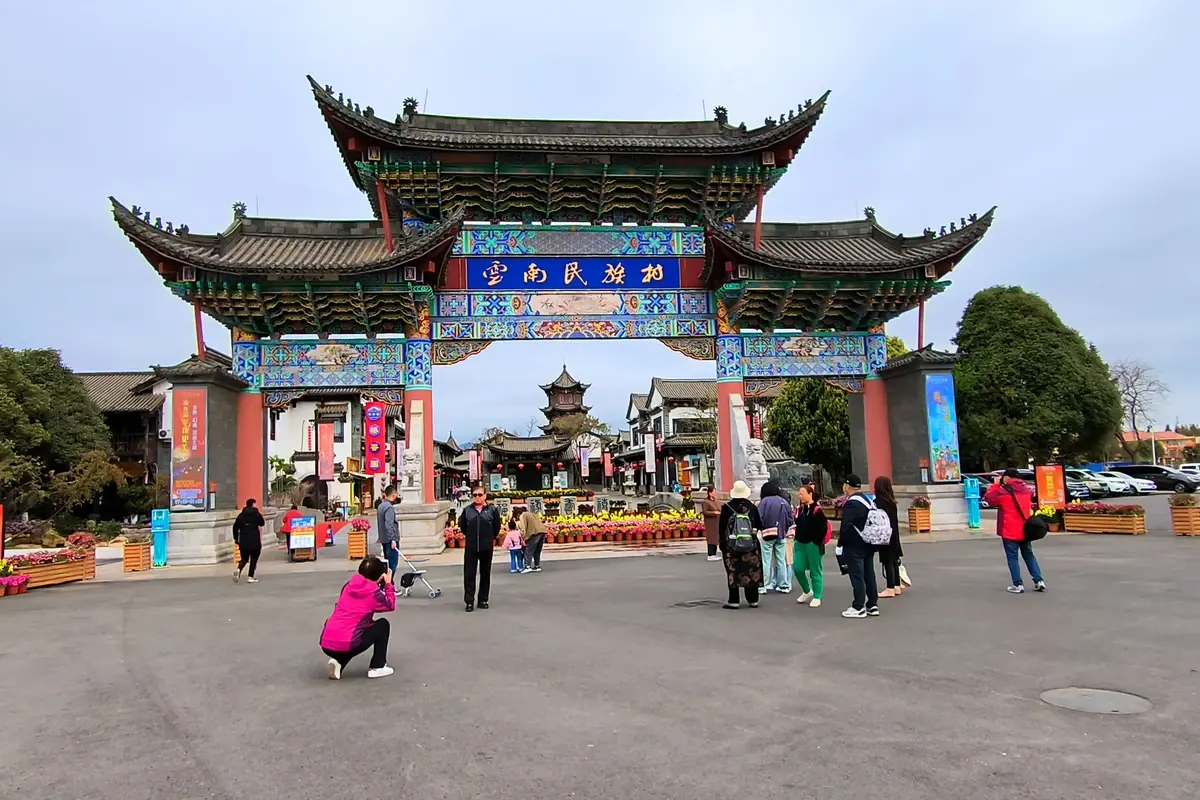
A photo at Yunnan Ethnic Village (Photo: Feng Ganyong)
At 9:40 a.m., after finishing my visit to Haigeng Park, I continued by taxi towards Daguan Pavilion. On the way, I suddenly caught sight of the grand archway of Yunnan Ethnic Village. Because I had shot a documentary titled "China’s Ethnic Sports" in Yunnan from 1 November to 16 December 1998, I have deep feelings for Yunnan’s minority peoples. So I changed my plan on the spot, making Yunnan Ethnic Village my second stop of the day instead of Daguan Pavilion.
Entering the Ethnic Village (Photo: Feng Ganyong)
Stepping into the 89-hectare Yunnan Ethnic Village scenic area, I was amazed by its sheer size. Fortunately, there are battery-powered sightseeing cars. After some thought, I decided wandering on foot would make photography easier, so my companions and I began strolling casually through the village.
Panoramic view of the Ethnic Village (Photo: Feng Ganyong)
Inside the village, waterways and land interweave, creating a fresh and elegant atmosphere. The villages and attractions are dotted in a well-ordered pattern. Winding paths under green shade, pavilion corridors, arched bridges and stone steps connect everything. It felt especially heart-warming to see some vaguely familiar ethnic houses I had encountered before.
Filming ethnic sports back then (Photo: Guo Gang)
I remember that from southeast to northwest Yunnan, during a month-and-a-half shoot, we filmed the folk sports of 11 ethnic minorities: Hani, Lahu, Dai, Wa, Naxi, Nu, Lisu, Jingpo, De’ang, Yao and Miao. Now, in the ethnic village, those memories came flooding back vividly.
Entering the Achang village (Photo: Feng Ganyong)
I entered the scenic area from the east gate and first visited the Achang village. After that, I wandered freely and saw, in turn, the Jingpo village, De’ang village, Ethnic Musical Instrument Square, Nu village, Instrument Workshop, Dulong village, Pumi village, Dai village, Ethnic Fruit Workshop, Shui village, Duoyi River Embroidery Workshop, Bouyei village, Bulang village, Ghost and God Square, Wa village, Sigangli, Miao village, Dujie Platform, Yao village, Hui village, Manchu village and Jino village, among many others. Although I couldn’t cover all the village’s attractions in one hour and forty minutes of sightseeing, I was more than satisfied.
Rehearsing a dance (Photo: Feng Ganyong)
The Achang village centres on a courtyard-style building, complemented by a village gate and handicraft workshops. It features grey tiles, brick walls and stone- plinth columns, quite distinctive. Entering the courtyard, I saw two young Achang men rehearsing ethnic dances, their every move precise and expressive.
Jingpo square (Photo: Feng Ganyong)
Not far from the Achang compound lies the 15-mu Jingpo village in Yunnan Ethnic Village. Here, spacious and well-designed dwellings are complemented by an exquisite "Mountain Official’s House". The architectural forms vividly showcase the "stilted" and "inverted-T" structural features and layout typical of Jingpo buildings.
The Manau Zongge pole I filmed back then (Photo: Feng Ganyong)
In the square’s centre, I saw the "Manau Zongge" ceremonial pole, which reminded me of filming the Manau festival in the Jingpo mountain villages of Longchuan’s Sading Village. The patterns and sculptures on the pole symbolise the Jingpo people’s unity and their valiant, hardy character. The Jingpo believe in an animistic primitive religion with spirits and ancestor worship.
Nu village (Photo: Feng Ganyong)
The Nu village features typical plank-walled houses with slate roofs, some with through corridors and others with linked suites. Terrace stone steps are scattered unobtrusively, fully expressing the dynamic spatial composition of Nu architecture and their skill in merging culture with nature. In the Nu village, I recalled happy times filming the Nu and Lisu peoples by the Nu River in Fugong county.
A corner of the Dulong village (Photo: Feng Ganyong)
Leaving the Nu village, I arrived at the Dulong village. Here, a typical plank-walled log house serves as the main exhibit, occupied by a mother and child to present a real domestic scene. A treehouse has also been built, seeking out a trace of history within the display.
Pumi village (Photo: Feng Ganyong)
In the Pumi village, the architecture is dominated by typical double-storey plank-wall log houses, enclosed in courtyards in the folk style. Barley-based "Sulima" wine is brewed by traditional methods and has long enjoyed a reputation as a "local beer". A western building recreates a Sulima "workshop".
A corner of the Dai village (Photo: Feng Ganyong)
Crossing a bridge opposite the Pumi village brings you to the Dai village, which covers 27 mu. Surrounded by water on three sides and shaded by green trees, rows of stilted Dai bamboo houses are linked by winding red sandstone paths leading to a solemn Burmese-style temple. The imposing white pagoda, delicate wind-and-rain bridge, rain shelters, water well and bell pavilion all brim with Dai flavour – a faithful recreation of an authentic Dai settlement.
A Shui house (Photo: Feng Ganyong)
The Shui village is built along the water and decorated with farming implements as scenery. It consists mainly of a representative plank-wall "street-front" building from the Gugan Shui township of Fuyuan County, Yunnan, combined with an Eight Trigrams wheel, Dragon Pool, a large Dragon Tree and other features, expressing the ancestral style and character of Shui culture. However, back then, I filmed the Shui people not in Yunnan but in Sanshui, Guizhou.
Bouyei village (Photo: Feng Ganyong)
The Bouyei village is also built beside the water. Two dwellings, faithfully following folk construction methods, perfectly combine the blockhouse and plank-wall architectural traditions. Curving waterside corridors and winding paths create a secluded feel. It both encapsulates Bouyei domestic life and innovates garden landscape design, being highly representative. Like the Shui, I filmed the Bouyei in Wudang, Guizhou, rather than Yunnan.
Wa village drum house (Photo: Feng Ganyong)
Continuing from the Shui village, I reached the Wa village in the southeastern corner of "Cuiyizhou". The village contains thatched stilted buildings, a Ox Head Square, a Spirit Square, Sigangli stone carvings and granaries.
The Wa wooden drum dance I filmed (Photo: Feng Ganyong)
The Wa were the first ethnic group I filmed when I came to Yunnan, so my memories are especially vivid. Back then, in a Wa village in Ximeng, I shot the "Wooden Drum Dance", "Ox-Slaughtering Dance", "Foot-Stomping Dance", "Rice-Pounding Dance" and many other Wa folk sports.
A behind-the-scenes shot while filming the Wa (Photo: Hu Xiaofei)
Some scenes in the Ox Head Square inside the ethnic village’s Wa settlement also looked familiar. This is where the Wa people’s ancient ox-slaughtering ritual takes place. The ox horns in the middle of the square represent the Wa village totem pole, while the two stone figures in front of the square are the male and female ancestors of the Wa.
Sigangli (Photo: Feng Ganyong)
The Spirit Square illustrates the Wa belief in animism and the immortality of the soul. The two stone statues here are "Mu Yiji" and "A Yi’e", the two most revered deities of the Wa. As I arrived, a young Wa man was performing a show, drawing many tourists to watch.
Bulang village (Photo: Feng Ganyong)
The Bulang village adjoins the Wa village. Inside are dwellings and a Ghost and God Square. This square demonstrates the Bulang belief in animism. In its centre rises the Bulang totem, and the square is also an important venue for worshipping spirits, performing songs and dances, and holding traditional folk activities.
Miao village (Photo: Feng Ganyong)
The Miao village in the ethnic village is set on a hillside, a very representative environment. Typical plank-walled stilted houses form the core, distilling the essence of Miao architecture. The stilted houses display Miao costumes and handmade crafts, while the residential buildings reflect traditional living styles. I recall filming the Miao in the Miaozhai of Tangzibian Village, Zhuilijie Township, Wenshan.
Yao village (Photo: Feng Ganyong)
The Yao village features stilted houses, single-storey dwellings, a rural Taoist temple, granaries and a village gate, all arranged with a pleasing irregularity. Infused with Taoist cultural elements, it is quite representative. I remember filming the Yao in the Cha Ping Ba Yao stockade in Hekou, and the scenes here vaguely evoked hazy memories of that time.
Hui village (Photo: Feng Ganyong)
The Hui quarter in the ethnic village consists of residential buildings, a mosque, streets and alleys, interspersed with garden horticulture, fairly completely reflecting the layout and architectural features of Yunnan’s Hui communities.
A photo at the Manchu courtyard (Photo: Feng Ganyong)
The Manchu courtyard draws on the construction style of Manchu residential compounds in Benxi, northeast China, while also incorporating many elements of Kunming courtyard houses. It is therefore a perfect fusion of the two regional dwelling traditions.
A photo at the Jino village (Photo: Wang Jue)
Finally I arrived at the Jino village, which is connected by a bridge to the Wa and Bulang villages, separated by the water. Stepping into the Jino village, I saw strangely shaped rocks dotted among green trees and flowers, with thatched Jino houses arranged in a pleasant jumble, as if I had walked into the undulating Jino mountain region. The Jino village includes a large communal house, residential buildings, granaries and a Sun Square.
De’ang Buddhist temple (Photo: Feng Ganyong)
Since it opened in February 1992, Yunnan Ethnic Village has vividly and dynamically showcased the architectural arts, songs, dances, costumes, cultural customs, religious beliefs and living habits of Yunnan’s many ethnic groups. Here, seeing these things stirred my emotions, blending present observations with past memories into a cherished experience. It was truly rewarding and left me deep in reflection.
Scenery of Yunnan Ethnic Village (Photo: Feng Ganyong)
13 March 2023 – with my tour of Yunnan Ethnic Village complete, my 11-day Yunnan journey finally came to an end. At 4:38 p.m., I took a Lucky Air flight 8L9987, a subsidiary of Hainan Airlines, back to Beijing. After a four-hour flight, we landed at 8:10 p.m. at Beijing Capital Airport Terminal 2.
Yunnan from the air (Photo: Wang Jue)
The moment the plane soared into the blue sky, I gazed out the window at the magnificent Yunnan landscape below, my heart captivated, reluctant to leave, savouring every last memory... Goodbye, Yunnan! I will come again when the chance arises. (Text and photos: Feng Ganyong)
(Source: Chinanews.com)