Yunnan Travel: A Whirlwind Glimpse of Kunming on My Ninth Visit (Photos)
Half a year after March 3, 2023, on September 11, 2023, because of an upcoming expedition journey from Yunnan to Tibet, I once again arrived in Kunming, the beautiful spring city and capital of Yunnan Province. At the same time, this was my ninth trip to Yunnan. Although I only had one day and one night in Kunming, a whirlwind tour was still quite enjoyable.
Scenery on the way from Beijing to Kunming (Photo: Feng Ganyong)
Speaking of this Yunnan-Tibet journey, it followed my first Sichuan-Tibet trip in August 1997, a second Qinghai-Tibet trip ten years later in August 2007, and now this Yunnan-Tibet trip another sixteen years later. At 22:20 on September 11, 2023, my group and I boarded the Z53 soft sleeper train at Beijing West Station, heading to Kunming to begin this third Tibet-bound expedition. In the waiting room, I couldn’t help but sigh—how rare in a lifetime to try three different routes into Tibet! I hoped the journey would be smooth and successful.
A corner of Kunming Railway Station (Photo: Feng Ganyong)
At 10:08 a.m. on September 13, 2023, the Z53 train departed Beijing, passing through Hebei, Henan, Hubei, Hunan, Guizhou, and Yunnan, after a 36-hour journey, arriving at Kunming Railway Station three minutes early. Since the platform at Kunming Station had no escalators or elevators, it was a real challenge for older passengers like us with heavy suitcases to descend from the platform to the exit... After exiting, a pickup vehicle was already waiting, and we headed straight to the Kunming Hot Spring Guanhong Hotel, where we would stay that day.
Kunming street scene (Photo: Wang Jue)
Although I have visited Kunming nine times, each trip has been brief, and as an outsider, I’m not very familiar with the city. For example, when I came in March this year and strolled around Cuihu (Green Lake), I missed the opposite side where the Yunnan Military Academy was located, just a stone’s throw away. So this time I made a point of visiting it. After arriving in Kunming and checking into the hotel for a short rest, I immediately headed to the former site of the Yunnan Army Military Academy. This became the first stop of my Yunnan-Tibet journey.
Photo taken at the Yunnan Military Academy site (Photo: a passerby)
At 12:45 p.m., a 28-yuan taxi ride from the hotel took me to the gate of the Yunnan Army Military Academy site. Looking at Cuihu across the street, I couldn’t help but feel amused and a bit annoyed. Why didn’t I glance across after visiting Cuihu last time? Otherwise, I wouldn’t have had to make a special trip back. Well, some things are just meant to be; better to relax and go with the flow.
Entering the Military Academy (Photo: Feng Ganyong)
Stepping into the Yunnan Army Military Academy site, a yellow building stood before my eyes. Above the entrance gate, a rectangular white plaque carried seven large black traditional Chinese characters from right to left: ‘Yunnan Lujun Jiangwu Tang’ (Yunnan Army Military Academy), clearly visible.
Photo at the academy’s parade ground (Photo: a passerby)
Passing through the arched gate to the parade ground and looking around, I realized the academy is an extremely classic ‘zouma zhuanjiao’ (horse-walking corner) style building. The east, south, and north two-story wings each stood about 10 meters tall, and on the south building there was a reviewing stand.
Entrance to the academy’s exhibition hall (Photo: Feng Ganyong)
Facing the parade ground, the east wing was three stories high, 16 meters, once used as the school’s administrative offices. The four wings were seamlessly connected, with open flow between floors, well-arranged, each side extending 120 meters long, perimeter 480 meters, covering a spacious area, with arched gateways on all sides for access.
Aerial view of a corner of the academy (Photo: Feng Ganyong)
The east and west wings looked roughly similar, both 11 meters wide, the walls entirely built of large bluestone. The west wing, being farther from the water, used rammed earth; the south and north wings were 9.4 meters wide, with walls of blue brick infill.
Entering the academy museum (Photo: Feng Ganyong)
Today, entering this circular building, one finds a museum exhibition hall detailing the academy’s history. Through numerous documents, artifacts, and more on display, visitors can gain an extremely comprehensive and in-depth understanding of the Yunnan Army Military Academy’s development.
A diorama of the academy in the exhibition hall (Photo: Wang Jue)
Tracing its history, the Yunnan Army Military Academy was a famous modern Chinese military school, originally established by the Qing Dynasty for training a new-style army and strengthening border defense. It was founded in 1909. Along with the Beiyang Army Military Academy (Tianjin) founded in 1906 and the Northeast Military Academy (Fengtian) founded in 1908, it was known as one of the three great military academies.
A corner inside the exhibition hall (Photo: Feng Ganyong)
In 1935, the Yunnan Army Military Academy was reorganized as the ‘Kunming Branch of the Central Army Officers School’, with Long Yun serving as director. After the Anti-Japanese War ended, in September 1945, the Fifth Branch was ordered to close. The Yunnan Army Military Academy and its successor school ran 22 classes, including various training teams and courses, producing a total of about 9,000 officers and non-commissioned officers.
Introduction to General Cai E in the exhibition (Photo: Wang Jue)
Cadets trained in infantry as the foundation while also studying other subjects; after specialization, they focused on their branch's drill manuals, aiming to produce all-around officers, even enabling logistics and supply officers to fight independently. Some of the academy’s teaching materials, such as ‘Zeng Hu’s Military Sayings’ compiled by Cai E as a textbook, were later adopted by the Whampoa Military Academy.
Introduction to Marshal Ye Jianying in the exhibition (Photo: Wang Jue)
After the 1911 Revolution, the Yunnan Army Military Academy was renamed Yunnan Army Military Academy School and continued for another 19 terms. Its faculty and students played important roles in the later Republic Protection War, Northern Expedition, Anti-Japanese War, and the Liberation War that overthrew the Chiang dynasty.
Selected mural in the exhibition hall (Photo: Feng Ganyong)
Over 4,000 cadets graduated from the Yunnan Army Military Academy. Each term lasted one and a half to two years, divided into infantry, cavalry, artillery, and engineering branches. Two marshals of the Republic—Zhu De and Ye Jianying—emerged from here, along with over twenty generals; the commander-in-chief of three countries’ armed forces and one defense minister also hailed from this academy.
Photo at the Jiangwu Post Office (Photo: a passerby)
Among its graduates, Lee Bum-suk served as South Korea’s first prime minister and defense minister; Vu Hoang Chu served as president of Vietnam’s provisional government. Marshal Zhu De called it ‘the melting pot of the Chinese Revolution’.
Statue of Marshal Zhu De (Photo: Feng Ganyong)
At 14:15 that afternoon, my group and I finished visiting the Yunnan Army Military Academy site. Following a local’s directions, we entered Cuihu Park through the west gate and exited through the east gate; right diagonally across was the Yunnan Uprising Memorial Hall and Lu Han’s Residence. That was the second stop of our Kunming whirlwind tour.
Lu Han's Residence (Photo: Feng Ganyong)
This was the residence of former Yunnan provincial chairman Lu Han. Built in 1933, Lu Han’s Residence is his private garden-style home, the best-preserved and largest French-style building in Kunming. Inside the residence’s ‘Yunnan Uprising Memorial Hall,’ a combination of scene reconstructions, artifact displays, and panels showcase Lu Han’s life and the uprising process.
Entering Lu Han's Residence (Photo: Feng Ganyong)
Stepping into the lush, green Lu Han’s Residence, the garden was extremely tranquil. Strolling along the path, I soon arrived at the front door. Looking up, the entire building was octagonal, two stories, with brick walls, timber roof trusses, and some reinforced concrete; the steeply pitched roof with flat tile ridges and triangular gables clearly showed a Gothic style. Stone columns, door casings, and window surrounds featured abundant relief decorations.
The residence’s meeting room (Photo: Wang Jue)
Inside the residence, there were fireplaces, and the interiors were elegantly luxurious, all finished with imported teak wood. The master bedroom, secondary bedrooms, and dining room all had floor-to-ceiling doors and windows opening onto balconies. The east and west sides featured three-sided bay windows. Red tiles, yellow walls, with gray trim lines. It now serves as the Yunnan Uprising Memorial Hall open to the public.
Lu Han's study (Photo: Feng Ganyong)
Historical records say: On December 9, 1949, during the Kunming Uprising, Lu Han detained Nationalist 8th Army commander Li Mi, 26th Army commander Yu Chengwan, and Yunnan station chief of the military secret service Shen Zui here, then announced the uprising at midnight.
A corner of the garden at Lu Han's Residence (Photo: Feng Ganyong)
Lu Han’s Residence is a private home of a modern Yunnan celebrity and witnessed the significant historical event of the Peaceful Uprising of Kunming, so it has high historical value. Particularly in the Yunnan Uprising Memorial Hall, through a series of historical documents and artifacts, visitors can fully understand that period of history. In 2003, the Yunnan Provincial People’s Government designated it as a provincial cultural heritage site.
Photo at Yuantong Temple (Photo: a passerby)
At 14:40, my group and I emerged from Lu Han’s Residence and turned right, walking straight for over ten minutes to reach the third stop of our Kunming whirlwind tour: a visit to the renowned Yuantong Temple. This is one of Kunming’s oldest Buddhist temples, with a history of over 1,200 years.
Towering trees in the temple (Photo: Feng Ganyong)
Yuantong Temple was originally built during the Tang Dynasty’s Nanzhao period, initially named Putuoluo Temple. In the 5th year of the Yuan Dynasty’s Dade era (1301 AD), Yuantong Temple was constructed, with the Yuan emperor granting an imperial edict in praise. The expansion took 18 years, only completed in the 6th year of Yanyou (1319 AD). During the Ming Dynasty, the temple was expanded, and a Jieyin Hall was built on the hilltop. In the Qing Dynasty, it saw multiple restorations.
Temple scenery (Photo: Feng Ganyong)
This temple is situated at the foot of a hill, but rather than hugging the slope, it descends lower as you go deeper inside—an unusual design for a temple.
The Yuantong Mahavira Hall (Photo: Feng Ganyong)
The entire temple resembles a garden, with green hills at its back and a jade pool inside, complementing the exquisite ancient buildings. It’s a magnet for photography enthusiasts.
Waterborne Buddha hall (Photo: Feng Ganyong)
Yuantong Temple integrates Han Chinese Buddhism, Tibetan Buddhism, and Theravada Buddhism from Southeast Asia, giving its architecture a variety of characteristics. For this reason, it stands out as a particularly distinctive Buddhist temple.
Photo inside Yuantong Temple (Photo: Feng Ganyong)
Upon entering Yuantong Temple, the first thing you see is a splendid archway inscribed with ‘Yuantong Shengjing’ (Wonder Land of Yuantong). Beyond it, a beautiful garden scene reminiscent of a Jiangnan water town unfolds. The lush trees here are praised as ‘Spiral Peak’s Embrace of Green’ and ‘Spiral Peak’s Layered Verdure’, one of Kunming’s eight scenic spots.
Waterscape at Yuantong Temple (Photo: Feng Ganyong)
Architecturally, Yuantong Temple seeks tranquility amidst the bustle, achieves grandness on a small scale, and borrows the backdrop of Spiral Peak to create a uniquely styled water-courtyard Buddhist temple, with a distinctive approach in Chinese garden artistry. In the history of Chinese temple architecture, it is a rare example of a ‘reverse-slope temple’.
The Bronze Buddha Hall at Yuantong Temple (Photo: Feng Ganyong)
At 15:20 that afternoon, my group took a 26-yuan taxi from Yuantong Temple to the last stop of our Kunming day trip: Jindian Park. Also known as the Kunming Golden Temple Scenic Area, it got its name because the main hall is cast entirely in brass, shining brilliantly under the sun, flooding the green valley with golden light. It’s also called Tongwa Temple (Copper Tile Temple).
Entrance to the Golden Temple Scenic Area (Photo: Feng Ganyong)
The renowned Golden Temple is part of the Daoist Taihe Palace, first built during the Ming Dynasty (1602). It is one of China’s four great bronze temples and the best preserved. In the 10th year of Kangxi (1671 AD), the Pingxi King Wu Sangui renovated it, giving it a long history. The natural scenery is beautiful, with paths threading through the woods, lush trees blocking out the sun, and occasional birdsong, deeply infused with Daoist culture.
The Third Heavenly Gate at the Golden Temple (Photo: Feng Ganyong)
On the way to the Golden Temple, the taxi driver explained that the typical tourist route starts from the foot of the hill, leaving the car and walking across Yingxian Bridge, passing through the ‘Mingfeng Scenic’ gateway, and proceeding through the ‘First Heavenly Gate,’ ‘Second Heavenly Gate,’ and ‘Third Heavenly Gate.’ Climbing up to the gate, you’ll see the simple, dignified entrance to Taihe Palace.
In front of Taihe Palace at the Golden Temple (Photo: Feng Ganyong)
But that route is strenuous. Considering our age, he suggested we drive directly to the scenic area gate halfway up the mountain near the Second Heavenly Gate, then walk a short distance along a mountain path to reach the Taihe Palace above the Third Heavenly Gate. I gladly agreed, so we drove straight to the hillside gate and began our tour of the Golden Temple.
Photo at Taihe Palace (Photo: a passerby)
In front of Taihe Palace, a couplet on either side of the gate reads: ‘Painted rafters touch the clouds, occupying only three acres of green hill; vermilion towers reflect the sun, opening up another realm amidst green fields.’ It is said there’s a story behind Taihe Palace. According to legend, during the Wanli era, the governor of Yunnan, Chen Yongbin, a devout Daoist, dreamed that immortal Lü Dongbin arranged to meet him at the foot of Mingfeng Hill the next day. He waited there and saw an old shepherd with a rope leading a sheep, cooking taro in two pots by the hillside, with another pot used as a lid. As he approached, the old man vanished, leaving only the two pots.
Chen Yongbin suddenly realized: two ‘mouth’ (口) pots stacked together form the character ‘吕’ (Lü), and the sheep on a rope meant ‘pure yang’ (Chun Yang), Lü Dongbin’s Daoist name, so the old man was Lü Dongbin. The immortal Lü indicated that Mingfeng Hill was a blessed land! So at the spot where he met Lü Dongbin, crossing Qingyang River, Chen built ‘Yingxian Bridge’ (Bridge Welcoming Immortals), and on the hill, modeled after the Taihe Palace and Golden Temple on Tianzhu Peak of Wudang Mountain in Hubei, constructed a temple dedicated to the Northern Emperor Zhenwu, surrounded by brick walls, with gate towers and palace gates, named Taihe Palace.
Lingxing Gate (Photo: Feng Ganyong)
Entering the gate of Taihe Palace, a magnificent lingxing gate with brackets and flying eaves stands before you. Lingxing refers to the star governing heavens; Confucius was revered as Lingxing, so lingxing gates were erected at all school temples and Confucian shrines, symbolizing the selection of scholars. The gate is flanked by statues of green lions and white elephants, embodying the Buddhist legend of ‘green lions offer auspiciousness, white elephants bring good fortune.’ Building this gate within the Golden Temple reflects the Ming and Qing syncretism of Buddhism, Daoism, and Confucianism in Yunnan.
Kuixing Tower (Photo: Feng Ganyong)
Passing the lingxing gate, you see a solidly built brick fortification, resembling a miniature royal Forbidden City. This small ‘Forbidden City’ was constructed in the Ming Dynasty to protect the bronze hall. The wall stands over one zhang (about 3.3 meters) high, with a perimeter of 365 chi (Chinese feet), representing the days of the year, symbolizing daily peace. The entire wall is built of blue bricks, sturdy and tightly laid.
Photo in front of Kuixing Tower (Photo: a passerby)
Gates are set on all four sides, each painted red and decorated with gold nails. Above the west gate rises a two-story tower housing Kuixing, the god of literature, commonly called ‘Kuixing Tower.’ The wall has weathered many hardships, damaged by war and earthquakes, but thanks to restorations over the centuries, it remains intact. On the tower hangs a couplet by Qing scholar Tu Zhuo, praising Zhenwu Emperor: ‘The seven stars’ banners point to the Han blue; five dragons’ thunder and lightning encircle the Mystic Capital.’
The Golden Temple (Photo: Feng Ganyong)
After passing Kuixing Tower and climbing the steps into the ‘wall’, you face the central structure of Taihe Palace: the famous Golden Temple. The Kunming Golden Temple, or Zhenwu Hall, when viewed up close, reveals that all its pillars, doors, windows, and roof are cast in bronze. It stands 6.7 meters high, 6.2 meters wide and deep, weighing 14 tons, with double eaves, majestic and gleaming brilliantly—hence the name Golden Temple. Its construction showcases the superb copper-casting technology of Yunnan 300 years ago. A bronze seven-star flag hanging beside the hall adds to its ancient, solemn charm.
The bronze seven-star flag by the hall (Photo: Feng Ganyong)
The Golden Temple sits on a marble platform. Its intricate carvings, well-proportioned design, and beautiful, imposing form make it a stunningly faithful imitation of a classic double-eaved, hipped-roof wooden structure—truly a masterpiece. The terrace edges are surrounded by stone balustrades; the upper platform, dragon-carved steps, imperial path, and flooring are all paved in Yunnan’s famed marble, with a warm, fresh luster. The lower platform’s railings, foundation stones, and cloud-dragon reliefs are made of a mix of black and sandstone. The railings are carved with floral patterns and the Twenty-Four Paragons of Filial Piety.
Exhibition hall of Wu Sangui's great sword (Photo: Wang Jue)
In a courtyard to one side of the Golden Temple, there are exhibition halls for Wu Sangui’s Great Sword and the True Wu Seven-Star Sword, and two halls about Wu Sangui and Chen Yuanyuan. Inside, one room displays Wu Sangui’s battle sword and a seven-star sword, while the other uses comic strips to tell the story of Wu Sangui and Chen Yuanyuan. The Golden Temple and its bronze inscriptions hold significant historical, artistic, and scientific value, and it is now a national key cultural heritage site.
Wu Sangui's great sword (Photo: Feng Ganyong)
On the other side of the Golden Temple, there’s a Zhuanyun Hall (Fortune-Turning Hall). Once inside, it was pitch dark, so I pressed close to the wall and squeezed through a narrow passage barely wide enough for one person, circling the Buddha statue inside clockwise. It was an experience not to be missed.
Photo at the Fortune-Turning Hall of the Golden Temple (Photo: a passerby)
The Golden Temple scenic area not only boasts admirable historical sites, but also embodies thousands of years of profound Chinese culture. The temple’s colorful couplets and poems are mostly tied to its unique natural setting and long-standing Daoist culture. The many plaques and couplets reflect deep cultural connotations, which makes it leap far beyond other golden temples.
Sampling Dali cuisine at Canger Renjia (Photo: Wang Jue)
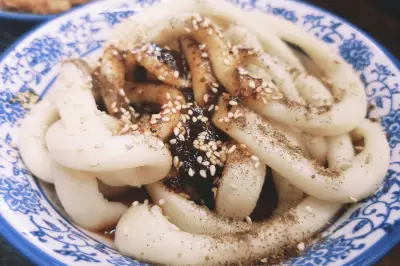
After finishing our tour of the Golden Temple, my group took a 51-yuan taxi back to the city. At 18:15 that evening, near our hotel, we dined at a restaurant called Canger Renjia, enjoying a meal of Dali-style flavors. We ordered pan-fried milk cake, plum sauce roast duck, eggplant with green beans, and seaweed taro soup. The food was delicious and very affordable. And so, my one-day whirlwind tour on my ninth visit to Kunming came to a perfect end. (Text/Photos: Feng Ganyong)