2020 51-Day Self-Drive Autumn Tour of Yunnan, Guizhou, and Sichuan (Part 6) – Shangri-La and Lijiang
2020 51-day self-drive autumn tour of Yunnan, Guizhou, and Sichuan, divided into 10 parts:
(1) – Zhijiang, Maotai Town, Chishui, Luzhou, Zigong.
(2) – Chengdu, Dujiangyan.
(3) – Wenchuan, Lixian, Barkam, Jinchuan, Danba, Xinduqiao.
(4) – Xinduqiao, Yajiang, Litang, Daocheng.
(5) – Daocheng Yading.
This is (6) – Shangri-La, Lijiang.
(7) – Jianchuan.
(8) – Dali, Weishan, Chuxiong, Kunming, Dongchuan.
(9) – Panzhou, Qianxinan, Ziyun, Duyun.
(10) – Qiandongnan, Fuzhou, Quzhou.
This self-drive trip lasted from October 9 to November 28, a total of 51 days, covering 8,780 kilometers.
Starting from Shanghai, passing through Quzhou (Zhejiang), Zhuzhou (Jiangxi), Zhijiang (Hunan), Maotai Town and Chishui (Guizhou), Luzhou, Zigong, Chengdu, Dujiangyan, Wenchuan, Lixian, Barkam, Jinchuan, Danba, Xinduqiao, Litang, Daocheng (Sichuan), Shangri-La, Lijiang, Jianchuan, Shaxi, Dali, Weishan, Chuxiong, Kunming, Dongchuan (Yunnan), Panzhou, Qianxinan, Ziyun, Duyun, Qiandongnan (Guizhou), then through Loudi (Hunan), Fuzhou and Quzhou (Zhejiang), and finally back to Shanghai.
Day 21, October 29: from Shangri-La Town in Daocheng County, Sichuan, to Balagezong Scenic Area in Shangri-La City, Yunnan: 261 km, standard time 6:30, actual time 9:15–16:30.
After finishing Daocheng Yading, I originally wanted to continue south to Liangshan Prefecture and Lugu Lake. However, navigation showed road construction on the southern route and suggested a detour via Xiangcheng to Shangri-La (Yunnan) and then to Xichang. I also didn’t know the road conditions of another southern route, the Luya Line. Just then, a friend who had recently visited Balagezong highly praised it—a scenic area not yet very famous. So I decided to go to Balagezong.
Along the way, few cars, good roads, and many curves. Heading north on National Highway 227, turning west to Xiangcheng County, then south on Provincial Highway 217, entering Yunnan, then National Highway 215 and the Xijing Line. First highland landscapes, then the Jinsha River accompanying us all the way, a colorful world. The water of the Jinsha River is truly green—real green mountains and clear waters.
Altitude: from 2,900m to 4,600m to 2,015m to 2,050m; temperature ranged from 0°C to 29°C.
Zagu Temple in Daocheng, altitude 4,200m.
Did not enter Xiangcheng County town (altitude 2,927m).
Highland wetland at 3,995m.
Leaving Sichuan, crossing this Jinsha River bridge, entering Yunnan:
Leaving the main southbound road, following the Gangqu River westward:
Shuizhuang Guanyin welcoming pilgrims:
Stayed at Balagezong Shuizhuang Hotel: 2 days.
Dined at the hotel restaurant; prices were reasonable.
Day 22, October 30: Balagezong Scenic Area, 4A, 8:20–16:45.
Original ticket price 110 RMB, half-price 55 RMB, sightseeing bus 60 RMB.
Balagezong Scenic Area is located deep in the mountains at the junction of Yunnan, Sichuan, and Tibet.
It was created after a man named Snaudinzhu built a road.
Snaudinzhu, born in 1964, from Bala Village. At age 10, while apprenticed as a blacksmith, he injured his eye. It took 5 days to walk from the village to Zhongdian County (now Shangri-La City), missing the optimal treatment time. He resolved to build a road.
At 13, he left Bala Village, doing business with beautiful stones from the mountains, roaming the world for 27 years, earning 40 million yuan. He spent 10 years, sold all his assets, took bank loans, and built a 35-km road through vertical mountain terrain to reach Bala Village. To date, 58 km of road have been built, costing a total of 850 million yuan.
A child who first left the mountains at age 10, never worn shoes, just seeing the outside world, with little schooling, yet at 13 he left the mountains to work and do business, going to Kunming, Guangzhou, Shanghai, etc., and earned 40 million yuan in 27 years—back in the era of the “ten-thousand-yuan household,” that was a huge fortune, enough to live a life above others. But he returned to his hometown to do good deeds!
I think he was sent by heaven! What do you think?
Building a road in a U-shaped valley with vertical terrain was extremely difficult—35 km with over 50 hairpin turns. The designers he hired backed out, but Snaudinzhu taught himself, designed the route, and organized the construction. Unimaginable.
One day is enough to visit the Balagezong scenic spots.
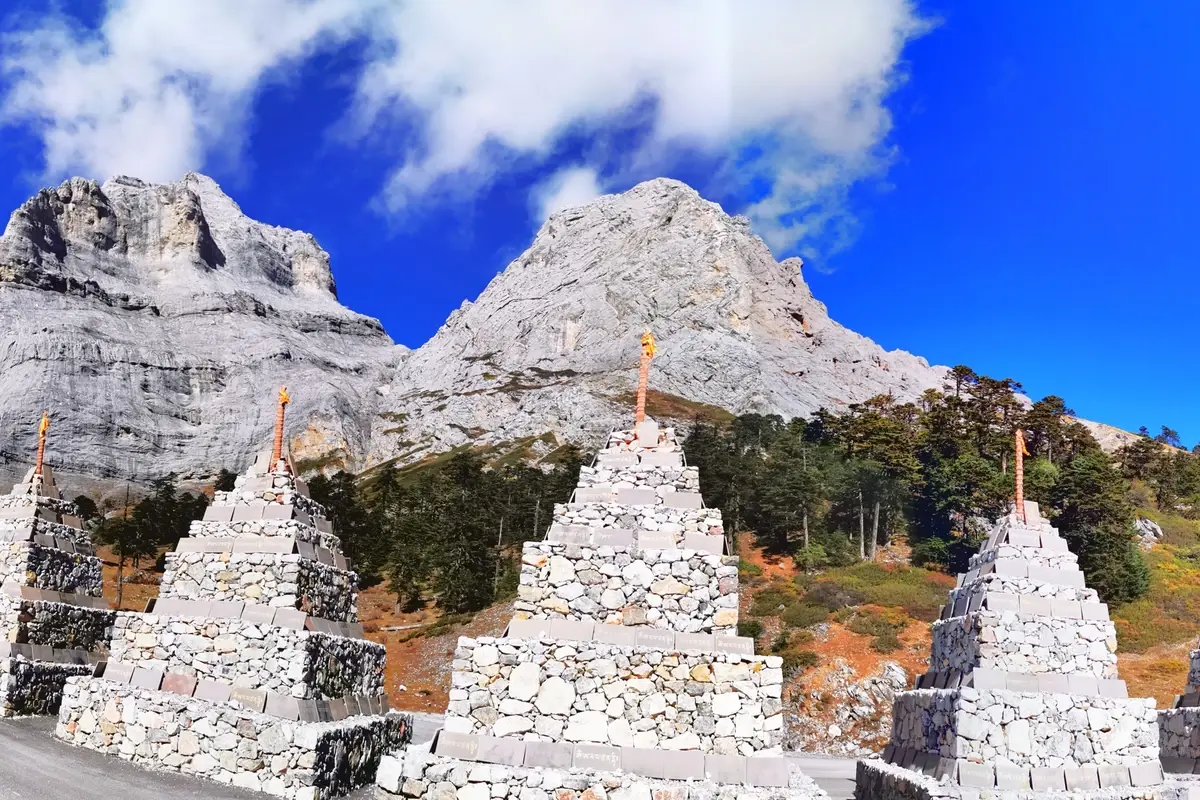
1. Shambhala Stupa: 75 RMB/person extra.
Translated as “Xiangqu Choden,” a natural stupa recorded in the “Great Tibetan Scripture.”
Altitude 4,250m, over 1 hour by car. Three sacred mountains, a pilgrimage journey. Few people go.
When Snaudinzhu encountered difficulties in road construction, he would sit in front of the Stupa Mountain to draw strength and wisdom. Afterward, he returned with greater drive.
The power of religion is infinite!
Those two “Tibetan little girls” were very pretty. When asked: they were from Henan. Their clothes were rented in Shangri-La City, 300 yuan per set per day.
2. Echo Wall, Gezong Snow Mountain, Glass Skywalk:
700m vertical drop. 1.4 km boardwalk, return the same way.
On the right is the old path used by mountain villagers:
The Gangqu River in the gorge:
There’s a zip line here for some excitement:
1 yuan to rent shoe covers, walk up:
3. Bala Village:
“Bala” is a transliteration of Tibetan, meaning a Tibetan village migrated from Batang.
Bala Village sits on the mountainside at 2,900m altitude under Gezong Snow Mountain in the middle of the Shangri-La Grand Canyon, about 700m vertically above the Gangqu River valley.
According to legend, over 1,300 years ago, a powerful Tibetan tribal chief, Snaudorje, seeking his wife Renchen Lhamo—who had left with an old lama due to her weariness of war—abandoned wealth, power, and vast territory to find a peaceful, secluded paradise. He led his tribe south from distant Batang, following Renchen Lhamo’s footsteps, and settled in Bala.
From then on, Bala Village became the ideal home of Snaudorje’s family, passed down through generations as aboriginal inhabitants. For thousands of years, the Bala people worked at sunrise and rested at sunset, living a secluded “paradise” life.
Bandan Lhamo Sacred Mountain.
4. Shangri-La Grand Canyon:
Unlike the typical “V”-shaped canyon, this is “U”-shaped with vertical terrain and a 3,500m drop. From high altitude, it should be frigid, but many temperate plants grow—from cacti and palm trees to cold-temperate spruce, fir, yew, and dry cypress. The Gangqu River winds through the grand canyon.
2.5 km boardwalk, can return the same way or take a rubber boat.
5. Tibetan Culture Exhibition Center (Bala Drolma Lhakhang):
Behind the ticket office at the entrance, together with the thousand-year-old Bodhi tree.
Drolma Lhakhang is a Guanyin temple built over 1,300 years ago by the chieftain Snaudorje behind Dayong Palace, enshrining 21 Taras.
6. Thousand-Year-Old Bodhi Tree:
At the entrance of the Shangri-La Grand Canyon, behind the ticket office.
This Bodhi tree is over 3,000 years old; its roots cover only a small part. Its entire trunk grows upward along the cliff in a peacock shape, covering over 400 square meters of the rock face.
Locals call it the “Phoenix Bodhi Tree.”
This thousand-year-old Bodhi tree once grew a left hand overnight. Approaching the base of the tree, you can see this legendary Buddha hand: a brown branch slants out from the trunk, its fingertips pointing into the rock face, five fingers clearly visible, rough to the touch, as if holding an old man’s hand.
On the trunk, like an old man’s face.
“The Bodhi is not a tree, the mirror is not a stand. Originally there is nothing, where can dust alight?” This is a famous Buddhist gatha. Whoever understands it achieves great enlightenment. Some interpret it as the state of mind when Shakyamuni sat under the Bodhi tree—unperturbed, not stained by dust.
This thousand-year-old Bodhi tree has a “Buddha hand” extending from its waist, and its trunk, from a distance, looks like a human face. The hand reaches to the cliff, firmly grasping a rock in a crevice. To many, it seems strange, but to Buddhists, this tree is very efficacious, as the Bodhi tree is a famous Buddhist plant with strong connections to Buddhism.
We visited three times; on the morning of the third day, just before leaving, we finally saw the “Buddha hand.” Amazing!
The photo below was taken with zoom; the actual trunk and hand are smaller—smaller than an adult hand.
The leaves are very dense, hiding the trunk; the divine hand is very small and not easy to spot. We only discovered it on the third visit, after close observation.
Today walked 17,200 steps.
The mouth of the canyon is actually a “tiankeng.” Unfortunately, no matter how you look up, you can’t capture it fully in a photo.
The mountain air quality was good.
Day 23, October 31, Saturday: from Balagezong to Shangri-La City, 9:35–13:00.
Leaving Balagezong, “the Bodhisattva” saw us off in Shuizhuang Village. Safe journey!
Kaizhang Water, First Bend of the Jinsha River:
Napahai, Yila Grassland:
7 km from town. Highland lake. The highest viewpoint is in front of the Alpine Botanical Garden gate, offering a panoramic view.
Stayed at Vienna Hotel Shangri-La Ancient Town:
Shangri-La City altitude 3,400m.
1. Dukezong Ancient Town:
Old street; center is Moonlight Square.
Central Town Hall, commonly called “Sutra Hall,” built in the 2nd year of Yongzheng of Qing Dynasty (1724).
Turtle Mountain Park: At the top is Chaoyang Tower, the highest point in the ancient town. On the north side halfway up is a pure copper gilded prayer wheel that requires four people to turn, world-class.
Day 24, November 1, Sunday: Shangri-La City, 9:45–17:30.
1. Potatso National Park:
5A, ticket 80 RMB, only one scenic spot open: Shudu Lake. The other two, Bitahai and Milithang Grassland, are under ecological restoration.
22 km from town, altitude 3,595m, Yunnan’s highest plateau tectonic lake.
Shudu Lake is a highland pasture, walking the boardwalk. Hike 3.3 km, 1.5–2 hours. Or take a boat 600m ahead for 50 RMB.
Second visit to Shudu Lake.
Overcast today; the scenery wasn’t stunning. Just leisurely relaxed inside, enjoyed the view, breathed fresh air, walked for two and a half hours.
The road to Potatso is under construction, bumpy and dusty.