Blue and White Greece - A 10-Day Self-Drive Tour of Peloponnese, Central Greece, Crete and Santorini (Two Islands)
Greece is probably a shared dream for those of us who grew up watching Saint Seiya.
During the pandemic, we had too many vacation days saved up at home, and I was forced to take leave by my company. Just as Greece opened to international travelers in May, I decided to go. I prepared proof of two vaccine shots, a large pack of masks, filled out the 14-day travel tracker online; transiting through Heathrow Airport for only an hour, the UK government also required a tracking form and a negative PCR test within 72 hours. After a flurry of activity, I finally boarded British Airways Flight 63 and arrived in sweltering Athens.
I rented a car at Athens Airport and drove directly south to a small village called Sounion. Athena and Poseidon both wanted to become the patron deity of Attica. Athena brought the olive tree to the local people, symbolizing peace and prosperity, and it was also the main source of cooking oil. She was also the patroness of weaving and was highly praised by women, ultimately winning. Attica was then named Athens after her (the highway sign outside the airport reads 'Athena'). Poseidon was essentially expelled from Athens, and his worshippers, mostly fishermen who lived by the sea, built a grand temple for him in Sounion.
【Temple of Poseidon at Sounion】
Sounion is mainly the domain of Poseidon. However, archaeologists have also discovered a temple of Athena in this area—truly the designated successor of Zeus, ubiquitous.
Temple of Poseidon at Sounion
Various coins were unearthed in the village near the Temple of Poseidon.
Poseidon was a rather despicable character. More on the Minotaur later; anyway, this god was very petty and vengeful. He had a grudge against Athena and committed an unspeakable act on the altar of Athena's temple against Medusa, one of Athena's priestesses. Because Athena was a virgin goddess who valued chastity highly, she was furious. But Athena's reaction at this point is truly baffling: why not go after Poseidon? Instead, she turned Medusa into a monstrous creature with snakes for hair, and anyone who looked into Medusa's eyes would turn to stone. This even led to the death of Medusa's only friend. This might be the origin of the ancient 'victim-blaming' attitude towards rape victims. Perhaps out of guilt later, after Perseus killed Medusa, Athena placed Medusa's head on her shield.
An image of Medusa's head should be inserted here: taken at the Basilica Cistern in Istanbul (I went to see it specially because of Dan Brown's Inferno).
Greece, a country where everyone can read my tattoo (lucky I didn't misspell it, otherwise it would be a social death scene instantly).
Sounion's natural beach.
Driving north and then west into Athens. The distance wasn't great, but the drive was infuriating: too many toll booths is one issue. The roads in Attica were decent, but after entering the city, the narrow streets caused heavy traffic jams everywhere, and parking was impossible to find (paid parking lots cost 15 euros a day and were full). In Athens, traffic rules and traffic lights depend on the driver's mood rather than being mandatory. Local drivers stop wherever they want with their hazard lights on, not caring about the cars behind them. Pedestrians cross the street randomly. At first, I stopped to let pedestrians cross as I would in Canada, but I got honked at by drivers behind me. You can imagine the scene.
I was driving innocently when suddenly someone drove the wrong way right in front of me. Surprise or shock?
Why did a car park that big have to park so close to me? I had to get in from the passenger side and climb over to the driver's seat!
A friend asked me when I'd write a travel diary. I said just the various behaviors of modern Greeks would be enough for me to rant about for three days and three nights. Seriously, since inventing feta cheese, Greeks haven't contributed much to human society.
The Daily Mail summed it up aptly: from 230 BC to the 19th century: nothing accomplished.
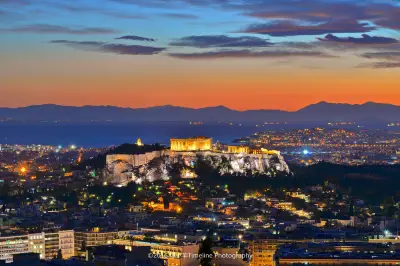
【Acropolis of Athens】
I arrived at the Acropolis early on a Sunday morning. The autumn heat was beyond description. But I had woken up early only to be delayed: the gates of the Acropolis were tightly shut, and hundreds of tourists were stuck outside. Eventually, I found an English-speaking person at the souvenir shop who told me that a delegation from the EU was visiting and had booked the entire place for the morning. After waiting under the scorching sun for over an hour, tourists were finally allowed in at 11 a.m.
The Theatre of Dionysus. It is still in use today, hosting many concerts and plays on summer evenings. Yanni's Acropolis concert (1994), which left a deep impression from my childhood, was held here.
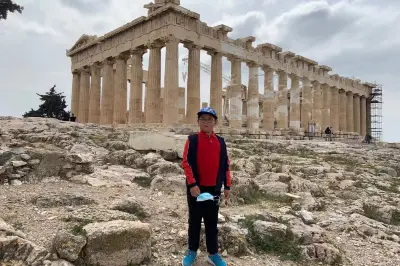
Climbing up to the hill where the Parthenon stands. The number of tourists was considerable.
'See his mansion rise, see his mansion fall.'
The Acropolis has many Doric and Ionic columns.
The Parthenon is a temple dedicated to Athena, built in the 5th century BC. The temple is rectangular, with a base length of 69.5 meters and width of 30.88 meters, surrounded externally by 46 marble columns 14 meters high and 1.5 meters in diameter. The 8-meter-tall giant columns have 8 on the short sides (east and west) and 17 on the long sides (north and south). Inside stood the work of the sculptor Phidias: a statue of Athena said to be 13 meters tall.
The Parthenon was not destroyed by fire or earthquake. In the 17th century, during a war between the Venetians and the Turks, the Turks used the Parthenon as a gunpowder store, and the Venetian army bombarded it... and then there was nothing left.
The ancient Greeks really loved the golden ratio.
The Erechtheion on the north side of the Parthenon, said to have been built by the mythical King Erechtheus, most famous for its Porch of the Maidens.
The north side of the Erechtheion. The Greek sun is simply insane.
To the east of the Parthenon, there is a small building built by the Roman Emperor Augustus to flatter himself.
********** A digression to mock Greek mythology ***********
A friend once talked to me about Greek mythology, and I said my favorite goddess was Artemis. He was surprised and said, 'Don't women usually like Aphrodite?' As soon as I heard that, I didn't want to continue the conversation—clearly we weren't on the same page.
I used to misunderstand and think Aphrodite was Zeus's daughter, but my partner corrected me: Aphrodite is Zeus's aunt (so marrying Hephaestus wasn't sibling incest but incest spanning three generations). Zeus's father Cronus rebelled against his father Uranus's tyranny, cut off Uranus's testicles and threw them into the sea. The testicles turned into foam, and from a large shell, Aphrodite was born.
Cronus was even worse than his father. Fearing his children would seize power, he swallowed all of them: Hera, Hades, Poseidon, Demeter, and Hestia. Only Zeus escaped because their mother Rhea wrapped a stone in baby cloth and pretended it was a baby for Cronus to swallow, hiding Zeus on the island of Crete. Later, Zeus tricked Cronus into drinking an emetic and made him vomit up the five children, who had grown to adulthood (???)
Maybe for this reason, Zeus early on designated Athena as his successor, his most favored child.
After Zeus gave birth to Athena from his head, Hera became jealous and said, 'I can do that too,' so she gave birth to Hephaestus on her own. But after giving birth, that weirdo Hera disliked the child's ugliness and threw him away. When the child grew up, he was very angry and wanted to take revenge on his mother. He was skilled with his hands and made all sorts of things: tools, weapons, furniture. He made a luxurious throne and presented it to Hera. When Hera sat down, she was trapped and couldn't get up. All the gods begged Hephaestus to release her; he agreed but set conditions: that he be made one of the twelve Olympians and that Aphrodite be given to him as his wife.
How could Aphrodite fancy this ugly, lame blacksmith? Unsurprisingly, she had an affair with Ares, the god of war, son of Zeus and Hera, and had several children, including Eros. One story says that Helios (or some say Apollo, the current sun god), because he had a grudge against Ares, reported it to Hephaestus. Hephaestus kept calm and modified his bed with a trap. Then he pretended to leave. Sure enough, Aphrodite eagerly called Ares home to do things that Jinjiang (a Chinese literature site) wouldn't allow. But the bed had a mechanism that trapped the adulterous couple. Hephaestus invited all the Olympian gods to come and watch (?? What's so interesting about seeing your own cuckolding??). The scene was so ridiculous that the gods burst out laughing, except for Hermes. Aphrodite was grateful to Hermes and, to repay him, she gave birth to a child with him (???? What kind of operation is that? Show gratitude by having a child???)
************** End of digression for now ************
After leaving the Acropolis, I downed a bottle of ice water, an ice-cold beer, and an ice cream before I could cool down a bit. I took a long detour on foot to the Ancient Agora of Athens.
Along the way, I passed the Cave of Pan. Pan, the god of the wild, is said to be Hermes's son. He loved nature and was skilled with the panpipes. Apollo was traditionally considered the god of music, and his favorite instrument was the lyre. Pan once challenged Apollo to a music contest. When everyone praised Apollo as superior, Pan's friend King Midas said Pan had won. Angered, Apollo turned King Midas's ears into donkey ears (since he dissed him for not understanding music, what use were human ears?).
The story of Dionysus tricking Midas with the golden touch, and the barber whispering into a tree hole 'King Midas has donkey ears,' are well known.
【Ruins of Ancient Athens】
The temple of Ares, the famous adulterer god of war, has collapsed into nothing. (Notice on the hill behind.)
The temple of Hephaestus, Aphrodite's legitimate husband, still stands intact on the hill behind. Truly the god of fire and craftsmanship.
As they say: karma comes... you just have to wait over two thousand years.
Stoa of Attalos – originally built in the 2nd century BC, with two stories. The outer columns are Doric, the inner ones Ionic.
Nike, the goddess of victory.
From the ruins of ancient Athens, I strolled through small streets full of souvenirs, food stalls, and bars, soon reaching the Library of Hadrian.
The Library of Hadrian – compared to the Library of Celsus in Ephesus from the same 1st century, it's far inferior.
Even libraries had bathhouses; Romans really loved bathing.
Hadrian's Arch, said to have been erected by the Athenians to thank Roman Emperor Hadrian for donating large amounts of supplies. Roman emperors loved shameless flattery: Alexandria has Pompey's Pillar praising Diocletian, Rome has Trajan's Column.
The Temple of Olympian Zeus in Athens.
The Temple of Zeus, now only a few columns remain.
Leaving the Temple of Zeus, I was as hot as a half-dead dog. I hurried to the air-conditioned Acropolis Museum to cool down. Luckily, it wasn't far—a five-minute walk. This was the first indoor activity of the trip. About 50 meters from the museum, staff checked for either proof of two vaccine doses or a negative test result. These museums accept antigen tests; there are clinics all over Athens where you can get tested without an appointment or queue.
The caryatids from the Erechtheion; I think the British Museum also has some. Although the Louvre and Vatican Museums also have Egyptian and Greek relics, I must especially mention the British Museum: don't forget the outstanding contributions of the British Empire to world conquest, colonization, and rule.
Horses from a four-horse chariot.
The east pediment of the Parthenon depicts the birth of Athena from Zeus's head, fully grown and in armor. From left to right: the horses of Helios (the first sun god), Dionysus, the twins Apollo and Artemis, Zeus, and Athena.
I took a photo and was shooed away by staff. It seems it's still under study and photography is not allowed.
Staying and eating at the Acropolis. At the Balcony restaurant, the grilled octopus had delicious side vegetables; the waiter said it's called Greek Almira, a type of seaweed.
Although the hotel was shabby, a martini cost 10 euros, but the view was truly splendid.
******** Continue digression on Greek mythology *********
Another misunderstanding I had about Greek mythology was that Zeus was a playboy. The reason everyone knows Zeus fooled around is because his wife Hera was extremely jealous and loved to blow things up (no wonder, since she was the goddess of marriage; how could she not make a fuss about her husband's infidelity?). Her powers couldn't match Zeus's, so she mainly targeted the mistresses and illegitimate children. Actually, Zeus only had 32 children, while Apollo had 65; Zeus is not as promiscuous as Apollo.
For instance, Leto, the mother of Apollo and Artemis, was cursed by Hera so that she could not give birth on any land. So the twins were born on a floating island (Crete). Some say Hera also sent Python to devour Apollo. Baby Apollo saved himself (??). Later, when he grew up, he sought revenge on the serpent. At the spot where he killed it, he ordered his followers to build a temple. That place is Delphi. Apollo spoke through the serpent's spirit (or through a priestess, according to another version). When human kings faced problems they couldn't solve, they came to consult Apollo. This is the Oracle of Delphi.
Many Greek myths begin when people, troubled and seeking answers, went to Delphi to ask the oracle, which then generated stories. For example, Oedipus killing his father and marrying his mother; Eros and Psyche; Perseus—all started with asking the oracle at Delphi.
Perseus's grandfather, King Acrisius of Argos, went to ask the oracle about his heir and was told that his daughter would bear a son who would eventually kill him. Terrified, the king locked his daughter in a windowless prison to prevent contact. He thought, 'Now she can't have a son.' But Zeus passed by, found the princess beautiful, and fell in love. He turned into a shower of gold and entered her cell through the skylight, and she became pregnant with Zeus's son. So Perseus is also a demigod.
The more I seriously reference Greek myths and legends, the more I feel like I'm engaging in erotic literature.
********* End of digression for now **********
【Oracle of Delphi】
Leaving Athens, I took the A1/E75 highway northwest for about 180 kilometers to Delphi, where ancient Greeks engaged in superstitious activities. The archaeological site of Delphi is right by the winding mountain road, with no parking lot; cars just park on the roadside. Only in Athens and Crete can you buy tickets online. At Delphi, tickets are sold at the entrance booth with no queue; the combo ticket for the site and museum is 12 euros. Wear hiking shoes because the site is entirely on the mountain.
【Ruins of the Temple of Apollo at Delphi】
The name Delphi is said to come from 'dolphin.' This is the sacred place for worshippers of Apollo. It is said that Gaia gave birth to a great serpent Python that lived here. After Apollo killed the serpent, the Temple of Apollo was built here, through which Apollo would give prophecies to mortals via a priestess.
The Treasury of Delphi.
The legendary 'navel of the earth.' It is said that Zeus wanted to find the center of the earth, so he released two eagles from opposite ends of the earth flying toward each other; the place where they met was Delphi, hence considered the center of the earth (Uluru in Australia would disagree).
The Temple of Apollo – view from the altar.
Legend says on the lintel of the temple were three maxims: 'Know thyself,' 'Nothing in excess,' and 'Surety brings ruin.'
The Temple of Apollo – view from the opposite direction.
The amphitheater of Delphi.
The stadium at Delphi – at the highest point of the site, it is probably the best-preserved ancient stadium in Greece. From it, you can look down directly on the Temple of Apollo.
The Olympic Games originated in Greece, and even today, the Olympic flame is kindled at the site of Olympia. But the ancient Greeks loved sports; they had four 'Panhellenic Games': the Olympic Games honoring Zeus at Olympia, every four years. Two years later were the Pythian Games honoring Apollo at Delphi, also every four years. The Isthmian Games honoring Poseidon at Corinth, every two years. The Nemean Games honoring Zeus and Heracles at Nemea, every two years.
Back then, there were no gold or silver medals; the winner received a crown made of olive branches (symbolizing peace, hence 'crown'). Champions were hailed as heroes by their hometowns, rewarded with great wealth, exempted from taxes for life, immortalized in poetry, and had statues made of them.
【Sanctuary of Athena Pronaia at Delphi】
Halfway to the Temple of Apollo, I passed the ruins of the Temple of Athena at Delphi. This site is free and open 24 hours. There is also a stadium below, but it has almost completely collapsed.
Tholos of Athena Pronaia – built in the 4th century BC – unlike other temples of Athena, this one is circular.
The Tholos of Delphi is a Doric circular building.
【The Crown】Season 3, Episode 8: When the Queen visits the French town of Rouen to commemorate Allied war dead, a building similar to this Tholos appears.
【Delphi Museum】
Like the Acropolis Museum, entry requires proof of two doses or a negative PCR test within 72 hours, and masks are mandatory with limited capacity.
The stone that Cronus vomited.
As mentioned earlier, Rhea hid baby Zeus on Crete and wrapped a stone in cloth and blankets to pretend it was a baby for Cronus to swallow. Later, when Zeus grew up and sought revenge, his grandmother Gaia gave him a potion, which he presented to his father Cronus as nectar. The arrogant Cronus drank it and began to vomit, bringing up his five fully grown children (Hera, Hades, Demeter, Poseidon, Hestia) – all alive – and also the stone that had replaced Zeus. That stone is now displayed in the Delphi Museum.
One of the labors of Heracles was the Erymanthian Boar. Erymanthus is in Arcadia, where a ferocious boar was terrorizing the countryside. Heracles consulted his teacher, who advised him to drive the boar into deep snow and capture it, then throw it into the sea.
Heracles was the product of another extramarital affair of Zeus. His mother was Alcmene, granddaughter of my hero Perseus. Perseus was also a son of Zeus, so Perseus was both great-grandfather and half-brother. Alcmene was pregnant with twins: Heracles, fathered by Zeus, and his twin brother Eurystheus, fathered by Alcmene's husband. Greek mythology is surprisingly progressive: twins can indeed have different fathers.
Hera was furious and first sent two witches to harm Alcmene, but they failed. On the day Heracles and Eurystheus were born, Hera tricked Zeus into promising that 'the first descendant of Perseus born today will rule the kingdom of Mycenae.' Zeus intended his illegitimate son to become king, but Hera caused Eurystheus to be born first, so he grew up to take the throne. Later, Hera sent two poisonous snakes to kill the infant Heracles, but the baby, being super strong, grabbed and strangled them.
Fearing Hera's wrath, Heracles' mother (his birth name was Alcides) abandoned him in the wilderness. Hera and Athena happened to pass by and found him cute. Athena urged Hera to breastfeed the baby, not knowing he was Zeus's illegitimate son. The divine milk made Heracles even stronger, and he was given the name Heracles ('Glory of Hera'). Because the baby was so strong, he bit Hera while feeding; she pushed him away in pain, and her milk scattered across the sky, forming the Milky Way.
Later, in Thebes, Heracles got married. But due to Hera's curse, he temporarily lost his mind and killed his wife and children. When he regained his sanity, he went to Delphi to ask the oracle. He decided to undertake ten impossible tasks assigned by King Eurystheus of Mycenae. Later, the king thought Heracles had cheated and added two more, resulting in the Twelve Labors of Heracles. The mother of the twins was dissatisfied with Eurystheus for sending Heracles to his death, so she led the Athenian army to kill Eurystheus.
Sun god in Western art: Apollo and Daphne.
Apollo looked down on the little god Eros carrying a bow and mocked him, saying that such weapons were for adults and that the child might hurt himself. Eros, who was already mischievous, felt insulted. He shot a golden arrow at Apollo, making him fall in love with Daphne, and a lead arrow at Daphne, making her despise Apollo. Finally, when Apollo chased Daphne to the point of exhaustion, she turned herself into a laurel tree. This is the origin of Apollo's laurel wreath.
Of course, the feud between Apollo and Eros continued. When Psyche's father went to Delphi to ask the oracle, Apollo described Eros as a monster, almost causing a tragedy between Eros and Psyche.
【Patras】
Leaving Delphi heading southwest, I realized it was unrealistic to drive from Athens to Delphi and then to Olympia in one day. I didn't want to drive tired, so I chose a place halfway between Delphi and Olympia: Patras, on the westernmost part of the Peloponnese, to spend the night.
Whether it was the temperature, the street noise, or some smell, Patras reminded me of Siena.
When eating out, checking Google ratings or finding trendy restaurants isn't as reliable as asking locals. The receptionist at the Patras hotel recommended this: chicken skewers and mixed pork-beef skewers, Greek salad with plenty of feta cheese, a piece as big as my phone. Including drinks, it cost only 11.9 euros.
【Ancient Olympia】
Driving south along the west coast of the Peloponnese for about an hour, I entered the mountainous region of Olympia.
The Peloponnese has a typical Mediterranean climate – cacti everywhere.
Every household grows orange and olive trees.
【Ancient Olympia Site】
September 21: All archaeological sites and museums in Greece were free entry. That saved me 20 euros.
Ancient Olympia – where the Olympic flame is kindled. Behind is the Temple of Hera.
After hearing so many Greek myths, Hera is definitely a case of 'if you're not tough, you're not stable.'
The tholos in front of the Temple of Hera.
The Temple of Zeus at Ancient Olympia.
On the way to the stadium – the stadium has almost completely collapsed.
Palaestra at Ancient Olympia – a wrestling and gymnastics facility.
【Museum of Ancient Olympia】
Hermes holding the infant Dionysus.
Nike, the goddess of victory.
Various vessels and utensils – some bronze, some clay – probably used for sacrifices, similar to the Terracotta Army.
Zeus turning Europa into a cow to hide from Hera.
'Probably some Roman general' – I didn't make this up; many statue descriptions are like that: possibly, probably, presumably.
A souvenir shop had a horse-head sculpture with a Mohawk hairstyle.
The mountainous Peloponnese is a good place to practice driving skills.
Leaving Ancient Olympia, Google Maps showed a road heading southeast. I thought Google would take me on highways, but it led me to all kinds of winding goat paths.
A forest fire that was only extinguished in August had left trees and bushes blackened and precarious.
Why does 123 kilometers take two hours?
For one and a half hours, it was zigzagging mountain roads. Even Takumi Fujiwara would have a tough time.
And there were flocks of sheep blocking the way constantly.
【Temple of Apollo Epikourios】
Bassae of Phigaleia: Temple of Apollo Epikourios. To prevent further damage, the Greek government has covered the temple with a tent.
Apollo has multiple roles: sun god, music god, protector of flocks and fields, and god of medicine. The temple at Bassae primarily worshipped Apollo as the helper (Epikourios).
The architect is said to be Iktinos, who also designed the Parthenon; indeed, there are similarities.
【Mycenaean Civilization and the Kingdom of Argos】
On the 21st, I stayed overnight in the seaside town of Nafplio. As I approached the hotel, I saw a brightly lit castle on a hill not far away. I asked the hotel receptionist, who wrote down the name for me. Since it was only a ten-minute drive, I decided to visit it early the next morning.
After returning home, my mother told me that when she and my father visited Greece in 2018, before visiting the Mycenae site, the tour guide took them to a place they couldn't identify. They only remembered it was on a hill, with stone walls, a small church, and a view of a beach below. I showed her this set of photos and said, 'Is this the place? Fortress of Palamidi.' My mother nodded; a three-year mystery was finally solved.
Behind me is that small church.
Some stair sections were as steep as Mount Hua.
Also climbing the hill were a group of young Greeks. Before the trip, my partner jokingly asked me, 'Are people in Greece greasy?' After arriving, I realized they really are. Maybe because of the intense sun, they produce a lot of oil, and they eat a lot of olive oil. And they eat so much goat cheese, which gives them an indescribable body odor. Especially when sweating from hiking, the smell carries for miles.
【Mycenae Ruins】
Greece was a city-state. So-called kings were really just city lords. Mycenaean civilization flourished from 1600 to 1100 BC, the late Bronze Age in Greece. The time of the Homeric epics falls within this period.
The cistern at Mycenae.
The north gate of the Mycenae ruins.
Tombs of the kings of Mycenae, except Agamemnon, who had a special status and was buried separately in a tomb outside the ruins.
【Mycenae Archaeological Museum】
It is not mentioned here that Helen was also a daughter of Zeus and had been abducted by Theseus.
Pottery unearthed at Mycenae.
【Tomb of Agamemnon】
From the outside, it looks like a small mound; inside, it is a stone-built corbelled dome.
【Ancient Theatre of Epidaurus (Sanctuary of Asclepius)】
The best-preserved amphitheater I have ever seen – second only to the Theatre of Dionysus in Athens and the theater at Ephesus. It is still in use today.
Ruins of Epidaurus.
There is also a stadium here!
Epidaurus Museum.
Asclepius the healer – son of Apollo, holding a staff with a serpent. He is the god of medicine.
The registered trademark of the American Medical Association is derived from this serpent staff.
Worshipping the son of Apollo naturally involves his sister.
Artemis is the goddess of the moon and hunting. Although she can be stubborn at times, like in the story of Orion, she is still my favorite Greek goddess.
I returned to Athens in the evening, passing the Corinth Canal.
On September 23, I took an Aegean Airlines low-cost flight to Crete.
Crete is actually quite large. As it is a tourist destination, all sectors are well regulated. There is no Uber in Greece. In Crete, you have to take taxis, which have fixed prices and no meters. There are taxi stands at airports, tourist sites, and near hotels, with standard rates displayed, e.g., from the airport to the museum, regardless of the number of passengers, time of day, or traffic, it's always 15 euros. This completely eliminates overcharging or refusal to take passengers.
【Heraklion Archaeological Museum (Minoan Museum)】
The most interesting museum in all of Greece – it hit all my funny bones. Special mention: it limits the number of visitors, so you have to wait a long time.
You might think it's a bathtub, but it's a coffin.
This looks like the Ukrainian folk dance Shumka – legs parallel to the ground.
This wig style is quite similar to Lucy from the Peanuts comic strip.
Hades, god of the underworld, with his abducted cousin Persephone, daughter of Demeter, and their three-headed dog Cerberus.
A laurel wreath made from the branches of Daphne's tree.
I saw an identical one in the catacombs of Alexandria.
An eagle wearing high socks and a neck warmer.
All the finds from Crete; the largest one, with two heads, is the most special: it features the tyrant Nero and his ambitious mother Agrippina.
As mentioned earlier, Poseidon was very petty. King Minos liked the bull so much that he kept it and offered an inferior one to Poseidon. Poseidon held a grudge. He made Eros shoot an arrow at King Minos's queen, making her fall in love with the bull. The queen asked the craftsman Daedalus to build a hollow wooden cow, climbed inside, and had intercourse with the bull. She later gave birth to the half-human, half-bull monster, the Minotaur, which King Minos locked in the Labyrinth under the palace. This led to Theseus, Ariadne, the thread, and then Theseus forgetting to hang white sails on the return trip, causing his father Aegeus to throw himself into the sea, giving the Aegean Sea its name.
【Minoan Palace of Knossos】
This is said to be the garbage dump.
Venetian Harbour (Chania)
I hear the sound of waves
Standing in the very center of the city
Early the next morning, I took the Minoan Palace ferry from Crete to Santorini. The journey took two hours, but the boat went very fast. I, who had never gotten seasick, threw up the whole way.
Santorini is the most expensive place on earth. A 20-minute bus ride from the port to the hotel costs 50 euros. Every business gouges you without mercy.
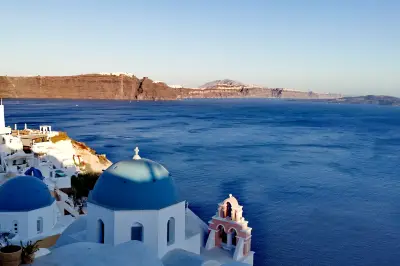
Night in Oia.
A yacht trip with food and drinks included – very comfortable.
【Oia】
My personal advice: stay in Fira. Fira is much cheaper than Oia. There are buses every half hour between the two villages, a 20-minute ride, 1.65 euros per ticket. You can also rent cars, motorcycles, or ATVs.
Various photography crews were busy.
At the end of the first Jason Bourne movie, the couple came here.
Atlantis Books.
Little donkeys everywhere.
Walking an hour to the village of Pyrgos, I found a Instagram-famous spot.
Parea Tavern in Fira – the seafood was delicious and reasonably priced, but the wait for a table was long.
I'll call out the restaurants in Oia – the food was bad, expensive, and the service rude. Don't go there.
After getting a PCR test at a clinic on Fira and obtaining the result, I ended the trip and flew from Santorini back to Athens.