Greek Travel I: The Most Outstanding Ancient Greek Architectural Complex – The Acropolis of Athens
Traveling to Greece originated from reading about Greek history while traveling in Turkey.
This island nation at the southeastern corner of Europe, at the southern tip of the Balkan Peninsula, has a history that can be traced back to ancient Greek civilization, and is hailed as the "Cradle of Western Civilization," "Birthplace of European Philosophy," and "Origin of the Modern Olympic Games."
At 10:25 PM on May 22, 2019, I set off from Pudong Airport with my friend Qiu Jie.
At 5:15 AM the next day, we arrived at Istanbul Atatürk International Airport in Turkey under a glow of dawn.
Since it was a connecting ticket, our luggage was checked through, and we boarded the plane smoothly in 2 hours.
The plane flew over Istanbul. Looking down, the entire city sparkled like a small luminous maze, as if still sleeping.
On the Golden Horn, Istanbul's landmark Galata Bridge connected the old and new cities, with the Atatürk Bridge nearby.
Istanbul's postcard building, the Bosphorus Bridge, lay quietly across the Bosphorus Strait.
An hour and a half later, we arrived at Athens Eleftherios Venizelos Airport, the largest international airport in Greece, located in the Attica region about 30 kilometers southeast of Athens.
After picking us up, local guide Wang told us we would go directly to the Acropolis of Athens. We passed by the Olympic Stadium on the way.
Athens, the city where the Greek gods lived, was protected and cherished by Athena, the goddess of wisdom. A trip to Greece must begin in Athens.
Speaking of the origin of the name Athens, there is a legendary myth: It is said that Athena and Poseidon, the god of the sea, competed for the city. Zeus decided that whoever could give humans something useful would get the city. Poseidon struck the rock of the city with his trident, and a war horse burst out from the rock, symbolizing war. Athena struck the rock with her spear, and an olive tree grew from it, considered a symbol of peace. As a result, the city belonged to Athena, and she became the protector of Athens. Athens was named after Athena.
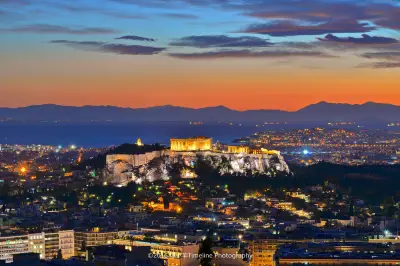
The Acropolis of Athens, one of the New Seven Wonders of the World, is located in the southwest of central Athens. It was first built in 580 BC, towering over 150 meters above the top of the Acropolis hill, and is the city's landmark and symbol of ancient Greece. The Acropolis of Athens is also called the Acropolis of Athens, meaning "high city" in Greek. The east, south, and north sides of the hill are sheer cliffs, forming a natural barrier that once served as a solid military fortress.
Enter the Acropolis from the main western entrance.
Not far away, we saw the Odeon of Herodes Atticus, built in 161 AD by the wealthy ancient Greek merchant and philosopher Herodes Atticus in memory of his deceased wife. It is the oldest theater in the world and one of the most outstanding buildings of its time. He donated this theater to the city of Athens.
With a three-story exterior, it has 32 rows of seats accommodating up to 6,000 spectators. The semicircular open-air theater has a diameter of 38 meters, and from any point inside, the performance on stage can be clearly heard. The stage backdrop is a Roman-style high wall with niches decorated with statues. In 267 AD, it suffered foreign invasions, experienced numerous ups and downs and disasters, and finally a great fire burned down its original cedar roof. During later restoration of the ancient site, the burned roof was not rebuilt. The marble seats now seen are all reconstructed.
The Odeon still hosts performances in summer in the 21st century. In November 2017, famous Chinese singer Liu Huan held a concert titled "Cheering for China – Athens Concert" here. Liu Huan sang "Believe in You" solo, sang "Crescent Moon" with Greek female singer Nana Mouskouri, and sang "Love Without Limits" with Nana Mouskouri, Huang Ying (China), and Mario Frangoulis (Greece), as well as the theme song of the Greek film "Beautiful Sunday."
Continuing along the winding stone path, a magnificent building complex called the Propylaia came into view. Built between 437 and 431 BC and designed by Mnesicles, it was made asymmetrical to adapt to the terrain, with a front height of 18 meters and a side height of 13 meters. The main building uses Doric columns, with the central span particularly wide at 3.85 meters, highlighting the gate. The roof was divided into two sections due to the sloping ground to ensure consistent facades. The interior uses Ionic columns with ornate decoration; the exterior is simple and solemn. The north wing is an exhibition room, and the south wing is an open colonnade. The smaller wings make the Propylaia more imposing.
During the Turkish occupation, the Propylaia was used as a powder magazine, and the Turkish governor also lived there. In 1640, the Propylaia was severely damaged by lightning.
Standing on the steps of the Propylaia, we looked out over the city of Athens, with dense residential buildings on the surrounding hillsides.
The gallery on the left side of the Propylaia houses many fine paintings.
Basking in the sunlight, we stepped onto the marble steps worn smooth of their edges and entered the Acropolis through the Propylaia, as if stepping into a period of history. The short gate passage was like a time tunnel through history.
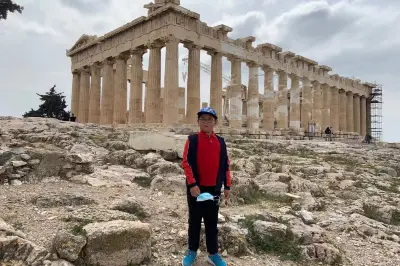
At the center of the Acropolis, on a limestone hill, stands a majestic rectangular building, the famous Parthenon Temple, the most important main building of the Acropolis of Athens. The name Parthenon comes from Athena's epithet Parthenon, a transliteration of the Greek word Παρθενών, meaning "virgin."
The Parthenon is the largest temple in Greek history, built entirely of Pentelic marble. The temple is 69.71 meters long and 30.86 meters wide, surrounded by 48 Doric marble columns with semi-circular flutes and conical capitals. Each column has a diameter of 1.9 meters and a height of over 10 meters. To create a perfect effect, the lines of the temple were subtly curved to create a visual illusion—the foundation slightly sagged, and the columns slightly bulged, so both appeared straight. This precise proportion, designed to achieve the best visual effect for visitors, made the Parthenon majestic yet harmonious, solemn yet lively. Such perfect design ensures the Parthenon's immortality in architectural history.
Legend has it that the temple housed a statue of Athena, the patron goddess of Athens, made entirely of gold and ivory. In later Greek civil wars, the statue of Athena was dismantled to fill the empty treasury and was never seen again.
Athena is one of the twelve Olympian gods in Greek mythology. She is the goddess of wisdom, as well as the protector of agriculture and horticulture. She taught humans weaving, painting, sculpture, pottery, animal husbandry, and other skills. She is also the goddess of law and order, having established the first court in Athens—the Areopagus. She is also a warrior goddess who raised and helped many heroes.
The magnificent Parthenon, even under constant renovation with scaffolding, does not diminish the powerful impact it gives.
The Erechtheion Temple is located north of the Parthenon, built between 421 and 405 BC. It is one of the famous buildings of the Acropolis of Athens, originally a stone shrine housing the relics of eight saints. Legend says it is the place where Athena and Poseidon competed to become the patron deity of Athens. It was the last important building completed in the reconstruction plan of the Acropolis initiated by Pericles, with exquisite design.
The Erechtheion has three shrines, dedicated to Zeus, the king of the Greek gods, Poseidon, the god of the sea, and Hephaestus, the god of blacksmiths, connected by two distinctive colonnades. The north colonnade has square holes in the ceiling and floor, said to have been pierced by Poseidon's trident.
The eastern section of the Erechtheion has a traditional six-column facade, while the southern part takes the form of a virtual hall. At the southern end, six marble Caryatids (maiden statues) replace columns to support the stone roof, fully demonstrating the architect's wisdom. They are dressed in long robes, light and ethereal, supporting a heavy load while standing gracefully. As the stone roof was very heavy, the necks of the six maidens had to be thick enough to bear it, but that would affect their beauty. So the architect left a thick lock of hair behind each maiden's neck and added a flower basket on top, successfully solving the aesthetic problem, making it world-famous. However, the Caryatids seen in the temple today are replicas; to avoid air pollution and preserve the relics, five of the original Caryatids are housed in the Acropolis Museum, while one original Caryatid is in the British Museum.
The Greek flag fluttering at the northeast corner of the Acropolis platform records the heroic acts of the Greeks against German forces: In 1941, after the Germans occupied Athens, they ordered the Greek soldier guarding the flag to take down the Greek flag and replace it with the Nazi flag. But the soldier wrapped the Greek flag around himself and jumped off the cliff. That same year, one night, two Greek youths secretly climbed up the Acropolis and tore down the Nazi flag.
From the Acropolis, one can overlook the ancient relics at the foot of the hill: the Temple of Olympian Zeus, the Olympic Stadium (the site of the first modern Olympic Games in 1896), and the Arch of Hadrian.
The Temple of Hephaestus is a well-preserved building.
The Temple of Athena Nike is located to the right of the Propylaia. Built between 449 and 421 BC, it uses Ionic columns. The base is 8.15 meters long and 5.38 meters wide, with beautifully decorated colonnades at the front and back. It is an artistic product jointly created by the Dorians and Ionians living in Athens. In the 1670s, this ancient temple stood intact on the promontory. In 1687, during the war between the Turks and the Venetians over the Acropolis of Athens, the building was demolished. In 1835, archaeologists carefully collected countless marble fragments and pieced together the temple completely. It is said to have originally been located to the right of the higher Propylaia, and in 2003 it was relocated as a whole to its current site and rebuilt.
The Acropolis of Athens, a vast and magnificent imperial city that took 70 years to complete, still reveals splendor amid the ruins, with the glory of the empire within reach.
Wandering among these ancient Greek buildings, there is always a sense of time travel that touches my nerves. The descendants of the British nobility who once removed treasures from the Acropolis also plundered China's Yuanmingyuan later, and our national treasures, along with the treasures of the Acropolis, now enrich the collections of the British Museum.
Standing before these solemn temples, feeling the breeze from the Mediterranean, I silently pray in my heart: May humanity live in peace, far from war...
May 23, 2019