Greece Trip Part 2: Attica Region by the Aegean Sea – A Glimpse of Athens, the Capital of Greece
Athens, the capital of Greece, is located in Europe, but it is not as bustling and lively as other European capitals.
As the center of the ancient Western civilization, it has not left behind many magnificent ruins.
The main attractions of Athens are concentrated in the city center. The Temple of Olympian Zeus is a ruined temple dedicated to Zeus, located 500 meters southeast of the Acropolis of Athens.
The entrance to the site is shaded by dense trees; walking forward, one sees foundation remnants and column bases.
Passing through these foundations, 13 marble columns stand solemnly before the eyes.
The Temple of Olympian Zeus was built from 174 BC to 132 AD during the reign of Emperor Hadrian, belonging to Ancient Roman architecture with Corinthian columns. It was the largest temple in Greece during the Hellenistic and Roman periods, with columns 17 meters high.
After being sacked by barbarians in the 3rd century AD, the temple was abandoned. Over the centuries following the fall of the Roman Empire, much of its stone was taken for use in other buildings. Today, only 15 marble columns remain standing solemnly, along with one that fell after a storm in 1852.
The once glorious temple now lies in ruins, silently recounting history and mythology...
Note: Due to the complexity of ancient Greek history, many people easily confuse the Temple of Zeus at Olympia with the Temple of Olympian Zeus in central Athens. Olympia is located in the western Peloponnese; it was the religious center of ancient Elis for worshipping Zeus and the site of the ancient Olympic Games. The Temple of Zeus at Olympia now only has scattered column fragments. The Temple of Olympian Zeus in central Athens is one of Athens' tourist attractions.
Hadrian's Arch stands across the road from the Temple of Olympian Zeus. It is a Roman triumphal arch built in 131 AD during the reign of Emperor Hadrian.
The arch was built between the old and new districts: to the east is the new city expanded by Emperor Hadrian, and to the west is the old city. The architrave bears two inscriptions, one on each side. The side facing the Acropolis reads: "This is Athens, the ancient city of Theseus." The side facing the new city reads: "This is the city of Hadrian, not of Theseus." Today, 2000 years later, the inscriptions are faded but still legible.
It is said that Hadrian's Arch was built to celebrate Emperor Hadrian's visit and his contributions to the city. Today, it still symbolizes the entrance to Athens.
Hadrian, born in Rome in 76 AD, was an emperor highly accomplished in poetry, mathematics, architecture, and painting. Known as the "Brave Emperor," he was one of the Five Good Emperors of the Roman Empire, reigning from 117 to 138 AD. In 112 AD, he served as the archon of Athens.
Syntagma Square is located 700 meters north of the Temple of Olympian Zeus. It is divided into two sides by a road: on one side is the Parliament Building and the Tomb of the Unknown Soldier, and on the other is the National Garden. The square was named "Constitution Square" to commemorate the first constitution promulgated here in 1834. It is the center of local activities, where various celebrations and political rallies are held.
The Hellenic Parliament Building is a pink neoclassical building located north of the Tomb of the Unknown Soldier. It was originally the palace of King Otto, the first king of Greece, designed by the Bavarian court architect Friedrich von Gärtner. Completed in 1942 (note: likely 1842? The text says 1942 but historical context suggests 1842; however, we translate as given: 1942), it has been used as the parliament building to this day. The building is not open to the public. Its front facade features classical Doric columns, with impressive thick colonnades, and a row of Victorian marble on the front is also striking.
The Tomb of the Unknown Soldier is located in front of the Hellenic Parliament Building, built in 1928 to commemorate the Greek unknown heroes who died in the war for independence from Turkish rule. The main body of the monument is a relief of an unknown soldier: a helmeted ancient Greek warrior lying on a stone slab. On either side of the relief are two famous quotes from a funeral oration by the 5th-century BC Greek statesman Pericles: "Here lies the foremost of the world's soldiers" and "This is the bed of the unknown soldier." Below the relief, 11 place names are engraved on the left and 12 on the right, all locations where Greek armies fought against foreign forces.
Two guards stand day and night on the left and right sides of the monument. During the day, they change positions every 15 minutes (rotation); every hour there is a formal changing of the guard (replacement of guards) with a small ceremony; every Sunday at 11 am, a large-scale changing of the guard ceremony is held with military band and honor guard performances, said to be spectacular.
We arrived at Syntagma Square around 1:45 pm, and two guards were rotating positions.
After the rotation, an instructor in camouflage with a navy blue beret came forward to adjust the uniforms of the two guards.
At this time, visitors can take photos with the guards on duty, but must not touch them.
These guards are called "Evzones," members of the Presidential Guard. The Presidential Guard is an elite ceremonial unit responsible for guarding the Tomb of the Unknown Soldier and the Presidential Mansion. The minimum height requirement is 1.86 meters, and they are very handsome.
The guards' uniforms are very distinctive: a small red cap with a long black tassel hanging from the right side, a khaki short jacket, an ultra-short Scottish-style pleated skirt, white tight pants, and red-brown ancient shoes with black pom-poms. Paired with an old-style ceremonial rifle, the outfit looks classical yet slightly comical.
At 2:00 pm, the changing of the guard (replacement) began. This is a must-see for every tourist visiting Athens.
Three guards walked from the middle of the square to the Tomb of the Unknown Soldier, while the two standing guards left their posts and walked toward the tomb. With 90-degree high leg lifts, wide arm swings, and especially slow-motion scraping of shoe soles and kicks, their steps looked utterly arrogant, making those of us used to standard marching unable to suppress laughter.
Syntagma Square is also an important leisure area for local residents, where people often stroll and rest. There are many pigeons in the square, which sometimes fly onto your head or shoulders. Tourists can buy pigeon feed to attract them and take happy photos with the pigeons.
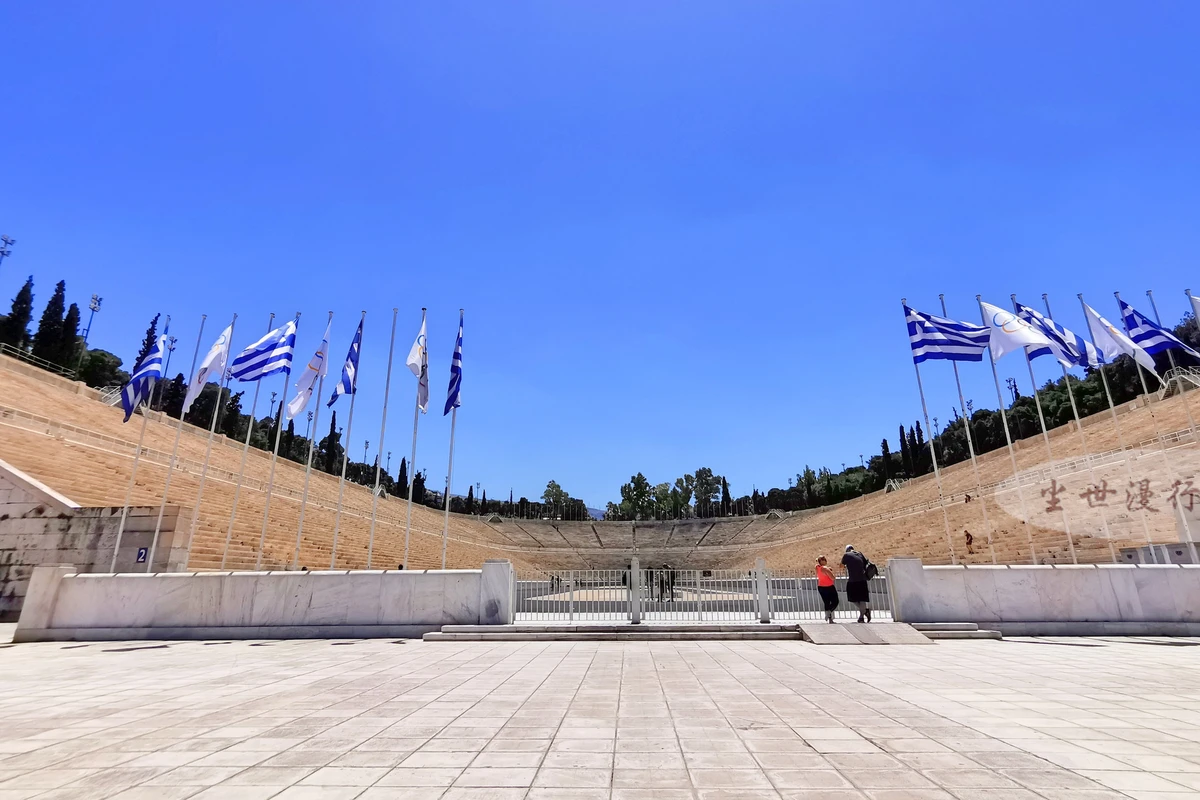
Many Chinese people still vividly remember the exciting scene twelve years ago: on March 30, 2008, at 8 pm, the Olympic flame for the Beijing Olympics was handed over at the Panathenaic Stadium. This sacred venue was the main stadium of the first modern Olympic Games in 1896.
The Panathenaic Stadium, also known as the Athens Stadium or the Marble Stadium, is a horseshoe-shaped venue with a rich historical heritage. In ancient Greek times, it was used mainly for the Panathenaic Games in honor of the goddess Athena, with very simple facilities. Rebuilt in 1895 with funding from Greek benefactors Evangelis Zappas and Georgios Averoff, it became one of the landmarks of Athens and Greece.
At the entrance stands a statue of Averoff.
Stadium gatekeeper or security guard.
Amazingly, this stadium, built around 330 BC, is still in use today. Though not very large by modern standards, it was equipped with expensive and elegant marble seats between 142 and 143 AD, for which a whole marble quarry was hollowed out. The great traveler Pausanias praised it in his "Description of Greece" as a "miracle of craftsmanship." Today, the Panathenaic Stadium is probably the only stadium in the world with seats like sculptural marble artworks.
Historically, the ancient Greeks were the first to use a curved shape in stadium construction. This design not only made the venue look smooth, continuous, and beautiful, but also extended the track without any sharp angles affecting the athletes. For spectators, the curve allowed good views from any seat in the venue. It is said that the builders of the Panathenaic Stadium were inspired by the ancient Greek semi-circular theaters. Indeed, modern stadiums today are all influenced by the Panathenaic Stadium; variations never stray far from its essence.
Ermou Street is a famous shopping pedestrian street in Athens, also known as Athens' "Women's Street," located in the bustling Monastiraki shopping area.
The street mainly sells high-end products such as fashion, shoes, and jewelry (mostly fast fashion brands).
Along the street, there are vendors with carts selling snacks, drinks, and fruits. A special item is fresh coconut with the flesh scooped out and cut into strips for sale.
Street performers and graffiti adorn Ermou Street.
In the center of the Ermou district stands a Byzantine-style church called Kapnikarea, converted from an ancient Greek temple dating back to the 11th century. It is one of the oldest Eastern Orthodox churches in Athens.
For a long time, Eastern Orthodoxy has been the common faith of the Greek people. In Athens, there are many similar beautifully designed small Orthodox churches, seemingly ordinary but upon closer inspection, they have hundreds of years of history. These ancient sites are well preserved, located in bustling areas yet undamaged. This is perhaps a manifestation of the power of religious belief.
Athens, over 3000 years, has seen glory, decline, and loss. Through the baptism of time, it still retains traces of history.
She is quiet, low-key, and gentle in pace. Having witnessed so many changes, even in the face of a severe economic crisis, she still holds a steadfast faith and never loses her love for life...
May 24, 2019
Travelogue Directory
1. Temple of Olympian Zeus
2. Hadrian's Arch
3. Syntagma Square
4. Panathenaic Stadium
5. Ermou Street
Travel Information
Hotel Index
Guide Index
Airfare Index
Website Navigation
Travel Index
Cruise Index
Corporate Travel Index
Partnership
Distribution Alliance
Friendship Links
Corporate Gift Card Purchasing
Insurance Agent
Agent Cooperation
Hotel Franchise
Destination and Attraction Cooperation
More Partnerships
About Trip.com
About Trip.com
Trip.com Highlights
Contact Us
Careers
User Agreement
Privacy Policy
Business License
Safety Center
Trip.com Content Center
Intellectual Property
Trip.com Group Algorithm Publicity