Athens, Greece - The Cradle of European Civilization (Ultimate Guide)
Athens, Greece is not large, and its attractions are centered around historical ruins, making it very suitable for a citywalk. If walking feels too tiring, you can also consider taking the subway. Parking in central Athens is difficult, so even if you drive, it's best to park in a parking lot. In Athens, parking lots require you to drive in and hand your keys to the attendant, who will park the car for you – presumably to maximize space in this expensive area.
Taking the Athens metro is very convenient. There are different types of travel cards: 90-minute, 25-hour, and 5-day. Regardless of which type you buy, the validity period starts from your first use. If unused, the ticket can be used later as long as it is kept in good condition. All travel cards are also valid for buses (except the airport express), trolleybuses, trams, and suburban railways.
The following map roughly covers all the attractions in Athens.
The Acropolis of Athens is one of the New Seven Wonders of the World and the most famous ancient architectural complex in Greece. Built in the 5th century BC, it has a history of 2,500 years. The overall project was directed by the sculptor Phidias, who also created the colossal statues of Zeus and Athena. Ancient Greece was a cultural pioneer and the cradle of European civilization, deeply influencing Europe's architectural and urban history for over 2,000 years. The Acropolis of Athens is the monument of this golden age. Since 1987, the Acropolis has been listed as a UNESCO World Heritage Site.
Unfortunately, the Acropolis was completely destroyed during the Greco-Persian Wars; what we visit now is the ruined site. The Acropolis is located on a small hilltop terrace south of central Athens, about 70–80 meters above the plain. We can follow the arrows in the map to visit in sequence.
After entering through the Acropolis ticket gate, the first thing you see is not the Propylaea, but the Theatre of Herod Atticus. Built in the 1st century AD, it is very well preserved and still in use today. The famous musician Yanni held a concert here in 1994. The theater was named after a wealthy Roman who reportedly spent most of his fortune on public buildings. In 160 AD, he funded its construction in memory of his beloved wife. Now, this theater is the main venue for the annual Athens Festival in summer. It is usually not open to the public. On the other side is the Theatre of Dionysus, dedicated to the god of wine.
Next, enter the Propylaea, the only entrance to the Acropolis, leading to the sacred precinct. The gate consists of three parts: the north wing, central building, and south wing from left to right. The central building of the Propylaea features six massive Doric and Ionic columns cleverly interwoven, creating an imposing appearance. Previously, the gate was flanked by palaces, but now only the columns of five gates remain. This area is the most crowded.
At this point, the Temple of Athena Nike is on the right. Built between 449 and 421 BC, it is one of the temples of the Acropolis, dedicated to Athena. It is the earliest Ionic temple on the Acropolis.
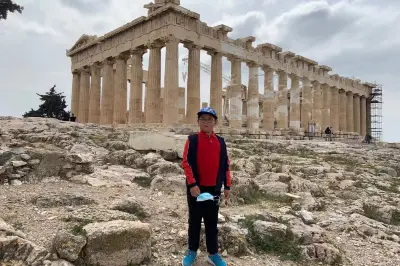
Passing through the Propylaea and climbing uphill, the terrain rises. On the right is the majestic Parthenon, a temple dedicated to the goddess Athena in ancient Greece. It has been under restoration since last century but never fully reconstructed. On the left is the elegant Erechtheion, a temple dedicated to both Poseidon, god of the sea, and Athena, goddess of wisdom. The Porch of the Maidens is its most iconic feature, with six maiden statues supporting the roof instead of columns. Because the statues' necks were too thin to bear the roof's weight, the designer added long hair and headdresses, achieving a perfect blend of aesthetics and mechanics. However, the current statues are replicas; five originals are housed in the Acropolis Museum, and one is in the British Museum. These two temples, one more monumental and the other more decorative, create a harmonious contrast.
Further ahead is a large Greek flag platform. Like Tiananmen Square in Beijing, Greek guards raise the flag at sunrise and lower it at sunset. From the platform, you can see Mount Lycabettus in the distance.
Tickets for the Acropolis come in regular and combo types. The Acropolis combo ticket costs €30 (visiting the Acropolis plus any two attractions on the pass makes it worthwhile) and is valid for 5 days. The regular ticket is €20, and in low season €10. Tickets can be purchased on-site or booked online in advance. Opening hours: 08:00-17:00; some attractions in low season (generally October to April) close as early as 3 PM, so plan accordingly. Around 5:30 PM is when the Acropolis lights are turned on.
Below the Acropolis is the old town of Athens. There are two ancient market ruins: the Ancient Agora and the Roman Agora. The Stoa of Attalos here is the only fully restored ancient site in Athens. The Temple of Hephaestus is also here. In front of its foundation was once the Temple of Apollo, a small Ionic temple built in the 4th century BC. The charm of the ancient agora lies in its integration into the heart of the old town, blending with residential houses and various shops. Today, the ancient agora feels more like a park in the bustling city. The Acropolis combo ticket is valid here. There are many restaurants where you can sit outdoors and overlook the Acropolis.
The Temple of Olympian Zeus is southeast of the Acropolis, built to honor Zeus and the largest temple in ancient Greece. The Acropolis combo ticket includes admission.
Plaka is the pedestrian district of old Athens, situated on a hillside. Due to its proximity to the Acropolis and ancient temples, it attracts many tourists, exuding charming rural vibes. Narrow cobblestone streets are lined with small shops selling jewelry, clothing, and local ceramics. Sidewalk cafes and family-run tavernas stay open late. The nearby Anafiotika neighborhood with its whitewashed houses brings a Greek island atmosphere to Plaka.
Syntagma Square is the heart of Athens, where major events in Greece are celebrated or mourned. The square was named after the first constitution promulgated here in 1834. Watching the changing of the guard at Syntagma Square is a highlight. Soldiers perform the ceremony every hour on the hour, 24 hours a day, lasting about 10 minutes.
The Zappeion, located in the National Garden of Athens, is now a convention center, completed in 1888. The adjacent National Garden is a park in central Athens.
The Acropolis Museum is southeast of the Acropolis, just a hundred meters from the Parthenon. Among the numerous ruins of the Acropolis, this modern glass building stands out. The museum houses all artifacts discovered on the Acropolis rock and surrounding slopes from the Aegean civilization, Roman period, and Byzantine rule. Five of the six maidens from the Erechtheion are exhibited here for conservation. Admission: €15 in high season, €10 in low season.
Also known as Panathenaic Stadium, it is the site of the first modern Olympic Games. Built at the end of the 17th century with funding from Zappas and Averoff of Athens, it was modeled after ancient Greek stadiums. It is the only large stadium in the world built entirely of marble, with a capacity of 70,000. Using such expensive material over 2,000 years ago is truly astonishing. To this day, before each modern Olympics, a delegation is sent to the Panathenaic Stadium to light the Olympic flame, symbolizing continuity and respect for the ancient Games. The best experience here is to run a lap on the stadium track and feel the Olympic spirit.
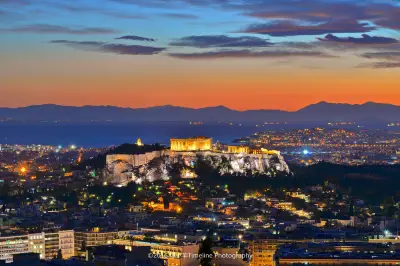
Mount Lycabettus, about 295 meters high, is the highest point in Athens, visible from almost anywhere. Its summit offers a panoramic view of the city and is an excellent spot to watch the sunset. On clear days, you can see the port of Piraeus and the Saronic Gulf. It is also a great place to view the Acropolis. On the hill are a theater, the white marble St. George Chapel, and upscale restaurants with views. You can walk to the summit or take a cable car (round trip about €7).
Athens has two hills offering panoramic views: the famous Lycabettus Hill and the less crowded Filopappos Hill. Filopappos Hill is opposite the southeast gate of the Acropolis. Compared to the bustling Lycabettus, it is quieter but closer to the Acropolis, offering a full view. It is recommended to look back at the Acropolis from the halfway point on Filopappos Hill rather than the summit, as the view is closest and clearest through the lush trees. If you go to the top, the distance becomes too far.
To the northwest of the towering Acropolis, across a small valley, lies the Areopagus. This narrow, bare limestone ridge is 113 meters (370 feet) high, while the Acropolis to the southeast is 43 meters (141 feet) higher. Approaching from the north, the path is flat; from the south, it is steep. At one time, the summit housed Greek altars, temples, statues, and the open-air Areopagus Supreme Court. Today, nothing remains except a few bench-like seats carved into the rock.
Once, the Apostle Paul came to Athens. The locals seized him and brought him to the Areopagus, saying, 'May we know what this new teaching is that you are presenting? You are bringing some strange ideas to our ears.' (Acts 17:19,20) Paul replied, carefully establishing one powerful fact after another with logical and persuasive arguments. Before he finished speaking, 'when they heard about the resurrection of the dead, some of them sneered.' However, Paul had already divided the audience into three groups: some scoffed, some said they would hear him again, and some 'became believers, including Dionysius, a member of the Areopagus, a woman named Damaris, and others.' (Acts 17:22-34) Today, a bronze plaque on the Areopagus commemorates these events, including Paul's speech. This is also the best spot to photograph the Acropolis, along with views of Mount Lycabettus and other landmarks of the old city.
Travel Directory: 1. Overview, 2. Acropolis of Athens, 3. Ancient Agora and Roman Agora, 4. Temple of Olympian Zeus, 5. Plaka, 6. Syntagma Square, 7. Zappeion and National Garden of Athens, 8. Acropolis Museum, 9. Panathenaic Stadium, 10. Mount Lycabettus, 11. Filopappos Hill, 12. Areopagus Hill. Travel Info, Hotel Index, Guide Index, Flight Index, Site Navigation, Travel Index, Cruise Index, Business Travel Index, Franchise Cooperation, Distribution Alliance, Friendly Links, Corporate Gift Card Procurement, Insurance Agency, Agency Cooperation, Hotel Franchise, Destination and Scenic Area Cooperation, More Cooperation, About Ctrip, About Ctrip, Ctrip Hot Topics, Contact Us, Careers, User Agreement, Privacy Policy, Business License, Security Center, Ctrip Content Center, Intellectual Property, Trip.com Group Algorithm Announcement