Athens: The Birthplace of European Civilization (First Chapter of a Six-Country European Road Trip, Exploring History and Culture, Part One)
In 580 BC, the Acropolis of Athens was first built. Its relatively well-preserved remains perfectly illustrate the prosperous and flourishing civilization, mythology, and religion of ancient Greece, embodying the concept of a world cultural heritage.
The Acropolis of Athens, originally meaning "city on a high cliff" in Greek, is built on a hill 150 meters high and covering 4 square kilometers.
On the east, south, and north sides are sheer cliffs; access to the city is only possible from the west side, through the gate, the Propylaea, and the front gate of the Acropolis.
On the north side of the Propylaea is the pedestal of a general's statue.
The Temple of Athena Nike is the earliest building on the Acropolis. In 2003, it was relocated from a high point on the Acropolis to the south side of the Propylaea.
The goddess of victory in the Acropolis of Athens, Nike, is wingless. In the Acropolis Museum, there is a statue of her adjusting her sandal (photography prohibited).
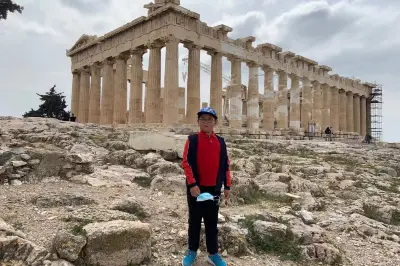
The Parthenon represents the highest level of Greek architectural art. It has 46 Doric columns, each 10.3 meters high with a base diameter of nearly 2 meters. The columns are equally wide and vertical, slightly thicker in the middle, and the outer columns gradually tilt inward, giving a masculine strength. The temple's name comes from an epithet of the goddess Athena.
The temple not only expresses reverence for the gods but also reflects the beginnings of Athenian democracy. The construction of the temple was decided by a direct vote of all citizens of the city-state, and the budget and expenses of the project were inscribed on stone, subject to the supervision of the citizens.
The relief being restored is "The Battle of the Centaurs and Lapiths."
The original is housed in the Acropolis Museum of Athens.
The last building completed on the Acropolis is the Erechtheion, built in 421 BC, a typical example of the Ionic order.
On the south porch, there are six caryatids, a variation of the Ionic order. Five of the originals are kept in the Acropolis Museum, and one is in the British Museum in London, awaiting return.
Chapter Two: Lower Athens, Chapter Three: Athens Past and Present