Madrid, Capital of Spain
Madrid is the capital and largest city of Spain, located in the center of the country, with the Manzanares River flowing through it. Historically, due to its strategic importance, it has been known as the 'Gateway to Europe'. Madrid was founded in the 9th century, developed on the site of the Moorish trading post 'Magerit'. In 1561, King Felipe II of Spain moved the capital from Toledo to here, and due to its special status, it rapidly developed.
First, a few photos of Madrid.
Arriving in Madrid in the evening, the hotel we checked into was also under the NH chain, same as the hotel in the ancient city of Zaragoza, but the impression was quite different. The hotel location was not bad, the hardware was okay, and breakfast was also plentiful. However, the staff seemed to treat guests unfairly; all three rooms were in the worst positions. Two rooms were at the corners of the building, and they were at opposite ends of the corridor, with windows opening to a narrow courtyard. The third room was even worse, hidden behind a security door in the corridor, so that we walked back and forth in the hallway and still couldn't find it. Such an arrangement was obviously deliberate.
NH Madrid Zurbano Hotel is located in the Chamberí district of Madrid, about 100 meters from Paseo de la Castellana, and not far from Metro Line 10. Without changing lines, you can reach the city center in 15 minutes.
After a day of running around, we didn't want to go looking for a restaurant, so we had dinner at the hotel's restaurant. It was Thai style, and they insisted we order a bottle of red wine, which added to our displeasure with this hotel.
At nearly 7 in the morning, I went out for a short walk. Madrid is indeed the capital; it was still dark, but cars on the street were already lined up.
The street in front is Paseo de la Castellana Boulevard, which, as the name suggests, is an important street in Madrid, with many government institutions located on it. In the 11th century, King Alfonso VI of Castile captured Madrid, and from then on, Madrid became an important stronghold of the Kingdom of Castile.
Plaza de Doctor Marañón has a statue of a figure on horseback with a sword in the center.
Google Maps labels the statue as 'Estatua del Marques'. The guide said this statue is the only remaining statue of the Spanish dictator Francisco Franco in Madrid, which seems to be incorrect. I checked a translation app, which gave: 'Statue of the Marquis of Del Duero' or 'Statue of the Duero'. Searching online, Franco statues in Madrid were all removed years ago.
Around the square, there are green spaces, modern sculptures, and a metro station. The Madrid metro sign looks like this: iron railings, simple and striking.
Morning stroll, aimless, just looking around, I went down into the metro station. Quite a few people were taking the metro to work early, and there was a queue at a small kiosk.
This red brick building along the street is very beautiful, with a flag flying, seems to be a government office.
The large dome building amidst the green trees is a museum.
A few steps further, a palm-shaped sculpture stands on the street.
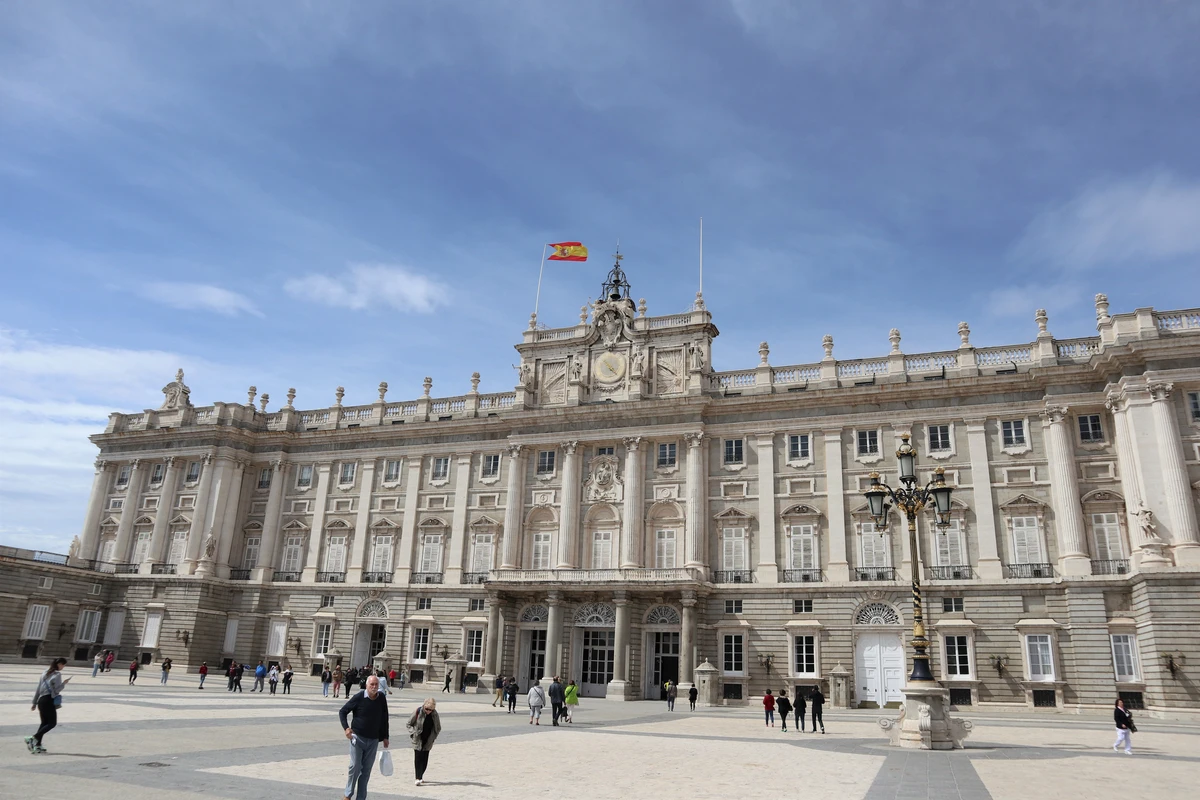
We stayed two nights in Madrid, but only had one day for sightseeing. The first stop was the Royal Palace of Madrid.
Many tourists had gathered around the palace, and there was a police car parked. The guide said there might be an event today.
Between the Royal Palace and the Almudena Cathedral is the Plaza de la Armería. The west side of the palace is very open, slightly lower, and on the map it's a large green area called the Campo del Moro (Moorish Garden).
Sure enough, arriving at the main visitor entrance of the palace confirmed the guide's guess: there was an important event in the morning, so it was temporarily closed. Disappointed but helpless, we had to go elsewhere first and come back in the afternoon.
We had lunch at a Chinese restaurant called 'Tang Chu Da Jiu Lou'. After lunch, we split into two groups: some went shopping, while I, unchanged in my plan, went to the Royal Palace again.
This is the Sabatini Gardens, located north of the Royal Palace. Originally part of the palace, they were opened to the public by King Juan Carlos I in 1978. This land was once the royal stables of the Spanish monarchy. In the 1930s, clearance began, and it wasn't until the late 1970s that the garden renovation was completed.
The garden has a neoclassical architectural style, with neatly trimmed shrubs, sculptures, fountains, and a pool, all reflecting symmetry. In summer evenings, there are often various small outdoor performances, including classical and jazz concerts or stage plays.
The garden is a great place for relaxation, with many children playing and frolicking.
The Royal Palace of Madrid is the official residence of the Spanish King, but the king and the royal family do not live here; they live at the Zarzuela Palace. Usually, the palace is used for state functions, and it is open to the public when there are no official events. The original site was a Habsburg dynasty castle, which was destroyed by a fire. In 1738, King Felipe V ordered its reconstruction, which was completed in 1764.
Visitors queued up to tour the palace, moving slowly, waiting about half an hour. But the wind was strong, and in the open area, it was uncomfortable.
After purchasing tickets and entering, there is a hall where you can rent audio guides, including in Chinese.
The Royal Palace of Madrid is the most exquisite building in the capital. Designed in the most popular 18th-century architectural style, it referenced the blueprints of the Louvre in Paris, with magnificent squares and a majestic main building complex. The exterior has typical French style, while the interior decoration is genuinely Italian. Overall, it is square, with prominent corners, and the interior forms a square courtyard with galleries, which is a traditional Spanish architectural style.
The Royal Palace is extremely luxurious. King Felipe V at the time wanted it to be the most luxurious palace in Europe. The palace houses countless gold and silver utensils, paintings, porcelain, tapestries, and other royal items. Every room is like an art exhibition hall, a must-see attraction when visiting Madrid.
The Royal Palace has 3,418 rooms, each with its own characteristics. It preserves a large number of exquisite oil paintings, collections, weapons, porcelain, clocks, gold and silver items. Among the most important collections are five violins made by Antonio Stradivari, one of the greatest string instrument makers in history, displayed in the music hall of the Royal Library. Also collected are paintings by famous Spanish painters such as Velázquez and Goya.
The main buildings include: the entrance of the main staircase, the famous Hall of the Throne, the rooms of Charles III, the Banquet Hall, and many others. The Hall of the Throne was built during the reign of Carlos II. Most of its decorations were made by the royal workshops, but there are also imported luxury items, such as Neapolitan velvet embroidery, Venetian crystal chandeliers, Roman bronze lion statues, etc. The frescoes on the dome are also very beautiful.
Some parts of the palace allow photography, others prohibit it.
Ascending the stairs, it is magnificent and imposing, truly befitting a royal residence.
The two lion statues at the corner of the grand staircase have different expressions, lifelike.
A quick tour of the Royal Palace, which is said to surpass Buckingham Palace, took over an hour. I felt it was not enough, but it was a worthwhile visit.
The Almudena Cathedral is adjacent to the Royal Palace, facing it across the Plaza de la Armería. Although not very ancient, in recent years the cathedral has become a landmark of Madrid. In 2004, the wedding of the Spanish Prince held here brought it great fame.
Construction of the Almudena Cathedral began in 1883, but was intermittent. It was even forced to stop during the Spanish Civil War, and only resumed in 1950, finally completed in 1993.
The cathedral is in a neo-Gothic style, with some Gothic features retained on the sides, but the main body is Baroque, with a semicircular blue-gray dome design, exuding elegance and becoming one of the most beautiful buildings in Madrid.
East of the palace is the Plaza de Oriente (Oriental Square). Because the Royal Palace is also called the Palace of the Orient, the square got its name. The square was built on the orders of King José I Bonaparte, Napoleon's brother. This unpopular king was always worried that the royal family would be harassed by commoners, so he decided to build a square in front of the palace.
The garden has a fountain and an equestrian statue of King Felipe IV. This statue was designed by the famous Spanish painter Velázquez and completed by the Italian Pedro Tacca in 1640, 12 meters high, lifelike.
On one side of the square is the Royal Theatre, which began construction in 1818. The buildings around the square are well-proportioned and complement each other, forming the most beautiful architectural complex in Madrid.
The Royal Theatre faces the Royal Palace across the street. What we see now is the result of over a century and a half of renovations and restorations. Although the exterior is ordinary, the interior decoration is grand and exquisite, with every hall extremely luxurious. It is the most luxurious opera house in Spain and holds an important position in the European opera scene.
Leaving the Plaza de Oriente, we walked to the Plaza de España to meet up with our shopping companions. The tall building in the distance is the Torre de Madrid on Plaza de España.
Plaza de España is at the westernmost end of Gran Vía, not far from the Royal Palace. It is one of Madrid's most popular landmark attractions, famous for the Cervantes Monument.
Across the street, behind the trees, is the Plaza de España, which is under renovation with barriers. Behind the square are two prominent high-rise buildings: on the left is Torre de Madrid, completed in 1957, 142 meters high, then the tallest building in Europe until 1967 when it was surpassed by the South Tower (150 m) in Brussels, Belgium. On the right is the Edificio España, directly behind the Cervantes Monument, completed in 1948. Before Torre de Madrid was built, it was also the tallest building in Europe and has always been a landmark of Madrid's commercial center.
The center of Plaza de España is the monument to Miguel de Cervantes Saavedra, including the stone sculpture of Cervantes above, and the bronze statues of Don Quixote and Sancho Panza in front.
To truly understand a city, walking is the best way, especially since parking in Madrid is difficult.
We followed the guide through streets and alleys, strolling through Madrid.
The other side of the Royal Theatre. Since its opening in 1850, this building has undergone many renovations, changed uses in different periods, and even suffered temporary closures. It has had a tumultuous history. Now, after renovations in 1997, it covers 65,000 square meters, seats 1,746 spectators, and has one of the most advanced and innovative stages in European theatres.
We entered a shop run by Chinese, selling products very characteristic of the region. The undisputed stars were Iberian ham and sherry. Sherry and raw ham are two totems of Spanish cuisine. If you travel to Spain and haven't tasted these, you haven't really been to Spain.
Spanish ham has a long history, world-renowned, known as the 'Rolls-Royce of pork'. Sliced paper-thin, with marble-like texture, rich fat and tender meat, strong acorn flavor, with a lingering nutty aftertaste...
In the late 16th century, sherry was praised as the best wine in the world in Europe. Columbus carried a large amount of sherry when he sailed around the world. Sherry is known as Spain's 'national wine', just like Moutai in China.
The bronze plaques on the ground are marks of old established shops.
Madrid's famous food market, a steel and glass structure, one of the most fashionable places in Madrid. Inside, there are various stalls and bars selling vegetables, fruits, seafood, and meat, including traditional salted cod, fresh pasta, fruit juices, desserts, and most notably, a variety of Spanish tapas.
A dazzling array of tapas, all kinds, making your eyes blur. But the guide told us in advance that this is a place for tourists; tapas are pre-made and stored in coolers. Hearing this, most of us didn't try them, but we strolled through the market, looking around, enjoying a memorable visual feast.
Wandering in the market felt like admiring an unprecedented, wonderful art exhibition. The colorful, ever-changing tapas were all unique, each showing off its charm, making you stare, drool, marvel, and praise endlessly. I was completely impressed by the imagination and creativity of the Spanish. Tapas are definitely a unique, wonderful, and bright landscape of Madrid and Spain.
Tapas originally meant small plates, but now they have become a famous Spanish dish. All restaurants, big or small, have tapas. Many Spaniards choose to go to taverns for dinner, drinking and chatting with friends, and ordering a few tapas.
Plaza Mayor is the central square of Madrid. King Felipe II began discussing plans to build the square in 1589, but construction only started in 1617 under Felipe III and was completed in 1619. However, the square seen today is not the original; it was rebuilt after a fire.
Many cities in Spain have a square called Plaza Mayor. This one in Madrid is 129 meters long and 94 meters wide. It was built as a city living room for citizens, used for bullfights, ball games, and even for executing heretics. The surrounding arcades are lined with open-air cafes and souvenir shops, perfect for strolling and relaxing.
The square is rectangular and enclosed, surrounded by a row of arcade buildings. The ground floor has shops, and the upper three floors are residences. There are 237 balconies facing the square.
The main building is the Casa de la Panadería (Bakery House), which serves municipal and cultural functions, with murals on its exterior. Inside, there is a tourist information office where you can get maps and buy souvenirs.
The statue in the center of the square is of Felipe III, who ordered the square's construction.
The Casa de la Panadería, an interesting name, origin unknown.
The square has nine arch entrances, each unique, ideal for painting and photography. Some entrances require going up steps.
This is the famous Puerta del Sol (Sun Gate) square. Puerta del Sol was the eastern gate of Madrid in the 15th century, named because the gate faces the direction of the sunrise. The streets around Puerta del Sol are also lively, bustling with people: local residents relaxing, street performers, and more tourists checking in.
Puerta del Sol is one of Madrid's famous landmarks. Around the square, there are many famous buildings and sculptures, as well as places for food, leisure, and shopping.
The earliest building on the square is the 18th-century Old Post Office, now the seat of the Madrid regional government. During the Franco era, it was the General Security Headquarters and a prison for serious offenders opposing the dictator Franco.
The Old Post Office was designed by a French architect and built from 1766 to 1768. The clock tower was added in 1867. Every New Year's Eve, Madrileños gather here, and as the clock strikes midnight, they eat 12 grapes for good luck to welcome the New Year.
On the roadside in front of the Old Post Office, there is a semi-circular pattern containing a map of the Iberian Peninsula, with 'Kilometer Zero' marked in the center. All road milestones in Spain are measured from here.
Statue of Carlos III, King of Spain during the Bourbon dynasty, born in Madrid. During his reign, he vigorously built public facilities in Madrid, earning him the title 'the greatest mayor of Madrid'.
On the opposite rooftop is a large advertisement for Tío Pepe sherry. Tío Pepe is a world-famous sherry. Shakespeare praised sherry as 'bottled sunlight from Spain'. The cartoon character on the billboard is affectionately called 'Uncle Pepe' by locals.
To the east of Puerta del Sol stands the 'Statue of the Bear and the Strawberry Tree' (Bear and the Madroño). This statue is the symbol of Madrid and the city's coat of arms.
Regarding the name Madrid, there is an old and interesting story: Legend says that long ago, a naughty little boy went out to play with his mother. He wandered away from her, when suddenly a brown bear appeared. The boy ran, with the bear chasing after him. In a panic, he climbed a big tree. Catching his breath, he heard his mother calling for him. To prevent the bear from harming his mother, he shouted from the tree, 'Madre, corre!' (Mother, run!). The bear was scared away. From then on, the city was left with this beautiful legend. The word 'Madrid' is said to mean 'Mother, run!' in Spanish.
Although we only had one day in Madrid, it was packed with activities. We also booked an evening flamenco show at the famous Las Ventas Bullring. To save time, we asked the guide to find a Chinese restaurant for some noodles or fried rice. But fast food wasn't fast; despite few customers, we waited a long time.
After a hasty dinner, we rushed to the Las Ventas Bullring for the performance. On the way, we passed the famous Santiago Bernabéu Stadium, a sacred place for football fans. I snapped a few photos from the car.
Santiago Bernabéu Stadium, named after the iconic figure of Real Madrid Club who led its construction, started in 1944 and completed in 1947, can host 80,000 spectators.
This stadium is the home of Real Madrid football team and one of the world's most famous football stadiums. In 2005, it was rated a five-star stadium by UEFA and has been the venue for the UEFA Champions League final.
Today, Spain has about 300 bullrings, but Las Ventas is the largest, accommodating over 20,000 people. The architectural style is Neo-Mudéjar, imposing and grand. Ticket prices for bullfights depend on distance from the 'stage' and whether the seat is in the sun or shade (the latter more expensive).
Bullfighting and flamenco are the two quintessences of Spain. A trip to Spain is complete only if you experience both. Comparatively, watching flamenco is easier; some bars have regular performances, and you might sometimes see amateur dancers on the streets. Watching bullfighting is more difficult; some places have banned it, and in places where it is allowed, you need to be there at the right time. The bullfighting season starts in March with the Fallas festival and ends in October with the Pilar Festival in Zaragoza.
Bullfighting originated from ancient religious activities in Spain, gradually became popular nationwide, gained worldwide fame, and became the most representative national sport, a national essence. It reflects the rough and uninhibited national character of the Spanish.
The flamenco performance venue is on the ground floor of the bullring. The performance hall has a sloped ceiling, with the bullring stands above. A stage is set up on one side, with several round tables below where you can eat while watching the show. The ticket price is 80 euros. There is also a no-food option for 55 euros.
The show was scheduled to start at 8:30 PM. We were a bit delayed due to dinner, so we rushed and arrived a few minutes late. But once inside, we waited a long time again. A tour group dining there was late; only when they arrived and had their food and drinks served did the show begin.
Flamenco is a special art form integrating song, dance, and music, originating from the common people. It is rhythmic, passionate, and uninhibited. The performance includes singing and guitar accompaniment. Initially, the male and female dancers move slowly, then the pace quickens, with clapping producing sharp sounds, and they perform various graceful movements with head and hands.
It was my first time watching authentic flamenco abroad. The passionate, vigorous dance, the thunderous stomping, the impassioned singing and accompaniment deeply moved the audience. Although the ticket was a bit expensive, it was worth it, especially watching it at Spain's most famous bullring, a rare opportunity that gave us extra satisfaction.
The unique experience of watching flamenco at Madrid's most famous bullring was surprising and wonderful, a perfect combination. It was also the most perfect and profound memory left to us by Madrid, the capital of Spain.
Bullfighting is spectacular, thrilling, and intense, but also dangerous. Many famous bullfighters have died in the ring throughout Spanish history. However, the danger is part of the charm. The bullfighter uses a colorful cape to tease the bull, making the enraged bull turn completely under his will until it is exhausted, then the bullfighter ends the bull's life according to procedure. These outstanding bullfighters are regarded as heroes, not only for their superb skills but also as representatives of a national spirit.
There is a saying in Spain that only a bullfighter who triumphs at Las Ventas is a true bullfighter. Therefore, this bullring is a necessary path to success and a symbol of honor for bullfighters.
In Spain, bullfighters are seen as brave and fearless men, admired and worshipped by the people, and are the pride of Spain. The status of Spanish bullfighters is higher than that of ordinary celebrities and artists. This unique group possesses elegant and brave souls, perfectly combining technique and physical strength, grace and courage.
Tour notes directory: 1) Madrid NH hotel 2) Royal Palace of Madrid 3) Street scenes 4) San Miguel Market 5) Plaza Mayor 6) Puerta del Sol 7) Flamenco at Bullring
Travel information: Hotel index, Strategy index, Ticket index, Website navigation, Travel index, Cruise index, Corporate travel index, Franchise cooperation, Distribution alliance, Friendly links, Corporate gift card purchase, Insurance agency, Agency cooperation, Hotel franchise, Destination and scenic spot cooperation, More franchise cooperation, About Ctrip, Ctrip hotspots, Contact us, Careers, User agreement, Privacy policy, Business license, Security center, Ctrip content center, Intellectual property, Trip.com Group algorithm disclosure.