Southern Europe Travelogue
Main countries visited: Spain, Lisbon in Portugal, and Paris in France. We also passed through Belgium and northern France for business.
Transportation: We booked a private tour for three through a travel agency recommended by a friend. The agency is European, specializing in high-end curated tours. The overall experience was good, but the price was high. The tour cost over 120,000 RMB for three people, excluding round-trip airfare from China to Europe and meal expenses. Car rental was 6,550 euros, plus an additional 1,150 euros for the driver's meals and accommodation. The experience was decent, but I felt we could have done it independently. Many city-center attractions are close to each other, but you need to know English.
1. Documents: Visa and flight tickets (applied one month in advance), passport, hotel bookings, flight confirmations, etc. (We arranged through the travel agency because we had trouble getting the visa on our own, and the agency handled it quickly.)
2. Clothing: Check the weather in advance. We went on September 27th this year. Spain was very hot, around 27°C, requiring summer clothes, though mornings and evenings were cooler. France was relatively cooler but still summer attire.
3. Photography equipment: If you bring a drone, you need an EU driver's license and other procedures to look up. I didn't have the license this time, nor good photography skills, so I left it behind—a bit regrettable.
4. Mobile apps: Download Google Play Store in advance (some attraction guides are electronic and require apps from Google Play), Google Maps (Baidu Maps also works for Europe), translation apps. For independent travel, download hotel booking apps.
5. European standard power adapter: European sockets are different from those in China.
6. European SIM card for internet access.
7. Toiletries: Many European hotels, for environmental reasons, do not provide disposable items.
8. If you need hot water, bring a thermos. If you can't get used to Western food, bring a pot to cook your own meals.
We were on a tour, and the accommodation provided was at least three-star, overall clean and nice, averaging around 200 euros per night. Hotels included breakfast. Note that due to environmental concerns, many European hotels do not provide disposable items like toothbrushes, toothpaste, or slippers, but they do have shower gel and shampoo.
Hotel breakfasts were typically Western-style. On this trip to Europe, I fell in love with butter.
These machines are very convenient, offering various coffees, milk, water, etc.
European food is mostly Western, but there are slight differences between countries. Spanish portions are enormous (for a southerner like me, northern Chinese might adapt). A steak in Spain is twice the size of one in China (referring to southern Chinese restaurants), and very thick. Spain and Portugal are the cheapest among developed European countries; a meal costs about 10-20 euros per person. French portions are smaller and more expensive, around 20-30 euros per person.
There are also Chinese restaurants in Europe, generally more expensive than Western restaurants of the same grade. However, high-end Western restaurants are the most expensive. Fast food like McDonald's and Pizza Hut is cheap, costing 4-10 euros per meal, slightly more at airports (e.g., Barcelona airport, a meal set is over 10 euros). Buying bread from a supermarket is even cheaper—a few cents or 1 euro in Madrid city center.
Costs: Due to exchange rates, travel in Europe is expensive. The three-person tour cost over 120,000 RMB. Since we booked flights late, round-trip airfare was 50,000 RMB. Miscellaneous expenses like meals totaled 12,000 RMB.
Spain covers an area of over 500,000 square kilometers, with a population of 48.2 million (over 50 million tourists visit Spain each year). Spain is located on the Iberian Peninsula in southwestern Europe, part of Southern Europe, bordering Portugal to the west and France to the north. It is surrounded by sea on three sides. The terrain is mainly plateaus. The climate is predominantly temperate continental and temperate oceanic. We went on September 27th this year; Spain was very hot, around 27°C.
The official language of Spain is Spanish. Spaniards are passionate and outgoing, love bullfighting, are enthusiastic about flamenco dance, and are known for the guitar.
Spain is rich in products, especially olives. Along the way, we saw endless olive trees.
Being surrounded by sea on three sides, it is also rich in seafood. Signature dishes include ham, paella, tapas, and sherry.
In prehistoric times, archaeological speculation suggests that Africans may have crossed the Strait of Gibraltar while hunting and arrived in Spain. Later, there were successive invasions, mainly by Romans and Moors (Muslims, primarily Berbers, Arabs, and Jews) who ruled for long periods. At the height of Moorish rule, the Caliphate of Córdoba split into several kingdoms. Christian Romans fought back and recaptured Toledo. The two kingdoms' monarchs, Isabella I and Ferdinand II, married and formally united into the Kingdom of Spain.
In 1492, Isabella I financed Columbus's voyage, leading to the discovery of the New World. Spain then began its conquest and colonization of Latin America, becoming a maritime power in the 15th and early 16th centuries. In the late 16th and 17th centuries, Spain gradually declined due to repeated defeats by England and France. In 1700, María of Spain married Louis XIV's grandson Philip V, who became king of Spain, transferring power to the French Bourbon family. Philip V fought wars with France and Austria over the throne, resulting in significant territorial losses. Later, Napoleon invaded Spain, causing Spain to lose most of its overseas colonies. After the Spanish-American War, Spain lost all its overseas colonies.
In 1837, Isabella II passed a constitutional monarchy act, formally uniting the country and naming it "España" (meaning "rabbit"), ending over 300 years of a personal union. Although the monarchy has been restored multiple times, Spain remains a constitutional monarchy today.
Spain is also a country rich in culture and art. Literary giant Miguel de Cervantes, author of the world-famous "Don Quixote," architect Antoni Gaudí, painters Picasso, Dalí, Goya, and sports star Rafael Nadal all hail from here.
Nowadays, Spaniards are quite laid-back—the laziest in Europe. Their schedule is very relaxed: work starts at 10 AM, lunch break from 2 to 5 PM, and work ends at 8 PM. According to the guide, ordinary Spaniards earn around 1,000 euros per month, civil servants about 4,000, and blue-collar workers like bus or truck drivers can earn over 6,000. However, Spain and Portugal have the lowest prices among developed European countries. Supermarket items are mostly within a few euros—cola for a few cents or 1 euro, bread for a few cents, vegetables 1-3 euros per kilo, snacks and toiletries from a few cents to 2-3 euros. House prices in Madrid are said to start at around 100,000 euros. With such low prices, even earning 1,000 euros is enough, so they live comfortably and are not driven to work hard.
Due to history, 96% of Spaniards are Catholic. Catholicism is one of the three major branches of Christianity (Catholic, Eastern Orthodox, and Protestant). The divisions arose when the Roman Empire split into Eastern and Western Empires, leading to the Eastern Orthodox Church in the east and the Catholic Church in the west. The Eastern Orthodox leader is the patriarch, but the pope rejected this, leading to a complete split. Later, the Protestant Reformation began, resulting in further divisions, characterized by the removal of certain Bible chapters; these became Protestantism.
Most Christians in China today are Protestant. Protestantism is mainly in Northern Europe, Eastern Orthodoxy in Eastern Europe, and Catholicism, with the largest number, in Southern and Western Europe.
Recommended documentaries about Spain: BBC's "The Art of Spain" and "Don Quixote."
Brussels is the seat of the EU and NATO headquarters, and its airport is very busy.
In the suburbs, I loved the houses along the road—many small villas, each unique and beautiful, with lovely countryside scenery.
We dined at a hotel in Belgium. The pasta was delicious, the burger was huge and a bit salty. Food here tends to be salty (I prefer light flavors).
The only Chinese phrase at Madrid airport.
Lunch in Madrid was Western cuisine. The fish was very fatty; it felt like pure oil with each bite.
We started our tour at noon the next day. First stop: Royal Palace of Madrid.
Royal Palace of Madrid (Best tour time: 1 day with guide)
The Royal Palace of Madrid is the third largest palace in Europe, after Versailles and the Schönbrunn Palace in Vienna.
In the 9th century, it was a fortress of Arab rulers, later recaptured by Christians and used as a residence for successive kings. However, a fire in 1734 destroyed the castle. The palace we see today was rebuilt by Philip V, the first Bourbon king, and completed in 1764. His son Charles III was the first to live there. The first statue in the palace grounds is of Charles III.
The entire palace blends traditional Spanish royal architectural style with Baroque. The interior is mainly Italian style. As soon as you enter, the splendid and breathtaking palace amazes you. Unfortunately, photography is not allowed inside other areas.
There are many rooms, similar in function and decoration to Versailles. I was especially impressed by the banquet hall, said to be used for receiving foreign leaders. It is entirely decorated with gold, making the room shine with opulence. The guide said the irregularly shaped floor tiles were hand-polished and fitted, a process complex even by modern standards. One room had a ceiling with a Chinese story mural.
The four corners of this photo feature four goddesses representing earth, water, wind, and fire.
Almost every room has intricate and detailed decorations on the floor, walls, and even ceilings. Ceilings often feature murals and plaster moldings, walls are mainly plaster and wainscoting, with gold applied to the surface. The bathrooms also have porcelain items learned from China, creating European-style ornaments using Chinese techniques.
The Royal Palace of Madrid is no longer a royal residence, but it is still used for hosting VIPs. When the king is present, a flag is raised on the roof.
Plaza de España is located in the center of Madrid, where many tourists and locals come to relax. The most famous feature is the statue of Cervantes and his characters Don Quixote and Sancho Panza. It was only in Spain that I learned Don Quixote's name is not actually "Don Quijote"—the Spanish "Don" is a title of respect, and "Quijote" is his name, so the correct translation is "Lord Quixote."
The square has performances and small shops selling food.
The building at Plaza de España was reportedly bought by Wang Jianlin to build a Wanda project, but faced strong opposition from Madrid residents who held protests, forcing him to sell at a low price. This is because many European cities develop outward from the city center to the suburbs, generally not destroying old towns, where people have deep emotional attachments.
This is the busiest street in downtown Madrid.
Near Plaza de España is an ancient Egyptian temple in a park. Many people sit on the grass chatting and playing leisurely.
In the evening, we had dinner at a Chinese restaurant nearby, costing 110 euros for four people—much more expensive than Western food.
Museo del Prado (Best tour time: 1-2 days with guide)
The Prado Museum is the artistic heart of Spain. The museum is enormous, and the artworks are incredibly stunning. The masterpiece "Las Meninas" by Velázquez is a highlight. He pioneered a technique simulating the human eye's perspective, creating a realistic view (sharp in the center, blurred at the edges). The painter originally painted the king, but from the king's perspective, he painted the princess, while the king and queen appear in a mirror—very clever.
Another impressive work is Hieronymus Bosch's "The Garden of Earthly Delights," illustrating humanity's greed leading to its downfall. Goya's "The Naked Maja" boldly challenged asceticism. The woman was the wife of a wealthy merchant who commissioned Goya to paint her portrait. Struck by her beauty, Goya painted her from memory after returning home. When the merchant found out, Goya quickly painted "The Clothed Maja" to avoid blame. Comparatively, "The Naked Maja" is more captivating.
In early times, especially the Middle Ages, art served religion, so many paintings are religious. We also learned some Christian stories. Common themes include the birth of Christ, such as "The Annunciation"—the angel telling Mary that God placed his son in her womb. There is the Trinity: the Father (God Yahweh), the Son (Jesus), and the Holy Spirit (dove), and the Crucifixion. Art was used to convey religious ideas. Photography is not allowed in the museum, so no photos.
The museum is huge, and we had limited time—only a 2-hour guided tour covering key works. We also noticed many European museums have kindergarten children brought by teachers for learning. It's said children are exposed to art from a young age, no wonder Europe is a cradle of art.
There were street performers at the museum entrance; there are many such artists in Europe.
Parque del Retiro (Best tour time: half a day)
Retiro Park was built by Philip IV, originally a royal leisure area, now a public park. It is very beautiful and large, with a Crystal Palace, an artificial lake, and more. You can spend half a day relaxing here.
Plaza Mayor + Mercado de San Miguel (Best tour time: 3 hours including meals)
In the afternoon, we visited Plaza Mayor, full of shops and restaurants. We had lunch there. The steak was medium-well and very tasty; the paella was a bit salty. We tried local drinks and cola.
European cola usually comes with ice and lemon—very refreshing. The meal cost 56 euros.
Near Plaza Mayor is Mercado de San Miguel.
We tasted tapas—bread topped with various ingredients, many flavors.
Puerta del Sol (Best tour time: 1 hour)
Puerta del Sol is semi-circular; from above, streets radiate outward like the sun, hence the name. There is a clock tower where people gather on New Year's Eve to hear the 12 chimes, eating 12 grapes for good luck in the coming year.
There is a statue of Charles III.
The square also has a zero-kilometer marker, from which all Spanish highway milestones are measured, and Madrid's street numbers start from here.
The statue of the Bear and the Strawberry Tree is the symbol of Madrid.
Toledo (Best tour time: 1 day)
Toledo has over 2,000 years of history. It was a Roman city, capital of the Visigothic Kingdom, a stronghold of the Caliphate of Córdoba, a frontline in the Christian-Moorish wars, and the temporary seat of supreme power under Charles V in the 16th century. Toledo nurtured three cultures and three major religions—Judaism, Christianity, and Islam—coexisting. In 1986, it was declared a UNESCO World Heritage Site.
From a distance, Toledo is surrounded by a river—the ancients knew how to choose a location. Inside the city are ancient streets and buildings, mostly made of brick and stone, with stone roads. No wonder they have lasted over a millennium. In contrast, Chinese architecture is mainly wooden, often burned down during dynastic changes—a pity.
This is also where Don Quixote set out. Many shops sell related souvenirs.
Here is the masterpiece of Gothic art: Toledo Cathedral. We happened upon a performance.
Consuegra Windmills (Best tour time: 0.5 hour)
This is a lesser-known spot added by the guide. It's where Don Quixote famously fought the windmills.
The windmills were once mills, using wind power to grind wheat.
We had lunch at the foot of the hill.
The steak was enormous—twice the size of a Chinese portion and very thick.
In the evening, we arrived in Córdoba and checked into a nice hotel.
Mosque-Cathedral of Córdoba (Best tour time: 1 day with guide + town)
The Mosque-Cathedral of Córdoba is a UNESCO World Heritage Site and the second-largest mosque in Spain. It was built under Moorish ruler Abd al-Rahman I, consisting of the Patio de los Naranjos and the mosque itself. After 1236, it was converted into a cathedral, adding Gothic and Renaissance elements to the original Moorish style, taking 240 years to complete.
Inside, many structures have arches on top with columns below—top-heavy but sparing space below for prayer.
As religion holds a pivotal place in Western countries, temples and churches are often the wealthiest, with the most luxurious architecture.
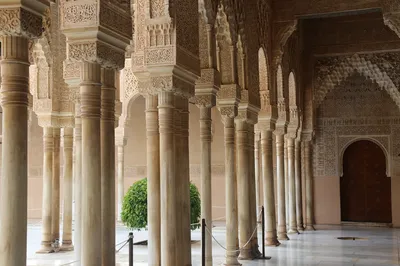
Córdoba's streets and buildings, possibly influenced by Muslims, feature white walls, yellow decorations, and arched shapes, giving a distinct Muslim ambiance.
This is the Roman Bridge, the entrance to the city.
Ronda (Best tour time: 1 day)
Ronda is described by Hemingway as "the perfect place for elopement." The town sits on a cliff, very unique.
Puente Nuevo (New Bridge) connects the old town of Ronda, standing over a deep gorge.
From a path downhill, there is a low point to photograph the bridge.
We had dinner at McDonald's in Ronda; the burgers were larger than in China.
Ronda's bullring is the birthplace of bullfighting. Spanish bullfighting originated from ancient religious activities: sacrificing bulls to gods, later evolving into performances. Spain now has over 300 bullrings, in almost every city.
The bullring is circular, seating 5,000 spectators. Inside is a bullfighting museum with clothing and cultural introductions. Although we didn't see a performance—regrettably—just reading about it seemed bloody and cruel. It reminded me of ancient Chinese emperors hunting for sport and conquest.
Royal Alcázar of Seville (Best tour time: half a day with guide)
Built in the 14th century under Pedro I, the Alcázar is also a filming location for "Game of Thrones." We rented an audio guide, but it wasn't great. The palace is beautiful.
Seville has many palm trees.
I almost lost my phone here, but a foreign girl picked it up. She called back; despite language barriers, she met a Chinese person who helped communicate, and it was returned. What luck!
Seville Cathedral (Best tour time: half a day with guide)
Seville Cathedral is one of the three largest churches in the world. Originally a mosque, it was converted into a Gothic-style Catholic cathedral. The interior is richly decorated with murals. The main altarpiece depicts 36 scenes from the life, passion, and death of Jesus, extremely ornate.
The sacristy houses Goya's masterpiece "Saints Justa and Rufina," very precious. It was once torn, and repair marks can still be seen. The Giralda tower is another highlight—a minaret from Moorish times, 98 meters high. A ramp leads to the top, offering panoramic views of Seville. The ramp was originally designed for horseback riding, so it's easier than stairs.
At the top, there are bells.
In the evening, we had oxtail nearby, which was good—similar to Chinese braised beef brisket with potatoes.
Ice cream from a trendy shop; many European trendy shops are centuries old. This ice cream was good, especially the white milk flavor.
At night, we saw a flamenco performance near the cathedral. "Flamenco" comes from Arabic for "fugitive peasant." It originated from the Roma (originally from Iran, also called Bohemians or Flamencos), who traveled from India to Spain, influenced by Eastern Indian and Arab dances. The Roma's love for freedom, indulgence, and passion is reflected in the dance, which is often improvisational, accompanied by guitar. Flamenco now also describes a lifestyle of unrestrained, free enjoyment.
Seville is the birthplace of flamenco. Even at first glance, you can feel the Spanish passion and straightforwardness. The dance involves vigorous stomping, like tap dancing, with large movements and strong rhythm. On stage, three fixed performers: one singer, one guitarist, and one clapper. Three dancers (two women, one man) performed in perfect synchronization—hands, feet, music, and voice matched flawlessly. The flowing skirts were beautiful.
Metropol Parasol (Best tour time: 1 hour)
Metropol Parasol is a modern structure built in 2011, shaped like an umbrella or mushroom, known as "the parasol of the Plaza de la Encarnación." It is one of the largest wooden structures in the world.
Plaza de España (Best tour time: half a day or more)
This is the most beautiful square I've ever seen—curved classical buildings, turquoise lake, elegant arched bridges, vast forests, fountains, swans, and ducks. Absolutely stunning.
In the afternoon, we headed to Lisbon.
Belém Tower & Monument to the Discoveries (Best tour time: 2 hours, can also take a boat nearby, reservation needed)
Belém Tower, by the sea, witnessed the departure and return of countless ships during the Age of Discovery. Built as a fortress in 1520, it later served as a customs house, telegraph station, and lighthouse.
The Monument to the Discoveries is right next to Belém Tower. You can take a boat, rest, and spend half a day. The monument was built to commemorate the 500th anniversary of the death of Prince Henry the Navigator. It is shaped like a caravel sailing into the sea, with statues of Henry, Vasco da Gama, and 80 other figures, including generals, missionaries, and scientists.
Here, Portugal's glorious achievements are displayed. As shown on the map, Portugal was a maritime power in the 15th-16th centuries, an early empire on which the sun never set, with colonies worldwide, including Macau. This map shows all their former colonies.
Portugal is only 92,000 square kilometers, but if you count its colonies, it was once larger than China. Such a small country, with only about 10 million people today, was once so powerful—truly admirable.
Portugal is also the birthplace of pastéis de nata (egg tarts). Near here is a famous century-old pastry shop. We tried authentic Portuguese egg tarts.
This shop dates back to 1837. The tarts and other sweets were extremely sweet—twice as sweet as what I'm used to in Hubei—even I, who loves egg tarts, found them hard to finish.
On the way, we passed a monastery.
Cabo da Roca (Best tour time: 0.5 hour)
Cabo da Roca is the westernmost point of the European continent. The inscription reads: "Where the land ends and the sea begins" by Portuguese poet Luís de Camões. Note: It's very windy and a bit cold here.
On the return, we took another road along the Atlantic coast. There were many seagulls.
The guide added a stop at a seaside town.
We tried ice cream from another century-old trendy shop—it was good.
Castelo de São Jorge (Best tour time: 2 hours)
Castelo de São Jorge is an ancient building in Lisbon, the highest point in the Alfama district, a Moorish fortress during their occupation of Lisbon.
Today, old cannons remain. From the top, you have a panoramic view of Lisbon—a great lookout spot.
There are many peacocks here.
Rua Augusta (Best tour time: half a day)
This is a bustling street in Lisbon. The square faces the sea, and the commercial street goes inward. There is also an elevator offering views of Lisbon.
We experienced the historic Tram 28. This was the worst part of the tour due to our guide's inexperience. Note: You don't need to board at the starting station; you can board at any stop. The starting station has a queue of at least an hour, but boarding at any intermediate stop requires no waiting. Moreover, there's no need to ride from start to end—the full journey takes over 40 minutes, a waste of time. We didn't know how to get back at the end station, and the round trip plus queuing took 3 hours, without seats or food, exhausting.
We flew directly from Lisbon to Barcelona, arriving at sunset. We went up to the Temple of the Sacred Heart of Jesus.
Temple Expiatori del Sagrat Cor (Best tour time: 0.5 hour)
This Catholic church is on a hilltop, offering panoramic views of Barcelona. The sunset glow made the church sparkle beautifully. It was closed when we arrived, so we couldn't take the elevator up.
The hilltop is also great for watching the sunset.
Casa Batlló (Best tour time: 2 hours with guide)
Casa Batlló is an apartment building designed by the renowned Catalan architect Antoni Gaudí. The whole building tells a story: a princess trapped in a castle by a dragon, the Catalan hero Saint George fights and kills the dragon, whose blood turns into a rose, which he presents to the princess. The facade is covered with colorful ceramic tiles like dragon scales, stained glass, and unique balconies shaped like masks.
The cross-shaped chimney represents the hero's lance; the undulating roof is the dragon's back.
The interior design is also creative: dragon-scale stairs, mushroom shapes, skin-like walls, and various curves—it feels like you're in the battle of Saint George and the dragon.
Gaudí was also skilled with light. He controlled window sizes: larger on lower floors, smaller on higher floors, ensuring uniform light in all spaces.
The central atrium, with blue tiles, feels like an underwater cave—the dragon's lair.
This is La Rambla. Buildings line both sides, with a pedestrian promenade in the middle, dotted with kiosks, flower shops, and restaurants.
La Boqueria market is also here; we had lunch there.
Black rice with squid—average taste.
Monument a Colom (Best tour time: 1.5 hours including boat ride)
At the end of La Rambla is the Columbus Monument. Columbus was an Italian navigator. He originally intended to go to India for pepper, which was rare and expensive in Europe, affordable only to nobles. Queen Isabella I financed his expedition with her dowry to find pepper and other treasures, but he accidentally discovered the New World, rewriting world history. Because of this discovery, Spain began its expansion and became a maritime power. Spaniards greatly respect Columbus. In Seville Cathedral, his coffin is carried by four kings. In Barcelona, we see his statue, built in 1886 for the Universal Exposition, commemorating his contributions to Spain and the world.
We took a boat at the port and sailed in the Mediterranean Sea off Barcelona for an hour. It was my first time on such a cruise.
Sagrada Família (Best tour time: half a day with guide)
Construction of the Sagrada Família began in 1882. It is also a work of Gaudí; the Nativity Facade is a UNESCO World Heritage Site. Originally not designed by Gaudí—a different architect designed the crypt—it was later taken over by Gaudí, who devoted his life to it but never completed it. Construction continues to this day. Fortunately, Gaudí left all the plans. It is expected to be completed in 2026, the centenary of his death.
Currently visible is the Nativity Facade, depicting many Bible stories. The Passion Facade is on the opposite side, and the Glory Facade (the main entrance) is yet to be finished.
Inside, it feels like a forest, with tree-like columns. Gaudí's imagination is evident—every work tells a story and has life.
Gaudí's use of light is masterful; different colors correspond to the sun's position as it hits the church.
Museu Picasso (Best tour time: half a day with guide)
The area where the Picasso Museum is located was once home to nobility dating back to the 13th century, retaining a strong medieval atmosphere with quiet courtyards and ornate walls.
The museum mainly houses Picasso's early works from Barcelona and Paris. His most famous works are not here, but other pieces are excellent. The most representative is his series of interpretations of Velázquez's "Las Meninas," reflecting his own thoughts.
Seeing so many works, I understood what my teacher once said: "Picasso innovated throughout his life." Each period has a different style, and the value of art lies in constant innovation, especially in thought.
This is the Barcelona City Hall, opposite the Provincial Council.
I heard that Barcelona, being wealthy, has had many independence movements. The flag on this building is the one they designed for Barcelona themselves.
The Wall of Love—difficult to see up close, but visible from afar, and even more so in photos.
Barcelona Cathedral: Many people were painting here—young and old—creating a strong artistic atmosphere.
Plaza de España—just a quick visit.
Barcelona Airport. Notably, even the airport reflects Europe's development: self-service check-in, electronic boarding passes, and automatic baggage wrapping, with minimal manual labor, reducing costs and increasing efficiency.
Even restrooms show differences. Almost all European restrooms, whether at airports or highways, have sensor-activated faucets, soap dispensers, hand dryers, toilet paper, and paper towels—complete sets, so we didn't use our own tissues at all.
Paris Airport's restrooms felt even more stylish, beautiful, and rich.
Paris Airport also has Chinese signage.
Arc de Triomphe (Best tour time: 0.5 hour)
The Arc de Triomphe was built to commemorate Napoleon's victory at the Battle of Austerlitz in 1806. The four facades feature four large reliefs representing "Departure" (or The Volunteers), "Victory," "Peace," and "Resistance."
Departure: The goddess of liberty draws her sword, leading the people forward, commemorating the events of August 10, 1792, a milestone in the French Revolution that led to the abolition of the monarchy.
Victory: Napoleon returning triumphantly, surrounded by the goddess of victory, crowning him with olive branches and playing celebratory music, recording his achievements.
Resistance: Commemorating the Sixth Coalition against France, depicting the French people's stubborn resistance.
There are many Arc de Triomphe in Europe, but this is the most famous.
Facing the Arc de Triomphe is the famous Champs-Élysées.
Following this avenue leads to Place de la Concorde. Louis XVI and his queen were executed here. The site was fenced off due to preparations for the Olympics.
Eiffel Tower (Best tour time: half a day; elevator queues are long)
The Eiffel Tower was built for the 1889 World's Fair and the centennial of the French Revolution. Steel symbolized a nation's strength, so this tower was constructed.
In front of the tower is a large square and lawns. Queuing to go up takes at least 1-2 hours, so we didn't go up; there is an elevator.
Seine River Cruise (1 hour 20 minutes)
The Seine is the second-largest river in France, flowing through the heart of Paris. Along its banks are major commercial and political centers. The cruise offers views of the Louvre, Orsay Museum, Notre-Dame, Grand Palais, Petit Palais, Les Invalides, Eiffel Tower, etc.
This is the Pont Alexandre III, named after Tsar Alexander III of Russia, linking the Champs-Élysées and Les Invalides (Napoleon's tomb), a symbol of Franco-Russian friendship.
Musée d'Orsay (Best tour time: 1-2 days with guide)
Europe is a cradle of art, and Paris is the brightest pearl. France has so many artworks that no single museum can hold them all. The Louvre houses works from prehistory to 1848, the Musée d'Orsay from 1848 to 1912, and the Pompidou Center from 1912 onwards. Additionally, Paris has the Orangerie Museum, Picasso Museum, Petit Palais, and many others.
The Musée d'Orsay was originally a railway station built for the 1900 World's Fair, later converted into a national museum. You can still see traces of the station, and the old restaurant is preserved. The museum is huge; a thorough visit takes at least 1-2 days. Our guided tour was 2 hours, covering only key works.
I recall my teacher mentioning Millet's "The Angelus" and "The Gleaners," which depict ordinary laborers with humanistic concern, portraying reality truthfully.
"The Birth of Venus" here is less famous than Botticelli's, and the artist is lesser-known. The guide said that famous masters today were often obscure in their time. According to myth, Venus was born from the foam of the sea after Uranus's severed genitals fell into the ocean, becoming the goddess of love (Roman Venus, Greek Aphrodite), mother of Cupid.
This work shows the decline of Rome: behind are once-glorious buildings, now decadent. It echoes the theme of China's "The Night Revels of Han Xizai."
Manet's "The Fifer" broke tradition by painting a figure without a background or ground—a new dimension in painting.
Manet's "Le Déjeuner sur l'herbe" was controversial when first shown because it depicted ordinary people nude. Manet intended to show reality, and eventually it was accepted as a masterpiece.
I had long heard of Monet as the founder of Impressionism. Viewing images online, I couldn't grasp its beauty, but seeing the originals, I truly understood its power. The key feature of Impressionism is that up close, it looks like messy dots; from a distance, you see the subject. It relies on the human eye's ability to assemble and understand images. Thus, both the artist and the viewer participate in creation—something only visible in person. Monet's mastery is incredible. He emphasized light and shadow, rendering them realistically. Before Monet, shadows were often painted black, but he noticed they aren't always black and used pale blue, achieving realism. His work deeply influenced Van Gogh.
Pointillism is similar to Impressionism but more detailed. Honestly, I prefer Monet.
I saw Van Gogh's "Starry Night Over the Rhône"—his state of mind was relatively calm then, so the painting is beautiful and serene, very different from "The Starry Night."
Château de Versailles (Best tour time: at least 2 days with guide)
Versailles was built under Louis XIV. It is enormous, covering 1.1 million square meters (including gardens, the largest palace in the world), and is one of the five great palaces (the Forbidden City in China at 720,000 sq m, Versailles, Buckingham Palace, the White House, and the Kremlin). Here we learned more about Louis XIV. He ascended the throne at age 5 and reigned for 72 years, the longest of any sovereign in world history. He established an absolute monarchy that lasted until the French Revolution. His three major wars made him the hegemon of Western Europe, but the costs exhausted his reputation in his later years.
Louis XIV's achievements led him to build Versailles to display luxury, wealth, and status. Versailles is even more magnificent than the Royal Palace of Madrid. The palace is vast, with grand, opulent interiors. The queen's and king's quarters are nearly all gold, and even the outdoor gates are gold.
Versailles is mainly classical in style, with interiors predominantly Louis XIV's Baroque, with some Louis XV's Rococo.
Two princesses' rooms.
The audience hall.
The queen's room is entirely gold, shining brightly.
We saw painted Chinese scenes.
A small part of the gardens. With an audio guide, we spent over 4 hours and hadn't finished. The gardens are much larger—probably a day is not enough to see them all. We estimated 2 days for the gardens alone, and at least a day for the palace. Versailles also has restaurants for dining when tired.
We had authentic French cuisine at a century-old restaurant for lunch.
Foie gras—not to my taste.
Oysters—raw oysters with lemon; without lemon, they are bitter, but still not my thing.
Snails—not to my taste.
Fish—delicious, the best dish of the meal.
Mashed potatoes—okay.
Local French wine.
I still prefer cola.
Dessert: crème brûlée—good.
Mille-feuille—okay.
In the afternoon, we went shopping for souvenirs like chocolate.
Musée du Louvre (Best tour time: at least 2 days with guide)
The Louvre is the world's largest museum (others are the British Museum, the Hermitage in Russia, and the Metropolitan Museum of Art). Built in 1204, it was originally a royal palace, now a museum, one of the finest examples of French classicism. The Louvre is huge; the guide said a thorough visit would take a month.
We first visited less crowded galleries. One work shows Alexander the Great meeting the philosopher Diogenes. Alexander asked if he needed help; Diogenes replied, "Don't block my sun." Alexander was amazed and stepped aside, showing the great ruler's magnanimity. This work also alludes to contemporary kings.
Another sculpture depicts a man who foolishly tried to split a tree with his bare hands, got his hand stuck, and was bitten by a lion—a lesson in overestimating oneself.
This is Napoleon, a great figure in France and Europe.
This is the Code of Hammurabi, similar to English common law, recording past cases for future reference.
Above is cuneiform script from over 3,000 BC, partially deciphered.
These are work tokens indicating job titles.
The Moabite Stone (Mesha Stele) is important, recording the war between Israelites and Moabites as described in the Bible. It was discovered, mistaken for useless, and shattered. It was later reassembled, and fortunately, rubbings were made before the destruction.
This is a 7,000-year-old standing figure from the Mediterranean, on loan to the Louvre.
These are French royal jewels.
This is a sugar box—elaborate, with a figure carrying sugarcane, from which sugar is derived.
Impressive: the clock, globe, and solar system model all move—an ancient timekeeping device of great ingenuity.
These are porcelains learned from China, but with their own style.
This is a seated scribe with crossed legs, writing—an ancient Egyptian artifact.
This is Akhenaten, who unusual appearance by choice.
He actually looked like this.
This hall is very luxurious, full of jewels. This is a queen's crown, this is a diamond.
Veronese's "The Wedding at Cana" depicts Jesus and his disciples attending a wedding, where Jesus turns water into wine. Interestingly, the bride and groom sit in the lower left corner looking at us, not in the center—showing respect for the guests. The central glowing figure is Jesus.
The Mona Lisa by Leonardo da Vinci, a masterpiece of the Renaissance, is the most popular—we couldn't get near it. My teacher explained that da Vinci broke the medieval tradition of painting gods by depicting an ordinary woman, daring to show the lower body—a breakthrough in thinking, focusing on humanity. Mona Lisa's eyes are fascinating: wherever you stand, she seems to look at you.
This is Pygmalion, whose statue came to life.
Napoleon's coronation: Napoleon crowns himself, ignoring the Pope (seated behind him), demonstrating his power. The elderly lady in the center is his mother, though she was already dead—the painter added her to flatter Napoleon.
"Winged Victory of Samothrace" is a marble sculpture from 200 BC, depicting the goddess of victory, missing head and arms, but the drapery is realistic, showcasing ancient Greek artistry.
"Venus de Milo" by Alexandros of Antioch, also ancient Greek marble. It was discovered by a farmer; Frenchmen bought it off him and dug it up, but Turks fought over it, and in the struggle, the arms broke off. Many Louvre artifacts were looted by France, though some small countries couldn't preserve or study them. Regardless, these are products of human wisdom, to be cherished and protected.
This is a hermaphrodite—originally a couple turned into one by the gods.
The Louvre's exterior. It's massive. Our 3-hour guided tour covered only a fraction, but it was stunning. The glass pyramid is by Chinese-American architect I.M. Pei.
We had steak and fish for lunch—both good.
This trip was very rewarding. I learned about Western religion, art, and culture, which are advanced and eye-opening. Westerners value culture—unlike us, who just drill exams and rarely create true art. However, I also noticed that past glories seem to have slowed the pace of development in these advanced countries. Perhaps due to wealth, work and life are less hectic. Life focuses on pleasure and leisure, a pattern seen throughout history. As depicted in that painting of ancient Rome, excessive indulgence leads to decline.
Travel Diary Contents:
1. Preliminary Notes
2. Day 1-3 (Business): Beijing → Brussels → Northern France → Madrid
3. Day 4: Madrid: Prado Museum → Retiro Park
4. Day 5: Toledo
5. Day 6: Córdoba Mosque-Cathedral → Ronda
6. Day 7: Seville: Alcázar, Cathedral
7. Day 8: Seville: Metropol Parasol, Plaza de España → Lisbon: Belém Tower, Monument to the Discoveries
8. Day 9: Lisbon: Cabo da Roca → Rua Augusta → Castelo de São Jorge → Tram 28
9. Day 10: Barcelona: Temple of the Sacred Heart
10. Day 11: Barcelona: Casa Batlló → La Rambla → Boqueria Market → Columbus Monument → Mediterranean Cruise → Sagrada Família
11. Day 12: Barcelona: Picasso Museum → Paris
12. Day 13: Paris: Arc de Triomphe, Champs-Élysées, Place de la Concorde, Eiffel Tower, Seine Cruise, Musée d'Orsay
13. Day 14: Paris: Versailles, Shopping
14. Day 15: Paris: Louvre
15. Summary
Travel Info: Hotel Index, Guide Index, Flight Index, Website Navigation, Travel Index, Cruise Index, Corporate Travel Index, Franchise Cooperation, Distribution Alliance, Links, Corporate Gift Cards, Insurance Agent, Agent Cooperation, Hotel Franchise, Destination & Scenic Spot Collaboration, More Franchise Cooperation
About Ctrip: About Ctrip, Ctrip Hot Topics, Contact Us, Careers, User Agreement, Privacy Policy, Business License, Security Center, Ctrip Content Center, Intellectual Property, Trip.com Group Algorithm Announcement