Spain Family Reunion Trip during 2023 Christmas Season - Favorite Cities: Córdoba and Granada
December 21
After checking out, we called an Uber to Madrid Atocha Station. Online it is introduced as the marvelous Atocha Railway Station, because the interior arrangement is simply a tropical plant paradise. Since I was constantly communicating with Shanghai about work, I didn't have a chance to appreciate the station. The train took less than 2 hours to reach Córdoba. Because we had seen various news online about poor order in Spain and many pickpockets, we kept checking whether our luggage on the rack was safe.
We booked a homestay in Córdoba for 2 nights: Apartamentos Turísticos Duque de Hornachuelos, an 8-minute walk from the famous La Mezquita Mosque. From the train station, it's a ten-plus-minute walk to the old town. First, we went to the reception office to pick up the key. The young man, in fluent English, explained how to check out and marked the main attractions on the map for us. Then we walked about 10 minutes to the center of the old town, but Google Maps gave wrong directions, so we couldn't open the door at all. Looking up, we realized we had mistaken the house number. I wonder if there was a camera capturing our movements and expressions.
The sunlight was superb, making the clear sky sparkle like a gem. The cobblestone slopes and steps, the high walls on both sides, the balconies, the street lamps—the winding paths made you feel suspended between reality and the Middle Ages. Specialty shops lined up one after another, and we couldn't resist buying some souvenirs. The Alcázar here looked rather simple, so we didn't buy tickets to enter, but we were attracted by the palm trees around it, which represent the tropics. Is it usually very hot here? The Alcázar de los Reyes Cristianos is near the Guadalquivir River, not far from the Roman Bridge, and across the street is the famous Great Mosque.
Ahead was the Roman Bridge, an ancient bridge standing quietly over the Guadalquivir River, leaving only tranquility and the sediment of history. A wandering artist played the accordion in a loop: "Bella ciao, Bella ciao!" It seemed he didn't know any other tunes. Standing at the southern end of the bridge, the mosque on the other side and the ancient bridge complemented each other beautifully.
Our family has always liked Spanish ham, but the price in China is very high. During this trip to the origin country, we had to indulge. Seeing a shop with a black pig model as a sign on the old street, we were attracted. Iberian ham (Jamón Ibérico) was displayed prominently, fixed on a stand with the trotters facing up. The boss tightened the screw, sharpened the knife, and sliced. The ham was firm, the knife sharp, and the sliced meat had a marbled texture. Based on personal experience, black label is more impressive for gifts; but for daily consumption, the difference between red and black label is not huge, very worth buying. We bought €15 worth of 50% Iberian ham (300 RMB worth of ham? Actually 15 euros for all-you-can-eat?), just 15 euros for all-you-can-eat deliciousness.
The 2-bedroom, 2-bathroom homestay had a fully equipped kitchen; guests only needed to buy their own food. Christmas was approaching; since we were worried that restaurants and supermarkets might be closed during the holidays, we chose to rent homestays rather than hotels around those days, one of the key criteria being well-equipped kitchen facilities. We bought a full cart of groceries each time and cooked for ourselves in the following days.
Our daughter left us to study in the UK; over the past few months she had been forced to learn cooking skills, and could now cook steak proficiently with good control of doneness. After three months, she finally got to taste her father's cooking again.
December 22
Today's main target was the Great Mosque of Córdoba (Mezquita de Córdoba). It is not only one of the most famous tourist attractions in Córdoba but also one of the largest Islamic sacred buildings in Spain. It looks like a mosque but is actually a Christian church. As soon as we entered, we were attracted by the sound of singing not far away. It turned out to be a group of six or seven teenagers singing, accompanied by simple guitar and harmonies. Their voices were beautiful, their expressions sincere and devoted, appearing especially captivating against the backdrop of the ancient architecture.
This largest mosque in Spain is, for Spanish Muslims, a pilgrimage site second only to Mecca and Jerusalem. In terms of layout, the mosque is divided into the front part—the Courtyard of the Oranges—and the rear part, the main building of the mosque. The entire structure is rectangular, containing 850 horseshoe arches. Besides their functional role, these arches have a strong decorative effect. The horseshoe arches unfold layer upon layer before the eyes, creating a sense of spacious depth. The vivid red-and-white stripes on the vaults are full of Arabian flair, creating a dreamlike atmosphere. Because it was later converted into a church, it blends Gothic, Renaissance, and Baroque architectural styles, making a tour of the building feel like traveling through time.
From the northern side of the Great Mosque on Calle Cardental Herrero (the street where the Puerta del Perdón is located), walking east a short distance leads to a famous alley: Calleja de las Flores (Flower Alley). The people of Córdoba love growing flowers. In this narrow, winding alley, flowers hang on walls, sit on windowsills, and even the air is filled with floral scents. I suggest girls not miss Flower Alley; any pose with a casual snap looks beautiful. The white walls on both sides are always decorated with seasonal flowers, and the quaint little shops on both sides make this tiny lane brim with the essence of spring all year round. Travelers who love flowers and beauty should not miss Flower Alley.
Right after turning out of Flower Alley, we found a well-reviewed small restaurant to sample local cuisine. The most famous dish in Córdoba is Salmorejo (cold vegetable soup); and meat lovers cannot miss the traditional Córdoba-style chicken and ham roll (Flamenquín)! And of course, braised oxtail (Rabo de toro), which is said to be slow-cooked for two to three hours.
Plaza del Potro is one of Córdoba's representative sights. At its top is a small horse statue, the city emblem of Córdoba. This Renaissance fountain dates back to 1577, and the square is named after the small horse on top. The square was once a bustling market where vendors gathered; now there are many gift shops selling local specialties. We saw many people enjoying food in the sun, a lifestyle that is enviable.
Before returning to the homestay, we went to the ham shop again to buy another variety of ham. Fine food and beautiful scenery—neither can be missed.
December 23
After getting up in the morning, we packed our luggage and quickly cleaned the room, hoping that when people saw the room after the Chinese guests checked out, it would be tidy and clean. When leaving, we took the trash out with us. According to the instructions, we dropped the key into the mailbox on the first floor and set off for the next leg: taking the train from Córdoba to Granada.
Córdoba, Seville, and Granada are collectively known as the Golden Triangle of southern Spanish tourism. Each has a rich history, similar to each other yet unique. Granada, because it was long occupied by the Arabs, is probably the least Spanish city, with a strong Islamic atmosphere. Its history is so complex that it might take a history teacher several lessons to explain. Roughly, it was ruled by Greeks, Visigoths, Jews, Moors, etc., experiencing war and chaos, but also creating glory and splendor.
I should mention that English proficiency in Spain is average, especially among ordinary citizens. Please download Google Translate or the built-in translator on iPhones for preparedness. The landlord we met in Granada could only use a translator to communicate with us sentence by sentence. The homestay was excellent, but communication was too arduous.
Since we had booked a visit to the Alhambra on the 24th, and the cathedral would be closed on the 25th, after dropping our luggage we first went to the Granada Cathedral. The cathedral is located in the old town, tightly surrounded by other buildings. Its entrance is unremarkable, but the interior is breathtaking. The interior is built entirely of white marble, with very bright overall tones. Adult tickets cost €5 each, student tickets €3.5, and a Chinese audio guide is included.
After leaving the cathedral, we immediately plunged into the narrow alleys of the Albayzín district, climbing along ancient cobblestones, quickly losing our sense of direction. We barely managed to follow the map directions. Albayzín is the old Muslim residential quarter in Granada, colloquially speaking, the Moorish Muslim community. Its status is equivalent to the Alhambra, making it a World Heritage site. Here, winding, narrow streets with a medieval atmosphere coexist with notorious safety warnings. Facing the magnificent Alhambra, it has witnessed history for a thousand years.
The alleys of Albayzín twist and turn, with shops full of Arabic style on both sides, selling various Arabic cuisines and handicrafts. The alley stretches so that you cannot see the corner at the other end; wandering in the alley, perhaps there is a malicious person hiding around that corner. Indeed, various pieces of advice we received suggested that when traveling in Spain, try not to carry a bag; just take a simple bag for sundries—safe and inconspicuous.
Near dusk, there were many tourists on the viewpoint, along with singers common everywhere in Europe. Sitting at the hilltop lookout, we gazed at the Alhambra opposite. The mysterious palace, under the blue sky, looked like a painting, with the snow-capped mountains in the background adding depth. Plaza San Nicolás, the highest point in Albayzín, is the best spot to view the Alhambra; the majestic grandeur of the palace seems to leap out. However, the climb up the steep, narrow, cobbled streets was somewhat painful.
December 24
If Albayzín represents the Muslim life submerged in history, the Alhambra represents the splendor of the Arab kingdom. In Granada, one way is to go deep into it, measuring the depth of history on foot; another way is to look far at this ancient civilization from the viewpoint across the way. We had booked tickets for the Alhambra at 10:00 am, and needed to arrive at the Nasrid Palaces one hour early.
We had checked transportation options in advance; almost none were very convenient. So we decided to leave before dawn and walk to the Alhambra. There were few pedestrians on the street, very quiet. Walking along the winding mountain path, we felt the cold ancient city. Only the echo of my footsteps broke the silence. Visiting the Nasrid Palaces (los palacios Nazaríes) requires entering within half an hour of the designated time on the ticket. Due to space constraints, only 300 people are allowed every half hour. If you miss the visit time, you lose the right to enter.
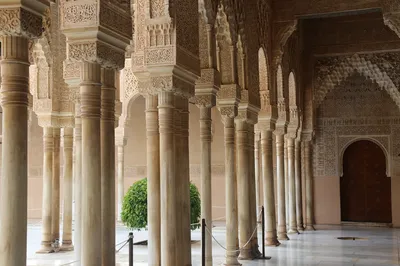
The Alhambra is vast, divided into five architectural groups: the Palace of Charles V, the Nasrid Palaces, the Upper Alhambra, the Alcazaba fortress, and the Generalife gardens. The Nasrid Palaces are the most exquisite part. Sunlight spilled onto the buildings, revealing the original colors of the walls; the light filtering through the intricate carvings was full of historical mottling. The Court of the Lions had a dazzling beauty. We strolled through the huge Alhambra, admiring the stalactite-decorated domes, the delicate sculptures, and the beautiful tiles, experiencing a world full of artistic symbols and visual pleasure.
Wood, stone, and plaster—these natural materials were meticulously designed and processed by the "geometry masters," the Moors, who derived infinite variations from simple shapes. The gradually fading ornate carvings on the walls and ceilings, and the touchable Quran verses inscribed in Arabic on the walls—at that moment, I touched time.
Domes, attics, carvings, palm trees, and reflections in pools. These intricate carvings can hardly be overstated as "uncanny workmanship." Rows of slender columns supported the magnificent vaults; exquisite carvings covered every corner, dazzling and astonishing in both their delicacy and color. The strong contrast between reality and illusion, the superlative craftsmanship—the Moors left all their artistic essence here, making this place a witness to the heyday of the Moorish kingdom, a pride of Spain, and a treasure of human civilization. Now, only this palace remains to tell future generations of its former glory and to pass on history.
Next to it, seemingly incongruous, is the Palace of Charles V—square on the outside, circular on the inside, with columns around the courtyard casting orderly shadows in the light. It is bold and rough, like a bullfighter, forming a sharp contrast with the Islamic palace.
Farther away, the summer palace "Generalife Gardens" had neatly trimmed yew trees and shrubs forming arched doorways; low fountains gurgled, flowers surrounded the pools; the empty Paradise Garden and the Islamic bathhouse were intoxicating. In the sunlight, the water channels were like dancing "notes."
Tip for independent travelers: The Alhambra is one of the hardest places to book tickets in the world. It is recommended to book official tickets one to two months in advance on the official website, or book through domestic travel platforms a few weeks ahead. This ensures you get your preferred date and time slot. However, prices on domestic platforms are higher than directly on the official website. After comparison, we booked tickets on the official website, so we could enter directly without exchanging tickets.
Today was a challenge for our legs! We visited continuously, not wanting to miss any wonderful part. After several hours, when we left the Alhambra, we were exhausted. But we still had an important task: to buy groceries before supermarkets and other businesses closed early on the 24th.
This Christmas Eve, we spent it in the wonderful city of Granada!