Spain Family Reunion Trip During the 2023 Christmas Season: The Famous Seville
December 25
After comparing the prices and travel times of trains and buses, we chose to take a coach from Granada to Seville, a 3-hour journey. We were initially worried that it would be hard to find a taxi on Christmas morning, but it turned out that taxis were still operating. A taxi was waiting in the central garden not far from our Airbnb. However, upon arriving in Seville, we found that taxis and Ubers were scarce. Occasionally a car would come, but because we had three large suitcases, the drivers had to apologize. Eventually, a Tesla taxi managed to squeeze in three people and three suitcases. The ride from the bus station to the city center's Santa Cruz neighborhood (Barrio de Santa Cruz) took less than 10 minutes and cost just over 6 euros.
The Tesla had to stop at a small alley because the road ahead was too narrow for the car to pass. Fortunately, around the corner was our last Airbnb of the trip, and the host was already waiting for us. Seville is in the southern region of Andalusia, separated from North Africa only by a strait. The host seemed a bit puzzled by our earnest eagerness to learn how to use the heating equipment—after all, two of us in the family are cold-sensitive!
A five-minute walk from the Airbnb brought us to the Metropol Parasol, locally known as the "Mushroom." This tree-shaped structure with a honeycomb design is full of futuristic flair, forming a stark contrast with the surrounding classical buildings. At sunset, children were playing under the giant mushroom, and the warm orange sunset gently draped a thin veil over the small city—everything felt just right.
Seville is the birthplace of Flamenco. The Museo del Baile Flamenco is dedicated to promoting Flamenco dance culture. We didn't tour the museum but bought tickets for the performance: 68 euros for the three of us. The 5 p.m. show required arriving at least half an hour early to grab seats. The dancers were all middle-aged or older, wearing not particularly refined dresses but exuding charm. The improvisational singing and castanets tested mutual rapport and control over rhythm. Every passionate footstep seemed to step right onto our hearts, and each arm swing was a display of strength and beauty. We highly recommend watching a Flamenco performance up close—it's truly spectacular.
Because we were worried that Christmas Day, like our New Year's Day, would have all shops closed, we carried leftover ingredients from the previous two days—including drinking water—all the way to this city. As a result, we enjoyed a delicious dinner, but we didn't expect that the Airbnb used an electric water heater. Washing dishes used up nearly all the hot water, leaving the three of us with no hot water for showers. We had to wait for the boiler to reheat for a long time before we could shower quickly and uncomfortably.
December 26
The Real Alcázar de Sevilla is extremely popular, and tourists often wait in line for over an hour to buy tickets at the gate, so it's recommended to purchase tickets online in advance. We had reserved tickets for 10 a.m. on December 26. 43.5 USD for three people, with an audio guide in Chinese.
On the way to the palace, we unexpectedly passed a lottery stand with a long queue again. It was already the second day of the New Year, yet the Spanish people's enthusiasm for lottery tickets is truly strong.
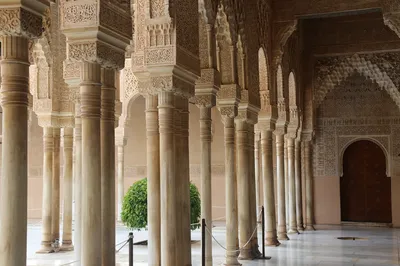
A building can carry the profound history of a land, and a people can embrace the commonalities of different religions and cultures—this is precisely the gain from traveling. The Alcázar of Seville was built in the Middle Ages, incorporating the essence of Seville's historical architecture. Renovated by successive kings, it became a peculiar palace blending various elements. Originally a Moorish castle, it later fused Islamic, Christian, and Gothic styles, perfectly reflecting the architectural style of the Andalusia region.
Similar to the Alhambra from our previous stop, the palace's walls feature intricate yet rhythmic decorations, ornate ceilings, and essential Arabic courtyards with water features. These elements constantly remind us of the "fusion" of different cultures. In the palace gardens, many peacocks roamed, though they didn't show off their beautiful feathers to the visitors.
Across from the palace is the cathedral. Three tickets cost 31 euros. Entering the Seville Cathedral requires security checks—the first time we've encountered a security check at a cathedral. This cathedral is a product of dual religious artistry: Islam and Christianity. Columbus's remains were brought back to Spain from Cuba in 1898 and are buried in the cathedral's Tomb of Columbus, carried by four knight statues representing the kingdoms of Castile, León, Navarre, and Aragon, expressing the highest respect for Columbus.
The Giralda Tower is another highlight of the Seville Cathedral. Originally a minaret built during Moorish rule, it stands 98 meters high. Climbing the slightly steep ramps and stairs to the top offers a panoramic view of Seville. Three tickets cost 31 euros, including a student discount and entrance to the tower. The Giralda, blending two styles, represents the intersection of Islamic and Christian civilizations. The effort of climbing countless slopes and stairs is worthwhile—on top, you can see the entire landscape of Seville and the hazy outlines in the distance.
Lunchtime arrived. We crossed the Isabel II Bridge over the river to the Triana district on the opposite bank. This area is full of bars and restaurants, offering a completely different character from the east bank. It is the birthplace of Flamenco dance. On the west bank of the bridge, there is a statue of what appears to be the founder of Flamenco. We randomly entered a corner restaurant and enjoyed a delicious lobster rice that left us fully satisfied. Carrying leftover bread, we strolled along the river and fed the pigeons on the street. The sun felt warm on our skin—if you like wandering around, Triana is the place to go.
That day we walked far too much. After another half hour or so, we arrived at the Plaza de España in the María Luisa Park. We reached just before dusk, precisely when the sun was slowly setting and the light was shifting. The Plaza de España before us was colorful—snap a photo casually, and it looked like an oil painting. As we moved, we could see the elegant crescent-shaped colonnades and the small bridges over the water, all bathed in the glow of the setting sun. Among all the Plaza de España squares in Spain, Seville's is the best. Of course, what also left a lasting impression were the ubiquitous vintage horse-drawn carriages. The clip-clop of hooves created a sense of traveling back hundreds of years. The sound of horseshoes and the smell of horse manure went hand in hand.
In the evening, we tried to walk into a Chinese restaurant but were turned away. So we went to a pizza place next door and ordered one normal-size pizza for three people—it was tasty and cost 17 euros. In fact, the local norm is that each person orders their own normal-size pizza, while the family-size pizza is as large as a small round table.
Travel tip: It's recommended to book restaurants in advance in Spain. We failed several times when trying to walk into restaurants in different cities.
December 27
Seville is in the southernmost part of Spain. Today we were to fly north to Barcelona. The flight was at 2 p.m., and checkout time was 11 a.m. In the early morning, we wandered aimlessly through the alleys of the old town, soaking in the antique charm. Just before checkout time, we grabbed our luggage, went to a street-side café for a coffee, and waited for the afternoon to arrive. This leisurely comfort was rare.
Travel tip: Vueling Airlines is a low-cost airline based in Barcelona, Spain, and is currently the second largest airline in Spain. Low-cost carriers strictly enforce hand luggage size limits. We had pre-purchased 25 kg of checked baggage per person; otherwise, you would have to pay extra to check luggage at the airport, which is much more expensive than pre-booking. Vueling opens check-in 7 days in advance. Checking in at the airport may result in no seats due to overbooking, or an additional fee. We booked our three tickets through Ctrip for RMB 3,378, plus a seat selection fee of 10 euros per person.
Barcelona has two terminals, T1 and T2, connected by a free shuttle bus that takes 10–15 minutes. We were at T1. We had researched several routes to the city center. Considering we had a lot of luggage, taking a taxi was more cost-effective for three people. The taxi to the hotel cost €32 and took about 30 minutes.
Other options include: ① Airport bus (AeroBus) A1/A2 from the airport to Plaça de Catalunya: 30–35 minutes, single ticket €5.9 (T-Casual 10-trip ticket not accepted), every 15 minutes. ② Train (R2N) from the airport to Passeig de Gràcia: departs only from T2, 25 minutes, can use T-Casual (€11.35). From T2, the train goes directly to Passeig de Gràcia station (not the terminus; T1 has no train station—take the free shuttle to T2 first). Journey time/frequency: 25 minutes, every 30 minutes. Tickets are available at station ticket machines. ③ Metro L9: does not go directly to the city center; requires a transfer; goes directly to Camp Nou (get off at Collblanc); T-Casual cannot be used; single ticket €5.15.
Most of Barcelona's attractions are concentrated in the Eixample district (also translated as L'Eixample) and around the old town. Staying in Eixample is most recommended, especially around Plaça de Catalunya and Passeig de Gràcia for convenience. The area around Sagrada Família, Plaça d'Espanya, and Gràcia are also good choices. Not recommended: the old town, especially the southern part of La Rambla, where there are many pickpockets and it can be chaotic at night.
We stayed at Catalonia Gràcia, a four-star hotel in the Gràcia district. It was conveniently located for transportation, and the friendly front desk guy gave us detailed recommendations for nearby food and supermarkets. The only issue with the hotel was the poor Wi-Fi.
In the evening, we chose a recommended Thai restaurant just a five-minute walk from the hotel. The restaurant's roll-up door was still half-down, and the staff was leisurely cleaning and preparing. We eagerly asked, "Are you open?"