Stories Told by Architecture – A 9-Day Self-Drive Tour of Spain
Why does Spain attract the whole world? Is it the dazzling historical monuments, or the breathtaking scenery and architecture? Is it the charming Madrid or the rural towns immortalized by Cervantes in his writings? Is it the Mediterranean sunshine or the thrilling bullfights? Why do people say, 'The whole world loves Europe, but Europeans love Spain'?
As one of the countries with the most World Heritage sites, Spain is a land of vibrant culture and talent. From the Segovia Aqueduct to the Alhambra in Granada, from the Alhambra to the Sagrada Familia, Spain interprets what 'perfection' means through one architectural marvel after another. From Picasso to Dalí, the geniuses' inspiration flows freely under the Spanish sun. Mountains, countryside, sunshine, beaches, glorious history, and world-shining artistic treasures—like pearls, they emit a soft yet radiant glow.
Spain, a country historically invaded by the Romans, Visigoths, Arabs, and others, has seen its various cultures separate, interweave, replace, separate again, and blend together. The clever borrowing and fusion of different styles give its culture a unique character and its architecture a special charm. You can find Gothic cathedrals, medieval classical town halls, Romanesque monasteries, and modernist abstract museums on the streets... These buildings richly reflect Spain's colorful culture.
It is here that all mainstream concepts lose their meaning. Spanish culture and architecture develop in a wandering manner, with events connected freely, disorderly, randomly, and full of coincidences, as fascinating as Cervantes' Don Quixote. You don't even know where it should start 'once upon a time,' nor do you know what its next 'but that's another story' refers to. In fact, you don't need to know at all. For those about to set foot on the Iberian Peninsula, it is enough to simply enjoy the insights and pleasures brought by the unexpected.
'No country is better suited for spinning tales than Spain.' Come, let us step into the story together...
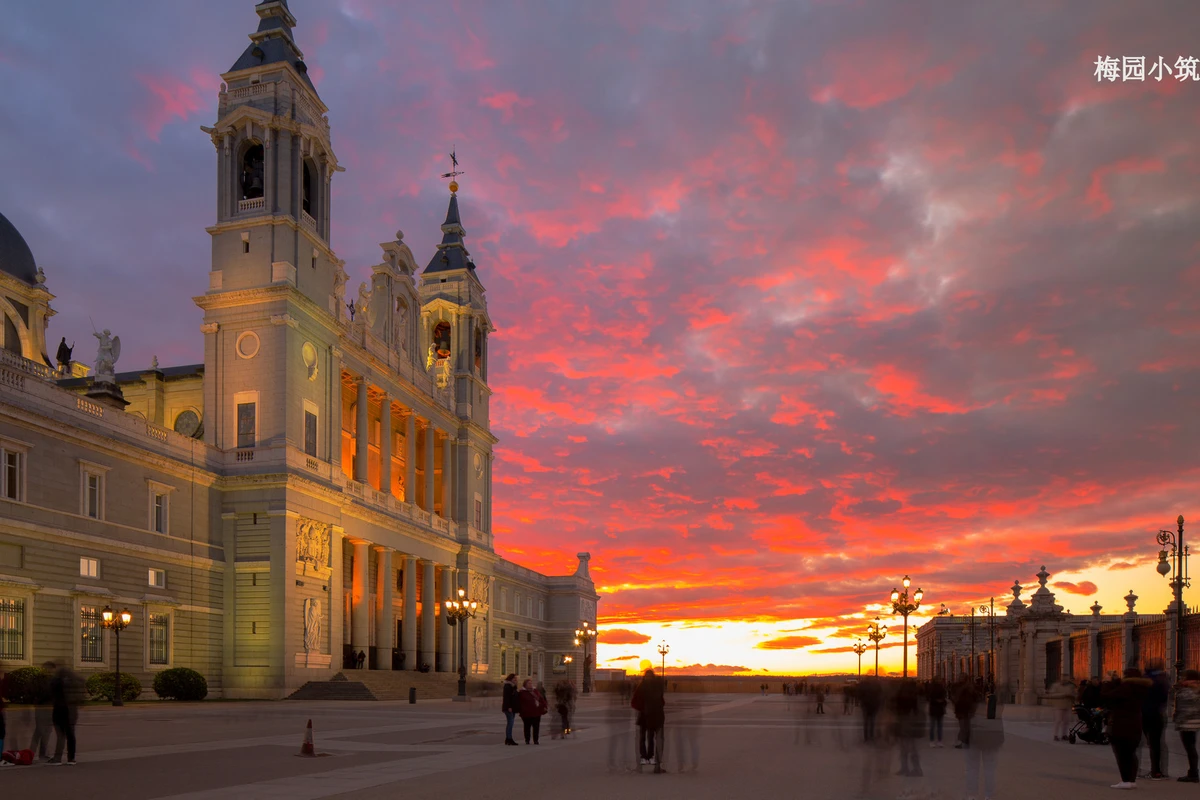
Day 1 Madrid. Due to road closures, after lunch we checked into Hotel Quatro Puerta del Sol. After checking in, we passed through Plaza Mayor and admired the sunset in front of the Royal Palace of Madrid.
Day 2 Segovia. Checked into Hotel Real Segovia. After breakfast, we visited the Royal Palace of Madrid. After lunch, we took the road through Las Rozas Village to Segovia and checked into a hotel with nearly a century of history.
Day 3 Salamanca. Checked into Hotel Casino del Tormes. After breakfast, we admired the ancient city of Segovia. After a Chinese lunch, we hurried to Salamanca.
Day 8 Seville. Checked into La Suite de Rubens. At noon, we returned to Spain from Portugal. After admiring the Seville Cathedral, we visited Plaza de España in the evening.
Day 9 Granada. Checked into Carmen Terrazas de la Alhambra. After lunch, we visited the Alhambra.
Day 10 Torrevieja. Checked into Hostal HB Torrevieja. Visited the trendy area of Torrevieja, Spain.
Day 11 Valencia. Checked into Mon Suites Catedral. Visited Valencia Cathedral.
Day 12 Barcelona. Checked into Hostal Marenostrum. Visited the Sagrada Familia.
Day 13 Barcelona.
At noon we arrived in Madrid. Like other European cities, once we entered the city, we twisted and turned, and a short distance seemed impossible to reach. What made it stranger today was that the route our navigation showed was blocked. After circling a few times, we came across a parking lot, so we parked and went to have lunch. We randomly entered a restaurant that seemed to have many locals. We ordered paella for three people, but in the end, we couldn't finish it.
The area around the main square (Plaza Mayor) mainly sells traditional items, such as various fabrics, ropes, hats, and religious articles. The square was commissioned by Philip III in 1619 and is a unique quadrangular plaza. It measures 128 meters in width and 94 meters in length, enclosed by four-story buildings. In the center of the square stands an equestrian statue of Philip III. Over the long years after its construction, it suffered three fires and was rebuilt, finally taking its current form in 1953.
The Almudena Cathedral is located directly opposite the Royal Palace of Madrid. Its exterior is very striking. In fact, it is a royal church. Construction began in 1879 and, after more than a century, was completed in 1993. Compared with the Seville Cathedral and the Great Mosque of Córdoba, it is quite young. In 2004, the wedding of Spanish Crown Prince Felipe and news anchor Letizia, which caused a global sensation, was held in this cathedral, giving birth to Spain's first commoner queen.
The Royal Palace of Madrid (Palacio Real de Madrid) is the third largest palace in Europe, after the Palace of Versailles and the Schönbrunn Palace in Vienna. It was built in 1738 and took 26 years to complete. It is one of the best-preserved and most exquisite palaces in the world. The palace has a square structure, similar to the Louvre in France; the interior decoration is Italian-style, lavish and magnificent. Inside, it houses countless gold and silver utensils, paintings, porcelain, tapestries, and other royal items. The palace has been converted into a museum. You should buy tickets online in advance; standing in a long line in the cold wind is a torment.
The origin of the Royal Palace of Madrid dates back to the 9th century. Initially, it was a fortress built by the Moorish King of Toledo on the left bank of the Manzanares River to defend against invasions. Later, it was occupied by the Kingdom of Castile (ancient northern Spain). In the 16th century, it became the Alcázar. On Christmas Eve 1734, the Alcázar was destroyed by a fire, and Philip V decided to build a new palace on the site. The main structure of the new palace was built entirely of stone and brick without any wood, so it could never be destroyed by fire again. Most areas inside the palace do not allow photography; you can only take photos on the staircase at the entrance for memories.
Las Rozas Village is located on the edge of the mountains, just a 30-minute drive from the capital Madrid. It gathers over 100 Spanish and international brand boutiques. Once we started shopping, we lost track of time. Suddenly noticing that it had gotten dark, we reluctantly left, and as a result, we encountered heavy snow while crossing the mountains.
The name Segovia comes from the Celtiberian language, meaning 'City of Victory.' The old city sits on a narrow rocky promontory, with numerous historical sites, including the cathedral, the Roman aqueduct, the Alcázar of Segovia, and many Romanesque-style churches, such as the Church of San Esteban, the Church of San Martín, and the Church of San Millán. The surrounding city walls were built in the 8th century on Roman foundations and have been extensively restored in recent decades.
Early in the morning, braving the snow, we strolled through this ancient city that reflects a complex historical reality. The layout, streets, and houses of the old city reflect different cultural backgrounds—Moorish, Christian, and Jewish. Wandering around, we stepped into history. As we walked, we thought how wonderful it would be to stay here for a few more days.
The Cathedral of Segovia stood proudly in the heavy snow. We almost rushed in and were immediately awed by its grandeur. If Romanesque architecture shows the authority of the church with its solid, sturdy, and immovable forms, carrying a sense of retro tradition, then Gothic architecture expresses the sacred spirit of the church with the rough, unrestrained, agile, and rising strength of the barbarians. Its ascending lines, surprising spatial transitions, colorful light through stained glass windows, and various delicate carvings collectively create a 'non-human' realm that gives a sense of mystery. Some say Romanesque buildings are palaces on earth, while Gothic buildings are divine palaces in heaven.
The Roman aqueduct was built during the reign of Emperor Trajan (53–117 AD) and remains intact today. The aqueduct is made of yellowish-brown granite dry-stacked (without mortar) and is extremely sturdy. It stretches 813 meters in length, has two tiers, consists of 148 arches, and rises 30.25 meters above the ground, making it truly majestic.
Our itinerary was a bit rushed; we had to leave at noon, regrettably missing the alcázar. However, we found some comfort in eating authentic Chinese food in the city.
Most of the buildings in Salamanca were built in the 19th century by the Marquis of Salamanca. It has now become one of the most luxurious neighborhoods in Europe, a symbol of elegance and charm. It is said that most buildings in Salamanca have red graffiti, a tradition dating back to the 15th century: after obtaining their degrees, students would participate in bullfights to celebrate and then write the word 'victory' and the date on the walls with the bull's blood. However, we didn't notice many such red marks.
When we came out of the cathedral, it was already dusk, and a biting wind was blowing through the alleys. It is said that the stone used for Salamanca's buildings sparkles under the night lights, hence the city is also called the Golden City. But in this weather, it was really not suitable for a walk in the old town. Instead, we chose a restaurant with a thick wooden door that kept the cold out.
Coming back to Spain from Portugal, the first city we visited was Seville. We arrived around two o'clock, but unfortunately, the landlord was late, wasting some time. After settling in, we hurried to the city center. Passing by the beautiful and understated Salvador Church, with many people sitting in the sun drinking coffee but no queue at the church entrance, we quickly decided to go in first before visiting the cathedral.
The beautiful and understated exterior belied the church's essence. The extremely ornate golden Baroque interior decoration left us astonished as soon as we entered. This church felt more intimate and charming. What's more, we bought a combined ticket here for visiting the Salvador Church and the cathedral, so we didn't have to stand in the long line in front of the cathedral. We were quite pleased with ourselves.
Seville, like many European cities, has a cathedral marking its center. The majestic cathedral always has a spacious hall, a resplendent chapel, and a high bell tower to highlight its grandeur. In these aspects, Seville Cathedral is indeed spectacular, but what truly fascinates people is its bell tower, known as La Giralda.
Seville Cathedral is the third largest cathedral in the world, after St. Peter's Basilica in Vatican City and Milan Cathedral in Italy. Built from 1402 to 1506, it was influenced by various architectural styles during the more than a century of construction, including Mudéjar, Gothic, Renaissance, and Baroque. However, the overall building belongs to the height of Spanish Gothic art while also incorporating Arabic architectural elements. The organic combination of these two styles has created today's architectural masterpiece.
The Plaza de España in Seville was built for the Ibero-American Exposition of 1929. It is a typical example of the Spanish Renaissance Revival architectural style and a microcosm of Moorish Revival architecture. This is a huge 270-degree semicircular square. The main tower is at the center, with the two ends curved into two subsidiary towers. The opening faces the Maria Luisa Park. Designed by architect Aníbal González, the exterior is decorated with various ceramic tiles representing the original 58 provinces of Spain, depicting the diverse charm of Spanish cities. Roman-style arcades, arches, capitals, fountains, rivers, small bridges, tiled railings, and a harmonious mix of Arabic and Spanish architectural styles make the Plaza de España in Seville unique and beautiful beyond compare!
Returning from Plaza de España to the hotel, we had to cross half of the old city of Seville. After some hesitation, we decided to walk back, after all, we could once again appreciate this exquisitely ancient city. Opportunities to stand in front of millennia-old historical sites unintentionally are rare.
Granada is a city suitable for strolling and full of reverie. The artistic brilliance displayed by its historical sites and the shimmering beauty of fountains, ponds, and parks are a delight to the eyes. The narrow streets of the city contrast sharply with the gorgeous gardens. With its religious atmosphere and the cheerful ambiance of the cave dwellings in the Sacromonte district, Granada always offers a fresh experience.
Today, Granada is a precious cultural heritage and artistic treasure of Spain. The Alhambra complex, the tombs of the Catholic Monarchs Ferdinand and Isabella, the bullring, and other sites attract tourists from all over the world every year. According to statistics, Granada receives the largest number of tourists among all Spanish cities.
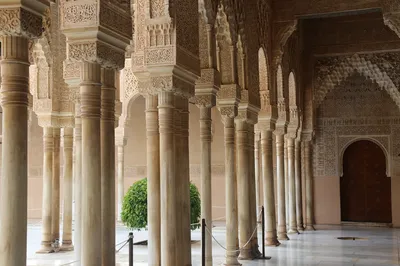
The Alhambra Palace was the palace of the Nasrid Kingdom of Granada built by the Moors in Spain. Its name comes from Arabic, meaning 'Red Fortress.' The palace is located on a hill at the northern end of Granada and is the essence of Arabic architectural art. In 1492, after the Moors were expelled from Spain, the Alhambra fell into disrepair. In 1828, with funding from Ferdinand VII, architect José Contreras, along with his son and grandson, carried out long-term restoration and reconstruction, returning it to its original appearance. It was designated a UNESCO World Heritage Site.
The Alhambra is also vastly different from other Spanish palaces. There are no eye-catching large portraits, golden cups and silver goblets, jewels and jades, or extravagant furnishings... The empty halls highlight only the intricately carved walls: from the frames of every arch, window, and niche to the ceilings, spiral Arabic inscriptions and various geometric patterns cover almost the entire interior. Most tourists cannot read the Arabic script, adding an air of mystery to the palace. The carvings that create these dazzling images are not stone or brick carvings but plaster stucco carvings.
It was already evening when we left the Alhambra, so we hurried to the hotel. The hotel was on a hillside, and the narrow, steep mountain roads made us truly admire the driver's skill. At the same time, we were moved by this old city built along the hillside, simple yet elegant, like a beauty in her twilight years, retaining all the charm of olden days! Following the owner's recommendation, we went down to the city center for dinner. Walking on the bluish-black stone slabs, threading through the narrow alleys, it felt like entering a maze. It was a well-known local restaurant, very crowded, bustling, and noisy.
This day's destination was the trendy spot: pink Torrevieja. We passed through Murcia to find a lunch restaurant. A delicious Chinese restaurant was near the Murcia Cathedral. Unfortunately, the cathedral was not open at that time, so we could only linger at the entrance. It is said that the cathedral's 23 chapels and a 92-meter-high tower encompass almost all architectural styles. The cathedral of the Diocese of Cartagena was built from 1394 to 1465 in the Gothic style. The bell tower was only completed in 1792, showing a mixture of styles: the bottom two floors are Renaissance (1521–1546), the third floor is Baroque, and the dome shows Rococo and Neoclassical influences. The main facade (1736–1754) is Spanish Baroque.
It is said that the Torrevieja salt lake in Spain is a pink pearl in the green fields, with ripples that spread romance. Perhaps because it was a cold winter day, we didn't experience the so-called freshness, elegance, or the pink visual seasoning. However, the reeds on the shore shimmered with unusually brilliant colors under the setting sun.
Torrevieja is a small coastal town with scenery as beautiful as a painting: deep blue sea, soft sandy beaches, soaring birds, and playful fish and shrimp. People are always playing on the soft sand. This is a paradise of nature and a heaven for leisure travel and vacation. The old and traditional church has always existed here, witnessing the upheavals and changes, as well as many joys and sorrows. Together with the museum on the street and the natural park, it forms the most beautiful city. The Chinese food was delicious, and although we walked quite a distance, it was worth it.
Valencia was originally a small village founded by the ancient Greeks. After being occupied by the Romans in 138 BC, it was renamed 'Valencia,' a name that has been used ever since. The ancient Romans brought language and culture, the Visigoths left a period of history that has not yet been fully deciphered, and the subsequent Arabs turned Valencia into a beautiful large garden with their scientific wealth. This is why Spaniards say, 'Valencia was built by the Romans but developed by the Arabs.'
Valencia Cathedral was built on the site of a mosque from the 3rd century. Construction began in 1262 and ended in 1426, after which it underwent expansions and repairs, adding other styles to the original mainly Gothic style. The three entrances of the cathedral are respectively Neo-Romanesque (main entrance), Baroque (south side gate), and Visigothic (north side Apostles' Gate). The Holy Grail Chapel houses what is said to be the chalice used by Jesus at the Last Supper.
The Serranos Gate was built in the 14th century and was part of the ancient city wall of Valencia. Today, the wall is completely destroyed, leaving only two gates, of which this is one.
La Rambla is the first wide avenue built in Barcelona. Because various street performers perform all kinds of shows here, and there are various 'living statues' along the street, it is also more commonly known as 'the street of wanderers.' Our hotel was on this avenue. Coming from Valencia to Barcelona felt like entering a different world, colorful and bizarre.
Although the Sagrada Familia is not yet completed, it has been selected as a UNESCO World Heritage Site. In November 2010, Pope Benedict XVI elevated the church to the status of a minor basilica. Construction began in 1882, and Gaudí took over the project in 1883, incorporating his own architectural style along with Gothic and Art Nouveau elements. Gaudí devoted his later years to the construction of the church, and when he died at the age of 73 (1926), only less than a quarter of the church was completed. It is expected to be completed in 2026, the centenary of Gaudí's death. I hope that year I can come here again.
The exterior of the Sagrada Familia is breathtaking, but the interior, with its dreamlike design and light effects, is truly awe-inspiring. The church mimics the tall trees in a forest; walking into the church is like stepping into an ancient forest. Sunlight shines through the magnificent dome, creating a mysterious and ethereal beauty. The genius' inspiration shines brightly within the church. The Sagrada Familia is a revolution in church architecture, using a completely different interpretation to portray a divine world.
La Roca Village stands on the road leading to the Costa Brava. Although it is only a 40-minute drive from Barcelona, finding the right exit was not easy. We circled around nearby several times, spending an extra half hour before finally getting off the highway and arriving at this peaceful and beautiful place in Catalonia.
In just a few days, we couldn't fully discover all the goodness of Spain, so let's consider this trip as a scouting journey. I hope that in the near future, I can set foot on this fiery land again.