The Ancient Victory City — Segovia Old Town, Spain
Las Rozas Village is located at the edge of the mountains, just a 30-minute drive from the capital Madrid, gathering over 100 Spanish and international brand boutiques. Once you start shopping, you lose track of time; suddenly you realize it's already dark, and you reluctantly leave. As a result, when crossing the mountains, we encountered heavy snow—not a gentle flurry, but a raging blizzard. At first, just a few scattered flakes, but soon they became dense. The snowflakes were no longer graceful dancers, but like white spirits driven by the howling wind, wildly swirling and spinning in the air. They were swept up by the wind, forming white whirlpools, as if the whole world was engulfed in a white storm. Consequently, what should have been an 80-kilometer drive took over two grueling hours. By the time we arrived at Segovia Old Town, the sky was pitch black.
In Europe, missing a meal time is quite painful. It was just past eight o'clock, and already no restaurants were open. After much searching, we found a bakery and bought some bread and pastries to make do. But then, as we stepped out, we stumbled upon a pizzeria. On such a snowy night, seeing hot pizza was impossible to pass up. So, cheerfully we bought two more pizzas and, slipping and sliding, returned to the hotel.
Segovia's history dates back to 146 BC when the Romans established a settlement here. In 80 BC, the city was rebuilt after being destroyed by the Romans, becoming one of the first towns built by the Roman Empire in Spain. In 1088, King Alfonso VI regained control of Segovia, after which the city entered a period of political and economic prosperity. During the Middle Ages, Segovia became an important city of the Kingdom of Castile, and Queen Isabella was crowned here.
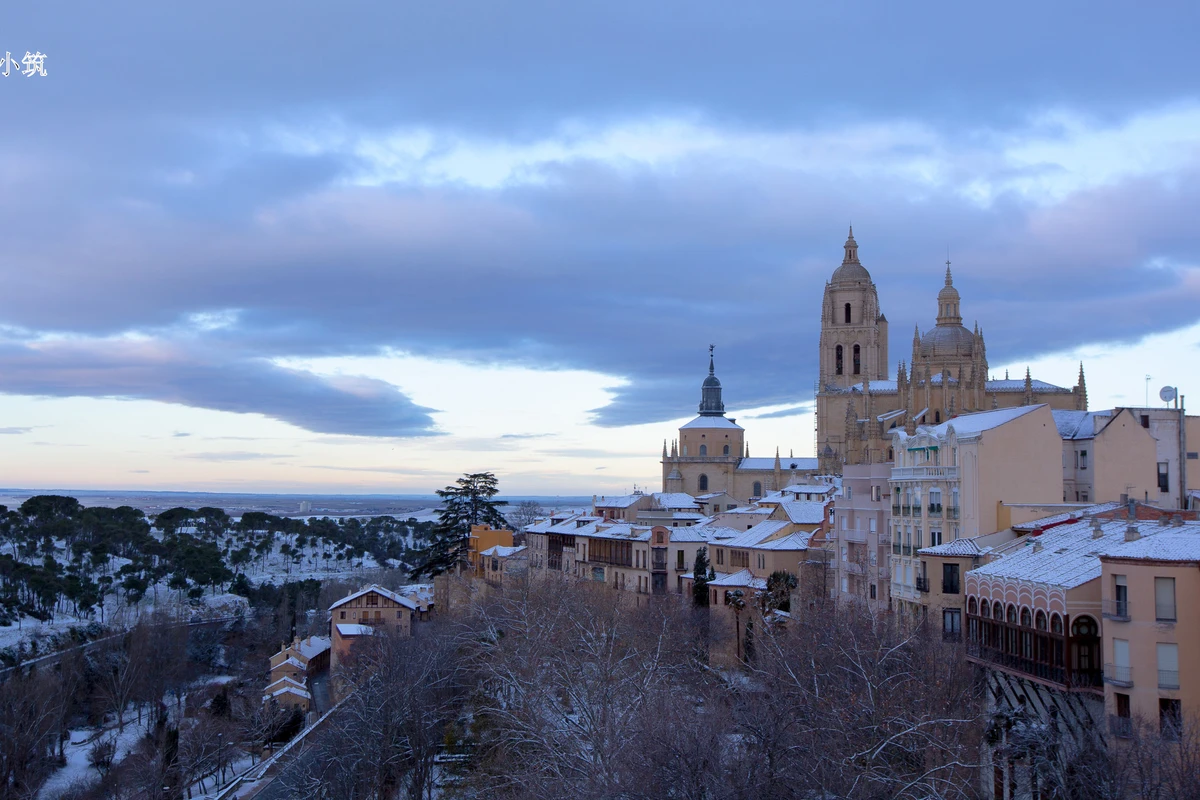
The name Segovia comes from the Celtiberian language, meaning 'Victory City.' The old town sits majestically on a narrow rocky ridge, with numerous historical sites, including the Cathedral, the Roman Aqueduct, the Alcázar of Segovia, and many Romanesque-style churches such as San Esteban, San Martín, and San Millán. The surrounding city walls, built in the 8th century on Roman foundations, have been extensively restored in recent decades.
The Alcázar of Segovia stands out among the thousands of castles in Spain as one of the oldest, most majestic, and spectacular. The castle is built on a strategic cliff at the edge of Segovia, with a drawbridge connecting it to the city and a deep moat on three sides, making it easy to defend. This 13th-century castle is another icon of Segovia, renowned for its towering spires and battlements. The interior features the Throne Room, the Pineapple Hall, and a chapel, and it inspired Disney’s Sleeping Beauty castle.
In the early morning, braving the snow, we strolled through this ancient city that embodies complex historical realities. The layout, streets, and houses reflect different cultural backgrounds—Moorish, Christian, and Jewish. Just wandering around felt like stepping into history. As we walked, we thought how delightful it would be to stay here for a few more days. The entire old town of Segovia is enclosed by city walls. The streets, paved with stone or brick, are winding, narrow, and deep. The antique architectural complexes are each a cultural relic. Among them, the cathedral is the last Gothic building in Spain. Its towering main spire, surrounded by numerous smaller spires, is extraordinarily noble, earning it the title 'Lady of Spanish Cathedrals.'
The Segovia Cathedral stood proudly in the snowstorm. We practically rushed in wrapped in snow and were immediately awestruck by its grandeur. If Romanesque architecture displays the authority of the church through its sturdy, solid, immovable forms, carrying a sense of revival and tradition, then Gothic architecture manifests the sacred spirit of the church with the barbaric vigor, agility, and upward force. Its vertical lines, sudden spatial shifts, colorful light streaming through stained glass windows, and various delicate carvings combine to create a 'supernatural' realm, evoking a sense of mystery. Some say Romanesque buildings are palaces on earth, while Gothic cathedrals are divine palaces in heaven.
The Roman Aqueduct was built during the reign of Emperor Trajan (AD 53–117) and remains intact. The aqueduct is constructed from yellowish-brown granite dry-stacked (without mortar), extremely sturdy. It spans 813 meters in total, composed of two tiers supported by 148 arches, rising 30.25 meters above ground, with an imposing presence. Originally, the Romans built this aqueduct to bring water from the Frío River, 18 kilometers away, into the city for drinking. To do so, Roman engineers built a canal with an average gradient of 1%. By their method, the only natural obstacle was crossing the Clamores River. To overcome this chasm and reach the solid rock on which the city sits, they had to use large stone blocks, constructing it in four sections. The aqueduct consists of double-tiered arches supported by 128 pillars. At the top of the aqueduct is the water channel, which still guides water; originally it had a standard cross-section of 30x30 cm. At the end of the 15th century, the bishop ordered its restoration, and it has been maintained and used ever since. In 1929–1930, the top was replaced with a concrete channel, severely damaging the original. Recent archaeological finds at the base of the aqueduct's pillars seem to confirm that the Segovia aqueduct was built around AD 50. This stunning double-arched structure is embedded in the magnificent old city, becoming a proud symbol of Segovia.
The itinerary was a bit rushed; we had to leave at noon, regrettably without time to visit the castle. However, we found some very authentic Chinese food in the city, which was some consolation.