Spain Travel Notes: Madrid Royal Palace
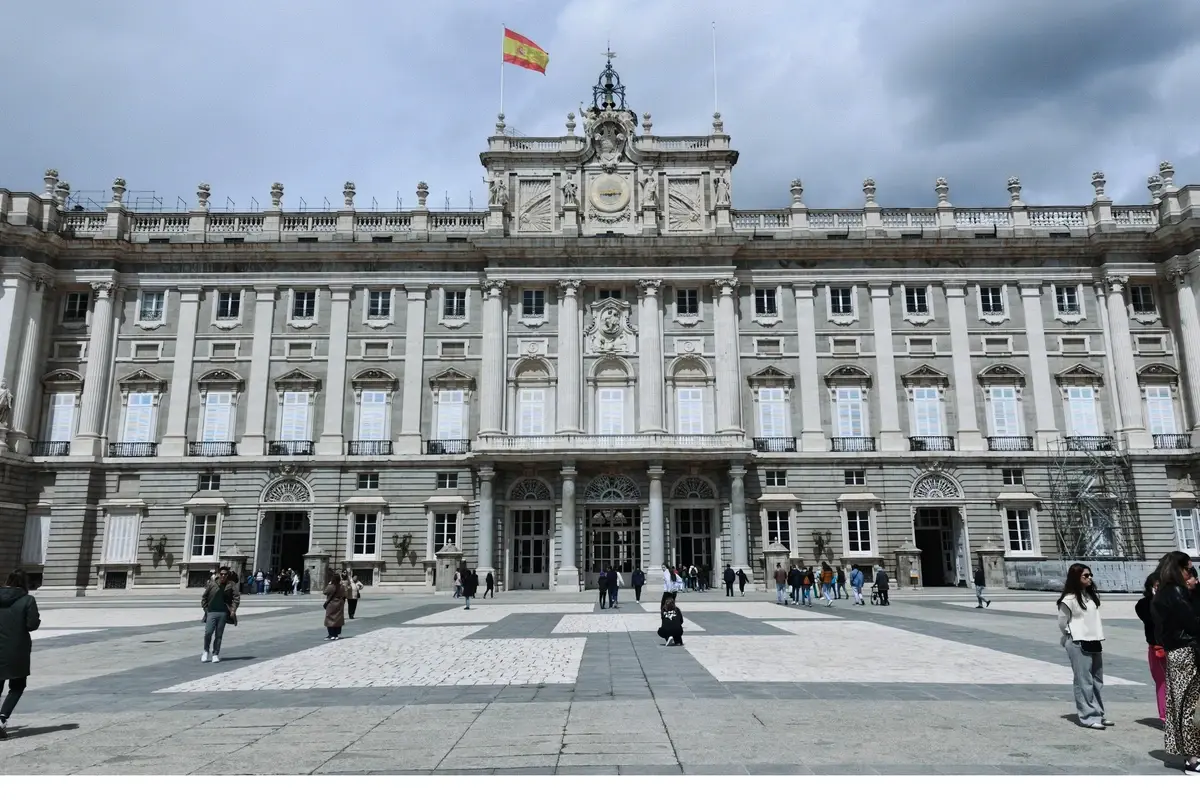
At around 2 pm on April 16, 2025, we arrived at the Madrid Royal Palace by car. The Madrid Royal Palace is the third largest palace in Europe after the Palace of Versailles and the Schönbrunn Palace in Vienna.
The Madrid Royal Palace was commissioned by Philip V, the first Bourbon king of Spain, in the 18th century, built on the site of an old fortress. The original fortress was a Moorish fort built in the 9th century, until it was destroyed by fire in 1734. Construction of the new palace began in 1738, took 26 years, and was completed in 1764, becoming the main residence of the Spanish royal family.
The Madrid Royal Palace is an outstanding example of Baroque architecture, with a symmetrical exterior and lavish interior decoration. It has 3,418 rooms and covers an area of 135,000 square meters, making it one of the largest palaces in Europe. The palace's design was inspired by the Louvre in Paris, using durable and beautiful limestone and granite. Inside, there are several famous halls, such as the Hall of the Ambassadors and the Hall of Mirrors, displaying works by masters like Velázquez and Goya.
Since successive kings decorated the palace according to their own tastes, it carries strong personal and historical marks, such as the bedroom arranged by Charles III, the Hall of Mirrors built by Charles IV, and the luxurious dining room favored by Alfonso XII.
The Throne Room was built during the reign of Charles II, and its decoration has never changed. The ceiling fresco tells the story of the Spanish monarchy, particularly highlighting the reigns of several 18th-century kings. Most of the decorations were produced in royal workshops, but there are also luxury items brought from afar, such as Venetian crystal chandeliers, Neapolitan velvet embroidery, and Roman bronze lion statues.
The Painting Gallery houses works by painters of various schools, including Juan de Flandes' Polyptych of Isabella the Catholic, Caravaggio's Salome with the Head of John the Baptist, and works by Velázquez and Goya. The Plaza de la Armería and the Balcony are in French style, while the interior of the building follows the Italian style popular at the time. The building, measuring 150 meters on each side, has 2,700 rooms, some of which are still used for state functions.
Passing through the Plaza de la Armería and entering the palace, we climbed the grand staircase and entered the 'Gallery' surrounded by many tapestries, followed by the 'Throne Room' modeled after the Hall of Mirrors at the Bellevue Palace. The three rooms known as the 'Gasparini Rooms' are breathtakingly luxurious. In the second room there are portraits of King Charles IV and Queen Maria Luisa by Goya. The third room is decorated in the then-popular Chinese style. In addition, these rooms include a 'Porcelain Room' specially for ceramic pieces, a 'Golden Room' whose walls were once covered with yellow silk, and a 'Grand Dining Room' that can seat 145 people, each with its own distinct character.
Because the palace is so vast, we followed the guide and Chinese interpreter step by step, hurrying through and only catching a glimpse of its splendor, barely scratching the surface.