Nanjing Countryside Tour: Shishanxia and Weijianshan
Travel time: 2020.3
Travel mode: self-driving
Route: Caowang Village Reservoir – Xiaoshan, Fenglin Town – Caowang Village – Shishanxia Village – Fujiabian Shanao Village (passed by) – Wuxiang Mountain Tianchi
At the intersection of the provincial and county roads stands a landmark building – Shishanxia, a rural idyll and creative tribe. Built with grey bricks of various shades, brick-wood structure, its original simplicity is fully displayed.
“Develop health and wellness tourism, support Healthy China” – this is the concept behind Lishui’s tourism construction.
Isn't the road leading into the village beautiful? Cherry blossoms in full bloom line the winding road all the way down.
The parking lot of Shishanxia Village is now surrounded by cherry blossoms.
A panoramic map of Lishui District. Lishui is the source of the hundred-li Qinhuai River. From the map, it features the charm of water towns, rural landscapes, and mountainous areas. Forested lands, arable fields, and abundant vegetation create excellent air quality, earning it the name “natural oxygen bar”. Hills, lakes, rivers, and diverse landforms, along with many cultural relics in Lishui, form the tourism resources of the new ten scenic spots of Lishui.
This diagram highlights the resources of Jingqiao Town. It introduces the thousand-year-old village Shishanxia right before us. Founded in 1245, Shishanxia has a long history, with many historical and cultural attractions.
The red-and-yellow Lishui tourist minibus, with its bright colors, is a beautiful sight against the spreading greenery.
Beside the parking lot is the visitor service center. The grey building stands there imposingly.
“Life is a long journey...” This sentence makes you stop and reflect. Travel is also a journey of growth, every detail can arouse inner reflection, precipitation, or growth...
The visitor center is huge, the largest I’ve seen among all the villages I’ve visited.
Inside, the visitor center is well-equipped. Perhaps due to the pandemic, the spacious hall is empty.
In one corner of the center, there is a bicycle home with an exhibition on the history of bicycles.
Looking down from the second floor, the village is lush with diverse vegetation.
Leaving the center, a wooden boardwalk leads us into the village.
The village is lush with greenery, clusters of flowers everywhere.
Rows of vegetable gardens in front of and behind the houses.
At the end of the wooden boardwalk is a small square in the village. The square features a four-cornered pavilion built of simple grey bricks, enclosed with glass so villagers can rest free from wind and rain. A long corridor is also a good place for leisure and entertainment.
To the east of the village there is a pond.
The pond, like a mirror, embraces the cottages on its banks.
This village scene is fresh and elegant, simple yet meaningful, beautiful, harmonious, and grand, reminiscent of Tang poetry and Song lyrics, or ink-wash paintings.
The clear, quiet water of the pond brings infinite vitality and tranquility to the village.
Beside the pond is another large grey building, similar in style to the visitor center.
Curious, I follow the village lane along the pond to get closer. Rows of outdoor fitness equipment line the pond side.
The grey building turns out to be the China Supply and Marketing Cooperative Museum. I never expected such a museum in this small village. With three floors, it must be sizable. Unfortunately, it was closed due to the pandemic.
The taste of the supply and marketing cooperative means something different to everyone. In my childhood memories, it was wonderful and full of expectations. I would go there to buy soy sauce, using a bamboo tube with a handle; usually two fills of the tube would fill my soy sauce bottle. The snacks at the cooperative were what I looked forward to. In those days of scarcity, my pocket money was spent there. I will come back to this museum to experience the feeling of time rewinding and see if I can recapture that sense of anticipation.
Rows of green broad beans, purple broad bean flowers, patches of golden rapeseed fields, and pink cottages—isn’t this a fairy-tale world?
The beautiful village road connects to Ruijia Line. Ruijia Line is accompanied by rolling hills and rapeseed flowers, so gorgeous.
The Supply and Marketing Museum is built on a small hillock, surrounded by streams. Strolling along the country paths, I see flowers and plants in courtyards, occasional little dogs that don’t panic at the sight of people, and an old man digging wild vegetables by the stream... The leisurely time flows slowly here.
Every family has a small Western-style building and, enviably, a neat and pretty yard.
Sauntering along the pondside path, weeping willows by the pond, lotus roots, water bamboo, red caltrops... these native aquatic plants create a delightful scene.
A little girl is selling homemade malt candy. Her practiced spiel is “taste the childhood flavor.” In our childhood, we saved toothpaste tubes to exchange for malt candy. Hearing the clinking sound of the candy vendor, if we didn’t have enough tubes, we’d mischievously squeeze out unused toothpaste to make up the number, trading a piece of malt candy.
Following the bluestone path further into the village, I see more stone houses and old mud-walled homes. It’s rare that the ancestral mud houses and wooden homes have not been torn down.
Many houses have been rented by young people, renovated and utilized. They preserve the original appearance while adding embellishments, creating unique rural hotels, art studios, and guesthouses. This blue-note cottage, built on stone-terraced fields, is a countryside beer bar. But now its door is also tightly shut.
To the south of the village lies a large open area—small hills, ponds, wetlands, bridges, cottages...
Along the road on the south side, there are small shops selling local specialties.
One shop, Liujiashop, is a famous local rice cake store. When we arrived, the rice cakes had been ordered by a rural tour group. We bought their qingtuan (green rice balls) as our lunch. Due to the pandemic, we didn’t dare to eat in farmhouse restaurants; we brought our own dry food and bought some local snacks to fill our stomachs.
Sitting on the wooden platform in front of the shop for lunch, the table was decorated with hydroponic flowers.
Before us spread an idyllic rural scene.
Rice flour for making rice cakes is being dried.
The village bookstore is also closed.
A few steps further is the Liu Ancestral Hall. Its exterior looks simple and rustic.
In front of the hall is a stone arch bridge, Hongshan Bridge, and across the square stands an opera stage. An ancestral hall paired with a stage is a standard feature in villages.
The bridge spans a stream that flows around the square near the stage.
Two drum-shaped stones in front of the hall are carved with horses.
Entering the hall, it’s not large but retains the layout of an entrance and a second hall. White walls, grey tiles, wooden thresholds, wooden doors and windows, an old well under the skylight... The mix of old and new brick and wood structure shows careful restoration.
The pillars, beams, and stone carvings are exquisite. Red lanterns on the eaves add vitality to the old residence.
Do not underestimate the hall; though small, it’s quite rich in content. The village rules in three-character verse and village chronicles.
Trophies from events are displayed in the hall.
Historical stone carvings and sculptures of the village.
Interesting is the collection of little red books from the Cultural Revolution and grain ration coupons and other items from the planned economy era.
The history of the war years is introduced.
The reunion of the New Bridge in Lishui is depicted through oil paintings.
The hall includes the Wuzhong Hall. Legend says that descendants of the King of Zhongshan, a relative of Liu Bei, moved here 600 years ago. Thirteen volumes of the Liu family genealogy, originating from the Western Zhou Dynasty, are still preserved in the hall.
This small ancestral hall is a mini-museum of Shishanxia.
Directly opposite the hall gate is Hongshan Bridge.
Cross the bridge and you face the proper opera stage.
Continuing southwest along the village road, a wide view opens up. Shishanxia is gently embraced by mountains, bathing in sunlight, letting golden rapeseed flowers bloom freely over the hills, with low tea gardens and orchards. Everything here feels refreshingly pure.
In the countryside, at this season, rapeseed blossoms contrast with blue sky and white clouds, flowing water under a small bridge, field scenery, and unique dwellings, creating charming, ever-changing vistas.
The rapeseed flowers wrap around the field ridges like silk. Two large “barns” not far away catch the eye. I’ve read much about “Weijianshan,” so I know these aren’t the Weijianshan we came for. Curious, I wonder what these interesting buildings are. The sign says it’s a Barn Art Hotel.
With rapeseed flowers all the way, I approach the Barn Art Hotel.
Under the blue sky, the two ancient barn shapes beneath tall, old tree branches are eye-catching.
A circular connecting corridor joins them, creating round enclosures and extensions.
Various circular enclosures form courtyards of different sizes.
Latticed corridors with thatched roofs, using local materials, exude strong rustic flavor.
The barns have rammed earth walls and timber frames with thatched roofs. The two large barns are linked by a glass corridor shaped like the character “品” (taste).
Beside the Barn Art Hotel is the village’s wildflower garden area.
The natural features of meadows and wetlands promise year-round floral beauty.
A few tall trees form a grove shaped like a giant “hydrangea.”
Following stone-slab paths toward the cluster of village houses.
Low red-brick walls enclose the pond. Let me take a photo of my “Buda” bag as a souvenir.
Ordinary village houses have romantic details: platforms jutting out over the water are little artistic touches.
Over the pond is the famous Weijianshan Country Hotel. But from here, you can’t enter; I can only admire the distant view across the pond.
The path ends ahead, so we turn back along the pond.
At a fork, we head north along the village road.
The north-south road is lined with concentrated houses, including local farmhouse restaurants.
Thanks to rural tourism development, various cultural creative teams have settled in Shishanxia, creating a creative tribe that fills the place with cultural atmosphere.
Following the bluestone path deeper into the village, I see more stone houses and old mud-walled homes.
Rural architecture is diverse.
Each household’s layout and materials differ; every flower, every blade of grass, every tree and stone has its charm, making each unique.
The small courtyards also have their own distinctive styles, never identical.
Wooden fences divide different areas.
Two decorative windows add artistic flair to an ordinary wall, and nostalgic wooden doors bear red couplets.
A hardy motorcycle stands parked on the bluestone.
The road is narrow but neat; the houses are low but well-arranged.
The village road is paved with large grey bricks laid horizontally and vertically, with cobblestone edging, skillfully blending nature and construction. The road is tidy and retains original rustic simplicity.
Cherry blossoms in front of a wooden house create a Japanese street vibe.
Stone-built houses with grey-tiled roofs, round stone tables and stools in the yard soften the hard material with their shape, and pink cherry blossoms make everything poetic. Whether sunny or rainy, sitting here quietly, sipping tea, watching falling flowers and drizzle—this leisurely mood is exactly what I like.
Houses are built of stones of various sizes and shapes; the stones themselves are artistically varied, and each whole wall is a painting. Even the ground is paved with stones, with different sizes guiding the way. Along the walls and roadsides are diverse flowers, coloring the rustic stones with vividness.
Shishanxia, a centuries-old village, features stone and mud-walled old houses everywhere. The old homes wait quietly, exuding a lonely, weathered beauty.
Today’s rural construction preserves the original residential patterns and retains as much as possible the materials and masonry techniques of the old houses, keeping the exterior simple and primitive.
In this stone-featured village, these characteristic stone houses gave birth to Nanjing’s earliest country hotel—Weijianshan Country Hotel.
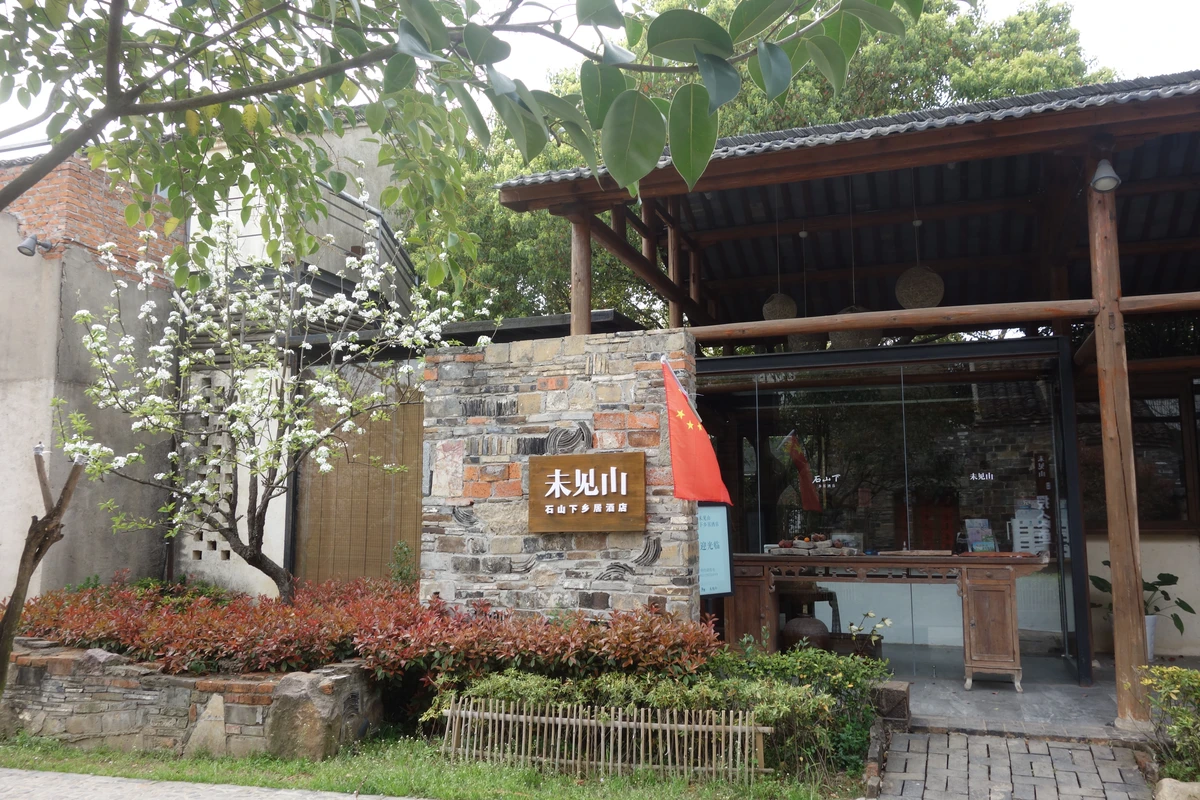
The open-air lobby of Weijianshan Country Hotel beside the path. It’s made of rustic stone and wood framing, with a long wooden table and a sleek glass front desk, surrounded by clusters of flowers.
The three characters “未见山” (Weijianshan) hang at the entrance, evoking limitless imagination. The mountain is right before you, so close; seeing or not seeing is just a state of mind. A pear tree blooming with white blossoms adds a fresh, elegant touch. Due to the pandemic, non-guests cannot enter the hotel to tour.
Standing at the lobby entrance, the scene mixes old and new: in the foreground, the ancient stone houses of the village; in the background, modern village homes—tradition inherited and modernity developed.
A stone wall, a red-brick house, a bamboo fence, a small gate with grey-tile roofing enclose a sunny courtyard. A table and a few chairs lazily bask in the sun.
The red-brick hut is a countryside café affiliated with the hotel.
With bricks of various shapes and colors, windows, and small flower beds, the little hut is full of romantic charm.
Here, order a latte and soak up the sun.
A blue bicycle becomes a scenic spot as well.
While having coffee, an elderly teacher came out from the Weijianshan lobby. Perhaps seeing me sitting there delightedly, taking photos from time to time, and our expressions showed we really liked it. He checked his watch, said there were still fifteen minutes, and offered to take us inside the hotel for a tour. I happily agreed. From his love and familiarity for the hotel, I guessed he might be a partner or something.
Walking into the hall, I saw a perfect blend of old broken walls and modern style. The rustic house, light industrial-style furnishings—everything felt natural and harmonious. He greeted the staff familiarly, saying he’d be just ten minutes. After presenting our health codes, using alcohol sanitizer, we entered the hotel.
Pushing open the wooden door, stepping on fallen leaves on the wooden floor, we entered the courtyard.
A winding path through the tranquil garden. The courtyard follows the original residential layout, preserving the materials and masonry of the old village, giving it a simple, primitive look.
A grey brick wall in the yard resembles a screen wall often used in classical Chinese architecture, both decorative and dividing. Behind the wall, a large white umbrella and wooden chairs—this is where true private space and relaxation begin.
It’s hard to imagine it as just a hotel; it feels more like a private villa. Do you yearn for this life? Escape the bustling city, leave the noisy mundane world, and enjoy pastoral elegance and leisurely contentment in this secluded little courtyard.
Going deeper, the atmosphere suddenly changes, as if in a paradise. A few standalone guestrooms in the yard, through narrow wooden doors, just a light knock on the rustic gate, and this small courtyard becomes a self-contained cozy world.
There’s no lavish gilding here; all materials are traditional rural—timber, bricks, tiles, mud plaster. Every house in the yard is built from the most honest stones of nature. Today, Shishanxia let me fully experience how stones of different shapes, thicknesses, and combinations can exhibit beauty—primitive, simple, rugged, desolate, and with a touch of literary flair.
Each guestroom ensures utmost privacy.
Several old dwellings are linked to serve as the hotel’s lobby bar, all-day dining restaurant, coffee bar, and tea room.
The hotel’s construction followed eco-building principles, retaining the original residential layout as much as possible and preserving the materials and masonry techniques of the old houses. The original rammed-earth walls, broken walls, make the exterior simple and primitive. A bamboo chair under the wall is a childhood memory.
The waterside house with wooden framing and floor-to-ceiling glass is a public lounge combining coffee shop, tea house, and library. Wooden structures create a fresh pastoral feel. The natural wood pillars and wooden chairs complement each other, simple yet quaint. Many seats are available: long tables for gatherings, small tables by the window for intimate conversations... In decoration, old and modern mix. Chairs, lamps, floor, bookshelves, bar, or even a wall, all showcase the experience and mood of Weijianshan.
On a small wooden table by the window, a plain clay vase holds subdued-colored hydrangeas.
The platform design by the pond is unique, made of wood base and cobblestone finish. Several wooden chairs surround a wooden table. A wooden fence gate connects to the village, communicating with it.
Here, we can hold a cup of tea amid nature, surrounded not only by tea fragrance but also by the scent of grass and water. Sipping tea, reading a book, quietly feeling the gentle time of the pond, fields, and mountains, where mountain is the main theme and water the vein. In this simple, fresh pastoral air, breathe deeply, reflect on past busy years, appreciate the tranquility of the moment, and lazily enjoy a warm afternoon. Regrettably, today we can’t; we only have fifteen quick minutes.
From this angle, view the waterfront complex.
In just a dozen minutes, even a cursory glance is insufficient for such a rich guesthouse; we barely caught a glimpse of Weijianshan. The teacher could only show us the public areas, but from his narration, I could feel his full love for the place. The interior of the guestrooms I can only imagine through his descriptions. During our chat, my initial notion changed; he was not a partner but an ordinary guest who comes here often with his wife on weekends because he loves it. He thought the price wasn’t low but occasionally affordable and well worth it. Because he loves it, he’s willing to pay. And because he loves it so much, seeing us at the café looking equally fond, he volunteered to show us around. His philosophy is: good things should be shared, so more people know about them. Travel is full of such touching moments—meeting the right person, sharing common interests.
Leaving the hotel, I waved goodbye to the teacher. His companions were also gathering. They seemed to be university teachers; as universities hadn’t reopened, they were traveling together. Clearly, the teacher was the organizer, as he told me: share good things, let more people love them. So he introduced Weijianshan to his colleagues, organizing them to enjoy the ancient village of Shishanxia. Savor the pond, old trees, homes, the quiet village, letting the world’s clamor fade, while it remains in its original state.
We continued strolling along the village roads. The architectural pairing in the village is well-considered, with original rural and artistic decoration harmonizing overall. This is no longer a traditional village. Through modern artistic touches, it gently retains the wild roughness, using urban fashion and elegance to adorn this originally stone-crafted bold village.
Everywhere, eco-friendly principles are followed. Different areas skillfully use partitions—white walls and grey tiles, grey brick and stone textures, red-brick openwork walls, wooden fences, a clump of bamboo, or a few plants all serve as enclosures. Natural materials and varied heights blend seamlessly with nature, harmonious and symbiotic.
Inside a bamboo fence, green leaves and white flowers are full of leisurely charm.
Along the village road, a water channel outlined with large stones facilitates irrigation for the fields.
Shishanxia is quiet and quaint; often we walked alone, rarely seeing tourists, occasionally villagers. I love such undisturbed places. That tranquility allowed me to detach from my originally cluttered mind and feel the moment calmly.
Murals are a means of rural construction. Many villages have murals depicting their characteristics. The murals on the outer walls of Shishanxia are themed “Childhood.” A bicycle beside a notice board, children playing hide-and-seek, a cute cat poking out its round head, children with red scarves holding hands on the way to school...
Village houses combine red and grey bricks.
Shishanxia, a village based on stone, uses stone as the main building material.
A plain grey concrete wall comes alive with a flock of cute white geese and yellow ducklings painted on it. The simplicity of the ancient village and modern artistic romance complement each other beautifully.
A cobblestone path is like a flower trail winding through the rapeseed fields.
The outer roads of the village are wider.
Introduction to “Jingqiao.”
The mill workshop in front, now closed, its use unknown.
The wider outer roads are accompanied by rapeseed flowers all the way.
Rural development has brought prosperity to villagers. Some run farmhouse restaurants using their own houses. Each home has its own vegetable garden, and the vegetables on guests’ plates might come straight from the garden—100% natural.
This quaint village is brimming with pastoral atmosphere. Whitewashed houses, mottled wooden doors, red couplets, and golden rapeseed flowers in front evoke a Jiangnan flavor.
This is a culturally ancient village blending the firmness of stone with the gentleness of water. Strolling here undisturbed, feeling the light breeze and clouds, enjoying slow life’s comfort. In recent years, rural construction has scientifically preserved the village’s original purity while adding modern artistic methods, creating an interesting mix of old and new in Shishanxia, evoking a return to simplicity. All these elements form beautiful pictures blending into the environment.
The parking lot is so beautiful and fresh.
Leaving Shishanxia, we headed to the next destination, Fujiabian Shanao Village. The beautiful Route 305.
Fujiabian Shanao Village is inside the Fujiabian Agricultural Park, with a guarded gate. As the pandemic eased, visitors could enter on foot. We could park and walk in. I thought about it and gave up, heading straight to Wuxiang Mountain not far away.
I had been to Wuxiang Mountain two years ago and had a great impression. It’s a natural giant oxygen bar with incredibly pure air. The mountain road winds up gracefully, well-built and scenic, drivable to the summit. The Wuxiang Temple halfway up is worth a visit.
Wuxiang Temple is not the square-shaped temple I expected, but a round building. The structure stacks upward like a pyramid, with a proper square temple on the top platform, two tiers of yellow eaves. The yellow roofs look like a hat covering the green mountains.
Under the blue sky and white clouds, Wuxiang Temple amid green pines and cypresses is resplendent.
Leaving the temple, we continued upward, rich vegetation all around. Green stretched as far as the eye could see, trees and more trees, seemingly moving yet still, only leaves flickered, then the wind was heard.
Looking up at the sky, white clouds billowed over the blue; the wind rustled through bamboo groves and leaves on the mountain, sounding like surging waves.
We reached the summit of Wuwang Mountain, nestled in the embrace of surrounding peaks. After parking, we walked to a depression at the mountaintop. Cradled there is a clear, sparkling body of water—Tianchi.
Tianchi is like a piece of beautiful jade set in the summit.
Here, some visitors and locals were seen, all cooped up at home too long, seeking an open, fresh-air place to release.
A wooden boardwalk spans across; during the rainy season, only the bridge deck emerges above water.
Beside Tianchi stands Huan Cui Ge (Surrounding Emerald Pavilion). It’s newly built; last time I visited Wuxiang Mountain, this beautiful structure wasn’t there. Built on mountain stone foundation, with a wooden attic above, large glass panels add a sense of crystal clarity to the sturdy building.
To keep this tree, Huan Cui Ge was designed this way, reminding me of a TV drama “There’s a Tree in the House.”
Climbing up, it’s actually a tea house. Amidst the green embrace, sipping tea in the mountain breeze, meditating, is the purest visual, auditory, and gustatory experience.
Standing in Huan Cui Ge, looking through green branch curtains at the lively Tianchi, so clear and deep, tolerant and tender.
Leaving the pavilion, a few steps further is this wooden Zhao Yun Pavilion (Cloud-greeting Pavilion). Wooden stairs lead to a summit platform, where a six-pillar, six-cornered wooden pavilion stands, reaching into the clouds, accompanied by blue sky and white clouds.
On the platform, looking around, green ridges are lush.
Gazing down, you feel the “all mountains are small below” sensation. In the distance, dense city towers are visible—that’s our habitat, a bustling, noisy world.
Today, with clear and refreshing weather, visibility was excellent; the view beneath was clear. A young couple nearby, locals by accent, pointed and discussed tall landmark buildings. I asked about buildings that interested me, and they identified them clearly. In travel, distances between people instantly shorten.
The natural scenery among the mountains is the most beautiful, capable of entering the heart.
Standing in the strong mountain wind, I tried to steady my breath, calm my mind, and treat nature gently.
Because of the pandemic, our busy feet have been forced to stop, letting us enjoy the enforced homebound life and these days of quiet simplicity. The pandemic gave me time to better understand the city I live in—Nanjing is beautiful, in many diverse and rich ways. Now, I truly enjoy this life and deeply admire and feel grateful for those fighting on the frontlines of the pandemic.
Tomorrow will be better.


