Tangshan's New Look and Old Charm – Tangjiajia Hot Spring Guesthouse Village
Tangjiajia Hot Spring Guesthouse Village
Address: Tangjiajia, Tanglong Road, Tangshan Subdistrict, Jiangning District, Nanjing
Visit time: March 2020
Travel mode: self-driving
A few days ago, while visiting Tangshan Mine Park, I picked up a guide map of the Tangshan Hot Spring Tourist Resort from the visitor center. Living in the eastern suburbs of Nanjing, getting to Tangshan is easy, so I took the map home and studied it carefully. Tangshan, located in Tangshan Subdistrict of Jiangning District, Nanjing, is named after its hot springs. With a history of over 1,500 years, it is one of China's four great hot spring sites and has long been praised as 'a millennium sacred spring, a paradise for health and wellness.' In recent years, it has been developed into a world-class hot spring town.
Along with resort areas like Ziqing Lake Resort, Xiangzhang Huaping Hot Spring Hotel, and Yishang Hot Spring Resort, Tangshan Hot Spring Town also boasts the Tangjiajia Hot Spring Guesthouse Village. The map featured a full page introducing each guesthouse with a photo, name, and phone number—simple yet thorough. I had read about a public foot bath in the village. Earlier in Nanjing, the temperature had soared to 20°C, but a cold snap sent me back into my down jacket. So we thought, why not head out today and soak our feet? Checking the map, we decided to stop by Ziqing Lake first. A friend in Tangshan had told me that even without dipping into the hot springs, the lake and mountain scenery there were worth a look.
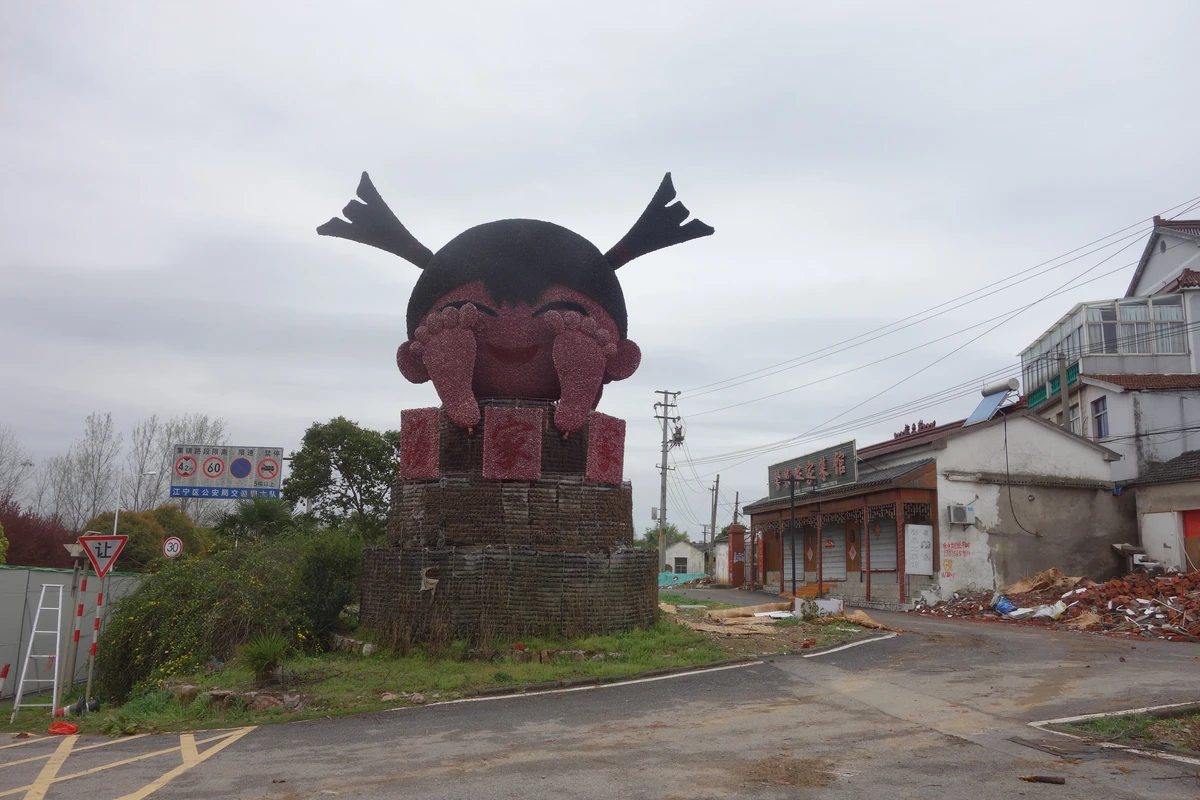
Driving along Ning-Hang Highway, Provincial Road 122, and County Road 426, as soon as we turned into the inner road, we realized we'd made a wasted trip. I knew the hot spring area would be closed, but I hadn't expected the entire complex to be sealed off. Not disappointed though—by now, getting turned away like this felt almost routine. Without even stopping the car, we set the navigation for Tangjiajia. Less than three kilometers away, on the provincial road Tonglong, we saw a sign with a pigtailed doll holding two big feet—we knew we were right. There was a parking lot nearby; we parked and got out, only to find a scene of demolition everywhere and construction debris on the road. No one around, not even a soul to ask. So we got back in the car and drove around to explore further.
The initial scene made me doubt we were in the right place. We drove north along the village road towards Tanglong Road, leaving the demolition zone behind, and gradually the real picture emerged. Seeing this sign, we knew we hadn't come to the wrong place. The entire village was built along the natural hillside. We turned uphill, following the east-west village road deeper in.
A few cars were parked here, so we joined them and got out for a closer look. 'Yun She' had an elegantly simple facade, as pure as a white cloud. Directly opposite stood a blue-and-white Mediterranean-style guesthouse—Meiquan Bathing Culture Guesthouse. Stepping up, the main building was white, with blue doors and window frames; the blue-and-white palette felt pure and beautiful. In the courtyard, ornate tables and chairs paired with charming potted flowers gave it a strong European flair.
Cacti and daisies together created an unexpected harmony. White door frame, blue door—posing for a portrait against that pure blue background would be striking. Further back, we found the homes of ordinary villagers. The pastoral scenery of the village cottages unfolded. This once purely rustic village is now being transformed, thanks to the overall development of Tangshan Hot Spring Town, with some houses renovated or rebuilt into unique guesthouses. It's become a village blending lodgings and residences.
Along the guesthouse street, every bit of space was used to create a holiday atmosphere. Colorful murals on the walls were lively and fun. A suspended bathtub model vividly demonstrated a bathing style. The name of this guesthouse was quirky—I prefer to call it 'Shede' (Willingness to Let Go). The overall architecture of the village features white walls and grey tiles, simple and old-worldly, full of charm. The streets were clean but deserted, with only us walking through.
Near the north end of Huanzhen Road, we came across a guesthouse called 'Dongxia' (Winter and Summer). The name alone didn't stand out, but below it read: 'The private hot spring villa of Mr. Su and Miss Xia.' That made it sound like a story waiting to be told, so we went in to explore. A large courtyard had a pool in the center, surely a hot spring pool. To the left, a big tree shaded a glass-and-wood cabin, and a sign on the platform said: 'Those who want to eat with you will enjoy sweet or sour; those who want to see you will be free in winter and summer.' A very down-to-earth statement.
A staircase led to the second floor and a third-floor terrace. From the terrace, we could see the neighboring Bansheng Garden Hotel. One guesthouse after another—plenty to choose from. Overlooking the village, the view was excellent, offering a bird's-eye view of Dongxia's layout; it occupied quite a sizable plot, and besides staying overnight, you could host a party there. Looking down from the third floor, the patterned floor tiles on the second-floor terrace were beautiful.
'Fusheng' (Floating Life)—many guesthouses here are named after such life philosophies. The porch was hung with origami cranes, full of warmth and hope. At the south end of the village, we found a guesthouse called 'Banmu Private Hot Spring.' The complex had a lower half of Chinese-style white walls with elegant ink-wash paintings, a wooden gatehouse with upturned eaves, and red lanterns hanging below—pure Chinese style. But the upper half was topped with a 'hat' of glass and wooden lattice above the eaves, a very unique touch.
At the south end of the road, we found a hand-drawn map. After wandering around for a while, we pieced together the general picture. Tangjiajia Hot Spring Village is small; originally, it was just an ordinary village in Tangshan. With its rich geothermal resources, hot spring water pipes have been laid to every household. As a result, most houses in this ordinary village at the heart of a world-class hot spring town have been converted into guesthouses—you could find a hot spring guesthouse every few steps. Tangjiajia has gradually been transformed into a guesthouse village. The owners aren't necessarily locals, but the transformation has brought local residents into the business. Alongside the unique guesthouses, many locals have turned their homes into eateries, lifting the village's economy.
Turning right along the village road, we passed fields on one side and another string of guesthouses on the other. One, with whitewashed walls, was 'Huazhu Right Neighbor.' The entrance hall was minimalistic in white, with a bench waiting. The words on the wall spelled out its invitation. White walls, black window frames, and red awnings added a splash of color—everything so simple and bright. A service center stood to one side, with stairs leading to a terrace. Each room had its own balcony, and the only decoration was a beautifully maintained bonsai. I loved this simplicity.
A hand-pump well hinted at the excellent water quality. Under the blue sky and white clouds, the black-and-white house was a picture of pure beauty. Massive utility poles and crisscrossing wires looked like musical staffs. Just outside the wall of 'Right Neighbor,' I snapped another photo. Each room had large floor-to-ceiling windows and its own balcony; upstairs, a big terrace was perfect for reading, sipping coffee, and sunbathing. Right outside, a pastoral landscape stretched out, instantly lifting the spirits.
Right next to 'Right Neighbor' was 'Huazhu Left Neighbor.' They looked like brothers, with the same style and vibe. Simple white dotted with small green plants, a fresh and tidy look. Left Neighbor and Right Neighbor—two crisp three-story guesthouses with white walls and grey tiles, clean and neat. Like family, they shared the same basic setup and furnishings, yet each had its own character.
Number 161, Moni Tangjia. 'Moni' means bosom friends—kindred spirits who see eye to eye. Pushing open the bamboo gate revealed a clean courtyard with an orange tree in the center. One side was a display and lounge area, the other the guest rooms. Slogans on the walls, and decor full of rustic charm—bathing, it seemed, was an art here.
In addition to guesthouses, the private homes here were also artistic, with staggered walls, ornamental windows, and even the thatched tops brimming with artistic flair. 'Offline Inn' was especially distinctive: its gate had one side of grey bricks and the other of stacked bamboo. Pushing open the wooden door, we entered a courtyard that felt like a standalone villa. Though just a small building, the spacious yard and elevated position gave it a very comfortable feel. 'Offline'—that's a state we all long for. Online life is about purposeful striving and fulfillment; offline is about letting go and being yourself.
I crisscrossed the village, checking out one guesthouse after another, though only from the outside or courtyard. A key feature of Tangjiajia's guesthouses is their privacy—if you want to delve deeper, you'd have to stay the night, haha. But from what I saw, each had its own style. Maybe later, when the mood strikes, I'll try them out one by one for an overnight stay. Imagine lodging beneath these hillside walls, soaking in the warmth of the steaming hot spring water, listening to the murmur of flowing streams and the breeze whispering through the valley—all your senses awakened on a journey to empty your mind and body. But now, at this time of year, the village was eerily quiet. Many guesthouses had only a receptionist on duty; some yards were completely empty, and a few even had their gates tightly shut. I had imagined this was their peak season. Not satisfied, we wanted to clear up the confusion from when we first arrived, so we crossed a small bridge.
A large area on the east side of the village was under development. White steam rose from the ground—clearly the hot spring pipes. I'd read about a public foot bath here but couldn't find it; this must have been the spot, now just a construction site. Tangjiajia Hot Spring Village is a peaceful paradise embraced by green hills and clear waters, a renowned hot spring village rich in underground thermal resources. Yet, in 2020, the construction site was idle, at a standstill. It was only by crossing the bridge and venturing deeper into the village that we could glimpse the guesthouse village's true character. But even then, it couldn't have been its usual state. Due to the pandemic, everything here felt slow, almost frozen. But that wasn't bad—it let us see a different side of the guesthouse village, undisturbed, quiet, its true self. Still, I hope it soon returns to normal. I'll come back to see its real self.


